CEE 370 Environmental Engineering Principles Lecture #7 - - PDF document

cee 370 environmental engineering principles
SMART_READER_LITE
LIVE PREVIEW

CEE 370 Environmental Engineering Principles Lecture #7 - - PDF document

CEE 370 Lecture #7 9/18/2019 Print version Updated: 18 September 2019 CEE 370 Environmental Engineering Principles Lecture #7 Environmental Chemistry V: Thermodynamics, Henrys Law, Acids-bases II Reading: Mihelcic & Zimmerman,


slide-1
SLIDE 1

CEE 370 Lecture #7 9/18/2019 Lecture #7 Dave Reckhow 1

David Reckhow CEE 370 L#7 1

CEE 370 Environmental Engineering Principles

Lecture #7 Environmental Chemistry V: Thermodynamics, Henry’s Law, Acids-bases II

Reading: Mihelcic & Zimmerman, Chapter 3

Davis & Masten, Chapter 2 Mihelcic, Chapt 3

Updated: 18 September 2019

Print version

David Reckhow

CEE 370 L#7

2

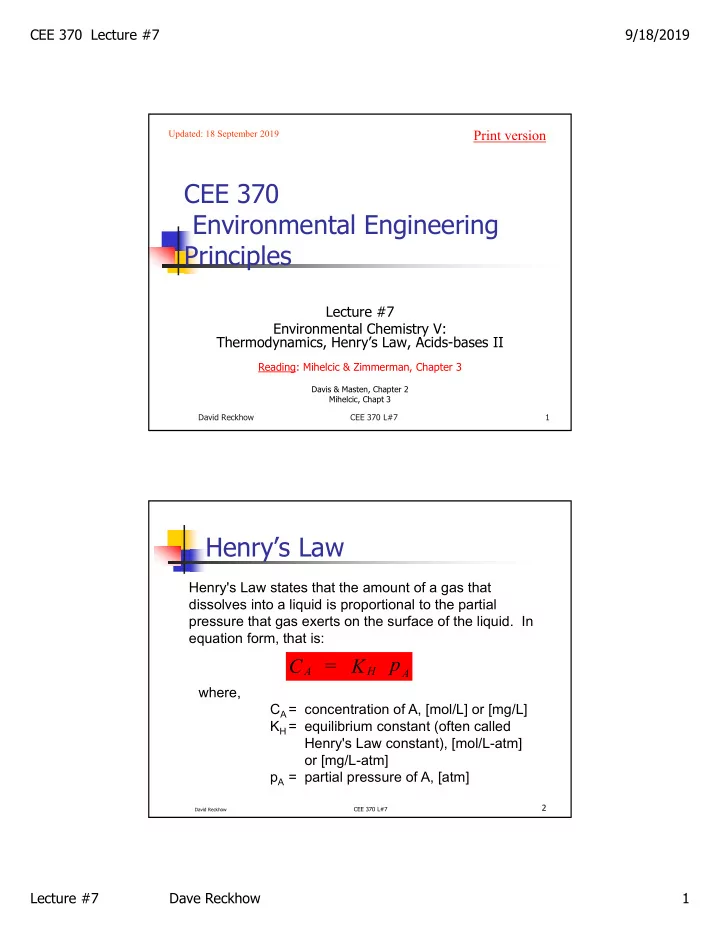
Henry’s Law

Henry's Law states that the amount of a gas that dissolves into a liquid is proportional to the partial pressure that gas exerts on the surface of the liquid. In equation form, that is:

A H A

C = K p

where, CA= concentration of A, [mol/L] or [mg/L] KH = equilibrium constant (often called Henry's Law constant), [mol/L-atm]

  • r [mg/L-atm]

pA = partial pressure of A, [atm]

slide-2
SLIDE 2

CEE 370 Lecture #7 9/18/2019 Lecture #7 Dave Reckhow 2

David Reckhow

CEE 370 L#7

3

Henry’s Law Constants

Reaction Name Kh, mol/L-atm pKh = -log Kh CO2(g) _ CO2(aq) Carbon dioxide 3.41 x 10⁻² 1.47 NH3(g) _ NH3(aq) Ammonia 57.6

  • 1.76

H2S(g) _ H2S(aq) Hydrogen sulfide 1.02 x 10⁻¹ 0.99 CH4(g) _ CH4(aq) Methane 1.50 x 10⁻³ 2.82 O2(g) _ O2(aq) Oxygen 1.26 x 10⁻³ 2.90

Example: Solubility of O2 in Water

 Background

 Although the atmosphere we breathe is comprised of approximately 20.9 percent oxygen, oxygen is only slightly soluble in water. In addition, the solubility decreases as the temperature increases. Thus, oxygen availability to aquatic life decreases during the summer months when the biological processes which consume oxygen are most active.

 Summer water temperatures of 25 to 30C are typical for many surface waters in the U.S. Henry's Law constant for oxygen in water is 61.2 mg/L-atm at 5C and 40.2 mg/L-atm at 25C.

 What is the solubility of oxygen at 5C and at 25C?

David Reckhow

CEE 370 L#7

4

Example 4.1 from Ray

slide-3
SLIDE 3

CEE 370 Lecture #7 9/18/2019 Lecture #7 Dave Reckhow 3

David Reckhow

CEE 370 L#7

5

Solution O2 Solubility Ex.

2 2 2

O H,O O

C (5 C) = K P = 61.2 mg L-atm x 0.209 atm  At 50C the solubility is:

2

O

C (5 C) = 12.8 mg L 

At 250C the solubility is:

2 2 2

O H,O O

C (25 C) = K P = 40.2 mg L-atm x 0.209 atm 

2

O

C (25 C) = 8.40 mg L 

David Reckhow

CEE 370 L#7

6

Air Stripping Tower

Air out with Carbon Dioxide Air In Water Out Water in with Carbon

slide-4
SLIDE 4

CEE 370 Lecture #7 9/18/2019 Lecture #7 Dave Reckhow 4

David Reckhow

CEE 370 L#7

7

Air Stripping Example

An air stripping tower, similar to that shown in the previous slide , is to be used to remove dissolved carbon dioxide gas from a groundwater supply. If the tower lowers the level to twice the equilibrium concentration, what amount of dissolved gas will remain in the water after treatment? The partial pressure is about 350 ppm or 0.00035. The log of 0.00035 is about -3.5. Therefore the partial pressure

  • f carbon dioxide in the atmosphere is 10-3.5 atm.

Example 4.2 from Ray

David Reckhow

CEE 370 L#7

8

Solution to Air Stripping Ex.

The first step is to determine Henry's Law constant for carbon dioxide. From the table it is 10-1.5. The equilibrium solubility is then:

L mole

5 .5 3

  • .5

1

  • CO

CO H, CO

10 atm 10 atm L- mole 10 = p K = C

2 2 2

2

CO

  • 5
  • 5

3

C = 10 M = 10 mole L x 44 g mole x 10 mg g

2

CO

C = 0.44 mg/ L

At equilibrium:

mg/L 88 0. = CCO2

After treatment:

slide-5
SLIDE 5

CEE 370 Lecture #7 9/18/2019 Lecture #7 Dave Reckhow 5

David Reckhow

CEE 370 L#7

9

where, P = absolute pressure, [atm] V = volume, [L] n = mass, [mol] T = absolute temperature, [K] R = proportionality constant or ideal gas constant, [0.0821 L-atm/K-mol]

Ideal Gas Law

The Ideal Gas Law states that the product of the absolute pressure and the volume is proportional to the product of the mass and the absolute temperature. In equation form this is usually written:

PV = nRT

David Reckhow

CEE 370 L#7

10

Ideal Gas Law Example

Anaerobic microorganisms metabolize organic matter to carbon dioxide and methane gas. Estimate the volume of gas produced (at atmospheric pressure and 25C) from the anaerobic decomposition of one mole

  • f glucose. The reaction is:

C6H12O6  3CH4 + 3CO2

Example 4.3 from Ray

slide-6
SLIDE 6

CEE 370 Lecture #7 9/18/2019 Lecture #7 Dave Reckhow 6

David Reckhow

CEE 370 L#7

11

Solution to Ideal Gas Law Ex.

Each mole of glucose produces three moles of methane and three moles of carbon dioxide gases, a total of six moles. The total volume is then:

V = nRT P = (6 mol)(0.0821 L-atm K- mol)(298 K) (1 atm)

V = 147 L

David Reckhow

CEE 370 L#7

12

Dalton’s Law of Partial Pressure

Dalton's Law of partial pressures states that the total pressure of a mixture of several gases is the sum of the partial pressures of the individual gases. In equation form this is simply:

t i=1 n i

P = P

where, Pt = total pressure of the gases, [atm] Pi = pressure of the ith gas, [atm]

slide-7
SLIDE 7

CEE 370 Lecture #7 9/18/2019 Lecture #7 Dave Reckhow 7

David Reckhow

CEE 370 L#7

13

Anaerobic Digester Example

Anaerobic digesters are commonly used in wastewater

  • treatment. The biological process produces both

carbon dioxide and methane gases. A laboratory worker plans to make a "synthetic" digester gas. There is currently 2 L of methane gas at 1.5 atm and 1 L of carbon dioxide gas at 1 atm in the lab. If these two samples are mixed in a 4 L tank, what will be the partial pressures of the individual gases? The total pressure?

Example 4.4 from Ray

David Reckhow

CEE 370 L#7

14 t CH CO

P = P + P = 1 atm

4 2

2

P = 1 atm 1 L 4 L = 0.25 atm      

2

P = 1.5 atm 2 L 4 L = 0.75 atm      

Solution to Anaerobic Digester Ex.

First, we must find the partial pressures of the individual gases using the ideal gas law:

1 1 2 2

P V = nRT = P V

2 1 1 2

P = P V V      

For methane gas For carbon dioxide gas: And the total is:

  • r
slide-8
SLIDE 8

CEE 370 Lecture #7 9/18/2019 Lecture #7 Dave Reckhow 8

David Reckhow

CEE 370 L#7

15

Equilibrium Reactions

aA + bB pP + rR 

eq c d a b

K = {C } {D } {A } {B }

a, b, p, r = stoichiometric coefficients of the respective reactants {A}, {B}, {P}, {R} = activity of the reactants and products

thermodynamics

David Reckhow

CEE 370 L#7

16

Chemical Activity

{A} = [A]

A

{A} = activity of species A, [mol/liter] [A] = concentration of species A, [mol/liter] A = activity coefficient of A, unitless

 is dependent on ionic strength -- the concentration of ions in solution. For dilute aqueous solutions  is near unity. Thus, the activity and concentration are approximately the same. For most freshwater systems,  may be neglected.

slide-9
SLIDE 9

CEE 370 Lecture #7 9/18/2019 Lecture #7 Dave Reckhow 9

David Reckhow

CEE 370 L#7

17

Activity conventions

 the activity of the solvent, water is set equal to unity  the activity of a solid in equilibrium with a solution is unity  the activity of a gas is the partial pressure the gas exerts on the liquid surface  the activity of a solute is related to the concentration by {A} = A[A], where A is the activity coefficient of species A

David Reckhow

CEE 370 L#7

18

Auto-dissociation of Water

2 +

  • H O

H + OH 

w +

  • 2

+

  • K = [ H ][OH ]

[ H O] = [ H ][OH ]

At 25C the value of Kw is 10-14

slide-10
SLIDE 10

CEE 370 Lecture #7 9/18/2019 Lecture #7 Dave Reckhow 10

David Reckhow

CEE 370 L#7

19

Example 4.12

Find the pH and pOH of water at 25C if the concentration of H+ ions is 10-5 M.

pH = -log{H } = -log(10 ) = 5

+

  • 5

Solution

{OH } = K {H } = 10 10 = 10

  • w

+

  • 14
  • 5
  • 9

pOH = -log{OH } = -log(10 ) = 9

  • 9

Acids & Bases

Which is the strongest acid

  • A. H3PO4
  • B. H2CO3
  • C. HNO3
  • D. CH3COOH
  • E. HF

David Reckhow

CEE 370 L#7

20

slide-11
SLIDE 11

CEE 370 Lecture #7 9/18/2019 Lecture #7 Dave Reckhow 11

David Reckhow

CEE 370 L#7

21

A +

  • 2

K 1 = { H }{HA } {H A}

Acid:Base Equilibria

HA H + A

+

A +

  • K = {H }{ A }

{HA}

2 +

  • H A = H + HA
  • +

2-

HA H + A 

A + 2-

  • K 2 = {H }{ A }

{HA }

Diprotic Acid Monoprotic Acid

David Reckhow

CEE 370 L#7

22

Acidity Constants

Reaction Name Ka pKa = ─log Ka HCl = H

+ + Cl─

Hydrochloric 1000

  • 3

H2SO4 = H

+ + HSO4

  • Sulfuric, H1

1000

  • 3

HNO3 = H

+ + NO3

  • Nitric

~1 ~0 HSO4

  • = H

+ + SO4

  • Sulfuric, H2

1 x 10

  • 2

2 H3PO4 = H

+ + H2PO4

  • Phosphoric, H1

7.94 x 10

  • 3

2.1 HAc = H

+ + Ac

  • Acetic

2.00 x 10

  • 5

4.7 H2CO3 = H

+ + HCO3

  • Carbonic, H1

5.01 x 10

  • 7

6.3 H2S = H

+ + HS

  • Hydrosulfuric, H1

7.94 x 10

  • 8

7.1 H2PO4

  • = H

+ + HPO4 ─2

Phosphoric, H2 6.31 x 10

  • 8

7.2 HOCl = H

+ + OCl

  • Hypochlorous

3.16 x 10

  • 8

7.5 NH4

+ = H + + NH3

Ammonium 5.01 x 10

  • 10

9.3 HCO3

  • = H

+ + CO3 ─2

Carbonic, H2 5.01 x 10

  • 11

10.3 HPO4

─2 = H + + PO4 ─3

Phosphoric, H3 5.01 x 10

  • 13

12.3

Similar to Table 3.5 in M&Z

slide-12
SLIDE 12

CEE 370 Lecture #7 9/18/2019 Lecture #7 Dave Reckhow 12

David Reckhow

CEE 370 L#7

23

NAME EQUILIBRIA pKa

Perchloric acid HClO4 = H+ + ClO4-

  • 7 STRONG

Hydrochloric acid HCl = H+ + Cl-

  • 3

Sulfuric acid H2SO4= H+ + HSO4-

  • 3 (&2) ACIDS

Nitric acid HNO3 = H+ + NO3-

Hydronium ion H3O+ = H+ + H2O Trichloroacetic acid CCl3COOH = H+ + CCl3COO- 0.70 Iodic acid HIO3 = H+ + IO3- 0.8 Dichloroacetic acid CHCl2COOH = H+ + CHCl2COO- 1.48 Bisulfate ion HSO4- = H+ + SO4-2 2 Phosphoric acid H3PO4 = H+ + H2PO4- 2.15 (&7.2,12.3) Ferric ion Fe(H2O)6+ 3 = H+ + Fe(OH)(H2O)5+ 2 2.2 (&4.6) Chloroacetic acid CH2ClCOOH = H+ + CH2ClCOO- 2.85

  • -Phthalic acid

C6H4(COOH)2 = H+ + C6H4(COOH)COO- 2.89 (&5.51) Citric acid C3H5O(COOH)3= H+ + C3H5O(COOH)2COO- 3.14 (&4.77,6.4) Hydrofluoric acid HF = H+ + F- 3.2 Formic Acid HCOOH = H+ + HCOO- 3.75 Aspartic acid C2H6N(COOH)2= H+ + C2H6N(COOH)COO- 3.86 (&9.82) m-Hydroxybenzoic acid C6H4(OH)COOH = H+ + C6H4(OH)COO- 4.06 (&9.92) Succinic acid C2H4(COOH)2 = H+ + C2H4(COOH)COO- 4.16 (&5.61) p-Hydroxybenzoic acid C6H4(OH)COOH = H+ + C6H4(OH)COO- 4.48 (&9.32) Nitrous acid HNO2 = H+ + NO2- 4.5 Ferric Monohydroxide FeOH(H2O)5+ 2 + H+ + Fe(OH)2(H2O)4+ 4.6 Acetic acid CH3COOH = H+ + CH3COO- 4.75 Aluminum ion Al(H2O)6+ 3 = H+ + Al(OH)(H2O)5+ 2 4.8

David Reckhow

CEE 370 L#7

24

NAME FORMULA pKa

Propionic acid C2H5COOH = H+ + C2H5COO- 4.87 Carbonic acid H2CO3 = H+ + HCO3- 6.35 (&10.33) Hydrogen sulfide H2S = H+ + HS- 7.02 (&13.9) Dihydrogen phosphate H2PO4- = H+ + HPO4-2 7.2 Hypochlorous acid HOCl = H+ + OCl- 7.5 Copper ion Cu(H2O)6+ 2 = H+ + CuOH(H2O)5+ 8.0 Zinc ion Zn(H2O)6+ 2 = H+ + ZnOH(H2O)5+ 8.96 Boric acid B(OH)3 + H2O = H+ + B(OH)4- 9.2 (&12.7,13.8) Ammonium ion NH4+ = H+ + NH3 9.24 Hydrocyanic acid HCN = H+ + CN- 9.3 p-Hydroxybenzoic acid C6H4(OH)COO- = H+ + C6H4(O)COO-2 9.32 Orthosilicic acid H4SiO4 = H+ + H3SiO4- 9.86 (&13.1) Phenol C6H5OH = H+ + C6H5O- 9.9 m-Hydroxybenzoic acid C6H4(OH)COO- = H+ + C6H4(O)COO-2 9.92 Cadmium ion Cd(H2O)6+ 2 = H+ + CdOH(H2O)5+ 10.2 Bicarbonate ion HCO3- = H+ + CO3-2 10.33 Magnesium ion Mg(H2O)6+ 2 = H+ + MgOH(H2O)5+ 11.4 Monohydrogen phosphate HPO4-2 = H+ + PO4-3 12.3 Calcium ion Ca(H2O)6+ 2 = H+ + CaOH(H2O)5+ 12.5 Trihydrogen silicate H3SiO4- = H+ + H2SiO4-2 12.6 Bisulfide ion HS- = H+ + S-2 13.9 Water H2O = H+ + OH- 14.00 Ammonia NH3 = H+ + NH2- 23 Hydroxide OH- = H+ + O-2 24 Methane CH4 = H+ + CH3- 34
slide-13
SLIDE 13

CEE 370 Lecture #7 9/18/2019 Lecture #7 Dave Reckhow 13

David Reckhow

CEE 370 L#7

25

Acidity Constants, #1

Reaction Name Ka pKa

HCl = H

++Cl

  • Hydrochloric

1000

  • 3

H2SO4 = H

++HSO4

  • Sulfuric, H1

1000

  • 3

HNO3 = H

++NO3

  • Nitric

~1 ~0 HSO4

  • = H

+ + SO4

  • 2

Sulfuric, H2 1x10

  • 2

2 H3PO4 = H

+ + H2PO4

  • Phosphoric, H1 7.9x10
  • 3 2.1

HAc = H

+ + Ac

  • Acetic

2.0x10

  • 5 4.7

H2CO3 = H

+ + HCO3

  • Carbonic, H1

5.0x10

  • 7 6.3

David Reckhow

CEE 370 L#7

26

Acidity Constants, #2

Reaction Name Ka pKa

H2S = H

++HS

  • Hydrosulfuric,

H1 7.9x10

  • 8 7.1

H2PO4

  • = H

++HPO4

  • 2

Phosphoric, H2 6.3x10

  • 8 7.2

HOCl = H

++OCl

  • Hypochlorous

2.5x10

  • 8 7.6

NH4

+ = H + + NH3

Ammonium 5x10

  • 10

9.3 HCO3

  • = H

+ + CO3

  • 2

Carbonic, H2 5x10

  • 11

10.3 HPO4

  • 2= H

+ + PO4

  • 3

Phosphoric, H3 5x10

  • 13

12.3

slide-14
SLIDE 14

CEE 370 Lecture #7 9/18/2019 Lecture #7 Dave Reckhow 14

David Reckhow

CEE 370 L#7

27

Example

What fraction of the following acids are ionized at pH 7? a) Nitric b) Hydrochloric c) Sulfuric d) Hypochlorous

David Reckhow

CEE 370 L#7

28

Solution to Example a)

a + 3

  • 3

K = [H ][NO ] [HNO ]

[HNO ] [NO ] = [H ] K = 10 1 = 10

3 3

  • +

a

  • 7
  • 7

F = [NO ] [HNO ] + [NO ] = [NO ] 10 [NO ] + [NO ] 1

3

  • 3

3

  • 3
  • 7

3

  • 3
slide-15
SLIDE 15

CEE 370 Lecture #7 9/18/2019 Lecture #7 Dave Reckhow 15

David Reckhow

CEE 370 L#7

29

[HOCl] [OCl ] = [H ] K = 10 10 = .

  • +

a

  • 7
  • 7.6

4 0

a +

  • K = [H ][OCl ]

[HOCl]

Solution to Example d)

F = [OCl ] [HOCl] + [OCl ] = [OCl ] [OCl ] + [OCl ] = 0.20

  • 4

David Reckhow

CEE 370 L#7

30

Log C vs pH Diagram for Hypochlorous Acid

  • 10
  • 8
  • 6
  • 4
  • 2

1 3 5 7 9 11 13 pH Log C (Molar) HOCl OCl-

CT= 10-3 M

slide-16
SLIDE 16

CEE 370 Lecture #7 9/18/2019 Lecture #7 Dave Reckhow 16

David Reckhow

CEE 370 L#7

31

Log C vs pH Diagram for Hypochlorous Acid

  • 5
  • 4.5
  • 4
  • 3.5
  • 3
  • 2.5

6 6.5 7 7.5 8 pH Log C (Molar) HOCl OCl-

CT= 10-3 M

[HOCl] [OCl ] = [H ] K = [H ] 10

  • +

a +

  • 7.6

David Reckhow

CEE 370 L#7

32

Definitions

 Bronsted-Lowry (1923)

 Acids: (proton donor)

 any substance that can donate a proton to any other substance

 Bases: (proton acceptor)

 any substance that accepts a proton from any other substance

Acid1 + Base2 = Acid2 + Base1 HNO3 + H2O = H3O+ + NO3

  • HOCl

+ H2O = H3O+ + OCl- NH4

+

+ H2O = H3O+ + NH3 H2O + H2O = H3O+ + OH-

  • Acid strength of a conjugate

acid-base pair is measured relative to the other pair

  • the stronger the acid, the

weaker the conjugate base, and vice versa

slide-17
SLIDE 17

CEE 370 Lecture #7 9/18/2019 Lecture #7 Dave Reckhow 17

David Reckhow

CEE 370 L#7

33

To next lecture