Who is at Risk Who is at Risk Necrotizing Soft Necrotizing Soft - - PDF document

who is at risk who is at risk necrotizing soft
SMART_READER_LITE
LIVE PREVIEW

Who is at Risk Who is at Risk Necrotizing Soft Necrotizing Soft - - PDF document

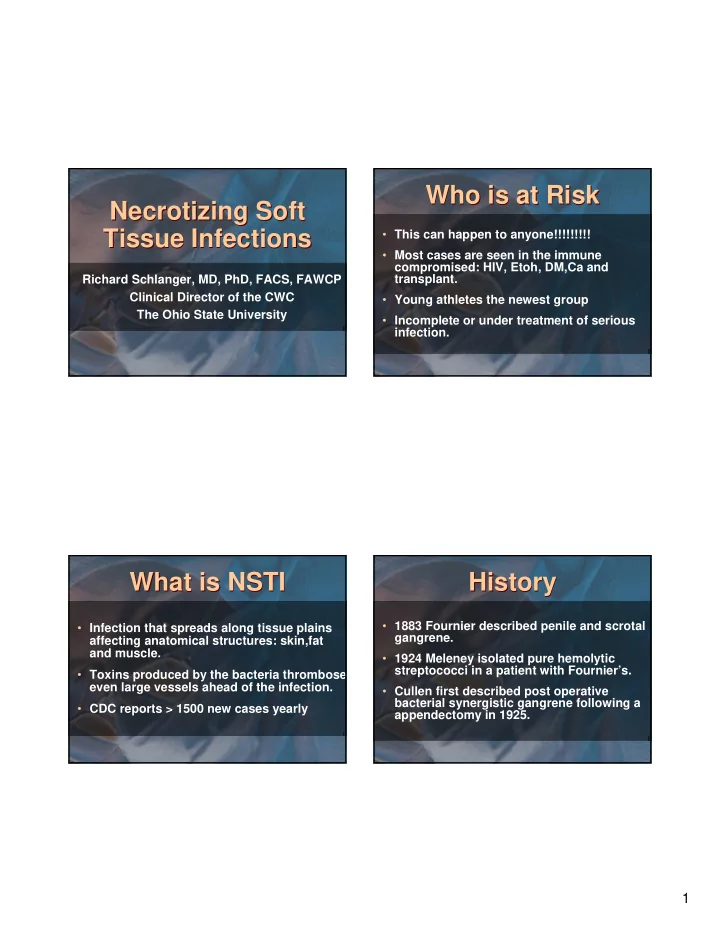
Who is at Risk Who is at Risk Necrotizing Soft Necrotizing Soft Tissue Infections Tissue Infections This can happen to anyone!!!!!!!!! Most cases are seen in the immune compromised: HIV, Etoh, DM,Ca and transplant. Richard Schlanger,


slide-1
SLIDE 1

1

Necrotizing Soft Tissue Infections Necrotizing Soft Tissue Infections

Richard Schlanger, MD, PhD, FACS, FAWCP Clinical Director of the CWC The Ohio State University

What is NSTI What is NSTI

  • Infection that spreads along tissue plains

affecting anatomical structures: skin,fat and muscle.

  • Toxins produced by the bacteria thrombose

even large vessels ahead of the infection.

  • CDC reports > 1500 new cases yearly

Who is at Risk Who is at Risk

  • This can happen to anyone!!!!!!!!!
  • Most cases are seen in the immune

compromised: HIV, Etoh, DM,Ca and transplant.

  • Young athletes the newest group
  • Incomplete or under treatment of serious

infection.

History History

  • 1883 Fournier described penile and scrotal

gangrene.

  • 1924 Meleney isolated pure hemolytic

streptococci in a patient with Fournier’s.

  • Cullen first described post operative

bacterial synergistic gangrene following a appendectomy in 1925.

slide-2
SLIDE 2

2

History History

  • Necrotizing Fasciitis was first described in

1948.

  • Clostridia first cultures in deep tissue

infection, 1952.

  • Hemolytic staphylococcus aureus linked to

the “Flesh Eating Bacteria” 1988.

  • MRSA the bacteria of the millennium.

Classification Classification

  • Type of microorganism.
  • Type of tissue involved.
  • Therapy required.
  • Rate of progression.
  • Initial findings at presentation: bullae, pain

and gas.

Etiology Etiology

  • Hypoxia to tissue.
  • Decrease in cellular metabolism, defense

reduction of membrane.

  • Decrease leukocyte function.
  • Localized tissue trauma.
  • Reduced host defense.

Diagnosis Diagnosis

  • HIGH INDEX OF SUSPICION !!!!!!!!
  • Poor condition of patient.
  • Absence of the usual signs of tissue

inflammation.

  • Fever and elevated WBC out of proportion

to wound.

slide-3
SLIDE 3

3

Diagnostic Aids Diagnostic Aids

  • Gram Stain of deep tissue.
  • Plain radiographs looking for gas or sub-Q

air.

  • CT scan
  • Culture using deep tissue, not swab.
  • Operating Room: debridement

Clinical Presentations Clinical Presentations

  • Necrotizing Fasciitis
  • Necrotizing Cellulitis
  • Myonecrosis

Necrotizing Fasciitis Necrotizing Fasciitis

  • Incubation

1- 4 days

  • Onset

Acute

  • Toxicity

2+

  • Pain

Moderate to severe

  • Exudate

Perfuse serosang

  • Odor

None initially

  • Gas

None initially

Necrotizing Fasciitis Necrotizing Fasciitis

  • Muscle

Viable

  • Skin

Cellulitic

  • Mortality

> 35 %

  • Bacteria usually aerobic strep and staph

with anaerobic symbiosis +/_ bacteroids and rarely clostridia, e-coli.

slide-4
SLIDE 4

4

Necrotizing Cellulitis Necrotizing Cellulitis

  • Incubation

1-2 days

  • Onset

Acute

  • Toxicity

3+

  • Pain

Out of proportion

  • Exudate

“dirty dish water”

  • Odor

“wet rodent”, foul

  • Gas

Present

Necrotizing Cellulitis Necrotizing Cellulitis

  • Muscle

Involved: “cooked”

  • Skin

Cellulitis and gangrene

  • Mortality

> 75%

Myonecrosis Myonecrosis

  • Incubation

1-3days.

  • Onset

Semi- acute

  • Toxicity

1+

  • Pain

Severe

  • Functional loss

Acute

  • Exudate

None

  • Odor

None

Myonecrosis Myonecrosis

  • Gas

Usually present ****

  • Muscle

Dead anatomic groups

  • Skin

Intact

  • Mortality

> 35%

  • Morbidity

> 60% high amp rate

slide-5
SLIDE 5

5

Treatment Treatment

  • The Gold Standard for almost forever was:
  • Surgery: wide and extensive debridement

to viable tissue, reoperation anticipated.

  • Antibiotics: broad coverage for aerobic and

anaerobic bacteria

  • MRSA is public enemy #1 and is presumed

present and treated.

Treatment 2010 Treatment 2010

  • All major medical and surgical texts:

“Some authors suggest that Hyperbaric Oxygen treatment may have some benefit, but it remains controversial.” Or, “It is cumbersome and may delay life saving surgery.”

  • This is not what we do at OSU !!!

The Ohio State Experience The Ohio State Experience

  • 225 patients from 1999- 2008
  • Ages 22 – 82 yo
  • > 50% DM
  • 25% documented immunocompromised
  • 20% misdiagnosed
  • Mortality depended on time of diagnosis

and treatment.

Group 1 Group 1

  • Patients transferred to OSU after diagnosis

and treatment done at another institution.

  • Average delay in transfer 3-5 days
  • Number of surgical debridement >3
  • All started on broad spectrum antibiotics
  • All need redebridement upon arrival at OSU
  • Mortality despite HBO > 75%
slide-6
SLIDE 6

6

Group 2 Group 2

  • Patients transferred for other facilities

within 24hrs of diagnosis.

  • No treatments done before arrival at OSU

except appropriate antibiotics.

  • Upon arrival: surgical debridement, HBO,

2nd look surgery and HBO bid until symptoms and cultures negative.

  • Mortality < 15%

Group 3 Group 3

  • All cases seen at OSU and diagnosed

in < 12hrs.

  • All cases treated by protocol: antibiotics,

surgery and HBO (critical care as needed)

  • Mortality < 5%

Why Hyperbarics Why Hyperbarics

  • HBO is the placement of a patient in a

closed acrylic tube, pressurized > 1ATA with 100% oxygen.

  • It is bacterialcidal
  • It increases WBC activity
  • It neutralizes toxins
  • It causes angiogenisis.

Surgery Surgery

  • Role #1 create decompression

fasciotomies

  • Role #2 debride only obviously dead tissue
  • Role#3 2nd and 3rd looks after HBO day 1

mandatory

  • Role #4 amputation is procedure of last

resort.

slide-7
SLIDE 7

7

slide-8
SLIDE 8

8

slide-9
SLIDE 9

9

slide-10
SLIDE 10

10

Conclusion Conclusion

  • Always suspect the worst case scenario
  • Treatment is a three headed monster;

massive antibiotics, surgery and HBO

  • If you do not have direct access to HBO ,

find the nearest center and get your patient there ASAP.

  • Mortality is care dependant.