CEE 370 Environmental Engineering Principles Lecture #12 - - PDF document

cee 370 environmental engineering principles
SMART_READER_LITE
LIVE PREVIEW

CEE 370 Environmental Engineering Principles Lecture #12 - - PDF document

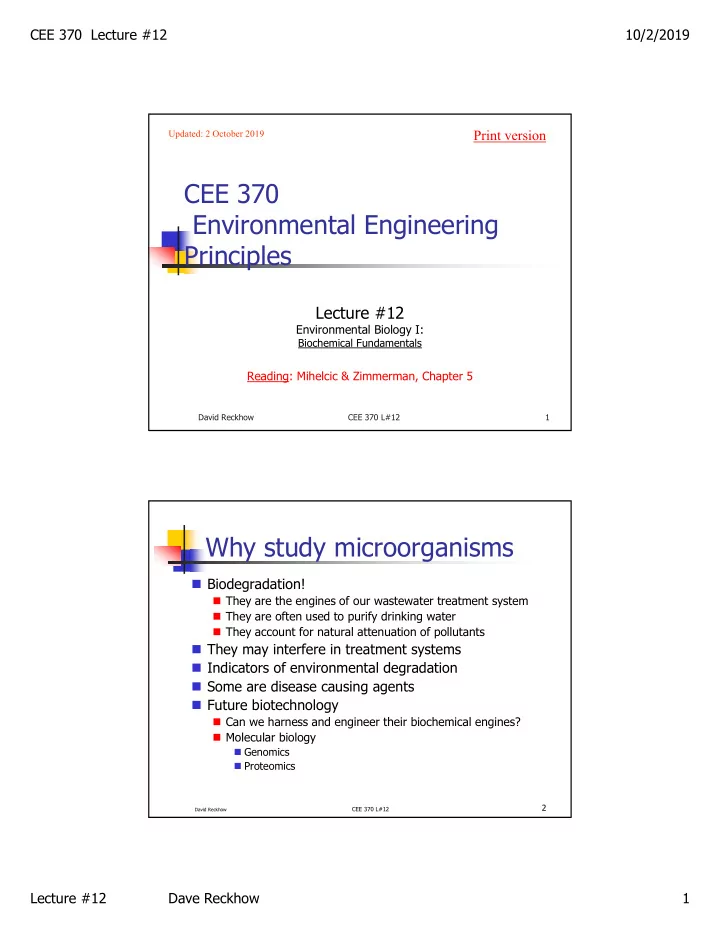
CEE 370 Lecture #12 10/2/2019 Print version Updated: 2 October 2019 CEE 370 Environmental Engineering Principles Lecture #12 Environmental Biology I: Biochemical Fundamentals Reading: Mihelcic & Zimmerman, Chapter 5 David Reckhow


slide-1
SLIDE 1

CEE 370 Lecture #12 10/2/2019 Lecture #12 Dave Reckhow 1

David Reckhow CEE 370 L#12 1

CEE 370 Environmental Engineering Principles

Lecture #12

Environmental Biology I:

Biochemical Fundamentals

Reading: Mihelcic & Zimmerman, Chapter 5

Updated: 2 October 2019

Print version

David Reckhow

CEE 370 L#12

2

Why study microorganisms

 Biodegradation!

 They are the engines of our wastewater treatment system  They are often used to purify drinking water  They account for natural attenuation of pollutants

 They may interfere in treatment systems  Indicators of environmental degradation  Some are disease causing agents  Future biotechnology

 Can we harness and engineer their biochemical engines?  Molecular biology

 Genomics  Proteomics

slide-2
SLIDE 2

CEE 370 Lecture #12 10/2/2019 Lecture #12 Dave Reckhow 2

What is the next lowest category below “Phylum”

David Reckhow

CEE 370 L#12

3

  • A. Kingdom
  • B. Discipline
  • C. Domain
  • D. Class
  • E. Order

phylogeny

Domains

Archae Bacteria Eucaryotes – nucleus, organelles

Kingdoms of Eucaryotes

Protists, Fungi, Plants, Animals

Other: KPCOFGS

David Reckhow

CEE 370 L#12

4

Procaryotes

slide-3
SLIDE 3

CEE 370 Lecture #12 10/2/2019 Lecture #12 Dave Reckhow 3

David Reckhow

CEE 370 L#12

5

Environmental Microbiology

Types of Microorganisms

Bacteria Viruses Protozoa Rotifers Fungi

Metabolism Microbial Disease Microbial Growth

Biochemical Molecules

 Carbohydrates: polysaccharides & sugars

 Sources of energy, structural components, markers for identification & communication

 Nucleic Acids

 Transmit information across generations – the blueprint, code for protein synthesis

 Proteins & amino acids

 Site of reactions, transport, storage, structure, defense

 Lipids

 Storage of energy, membrane functions

David Reckhow

CEE 370 L#12

6

slide-4
SLIDE 4

CEE 370 Lecture #12 10/2/2019 Lecture #12 Dave Reckhow 4

Carbohydrates

Polyhydroxy aldehydes and ketones

Empirical formula: CH2O

Monomer: sugars

Linear chain and ring forms

example: glucose

David Reckhow

CEE 370 L#12

7

Types of sugars

Position of carbonyl

Terminal: aldehyde – an aldose Mid-chain: ketone – a ketose

Number of carbons

Three – triose Five – pentose Six - hexose

David Reckhow

CEE 370 L#12

8

slide-5
SLIDE 5

CEE 370 Lecture #12 10/2/2019 Lecture #12 Dave Reckhow 5

Polymeric carbohydrates

Disaccharides

Example: sucrose

D-glucose + D-fructose

Polysaccharides

Example: Starch

Amylose unit

 Linear array of Glucose units

David Reckhow

CEE 370 L#12

9

Glycosidic bonds

Large polysaccharides

 Glycogen

 Long-term storage in animals & fungi  Core protein surrounded by glucose chains

David Reckhow

CEE 370 L#12

10

slide-6
SLIDE 6

CEE 370 Lecture #12 10/2/2019 Lecture #12 Dave Reckhow 6

Lipids I

David Reckhow

CEE 370 L#12

11

Hydrophobic – not very soluble in water Fats

Glycerol + fatty acids bound by ester linkages

Lipids II

David Reckhow

CEE 370 L#12

12

Phospholipids

Major components

  • f cell membranes

Composed of a glycerol, 2 fatty acids and a phosphate group

slide-7
SLIDE 7

CEE 370 Lecture #12 10/2/2019 Lecture #12 Dave Reckhow 7

Steroids

4 fused rings

David Reckhow

CEE 370 L#12

13

Others

Very important and will be discussed in lecture on genetics (#10)

Proteins, amino acids Bases, Nucleic acids, DNA, RNA

David Reckhow

CEE 370 L#12

14

slide-8
SLIDE 8

CEE 370 Lecture #12 10/2/2019 Lecture #12 Dave Reckhow 8

David Reckhow

CEE 370 L#12

15

To next lecture