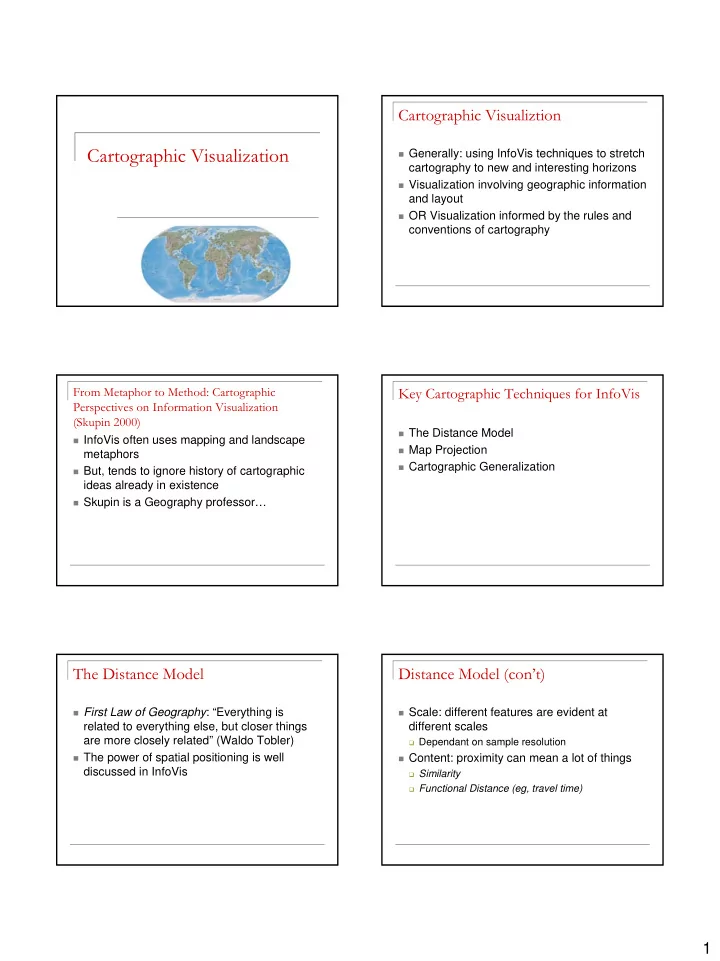
Cartographic Visualization Generally: using InfoVis techniques to - - PDF document

cartographic visualization
SMART_READER_LITE
LIVE PREVIEW

Cartographic Visualization Generally: using InfoVis techniques to - - PDF document

Cartographic Visualiztion Cartographic Visualization Generally: using InfoVis techniques to stretch cartography to new and interesting horizons Visualization involving geographic information and layout OR Visualization informed by the


slide-1
SLIDE 1

1

Cartographic Visualization

Cartographic Visualiztion

Generally: using InfoVis techniques to stretch

cartography to new and interesting horizons

Visualization involving geographic information

and layout

OR Visualization informed by the rules and

conventions of cartography

From Metaphor to Method: Cartographic Perspectives on Information Visualization (Skupin 2000)

InfoVis often uses mapping and landscape

metaphors

But, tends to ignore history of cartographic

ideas already in existence

Skupin is a Geography professor…

Key Cartographic Techniques for InfoVis

The Distance Model Map Projection Cartographic Generalization

The Distance Model

First Law of Geography: “Everything is

related to everything else, but closer things are more closely related” (Waldo Tobler)

The power of spatial positioning is well

discussed in InfoVis

Distance Model (con’t)

Scale: different features are evident at

different scales

Dependant on sample resolution

Content: proximity can mean a lot of things

Similarity Functional Distance (eg, travel time)

slide-2
SLIDE 2

2 Map Projection

How to fit multi-dimensional data into 2D

space?

InfoVis has many methods available, eg.

Self-Organizing Maps (SOM)

But all projection distorts! Beware!

Mercator Projection Gall-Peters Projection Robinson Projection Cartographic Generalization

Maintaining meaning over range of scales University courses taught on just this subject! Not too many general rules provided

Geographic Visualization: Designing Manipulable Maps for Exploring Temporally Varying Georeferenced Statistics (MacEachren et al 1998)

How to display time-dependant geographic

data informatively?

Specifically regional health data (mortality

rates etc) for series of years

Informed by cartographic principles

slide-3
SLIDE 3

3 Cartographic Principles in Design

Animation of maps to show time series data Representing multiple non-geographic

variables on a map

Problem: spatial location is already taken!

Interactivity

HealthVis

Can control type of

data and method of display

Can step through or

play data for change

  • ver time

Evaluation of System

Usability analysis somewhat unusual:

comparison of exact number of times each action done

Overall result: if right setting used, useful

patterns in data were found

System left too much to the user, had to

fiddle with parameters to find useful patterns

Problems with Cartographic Visualization

The history of cartography is not a scientific

  • ne (for the most part)

Largely based on intuition & rules of thumb Good for making a single map, for a few main

purposes

Very hard for automatically created dynamic

maps

Advantages of Cartographic Visualization

We intuitively understand the metaphor Easy to leverage familiar cartographic

conventions & users pre-existing knowledge

As we already know, spatial position is where

it’s at!

Conclusion

A lot of useful knowledge to be found in

cartography

But work has to be done to apply it properly

to InfoVis problems

slide-4
SLIDE 4

4

References

  • MacEachren, A.M. Boscoe, F.P. Haug, D. Pickle, L.W. (1998). Geographic

visualization: designing manipulable maps for exploring temporally varying georeferenced statistics Information Visualization. Proceedings 1998, 87 – 94.

  • Found at

<http://doi.ieeecomputersociety.org/10.1109/INFVIS.1998.729563>

  • Skupin, Andre. (2000). From Metaphor to Method: Cartographic

Perspectives on Information Visualization. Proc. InfoVis 2000, 91-97.

Questions?