Cartographic Visualization Geographic visualization: designing - - PDF document

cartographic visualization
SMART_READER_LITE
LIVE PREVIEW

Cartographic Visualization Geographic visualization: designing - - PDF document

From Metaphor to Method: Cartographic Perspectives on Information Visualization Andre Skupin, Proc. InfoVis 2000, pp 91-97. An evolving cognitive-semiotic approach to geographic visualization and knowledge construction Alan M.


slide-1
SLIDE 1

1

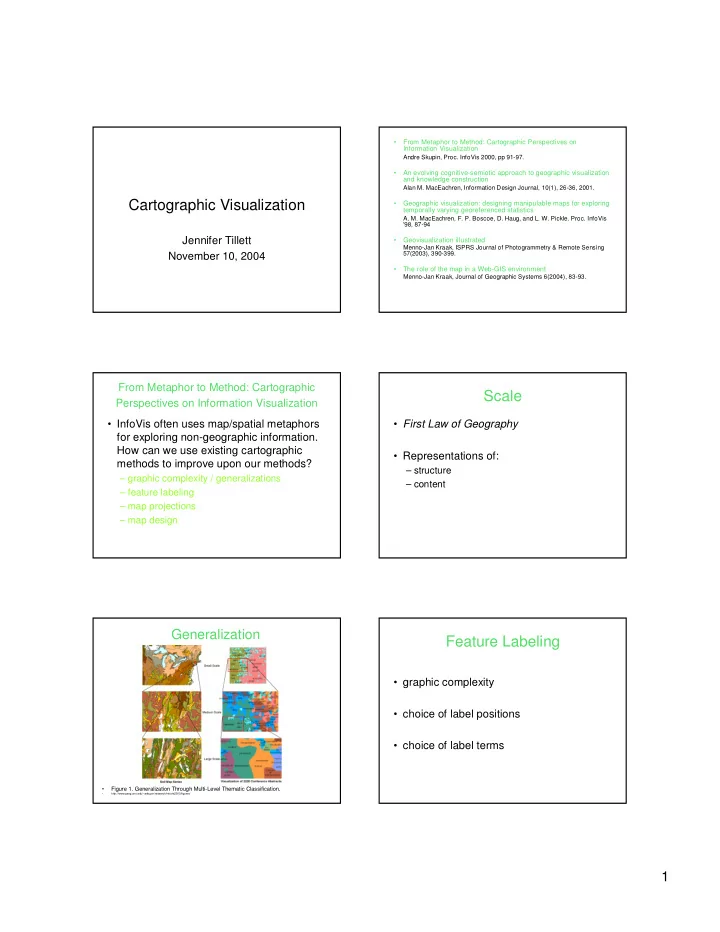
Cartographic Visualization

Jennifer Tillett November 10, 2004

  • From Metaphor to Method: Cartographic Perspectives on

Information Visualization Andre Skupin, Proc. InfoVis 2000, pp 91-97.

  • An evolving cognitive-semiotic approach to geographic visualization

and knowledge construction Alan M. MacEachren, Information Design Journal, 10(1), 26-36, 2001.

  • Geographic visualization: designing manipulable maps for exploring

temporally varying georeferenced statistics

  • A. M. MacEachren, F. P. Boscoe, D. Haug, and L. W. Pickle. Proc. InfoVis

'98, 87-94

  • Geovisualization illustrated

Menno-Jan Kraak, ISPRS Journal of Photogrammetry & Remote Sensing 57(2003), 390-399.

  • The role of the map in a Web-GIS environment

Menno-Jan Kraak, Journal of Geographic Systems 6(2004), 83-93.

From Metaphor to Method: Cartographic Perspectives on Information Visualization

  • InfoVis often uses map/spatial metaphors

for exploring non-geographic information. How can we use existing cartographic methods to improve upon our methods?

– graphic complexity / generalizations – feature labeling – map projections – map design

Scale

  • First Law of Geography
  • Representations of:

– structure – content

Generalization

  • Figure 1. Generalization Through Multi-Level Thematic Classification.
  • http://www.geog.uno.edu/~askupin/research/infovis2000/figures/

Feature Labeling

  • graphic complexity
  • choice of label positions
  • choice of label terms
slide-2
SLIDE 2

2

Map Design

  • Figure 2. Visual Hierarchy in a Map of U.S. States and Counties.
  • Figure 3. Visual Hierarchy in a Visualization of Newspaper Article Content.

http://www.geog.uno.edu/~askupin/research/infovis2000/figures/

Map Projection

  • Distortion
  • - MDS
  • - SOM

Critique

+ Useful overview + Good contributions to InfoVis

  • Reaching, at times. Some of his

contributions have already been acknowledged in InfoVis

  • Severe lack of details in places, with a

"paper-pointer" inserted instead An evolving cognitive-semiotic approach to geographic visualization and knowledge construction

  • Discusses how current work in

geographic visualization has extended and critiqued Bertin's work, expecially "graphic variables."

  • Also outlines 3 specific geovisualization

challenges for the next decade.

"Graphic Variables"

  • location
  • size
  • value
  • texture/grain
  • color
  • orientation
  • shape

Saturation

slide-3
SLIDE 3

3

Tactile Variables

  • location
  • size
  • value
  • texture/grain
  • color ===>elevation
  • orientation
  • shape
  • Resistance, friction, kinesthetic location?

Dynamic & Sonic Variables

  • Size loudness, duration
  • Value pitch & register
  • Shape timbre
  • Location position (in time)
  • Texture order
  • Rate of change & attack/decay
  • Frequency
  • synchronization

Graphic Info Processing => Geovisualization

Geovis uses visual geospatial displays to:

– Explore data – Generate hypotheses – Develop problem solutions – Construct knowledge

Highly Interactive Displays Highly Interactive Displays

GeoVis Challenges For Next Decade

  • Developing a typology of operations for

georepresentations and a syntactics for their use

  • Balancing abstraction and realism in

GeoVirtual environments

  • Facilitating different-place collaboration
slide-4
SLIDE 4

4

Critique

+ Nice commentary on Bertin + Extensions useful and shed more light on rare Bertin book

  • Quite self-referential, without explanations
  • Points reader to systems that use

principles, but doesn't discuss

Geographic visualization: designing manipulable maps for exploring temporally varying georeferenced statistics

Research was aimed to understand the cognitive aspects of map use in the context of health data analysis, and develop visual analysis tools that integrate principles from cartography, GIS and EDA.

Geographic Visualization

  • Construct knowledge

– Using maps and other representation forms

  • Dynamically link the visual map display with

– underlying geographic data structures and – the system users (resulting in maps that change in response to changes in data and/or to actions on the part of users)

Related Work

  • Map Animation
  • Multivariate Representation
  • Interactivity

Prototype Design

Goal: Enhance ability of health/statistics specialists to recognize (and draw inferences about) mortality rate patterns, risk factor patterns, relations between risk factors and mortality, and change in both mortality and risk factors (and their relations) over time.

  • spatial pattern analysis
  • spatiotemporal analysis
slide-5
SLIDE 5

5

Expert Use / Results Critique

+ lots of different tasks + appropriate conclusions

  • vis for examining results a little confusing

Geovisualization illustrated

  • Demonstrates usefulness of geovis and
  • How alternative graphic representations

can stimulate the visual thought process.

Small Multiples/Time Series Animation

  • Better able to represent time
  • See web site

www.itc.nl/personal/kraak/1812

slide-6
SLIDE 6

6

Other Views

  • See web site for:

– 3D view – Space-time cube

Critique

+ Nice array of techniques presented

  • Too little discussion of techniques’

advantages/disadvantages

  • Makes same assertions as MacEachren

without evidence

The role of the map in a Web-GIS environment

  • Defines the function of the map in WebGIS

– Traditional – Search engine – Index – Interface to other geographic and non- geographic info on the Web

Functions of maps

slide-7
SLIDE 7

7

Critique

+ Survey points out really cool things

  • Surveys without saying much
  • Plagiarizes himself from last paper (for no

good reason)