CAP Excess Water Task Force Patrick Dent PE CAP Water Control - - PDF document

cap excess water task force
SMART_READER_LITE
LIVE PREVIEW

CAP Excess Water Task Force Patrick Dent PE CAP Water Control - - PDF document

Agenda Number 2. CAP Excess Water Task Force Patrick Dent PE CAP Water Control Manager September 6, 2017 Introduction Excess Water is defined as all Project Water that is in excess of the amounts used, resold, or exchanged


slide-1
SLIDE 1

1

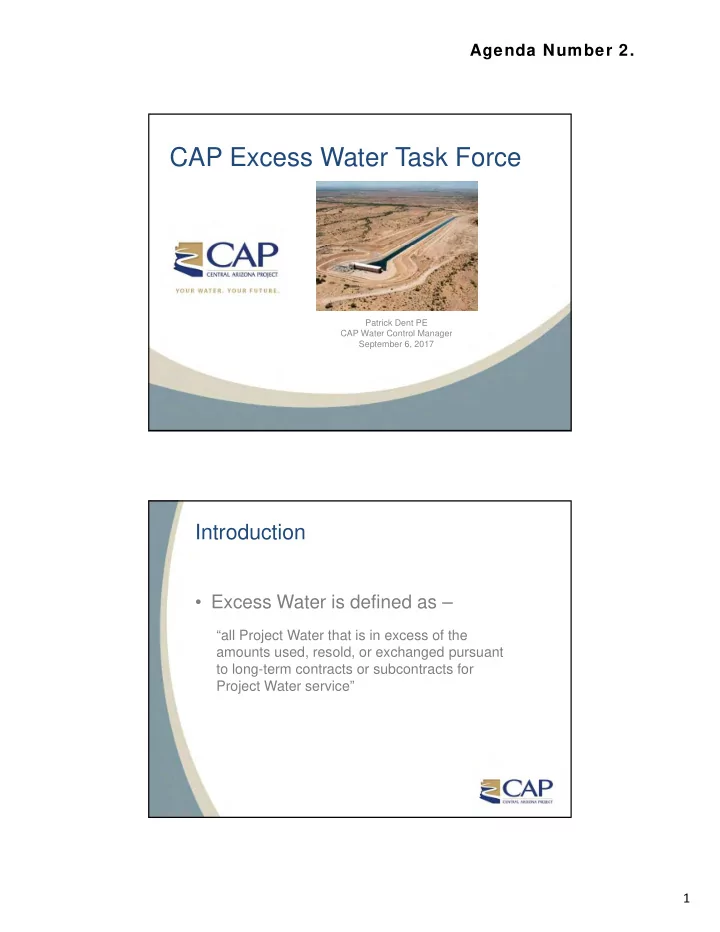
CAP Excess Water Task Force

Patrick Dent PE CAP Water Control Manager September 6, 2017

Introduction

  • Excess Water is defined as –

“all Project Water that is in excess of the amounts used, resold, or exchanged pursuant to long-term contracts or subcontracts for Project Water service”

Agenda Number 2.

slide-2
SLIDE 2

2

Today’s Objectives

  • Discuss development of the annual
  • perating plan prior to the water delivery

year

  • Discuss within year CAP remarketing
  • Discuss end of year CAP operations

Annual Operating Plan (AOP) Timeline

  • September
  • Consult with Reclamation regarding

next year’s Colorado River diversion

  • October
  • Receive orders from CAP customers
  • Determination of CAP delivery supply
  • Determination of excess supply
  • November
  • Approve schedules for CAP

customers

  • December
  • Approval of CR diversion from

Reclamation

slide-3
SLIDE 3

3

CAP Annual Delivery Supply

The CAP annual delivery supply is defined as the volume of water that CAP will commit to deliver to CAP customers for the year.

  • Factors determining CAP annual delivery supply:

– Estimate of Colorado River water available to CAP – System operations and losses – Forbearance and system conservation

2017 CAP Annual Delivery Supply

Estimate of Colorado River Supply 1,650,000 AF Lake Pleasant Operations + 50,000 AF CAP System Losses ‐ 75,000 AF Colorado River Conservation Target ‐ 185,000 AF CAP Annual Delivery Supply 1,440,000 AF Colorado River conservation target ‐ 185,000 AF CAP delivery supply 1,440,000 AF

slide-4
SLIDE 4

4

Estimate of Available CR Water

  • Junior Priority – subordinate to higher priority

uses and shares priority with 164,652 acre-feet

  • f Arizona on-river diverters
  • Estimate based on a recent history of Arizona

consumptive use – varies year to year

  • CAP’s Colorado River estimate and submitted

water order is generally higher than the water

  • rder that is approved by Reclamation, but

aligns by the end of year

  • Reclamation forecasts the amount of water

available to Junior Priority users and coordinates monthly water diversion schedules

1,000,000 1,100,000 1,200,000 1,300,000 1,400,000 1,500,000 1,600,000 1,700,000 1,800,000

2012 2013 2014 2015 2016

Available Colorado River Water to CAP Acre-feet

BOR Approved CAP Diversion Water Available to CAP CAP Estimate

slide-5
SLIDE 5

5

Lake Pleasant Operations

  • Lake Pleasant is a multi-use facility that is

shared with Maricopa Water District (MWD)

  • CAP operates New Waddell Dam
  • CAP and MWD have independent water delivery

plans

  • Lake Pleasant has a conservation pool of 812

KAF (roughly 80/20 split between CAP/MWD)

  • MWD stores Agua Fria water
  • CAP stores Colorado and Agua Fria water

Lake Pleasant Operations

Lake Pleasant is CAP’s regulatory reservoir with the following purposes – Operational reserve of a 60-90 day delivery supply of approximately 200,000 acre-feet – Energy Management – Water Delivery – Flood Control – Recreation

slide-6
SLIDE 6

6

Lake Pleasant Operations

  • Operations will result in either

– An increase in the CAP Annual Delivery Supply (+) – An increase in Lake Pleasant storage (-)

Determination of Available CAP Supply

Estimated Colorado River supply +/-Lake Pleasant operations

  • CAP system losses

Available CAP Supply

slide-7
SLIDE 7

7

2017 Available CAP Supply

Estimate of Colorado River Supply 1,650,000 AF Lake Pleasant Operations + 50,000 AF CAP System Losses ‐ 75,000 AF Available CAP Supply 1,625,000 AF Colorado River conservation target ‐ 185,000 AF CAP delivery supply 1,440,000 AF

Determination of Excess Supply

Available CAP supply – Water orders of CAP long-term contracts CAP Excess Supply

  • Board Policies governing CAP excess supply

– Excess Water Marketing for Non-Indian Agriculture Use – 2004 through 2030 “Ag Pool” – CAWCD Procedure to Distribute Excess Water in 2015 through 2019 “Access to Excess”

slide-8
SLIDE 8

8

2017 CAP Excess Supply

Available CAP Supply 1,625,000 AF M&I Subcontract Requests ‐ 571,435 AF Federal Contract Requests ‐ 573,006 AF CAP Excess Supply 480,559 AF

Excess Deliveries Last 10 Years

0.00 200,000.00 400,000.00 600,000.00 800,000.00 1,000,000.00 1,200,000.00 WATER VOLUME (AF) YEAR

Excess Water Delivered 2007-2016

Ag Pool Other Excess

slide-9
SLIDE 9

9

Distribution of CAP Excess Supply

– Ag Settlement Pool – “Other Excess”

  • CAGRD Obligation
  • Statutory Firming

– AWBA – US Bureau of Reclamation – CAGRD – Replenishment Reserve

2017 Distribution of Excess Water

CAP Excess Supply 480,559 AF Ag Settlement Pool ‐ 300,000 AF Ag Forbearance 3 + 46,076 AF Remaining Available Excess Supply 226,635 AF System Conservation ‐ 185,000 AF CAGRD Obligation ‐ 23,005 AF AWBA ‐ 17,630 AF CAGRD Replenishment Reserve ‐ 0 AF Reclamation ‐ 1,000 AF 0 AF

slide-10
SLIDE 10

10

2017 CAP Annual Delivery Supply

Estimate of Colorado River Supply 1,650,000 AF Lake Pleasant Operations + 50,000 AF CAP System Losses ‐ 75,000 AF Colorado River Conservation Target ‐ 185,000 AF CAP Annual Delivery Supply 1,440,000 AF Colorado River conservation target ‐ 185,000 AF CAP delivery supply 1,440,000 AF

Finalizing CAP’s AOP

  • Coordinate final customer schedules
  • Prepare CAP’s direct recharge facilities
  • perating plan
  • Prepare customer invoices
  • Coordinate outages to support maintenance and

capital projects

  • Create power schedules and prepare Navajo

reservation

  • January 1 begin real-time execution of water
  • rders
slide-11
SLIDE 11

11

Key Points

  • Once the CAP annual delivery supply is

determined it becomes fixed for the water delivery year.

  • Deviations from the CAP delivery supply are

generally limited to: – A customer requested a remarket but remarketing was unsuccessful – Water ordered but not delivered – Within year Forbearance/Conservation

2017 AOP

500 1000 1500 2000 2500 3000 3500 4000 Jan Feb Mar Apr May Jun Jul Aug Sep Oct Nov Dec FLOW IN CFS

2017 PLANNED COLORADO RIVER DIVERSION AND PLANNED CAP DELIVERY OPERATIONS

Planned Delivery 2017 Planned Diversion 2017

slide-12
SLIDE 12

12

CAP Storage Accounts

Acre Feet 2012 2013 2014 2015 2016 Lake Pleasant Account 425,895 518,154 545,310 549,621 545,060 Lake Roosevelt Account 51,516 31,468 31,463 16,452 441 Total 477,411 549,622 576,663 566,063 545,501

Questions

  • Determination of CAP annual delivery supply
  • Determination of Colorado River availability
  • Operation of Lake Pleasant
  • Allocation of excess
  • CAP’s AOP process
slide-13
SLIDE 13

13

Within Year Operations

CAP’s response to a reduction of a water order “turnback” If time, operational capacity and a customer exists, CAP will re-market the unwanted water to the next highest priority user within the same entitlement category

Within Year Operations

The turnback is currently managed as follows

– Re-market water to a CAP contractor with a need for water and can use the water within their entitlement – Return the water to the excess pool and make available to CAGRD, AWBA, and Reclamation in accordance to the access to excess policy – Ag pool re-markets are remarketed first within the Ag pool then to the next highest priority user

slide-14
SLIDE 14

14

Within Year Operations

CAP response to a reduction of a water order “turnback” If time, operational capacity and a customer do not exist, the customer is obligated by contract to pay the fixed OM&R and the water is retained in Lake Pleasant.

Within Year Turnback Objectives

  • Deliver the entire volume of the CAP annual

delivery supply

  • Make best efforts to relieve a CAP customer of

the cost of water it does not intend to use

  • Put to use water that is unwanted by a higher

priority user to achieve broader water management goals in Arizona

slide-15
SLIDE 15

15

Within Year Remarketing Limitations

  • Demand – strength of a monsoon season
  • GSF capacity
  • Timing
  • USF capacity

Task Force – Within Year Turnback

  • Direction regarding the management of water
  • rdered but reduced within the year
  • Potential alternatives to remarketing

– Reduce CR diversion and leave in Lake Mead – Retain in Lake Pleasant

  • Issue with fixed OM&R
slide-16
SLIDE 16

16

Year End – Customer Deliveries

  • Water that is scheduled but not delivered,

remains in Lake Pleasant as storage

  • Customers who do not deliver their entire

scheduled volume are responsible for the fixed OM&R, “take or pay”

Recent History of Turnback Water

2012 2013 2014 2015 2016 Successful Remarket (Delivered) 10,247 28,954 19,753 41,148 6,466 Unsuccessful Remarket (Lake Pleasant) ‐ ‐ ‐ 9,511 ‐ Not Delivered (Lake Pleasant) 2,566 22,697 44,533 38,704 9,070 Total 12,813 51,651 64,286 89,363 15,536 % of Total Deliveries 0.8% 3.4% 4.2% 6.0% 1.1%

slide-17
SLIDE 17

17

Year End – Colorado River Forecasting

  • Coordination with Reclamation occurs on a

monthly basis throughout the year, increases as necessary at the end of the year

  • Reclamation provides a forecast of Colorado

River supply availability to the junior priority users

  • Reclamation forecasts are updated regularly

(weekly or more often if needed)

Year End – Colorado River Operations

  • Colorado River pumping is adjusted to conform

with the best estimate of available water to CAP

  • Colorado River water in excess of the volume

planned for delivery at the beginning of the year is delivered to Lake Pleasant

  • Lake Pleasant water is considered in the

determination of the CAP annual delivery supply for a subsequent year

slide-18
SLIDE 18

18

Colorado River Diversion

  • Board Direction (March 8, 2001) - Encourage

Maximum Use of Available Colorado River Water

  • Long standing goal of the State to divert all of

Arizona’s Colorado River apportionment

  • Since 2014, by intent, water has been

dedicated to various conservation programs for the protection of Lake Mead.

slide-19
SLIDE 19

19

Potential Task Force Focus

  • Allocation of excess from the CAP annual

delivery supply (Access to Excess Policy)

  • Direction regarding the management of

water ordered but reduced within the year – “turnback”