
SLIDE 1
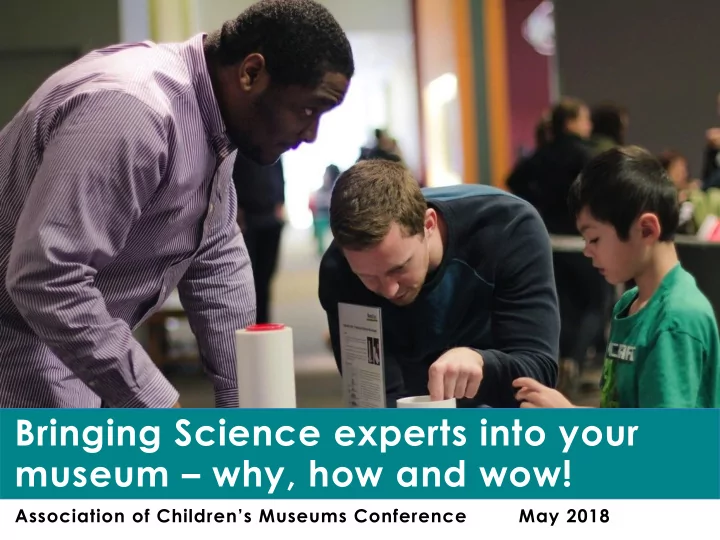
Bringing Science experts into your museum – why, how and wow!
Association of Children’s Museums Conference May 2018
Bringing Science experts into your museum why, how and wow! - - PowerPoint PPT Presentation
Bringing Science experts into your museum why, how and wow! Association of Childrens Museums Conference May 2018 Presenters Catherine McCarthy , Science Museum of Minnesota, Saint Paul, MN cmccarthy@smm.org Michelle Kortenaar,
Bringing Science experts into your museum – why, how and wow!
Association of Children’s Museums Conference May 2018
Saint Paul, MN cmccarthy@smm.org
mkortenaar@sciencenter.org
Saint Paul, MN cleavell@smm.org
beckyw@childrensmuseum.org
ckathleen@marbleskidsmuseum.org
Introduction Why, When, Resources
Working with and training college students facilitators
Recruiting volunteers from professional societies and expert networks such as Solar System Ambassadors
Preparing for successful family-friendly large scale events
Forming connections with local scientists and businesses, preparing them for play-based programming
Bringing Science experts into your museum – why, how and wow!
www.nisenet.org
Catherine McCarthy cmccarthy@smm.org Association of Children’s Museums, May 2018
your local community (businesses, industry, college)
local university/ college
for students /scientists
conversations (public engagement in science)
– Earth Day – National Chemistry Week – Astronomical / Celestial events – NanoDays – Special STEM days and events
materials and professional development resources
activities
The Nanoscale Informal Science Education Network is supported by the National Science Foundation under award numbers 0532536 and 0940143. Multi-Site Public Engagement in Science is supported by the National Science Foundation under award number 1421179. Transmedia Museum is supported by the National Science Foundation under award number 1516684. ChemAttitudes is supported by the National Science Foundation under award number 1612482. Collaborative Research: Grounding Institutional Partnerships in Structures for Broader Impacts Design is supported by the National Science Foundation under award number 1610039. Any
authors and do not necessarily reflect the views of the Foundation. Space and Earth Informal STEM Education is supported by NASA under cooperative agreement number
those of the author(s) and do not necessarily reflect the view of the National Aeronautics and Space Administration (NASA). Sustainability in Science Museums is supported by the Walton Sustainability Solutions Initiatives at Arizona State University (ASU) and is a collaboration with the Center for Engagement and Training in Science and Society at ASU.
Introduction Why, When, Resources
Working with and training college students facilitators
Recruiting volunteers from professional societies and expert networks such as Solar System Ambassadors
Preparing for successful family-friendly large scale events
Forming connections with local scientists and businesses, preparing them for play-based programming
Bringing Science experts into your museum – why, how and wow!
Michelle Kortenaar mkortenaar@sciencenter.org Sciencenter Ithaca, NY
In the Community
Meet a Scientist
Every Saturday (52+ times/year!)
Broader Impact Design
Introduction Why, When, Resources
Working with and training college students facilitators
Recruiting volunteers from professional societies and expert networks such as Solar System Ambassadors
Preparing for successful family-friendly large scale events
Forming connections with local scientists and businesses, preparing them for play-based programming
Bringing Science experts into your museum – why, how and wow!
Christina Leavell
Manager, Network Projects and NISE Network Midwest Regional Hub Leader at The Science Museum of Minnesota
– NOT a comprehensive overview! – Earth and Space Project – Chemistry Project
Ambassadors program
WHY
– Special way of engaging with audiences around this content
experienced working in a museum setting – Easily oriented to working with your audiences – less staff time training
– Telescopes – Model Rovers – Make and takes
WHEN
– 2017 Total Solar Eclipse – Earth Day, Yuri’s Night, etc. – National Chemistry Week
– Special Events - Sit with an Amateur Astronomer – Evening Programs - Scientist Speed Dating – Large group presentations
– Summer Camps – Afterschool programs – Regular floor demos and toolkit activities More ideas: nisenet.org/seasons
Earth and Space Science
astronomy clubs, members share their time and telescopes to provide unique astronomy experiences at science museums, observatories, classrooms, and under the real night sky. http://nightsky.jpl.nasa.gov/index.cfm
“Astronomy Ambassadors,” program provides mentoring and training experiences for young astronomers http://aas.org/outreach/roster-aas- astronomy-ambassadors
(SSA) http://solarsystem.nasa.gov/ssa/home .cfm
Collaboration with the NASA Museum Alliance at JPL
– Puerto Rico, Guam, US Virgin Islands – US citizens living abroad: Netherlands, Nigeria, Germany, Japan, Republic of Korea, United Kingdom
solarsystem.nasa.gov/ssa/home.cfm
Chemistry
Local Sections: 185 nationwide https://lslookup.acs.org/lslookup/local _search
Student Chapters: located on many college campuses across the country. https://www.acs.org/content/acs/en/e ducation/students/college/studentaffil iates/find-a-chapter.html
Applications due June 1, 2018 Kit Overview document and how to apply: http://www.nisenet.org/chemistry-apply
has assembled a set of engaging, hands-on experiences designed to stimulate interest, sense of relevance, and feelings of self-efficacy about chemistry among public audiences.
events between October and December 2018.
is during National Chemistry Week taking place October 21-27!
STILL TIME TO APPLY!!!
networks…
– Access to current pool of passionate professionals – Expands upon program offerings at your museum – No additional training required – Gives audiences an engaging and unique experience
Contact me with questions & find your local societies/networks!
This material is based upon work supported by NASA under cooperative agreement award number NNX16AC67A. Any opinions, findings, and conclusions or recommendations expressed in this material are those of the author(s) and do not necessarily reflect the view of the National Aeronautics and Space Administration (NASA).
Christina Leavell, Science Museum of Minnesota: cleavell@smm.org
Introduction Why, When, Resources
Working with and training college students facilitators
Recruiting volunteers from professional societies and expert networks such as Solar System Ambassadors
Preparing for successful family-friendly large scale events
Forming connections with local scientists and businesses, preparing them for play-based programming
Bringing Science experts into your museum – why, how and wow!
Scientists and Large Scale Events
Becky Wolfe
Before You Recruit
day
Reminder - not everyone will be a good fit
Questions to Ask
middle school students before?
– Ask about TED talks, other local events
Prepping Your Speaker & Event
Presentation Day!
The Good and the Questionable
Introduction Why, When, Resources
Working with and training college students facilitators
Recruiting volunteers from professional societies and expert networks such as Solar System Ambassadors
Preparing for successful family-friendly large scale events
Forming connections with local scientists and businesses, preparing them for play-based programming
Bringing Science experts into your museum – why, how and wow!
Engaging Scientists at Marbles Kids Museum
Smaller opportunities: monthly Large Scale Programs: quarterly
year
Engaging Scientists at Marbles Kids Museum SMALL SCALE
focusing on his or her work
Engaging Scientists at Marbles Kids Museum LARGE SCALE
partners
Off, Kids Code, Engineer It)
Engaging Scientists at Marbles Kids Museum RECRUITMENT:
KEYS TO SUCCESS:
the forefront
experts with play experts
scientists for the type of audience your museum will be.
Introduction Why, When, Resources
Working with and training college students facilitators
Recruiting volunteers from professional societies and expert networks such as Solar System Ambassadors
Preparing for successful family-friendly large scale events
Forming connections with local scientists and businesses, preparing them for play-based programming
Bringing Science experts into your museum – why, how and wow!
materials and professional development resources
activities
The Nanoscale Informal Science Education Network is supported by the National Science Foundation under award numbers 0532536 and 0940143. Multi-Site Public Engagement in Science is supported by the National Science Foundation under award number 1421179. Transmedia Museum is supported by the National Science Foundation under award number 1516684. ChemAttitudes is supported by the National Science Foundation under award number 1612482. Collaborative Research: Grounding Institutional Partnerships in Structures for Broader Impacts Design is supported by the National Science Foundation under award number 1610039. Any
authors and do not necessarily reflect the views of the Foundation. Space and Earth Informal STEM Education is supported by NASA under cooperative agreement number
those of the author(s) and do not necessarily reflect the view of the National Aeronautics and Space Administration (NASA). Sustainability in Science Museums is supported by the Walton Sustainability Solutions Initiatives at Arizona State University (ASU) and is a collaboration with the Center for Engagement and Training in Science and Society at ASU.
How do you select and screen volunteers?
Can you tell us about things that didn’t go so well? Any cautionary tales we can learn from