
SLIDE 1
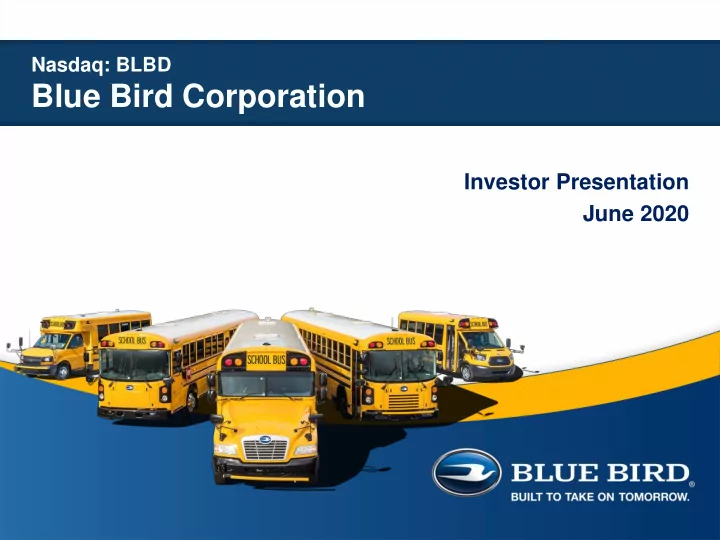
Blue Bird Corporation Investor Presentation June 2020 Agenda - - PowerPoint PPT Presentation
Nasdaq: BLBD Blue Bird Corporation Investor Presentation June 2020 Agenda Business Summary School Bus Industry Overview Blue Bird Highlights Financial Overview 2 Business Summary Founded in 1927, Blue Bird product development,
2
3
❖ Founded in 1927, Blue Bird product development, manufacturing, fabrication and headquarters located in Middle Georgia ❖ Only pure-play school bus manufacturer
➢ Product-focused and purpose-built ➢ Most recognized school bus brand
❖ High barriers to entry
➢ Highly specialized/custom product ➢ Relationship-driven with exclusive, franchised dealer network ➢ Highly seasonal market
❖ Strong free cash flow generation
➢ Typically operating with negative working capital over the year ➢ Only build to firm orders ➢ Low ongoing capital requirements
❖ Broadest range of product with gas, diesel, propane, CNG and electric offerings ❖ Undisputed leader in alternative fuels – the fastest growing segment of the school bus market
➢ Exclusive partnerships with Ford and ROUSH CleanTech ➢
❖ Transformational Initiatives underway, supporting Adj. EBITDA Margin growth to 10%
➢ Significant company-wide cost reductions, led by material costs ➢ All-new, robotic paint facility ➢ Efficiency gains from industrial engineering work ➢ Major product changes, addressing features, quality and cost
4
Blue Bird offers most expansive range, from 10 to 90 passengers with multiple body and engine choices
5
Type C Buses
(Conventional) Seating Capacity: 36-83 Fuel Types: Diesel, Propane, CNG, Gasoline, Electric (2019)
Type D FE Buses
(Front Engine, Transit-Style) Seating Capacity: 54-90 Fuel Type: Diesel
Type A Buses
Seating Capacity: 10-30 Fuel Types: Diesel, Propane, Gasoline, Electric (2018)
Type D RE Buses
(Rear Engine, Transit-Style)
Seating Capacity: 66-84 Fuel Types: Diesel, CNG, Electric (2018)
6
~10,000 School Districts
~3,400 Contractors
School Bus Customers OEMs
Blue Bird Thomas IC
High barriers to entry
Highly specialized product Complex state and customer requirements Dealer and service network Customer relationship driven business
Demand Drivers
Population of school age children increasing Increasing average age of existing fleet
Relatively Clear Funding Sources
Property taxes are primary source of funding; volume tracks housing prices
7
Source: R.L. Polk New Registrations, based on Type C/D school buses registered during BB fiscal year
❖ Industry average size is 30,800 new units annually based on RL Polk registrations ❖ Total fleet of school buses is ~590,000 units and average age is about 11 years ❖ Industry size is driven by: 1. Number of school age children 2. Age of existing fleet – most states set 15 years as a replacement target 3. Average ridership per bus 4. Funding – primarily from property tax
37,641 23,821 35,000
15,000 20,000 25,000 30,000 35,000 40,000New School Bus Registrations Long Term Average
Mean: 30,800
8
10,000 15,000 20,000 25,000 30,000 35,000 40,000
2 3 4 5 6 7 8 9 10 11 12 13 14 15 16 17 18 19 20 21 22 23 24 25 26 27 28 29 30 31 32 33 34 35 36 37
School Buses in Operation Age
300k / 52% under 10 years 110k / 19% 10-14 years 180k / 30% 15years and
Source: R.L. Polk Registrations, based on Type C/D school bus fleet at the end of BB fiscal year
9 17% 83%
Diesel 89% 6% 5% Type C Type D RE Type D FE 85% 8% 7% Type C Type D RE Type D FE 4% 96%
Diesel
Source: R.L. Polk New Registrations, based on Type C/D school buses registered during BB fiscal year
38% mix for Blue Bird
10
Two production centers – Type C & D in Fort Valley, Georgia and Type A in Drummondville, Quebec. Parts warehouse in Ohio
11
Assembly (Fort Valley, Georgia) Commentary Centralized manufacturing, engineering, and support functions Size (square feet) 900,000 Salaried Headcount 87 Hourly Headcount 1,631 Own / Lease Own Labor Non-Unionized Volume / Capacity 11.5K Units / 13K Units Blue Bird South (Fort Valley, Georgia) Commentary Fabrication facility that manufactures parts for Type C/D vehicles assembled at HQ Size (square feet) 340,000 Salaried Headcount 11 Hourly Headcount 305 Own / Lease Own Labor Non-Unionized Product Breadth 5,900 active SKUs Parts Distribution Center (Delaware, Ohio) Commentary Electronically guided, houses and distributes parts for current and past models Size (square feet) 200,000 Salaried Headcount 4 Hourly Headcount 26 Own / Lease Lease Labor Non-Unionized Product Breadth 32,000 SKUs Micro Bird JV Facility (Drummondville, Quebec) Commentary Design, fabrication, and assembly of Micro Bird by Girardin Type A buses Size (Square Feet) 100,000 Salaried Headcount 150 Hourly Headcount 375 Own / Lease Lease Labor Unionized Volume / Capacity 3.1K Units / 3.9K Units
Micro Bird JV Facility (Drummondville, Quebec, Canada) Parts Distribution Center (Delaware, Ohio) Corporate Office (Macon, Georgia) Blue Bird South and Assembly (Fort Valley, Georgia)
Corporate Office (Macon, Georgia) Commentary New headquarters in 2nd Floor of Highridge Centre Size (square feet) 50,000 Salaried Headcount 200 Hourly Headcount Own / Lease Lease Labor Non-Unionized
12
#1 Safety
Durability
Source: Freedonia Custom Research, Inc. 9/4/2013 (study commissioned by Blue Bird) 1 Checkmarks/Corporate Logo indicate leadership in category
13
Record Sales in FY2019
▪ Full Year sales 21% above last year ▪ Record Full Year sales mix at 48% ▪ 54% sales mix achieved in 2H ▪ Propane sales 41% above last year
Opportunities
▪ VW mitigation funds
buses; about $150M spent to date
ultra- low NOx school buses available
▪ Less than 15% of customers have purchased
alternative-fuel powered buses
14
Up 21%
15
Electric All- American, Vision and Micro Bird Exclusive ROUSH CleanTech and Ford Gen 4 Low NOx Propane Launched Exclusive ROUSH CleanTech and Ford Vision Gasoline and Vision CNG Launched Exclusive Partnership with ROUSH CleanTech and Ford Established to Launch Gen 3 Propane Vision and Micro Bird Gen 2 Propane Launched
2017 2016 2012 2007 1991–1994
First Propane, CNG and Electric Blue Bird Buses
2018
16
Type C
Value
Ford/ROUSH Gasoline
Type C
Traditional
Cummins ISB Diesel
Type C
Alternative Fuel
Ford/ROUSH Propane
Type D Front Engine
Traditional
Cummins ISB Diesel
Type C
Alternative Fuel
Ford/ROUSH CNG
Type D Rear Engine
Traditional
Cummins ISB/ISL Diesel
Type D Rear Engine
Alternative Fuel
Cummins ISL-G CNG
Type C & D Alternative Fuel Cummins Electric
#1 #1 #1 #1 #1
NEW
17
$554 $730 $802 $862 $876 $931 $963 $952 $44 $46 $54 $57 $56 $60 $62 $66 6,882 8,654 9,604 10,378 10,616 11,317 11,649 $11,017
6,000 7,000 8,000 9,000 10,000 11,000 12,000 13,000 14,000 15,000 $- $200 $400 $600 $800 $1,000 $1,200FY2012 FY2013 FY2014 FY2015 FY2016 FY2017 FY2018 FY2019
Bus Net Sales Parts Net Sales Bus Units Sales
18
$598 $1,025 $7771 $856
1 Total does not sum precisely due to rounding
($ in millions)
$919
$81 $84 Memo ASP: $84
($ in thousands)
$83 Bus Only:
$932 $991
$83 $82 $83
$1,018
19
($ in millions)
$17 $50 $67 $70 $72 $69 $70 $82 3% 6% 8% 8% 8% 7% 7% 7%
0% 2% 4% 6% 8% 10% 12% 14% $- $10 $20 $30 $40 $50 $60 $70 $80 $90FY2012 FY2013 FY2014 FY2015 FY2016 FY2017 FY2018 FY2019
Adjusted EBITDA Adjusted EBITDA Margin
$12 $31 $59 $45 $33 $44 $40 $36
FY2012 FY2013 FY2014 FY2015 FY2016 FY2017 FY2018 FY2019
20
($ in millions)
Lower FCF driven by higher CapEx associated with all-new robotic paint facility
21
Despite COVID-19, cost initiatives are ongoing; new paint facility fully operational;
FY2018 FY2019 FY2020+
Purchased Material – Commercial – Sourcing Purchased Material – Commercial – Sourcing – Initial design Purchased Material – Commercial – Sourcing – Design Build and Launch New Paint Facility – Test and validate – Prepare for production – Plant rearrangements New Paint Facility Fully Operational – High first-time pass rate – Greater capacity – Less paint usage – Lower labor cost – Lower warranty expense Plant Productivity – Optimize time per station – Labor efficiencies – Break bottlenecks – Design-for-manufacturing – Improve quality/rework – Material setup to line – Single Shift Production
($ Millions)
As of April 4, 2020 Debt $208.6 Cash 34.1 Net Debt $174.5 Net Debt / Adjusted EBITDA 2.1x Net Leverage Ratio
Compared with minimum bank Net Leverage Ratio covenant of 3.75x
2.4x Liquidity1 $97.2
22
1 Liquidity is defined as cash and cash equivalents plus availability on revolving line of credit
❖ As 2Q results showed, Blue Bird’s business fundamentals remain strong – increased bus selling price, lowered cost and achieved higher mix of alternative fueled-buses ❖ Demand for new school buses remains high with 25% of US and Canadian fleet aged 15 years or older; limitation is funding capability and outlook is uncertain at this time ❖ Action taken to protect employees has lowered production capacity through June but meets present lower incoming-order rate. Now filling July production slots ❖ School transportation staff now returning to work and planning for school start. We expect surge in 4Q demand in support of school start. 3Q will be most difficult quarter ❖ Strong 1Q FY2021 expected with late orders causing delivery beyond school start ❖ Like most public companies dealing with these uncertain times, we are withdrawing
and into June, we will have better clarity on the outlook and will advise accordingly ❖ FY2020 school bus industry forecast reduced by 10-12%, to 30-31k buses ❖ Taking ongoing actions to adapt and restructure the business accordingly. Moving to single-shift production from June 1, improving cost, efficiencies and quality
23
23
24
25
Pricing and Transformational Initiatives more than offset the impact of lower volume, material economics and manufacturing launch costs
26
See appendix for additional detail regarding Adjusted EBITDA
($ Millions)
FY2019 Adj. Free Cash Flow was $4.7M lower than FY2018 primarily reflecting higher CapEx and inventory levels, partially offset by higher Adj. EBITDA
27
($ Millions)
FY2019 FY2018 FY2019 FY2018 Adjusted EBITDA $ 33.4 $ 29.1 $ 81.8 $ 70.4 Cash Paid for Interest (Net) (2.5) (1.2) (10.4) (5.8) Trade Working Capital1 55.4 14.3 (1.6) 7.0 CAPEX (5.4) (16.5) (35.5) (32.1) Cash Taxes (2.2) — (4.6) (3.7) Other2 (1.5) 5.0 5.8 4.4 Adjusted Free Cash Flow $ 77.2 $ 30.7 $ 35.5 $ 40.2 Operational Transformation Initiatives/Other (6.4) (4.2) (10.6) (17.7) Product Redesign (1.4) (1.7) (4.7) (6.3) Free Cash Flow $ 69.5 $ 24.8 $ 20.2 $ 16.2
1 Inventories, accounts receivable and accounts payable 2 Accrued expenses and other receivables
4Q Full Year
28 Reconciliation of Net Income to Adjusted EBITDA
Three Months Ended Fiscal Year Ended
(in thousands of dollars)
September 28, 2019 September 29, 2018 September 28, 2019 September 29, 2018
Net income $ 11,592 $ 14,932 $ 24,300 $ 30,820 Adjustments: Discontinued operations income — — — (81) Interest expense, net (1) 2,737 1,521 13,279 6,591 Income tax expense (benefit) 4,740 3,042 7,573 (2,620) Depreciation, amortization, and disposals (2) 3,112 2,731 11,102 9,214 Operational transformation initiatives 6,401 4,161 10,594 17,708 Foreign currency hedges — 719 109 (109) Share-based compensation 1,127 248 4,273 2,628 Product redesign initiatives 3,663 1,727 10,540 6,253 Other (3) 29 59 (25) Adjusted EBITDA $ 33,369 $ 29,110 $ 81,829 $ 70,379 Adjusted EBITDA margin (percentage of net sales) 9.7% 8.8% 8.0% 6.9% (1) Includes $0.1 million and $0.4 million for the three months and fiscal year ended September 28, 2019, representing interest expense on lease liabilities, which are a component of lease expense and presented as a single operating expense in selling, general and administrative expenses
(2) Includes $0.2 million and $0.7 million for the three months and fiscal year ended September 28, 2019, representing amortization charges on right-to-use lease assets, which are a component of lease expense and presented as a single operating expense in selling, general and administrative expenses on our Condensed Consolidated Statements of Operations.
29 Reconciliation of Free Cash Flow to Adjusted Free Cash Flow
Three Months Ended Fiscal Year Ended
(in thousands of dollars)
September 28, 2019 September 29, 2018 September 28, 2019 September 29, 2018
Net cash provided by operating activities $ 74,819 $ 41,331 $ 55,706 $ 48,353 Cash paid for fixed and acquired intangible assets (5,360) (16,546) (35,514) (32,118) Free cash flow $ 69,459 $ 24,785 $ 20,192 $ 16,235 Cash paid for product redesign initiatives (1,386) (1,727) (4,740) (6,253) Cash paid for operational transformation initiatives (6,401) (4,161) (10,594) (17,708) Adjusted free cash flow 77,246 30,673 35,526 40,196
30
(1) Amounts are net of estimated statutory tax rates of 25%.
Three Months Ended Fiscal Year Ended September 28, 2019 September 29, 2018 September 28, 2019 September 29, 2018
Diluted earnings per share $ 0.43 $ 0.52 $ 0.90 $ 1.08 One-time charge adjustments, net of tax benefit or expense 0.31 0.18 0.71 0.69 Adjusted diluted earnings per share, non-GAAP (1) $ 0.74 $ 0.70 $ 1.61 $ 1.77 Weighted average dilutive shares outstanding 26,904,766 28,579,670 27,043,814 28,616,862
Reconciliation of Diluted EPS to Adjusted Diluted EPS
(1) Numerator is adjusted net income, non-GAAP for all periods presented
Reconciliation of Net Income to Adjusted Net Income
Three Months Ended Fiscal Year Ended
(in thousands of dollars)
September 28, 2019 September 29, 2018 September 28, 2019 September 29, 2018
Net income $ 11,592 $ 14,932 $ 24,300 $ 30,820 Adjustments, net of tax benefit or expense (1) Operational transformation initiatives 4,801 3,121 7,946 13,281 Product redesign initiatives 2,747 1,295 7,905 4,690 Foreign currency hedges — 539 82 (82) Share-based compensation 845 186 3,205 1,971 Discontinued operations income — — — (61) Other (2) 22 44 (19) Adjusted net income, non-GAAP $ 19,983 $ 20,095 43,481 50,601 Less: preferred stock dividends — 181 — 1,896 Adjusted net income available to common stockholders, non-GAAP $ 19,983 $ 19,914 43,481 48,705
31
THE INFORMATION CONTAINED IN THIS PRESENTATION HAS BEEN PREPARED OR OBTAINED BY THE COMPANY FROM ITS BOOKS AND RECORDS AND OTHER SOURCES THAT THE COMPANY BELIEVES TO BE REASONABLY ACCURATE AND RELIABLE. HOWEVER, SUCH INFORMATION NECESSARILY INCORPORATES SIGNIFICANT ASSUMPTIONS AND ESTIMATES INCLUDING, BUT NOT LIMITED TO, FORWARD LOOKING PROJECTIONS AND OTHER STATEMENTS, THAT INVOLVE KNOWN AND UNKNOWN RISKS, UNCERTAINTIES AND OTHER IMPORTANT FACTORS THAT COULD CAUSE THE ACTUAL RESULTS, PERFORMANCE OR ACHIEVEMENTS OF THE COMPANY OR THE INDUSTRY IN WHICH IT OPERATES, TO DIFFER MATERIALLY FROM ANY FUTURE RESULTS, PERFORMANCE OR ACHIEVEMENT IMPLIED BY SUCH FORWARD-LOOKING STATEMENTS. STATEMENTS IN THIS PRESENTATION THAT ARE FORWARD-LOOKING IN NATURE ARE BASED ON THE COMPANY’S CURRENT BELIEFS REGARDING A LARGE NUMBER OF FACTORS AFFECTING THE COMPANY’S BUSINESS. ACTUAL RESULTS MAY DIFFER MATERIALLY FROM EXPECTED RESULTS. THERE CAN BE NO ASSURANCE THAT (I) THE COMPANY HAS CORRECTLY IDENTIFIED OR ASSESSED ALL OF THE FACTORS AFFECTING ITS BUSINESS OR THE EXTENT OF THEIR LIKELY IMPACT, (II) THE PUBLICLY AVAILABLE INFORMATION ON WHICH THE COMPANY’S ANALYSIS IS BASED IS COMPLETE OR ACCURATE, (III) THE COMPANY’S ANALYSIS IS CORRECT, OR (IV) THE COMPANY’S STRATEGY, WHICH IS BASED IN PART ON THIS ANALYSIS, WILL BE SUCCESSFUL. THE READER OF THIS PRESENTATION SHOULD TAKE CARE TO EVALUATE THE COMPANY’S BUSINESS AND PROSPECTS BASED ON ITS OWN ASSESSMENT OF THE RISKS AND OPPORTUNITIES FACING THE COMPANY BASED NOT ONLY ON THIS PRESENTATION, BUT ALSO ON SUCH OTHER INFORMATION FROM OTHER SOURCES THAT THE READER DEEMS TO BE ACCURATE AND RELIABLE.
32