
SLIDE 1
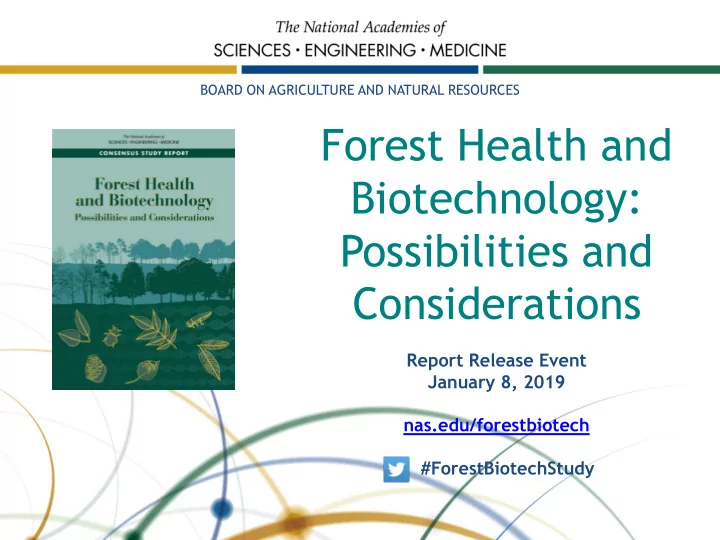
Report Release Event January 8, 2019 nas.edu/forestbiotech #ForestBiotechStudy
Forest Health and Biotechnology: Possibilities and Considerations
BOARD ON AGRICULTURE AND NATURAL RESOURCES
Biotechnology: Possibilities and Considerations Report Release - - PowerPoint PPT Presentation
BOARD ON AGRICULTURE AND NATURAL RESOURCES Forest Health and Biotechnology: Possibilities and Considerations Report Release Event January 8, 2019 nas.edu/forestbiotech #ForestBiotechStudy Committee on the Potential for Biotechnology to
Report Release Event January 8, 2019 nas.edu/forestbiotech #ForestBiotechStudy
BOARD ON AGRICULTURE AND NATURAL RESOURCES
Susan E. Offutt, Chair U.S. Government Accountability Office (retired) Vikram E. Chhatre, University of Wyoming Jason A. Delborne, North Carolina State University Stephen DiFazio, West Virginia University Doria R. Gordon, Environmental Defense Fund Inés Ibáñez, University of Michigan Gregory Jaffe, Center for Science in the Public Interest Mark D. Needham, Oregon State University Clare Palmer, Texas A&M University Jeanne Romero-Severson, University of Notre Dame Ronald R. Sederoff (NAS), North Carolina State University (emeritus) Diana L. Six, University of Montana Richard A. Sniezko, U.S. Forest Service Forest population genetics Tree gene flow and reproductive biology Genomics and quantitative genetics Forest ecology and entomology Selective breeding and genetic engineering of forest trees Sociology and ethics Economics U.S. environmental and regulatory law
to forest tree health
deploying biotechnology in forests, and develop a research agenda to address knowledge gaps about its application
use of biotechnology to protect a tree species from an insect and/or disease where negative consequences for forest health are anticipated.
provides value to humans
climate change
released into unmanaged forest ecosystems
Aquatic Terrestrial Atmospheric Water Flora Fauna Other Biotic Components Atmospheric Components Soil Other Abiotic Components Composite End-Products Other End-Products Extractive Use In-situ Use Non-Use
Industries Households Government Environment End-Products Direct Use/Non-Use Direct User
SOURCE: EPA. 2015.
Flows of Final Ecosystem Services
Harmful introductions Lack of resistance Climate change More than one threat
SOURCE: Krist et al., 2014.
Dark red areas represent estimates of at least 25% loss of tree vegetation between 2013 and 2027 due to insects and diseases.
Sap feeders Phloem and wood borers
SOURCE: Aukema et al., 2010.
Ash: Emerald Ash Borer Chestnut: Chestnut Blight, Root Rot Whitebark Pine: White Pine Blister Rust
SOURCE: U.S. Forest Service SOURCE: R. Sniezko SOURCE: iStock Photo
Poplar: Canker (Septoria)
SOURCE: S. Simon
Estimated development of spruce beetle in a single year in North American spruce forests
SOURCE: Bentz et al. 2010.
Chestnut: Chestnut Blight, Root Rot
SOURCE: U.S. Forest Service
Whitebark Pine: White Pine Blister Rust, Mountain Pine Beetle
SOURCE: R. Sniezko
SOURCE: Adapted from GAO, 2015.
increase resistance to pests
– 2 tree species have been altered with biotechnology for forest health purposes, but both are still in field trials
– Lack of knowledge about the mechanisms of pest resistance in trees – Large genome size and long life span – Lack of information on the effects of releasing new genotypes into the environment – Need for resistant trees to be suitably adapted to specific environments – Many tree species under pest attack do not have adequate or sustained breeding programs in which to integrate biotechnology
effective and lowest impact approaches to managing nonnative pests.
introduce resistance into tree species threatened by insects and pathogens.
resistance to pests and adaptation to diverse environments under a changing climate.
health should be preceded by developing a reasonable understanding in the target species of (a) rangewide patterns of distribution of standing genetic variation, if known; (b) magnitude of local adaptation; and (c) identification of spatial regions that are vulnerable to genetic offset.
resistant trees within a population that have survived a pest outbreak. Research to understand the role of resistance in coevolved systems from the perspective of a global host–pest system, where the nonnative pathogen or insect originate, would help guide efforts in North America.
genetic change will be sufficient to persist in trees that are expected to live for decades to centuries as progenitors of future generations.
biotech tree on forest health needs to enable evaluation of trade-offs between positive, negative, and neutral impacts
risk to forest function as well as consideration of the ecosystem services lost
durability and effectiveness of resistance, seed generation and dispersal, genetic fitness, and some ecosystem impacts
– Address large spatial and temporal scales and stochasticity of forests – Quantify reliability of impact assessments – Estimate predictive capacity of models – Identify data needs for models – Account for climate change in areas targeted for species restoration
components of ecosystem services into the integrated impact assessment.
about biotech tree gene flow, dispersal, establishment, performance, and impact that are precluded where flowering of field trial material is restricted.
for sources of uncertainty.
continued learning and address impacts to both the environment and society.
not be pursued to the exclusion of other options
health threats
consider social values
– Biotechnological interventions are likely to impose varying risks, costs, and benefits on different groups of people over time – Social impacts should be investigated, research into the perspectives of individuals and communities likely to be affected should be carried out, and affected communities should be engaged transparently and respectfully – Engagement processes could include surveys, focus groups, town hall meetings, science cafes
complement impact assessment
should be the first line of defense against nonnative species in efforts to maintain forest health.
in combination to combat threats to forest health.
encompass the genetic diversity needed to preserve tree species essential to ecosystem services.
tree breeding, forest ecology, and rural sociology, to guide the development and potential deployment of pest-resistant trees effectively.
threats in the United States are needed. Such studies might investigate (1) the responses of different social and cultural groups to the deployment of biotechnology in forests, (2) the stability and consistency of attitudes toward the different applications of biotechnology in a range of circumstances, (3) differences in attitudes toward biotechnology strategies (e.g., cisgenesis, transgenesis, genome editing), (4) the relationship between deeper value
between values such as wilderness and species protection.
should be used to help in developing a complementary framework to ecosystem services that takes into account intrinsic values, related spiritual and ethical concerns, and social justice issues raised by the deployment of biotechnology in forests.
should be developed and deployed, both to increase understanding of forest health threats and to uncover complex public responses to any potential interventions, including those involving biotechnology.
that engage stakeholders, communities, and the public.
and its value to humans
– Deliberate release of resistant tree into the environment intended to protect forest health – Geographic scope of release means involvement of large, diverse group of stakeholders – Contrast with regulatory experience with agronomic crops
Recommendation: Regulatory agencies should explore ways to incorporate into their regulatory oversight responsibilities the ability to assess the impact on ecosystem services for biotech and nonbiotech products developed for improving forest health.
– Establish connection between ecosystem functions and the goods and services provided to humans – Consider both positive and negative effects on ecosystem services and identify distribution of effects across stakeholders
– Forest genetics – Tree breeding
– Effective engagement with stakeholders and communities – Linkage between ecosystem functions and services
Study Sponsored by
www.nas.edu/forestbiotech @NASEM.Ag @NASEM_Ag #ForestBiotechStudy
Committee members Reviewers Speakers and members of the public Sponsors National Academies staff