KwaZulu-Natal Museum A never ending journey of discovery 237 Jabu - - PowerPoint PPT Presentation

kwazulu natal museum
SMART_READER_LITE
LIVE PREVIEW

KwaZulu-Natal Museum A never ending journey of discovery 237 Jabu - - PowerPoint PPT Presentation

KwaZulu-Natal Museum A never ending journey of discovery 237 Jabu Ndlovu Street, Pietermaritzburg 1 BACKGROUND Established by the Natal Society Library in 1897 Opened its doors to the public in 1904 KwaZulu-Natal Museum is


slide-1
SLIDE 1

1

KwaZulu-Natal Museum

“A never ending journey of discovery”

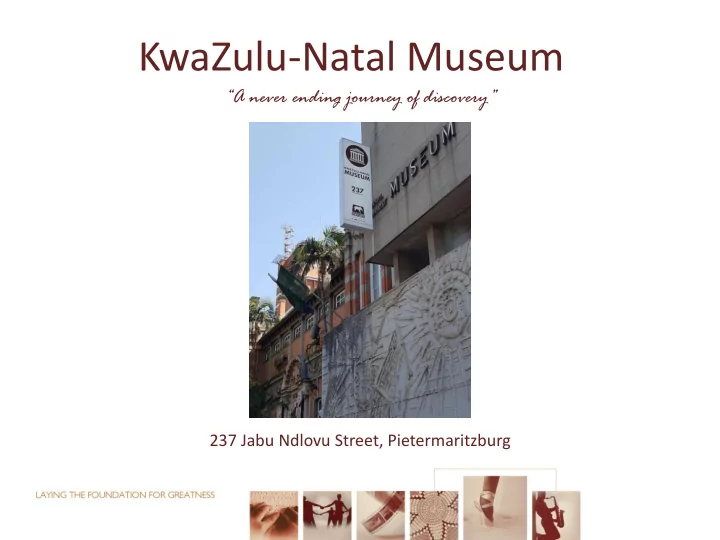
237 Jabu Ndlovu Street, Pietermaritzburg
slide-2
SLIDE 2

2

BACKGROUND

  • Established by the Natal Society Library in 1897
  • Opened its doors to the public in 1904
  • KwaZulu-Natal Museum is a schedule 3A public entity.
  • The Museum was declared in terms of the Cultural Institutions Act, 1998

(Act No. 118 of 1998).

  • The Museum receives institutional transfers from the Department of Arts

and Culture to finance its operations and address its infrastructural needs.

  • The entity discharges its obligation through three programs, namely

Administration, Business Development and Public Engagement

3

slide-3
SLIDE 3

3

The KwaZulu-Natal Museum is dedicated to serving the people of South Africa by interpreting material evidence of the cultural and natural world, in order to increase knowledge, understanding and appreciation of the nation’s wealth of history and biodiversity. To position the KwaZulu-Natal Museum as a leading heritage institution in South Africa. MISSION VISION

slide-4
SLIDE 4

4

KEY PROGRAMS

  • PROGRAMME 1: ADMINISTRATION
  • PROGRAMME 2: BUSINESS DEVELOPMENT
  • PROGRAMME 3: PUBLIC ENGAGEMENT

1

slide-5
SLIDE 5

5

RESEARCH DEPARTMENTS

Scientific publications Leadership in Science Biodiversity conservation Popular publications Source of expert knowledge Human capacity development Educational enrichment Community

  • ut-reach

National and international initiatives Collaboration with National & International Institutions Applied Research / Cultural Resource Management

RESEARCH OUTPUTS

slide-6
SLIDE 6

6

ALIGNMENT WITH DAC GOALS

7

Strategic outcome

  • riented goal

DAC strategic objective KZN museum strategic goal Output for 2017/18 A transformed and productive ACH sector. To develop, protect and promote cultural and creative sector. To develop and preserve the museum collections that reflects the nations diversity Collaborate in collections with Durban Natural Sciences Museum New collection areas, diversity Promote Research Capacity 90 % heritage assets databased Editorial of research journals 10 papers published & 12 presentations Membership of the NRF’s Natural Sciences Collections Facility Project To account for heritage assets in the care of the Museum Staff appointed for Electronic Asset Registers Grant Thornton to verify and valuate assets (R3m) Interns (5) for databasing.

slide-7
SLIDE 7

7

Collections: Mollusca

  • > 150 000 catalogue entries
  • ~ 600 000 specimens
slide-8
SLIDE 8

8

Collections: Mollusca

  • > 150 000 catalogue entries
  • ~ 600 000 specimens
  • Main challenges:

– Climate control – Wet collection storage – Sample backlog

slide-9
SLIDE 9

9

Collections: Mollusca

  • > 150 000 catalogue entries
  • ~ 600 000 specimens
  • Main challenges:

– Climate control – Wet collection storage – Sample backlog

  • Current projects

– Mount Nimba mollusc diversity

slide-10
SLIDE 10

10

Collections: Entomology

  • > 240 000 pinned specimens
  • ~ 250 000 specimens in mixed samples
  • > 2100 types (> 7200 specimens)
slide-11
SLIDE 11

11

Collections: Entomology

  • > 240 000 pinned specimens
  • ~ 250 000 specimens in mixed samples
  • > 2100 types (> 7200 specimens)
  • Main challenges

– Climate control – Mixed storage areas – Sample backlog

slide-12
SLIDE 12

12

Collections: Entomology

  • > 240 000 pinned specimens
  • ~ 250 000 specimens in mixed samples
  • > 2100 types (> 7200 specimens)
  • Main challenges

– Climate control – Mixed storage areas – Sample backlog

  • Projects

– PINDIP: www.pindip.org

  • Mobilisation of specimen data
  • Training of Diptera taxonomists
  • Create awareness about dipteran pollinators
slide-13
SLIDE 13

13

Collections: Oligochaeta

  • > 7000 catalogue entries
  • Main challenges

– Shared work and storage area – Lack of space

slide-14
SLIDE 14

14

Collections: Oligochaeta

  • > 7000 catalogue entries
  • Main challenges

– Shared work and storage area – Lack of space

  • Current projects

– Revision of Kazimierzidae and Microchaetus

slide-15
SLIDE 15

15

Collections: Wet Collections

  • Arthropoda: 22000 (> 20% types)

– (Spiders, Scorpions, Myriapods)

  • Herpetology: ~ 8500
  • Other Invertebrates:

– Marine inverts: ~ 500 – Onychophora: ~ 170 – Minor arthropod collections: ~ 1900

slide-16
SLIDE 16

16

Collections: Wet Collections

  • Arthropoda: 22000 (> 20% types)

– (Spiders, Scorpions, Myriapods)

  • Herpetology: ~ 8500
  • Other Invertebrates:

– Marine inverts: ~ 500 – Onychophora: ~ 170 – Minor arthropod collections: ~ 1900

  • Main challenges

– No curator – Lack of space

slide-17
SLIDE 17

17

Collections: Wet Collections

  • Arthropoda: 22000 (> 20% types)

– (Spiders, Scorpions, Myriapods)

  • Herpetology: ~ 8500
  • Other Invertebrates:

– Marine inverts: ~ 500 – Onychophora: ~ 170 – Minor arthropod collections: ~ 1900

  • Main challenges

– No curator – Lack of space

  • Main projects

– No curator

slide-18
SLIDE 18

18

Collections: Earth Science

  • Geology: ~ 3000
  • Palaeontology: ~ 1500
  • Main challenges

– No curator – Poor storage conditions

slide-19
SLIDE 19

19

Collections: Earth Science

  • Geology: ~ 3000
  • Palaeontology: ~ 1500
  • Main challenges

– No curator – Poor storage conditions

  • Current projects

– No curator

slide-20
SLIDE 20

20

Conclusion

  • Collections are not extensive, but are significant
  • Climate control, space limitations and lack of staff are major

challenges

  • Only one major collaborative project

Thank you for your time