Ma: Knabel Secondary sexual traits are seen in some - - PowerPoint PPT Presentation

ma knabel secondary sexual traits are seen in some
SMART_READER_LITE
LIVE PREVIEW

Ma: Knabel Secondary sexual traits are seen in some - - PowerPoint PPT Presentation

Male horn dimorphism in the scarab beetle, Onthophagus taurus : do alterna4ve reproduc4ve tac4cs favour alterna4ve phenotypes? Armin P. Moczek and Douglas J.


slide-1
SLIDE 1

Male ¡horn ¡dimorphism ¡in ¡the ¡scarab ¡beetle, ¡ Onthophagus ¡taurus: ¡do ¡alterna4ve ¡reproduc4ve ¡ tac4cs ¡favour ¡alterna4ve ¡phenotypes? ¡

Armin ¡P. ¡Moczek ¡and ¡Douglas ¡J. ¡Emlan ¡

Animal ¡Behavior, ¡2000, ¡Vol. ¡59 ¡(459-­‑466) ¡ ¡

Ma: ¡Knabel ¡

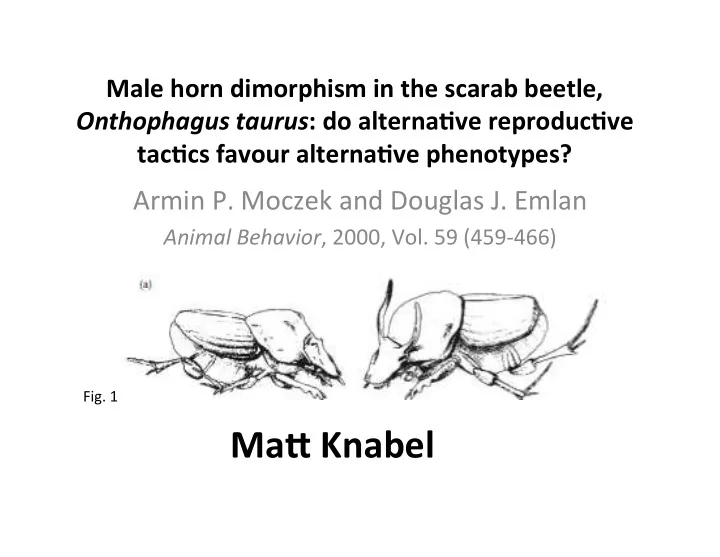
  • Fig. ¡1 ¡
slide-2
SLIDE 2
  • Secondary ¡sexual ¡traits ¡are ¡seen ¡in ¡some ¡

species ¡to ¡be ¡discon4nuous ¡leading ¡to ¡co-­‑

  • ccurrence ¡of ¡two ¡dis4nct ¡phenotypes ¡

(Anderson ¡1994). ¡This ¡is ¡seen ¡in ¡the ¡horns ¡of ¡ the ¡Scarab ¡beetle ¡(discrete ¡rather ¡than ¡ con4nuous). ¡

– Con4nuous ¡– ¡Wide ¡range ¡of ¡variaIon ¡(Hair ¡Color) ¡ – Discrete ¡– ¡Either/or ¡(long ¡horns ¡or ¡no ¡horns) ¡

  • Fig. ¡1 ¡
slide-3
SLIDE 3

The ¡Scarab ¡Beetle ¡

  • Feeds ¡off ¡of ¡dung. ¡
  • Burrows ¡tunnels ¡

beneath ¡these ¡piles. ¡

  • Intense ¡compe44on ¡

for ¡tunnels ¡under ¡ dung ¡pads ¡ containing ¡ma4ng ¡

  • females. ¡
  • At ¡a ¡cri4cal ¡mass, ¡

large ¡horns ¡grow. ¡

slide-4
SLIDE 4

Dimorphism ¡

  • Two ¡dis4nctly ¡

different ¡ phenotypes ¡

– Large-­‑Small ¡ – Horned-­‑ ¡Hornless ¡

  • Two ¡dis4nctly ¡

different ¡ma4ng ¡ behaviors ¡between ¡ the ¡two ¡phenotypes ¡

– Head-­‑to-­‑head ¡ – Sneaking ¡and ¡agility ¡ ¡

Drawing ¡by ¡Shane ¡Richards ¡

slide-5
SLIDE 5
  • Fig. ¡1; ¡Paulian ¡1935; ¡Moczek ¡1996, ¡1998; ¡Hunt ¡& ¡Simmons ¡1997; ¡Emlen ¡& ¡Nijhout ¡

1999; ¡Moczek ¡& ¡Emlen ¡1999. ¡

slide-6
SLIDE 6

Overall ¡ObjecIve ¡

  • Produce ¡experimental ¡and ¡behavioral ¡data ¡

sugges4ng ¡that ¡the ¡alterna4ve ¡ma4ng ¡tac4cs ¡ selec4vely ¡favor ¡discretely ¡different ¡male ¡

  • phenotypes. ¡
slide-7
SLIDE 7

Experimental ¡Set ¡Up ¡

  • Observa4on ¡nests ¡(similar ¡to ¡ant ¡farms) ¡with ¡

with ¡tunneling ¡through ¡sand/soil ¡and ¡dung. ¡

  • All ¡imaging ¡done ¡dark ¡room ¡with ¡red-­‑filtered ¡
  • light. ¡
  • Compe44on ¡of ¡two ¡males ¡over ¡a ¡single ¡female. ¡

– First ¡male ¡given ¡2 ¡hrs ¡to ¡adjust ¡to ¡the ¡observaIon ¡ nests ¡before ¡introducIon ¡of ¡a ¡second ¡male. ¡ – CompeIIon ¡was ¡judged ¡by ¡which ¡beetle ¡le] ¡the ¡

  • tunnel. ¡
slide-8
SLIDE 8

Three ¡sec4ons ¡of ¡tes4ng ¡

  • Observa4on ¡of ¡Male ¡Reproduc4ve ¡Behavior ¡

– 67 ¡compeIIons ¡(19 ¡– ¡horned ¡males, ¡17 ¡– ¡hornless ¡ males, ¡and ¡31 ¡– ¡horned ¡and ¡hornless). ¡

  • Male ¡Figh4ng ¡Performance ¡as ¡a ¡Func4on ¡of ¡

Horn ¡Length ¡

– 27 ¡compeIIons ¡between ¡beetles ¡of ¡the ¡same ¡ size, ¡but ¡differing ¡horn ¡lengths. ¡

  • Male ¡Agility ¡as ¡a ¡Func4on ¡of ¡Horn ¡Length ¡

– Comparisons ¡of ¡speeds ¡between ¡horn ¡lengths. ¡

slide-9
SLIDE 9

Results ¡Horned ¡Males ¡

  • Head-­‑to-­‑head ¡combat. ¡
  • Pushing ¡and ¡jerking ¡of ¡head ¡to ¡push ¡the ¡

weaker ¡male ¡out ¡of ¡the ¡tunnel. ¡ ¡

  • The ¡larger ¡beetle ¡won ¡the ¡majority ¡of ¡
  • compe44ons. ¡
slide-10
SLIDE 10

Results ¡Hornless ¡Males ¡

  • Head-­‑to-­‑head ¡pushing ¡and ¡jerking. ¡
  • The ¡defeated ¡male ¡remained ¡close ¡to ¡the ¡

tunnel ¡and ¡repeatedly ¡a:empted ¡to ¡gain ¡

  • entry. ¡
slide-11
SLIDE 11

Results ¡Horned ¡and ¡Hornless ¡Males ¡

  • The ¡behavior ¡of ¡the ¡hornless ¡males ¡was ¡found ¡to ¡

differ ¡when ¡faced ¡with ¡a ¡horned ¡male. ¡

  • When ¡head-­‑to-­‑head, ¡the ¡bigger ¡horned ¡beetle ¡

won ¡quickly ¡every ¡4me. ¡

  • Three ¡ways ¡the ¡hornless ¡male ¡gained ¡entry ¡and ¡
  • mate. ¡

– Quickly ¡entered ¡and ¡mated ¡(agility ¡and ¡ maneuverability). ¡ – Mated ¡while ¡female ¡was ¡leaving ¡the ¡tunnel ¡for ¡dung. ¡ – Use ¡of ¡accessory ¡tunnels ¡to ¡gain ¡entry ¡to ¡main ¡tunnel. ¡

slide-12
SLIDE 12

The ¡Effects ¡of ¡Horn ¡Length ¡

  • When ¡equally ¡sized ¡beetles ¡competed, ¡the ¡
  • ne ¡with ¡the ¡longer ¡horn ¡length ¡won ¡22 ¡out ¡
  • f ¡27 ¡4mes. ¡
slide-13
SLIDE 13

The ¡Effects ¡of ¡Horn ¡Length ¡on ¡Agility ¡

  • Smaller ¡horned ¡beetles ¡were ¡rela4vely ¡
  • faster. ¡(20 ¡of ¡30). ¡
  • Times ¡were ¡seen ¡to ¡be ¡farther ¡apart ¡with ¡

increased ¡disparity ¡in ¡horn ¡length ¡between ¡ beetles ¡

slide-14
SLIDE 14
  • Horned ¡trait ¡was ¡seen ¡to ¡affect ¡ma4ng. ¡

– Weapon ¡for ¡interspecies ¡compeIIon ¡over ¡possession ¡of ¡tunnels ¡ containing ¡breeding ¡females. ¡

  • The ¡having ¡horns ¡is ¡not ¡a ¡determinant ¡in ¡adop4on ¡of ¡

figh4ng ¡behavior. ¡

– Head-­‑to-­‑head ¡was ¡seen ¡in ¡both ¡morphs. ¡Those ¡without ¡horns ¡ had ¡developed ¡alternaIve ¡ways ¡of ¡reaching ¡the ¡maIng ¡female. ¡

  • The ¡scarab ¡beetle ¡favors ¡opposite ¡horn ¡phenotypes, ¡

which ¡could ¡be ¡a ¡main ¡reason ¡for ¡the ¡scarcity ¡of ¡ intermediate ¡morphologies ¡in ¡popula4ons ¡found ¡in ¡

  • nature. ¡

Results ¡

slide-15
SLIDE 15

Results ¡

  • There ¡is ¡a ¡body ¡size-­‑dependent ¡dimorphism ¡

in ¡the ¡length ¡of ¡male ¡horns. ¡

– Long ¡horns ¡are ¡advantageous ¡for ¡males ¡engaging ¡ in ¡fights ¡with ¡other ¡males ¡ – The ¡lack ¡of ¡horns ¡is ¡advantageous ¡for ¡sneaking ¡

  • behaviors. ¡

¡

slide-16
SLIDE 16

Significance ¡

  • These ¡results ¡support ¡the ¡possibility ¡of ¡social ¡

situaIons ¡allowing ¡the ¡coexistence ¡of ¡ dimorphic ¡morphologies ¡as ¡seem ¡in ¡the ¡scarab ¡

  • beetles. ¡
  • This ¡is ¡especially ¡interesIng ¡to ¡evoluIonary ¡

biology ¡because ¡few ¡studies ¡have ¡explored ¡the ¡ possibiliIes ¡differences ¡in ¡interspecies ¡ compeIIon ¡having ¡the ¡ability ¡to ¡change ¡ behavioral ¡and ¡morphology ¡in ¡populaIons ¡ found ¡in ¡nature. ¡

slide-17
SLIDE 17

References ¡

Emlen, ¡D. ¡J., ¡& ¡Moczek, ¡A. ¡P. ¡1999. ¡Male ¡horn ¡dimorphism ¡in ¡the ¡scarab ¡beetle, ¡ Onthophagus ¡taurus: ¡do ¡alternaIve ¡reproducIve ¡tacIcs ¡favour ¡alternaIve ¡ phenotypes? ¡Animal ¡Behavior, ¡59 ¡(2), ¡459-­‑466. ¡ ¡ Anderson, ¡M. ¡1994. ¡Sexual ¡SelecIon. ¡Princeton, ¡New ¡Jersey; ¡Princeton ¡University ¡Press. ¡ Emlen, ¡D. ¡J. ¡& ¡Nijhout, ¡H. ¡F. ¡1999. ¡Hormonal ¡control ¡of ¡horn ¡length ¡dimorphism ¡in ¡the ¡ horned ¡beetle ¡Onthophagus ¡taurus. ¡Journal ¡of ¡insect ¡Physiology, ¡24, ¡45-­‑53. ¡ Hunt, ¡J., ¡KoIaho, ¡J. ¡S. ¡& ¡Tomkins, ¡J. ¡L. ¡1999. ¡Dung ¡pads ¡residence ¡Ime ¡covaries ¡with ¡male ¡ morphology ¡in ¡the ¡dung ¡beetle ¡Onthophagus ¡taurus. ¡Ecological ¡Entomology, ¡24, ¡ 174-­‑180. ¡ Moczek, ¡A. ¡P. ¡1996. ¡Male ¡dimorphism ¡in ¡the ¡scarab ¡beetle ¡Onthophagus ¡taurus ¡Schreber, ¡ 1759 ¡(Scarabaeidae, ¡Onthophagini): ¡evoluIon ¡and ¡plasIcity ¡in ¡a ¡variable ¡environment. ¡ M.S. ¡theis, ¡Julius-­‑Maximilians_university, ¡Wurzburg ¡Germany. ¡ Moczek, ¡A. ¡P. ¡& ¡Emlen, ¡D. ¡J. ¡1999. ¡Proximate ¡determinaIon ¡of ¡male ¡horn ¡dimorphism ¡in ¡ the ¡beetle ¡Onthophagus ¡taurus ¡(Coleoptera: ¡Scarabaeidae). ¡Journal ¡of ¡Evolu:onary ¡ Biology, ¡11, ¡27-­‑37. ¡ Paulian, ¡R. ¡1935. ¡Le ¡polymorphisme ¡des ¡males ¡de ¡coleopteres. ¡In: ¡Exposes ¡de ¡Biometrie ¡et ¡ Stais:que ¡Biologique ¡IV. ¡Actualites ¡ScienIfiques ¡et ¡industrielles ¡255 ¡(Ed. ¡By ¡G. ¡Tessier), ¡

  • pp. ¡1-­‑33. ¡Paris: ¡Hermann. ¡

¡