BEND MAGNET HEAT LOADS & OUT OF ORBIT SCENARIOS d r h g f d - - PowerPoint PPT Presentation

โ–ถ
bend magnet heat loads out of orbit scenarios
SMART_READER_LITE
LIVE PREVIEW

BEND MAGNET HEAT LOADS & OUT OF ORBIT SCENARIOS d r h g f d - - PowerPoint PPT Presentation

BEND MAGNET HEAT LOADS & OUT OF ORBIT SCENARIOS d r h g f d j h n g n g f m h g m g h m g h j m g h f m f TIM VALICENTI Lee Teng Intern Wednesday, August 3 rd Lemont, Illinois OVERVIEW THE PROBLEM This is an optimization


slide-1
SLIDE 1

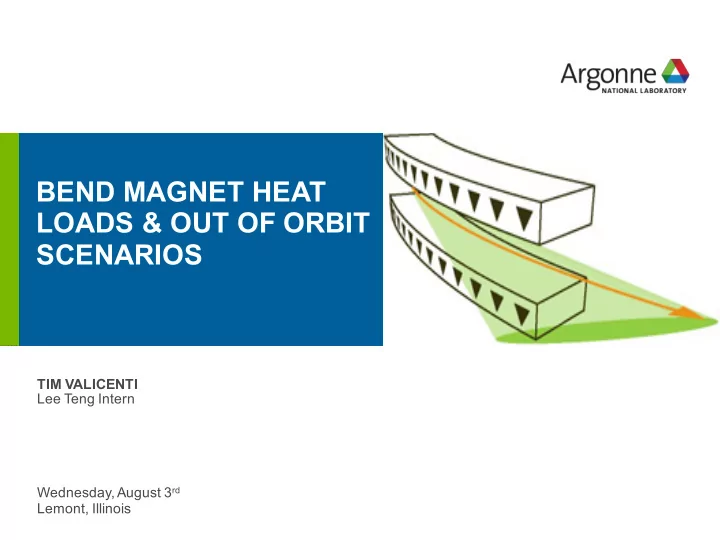
BEND MAGNET HEAT LOADS & OUT OF ORBIT SCENARIOS

d r h g f d j h n g n g f m h g m g h m g h j m g h f m f

TIM VALICENTI Lee Teng Intern Wednesday, August 3rd Lemont, Illinois
slide-2
SLIDE 2

OVERVIEW

slide-3
SLIDE 3

THE PROBLEM

This is an optimization problemโ€ฆ

3

  • What power distributions do the APS-U bend magnets emit?
  • Changing the position and orientation of absorbing surfaces can

reduce the peak intensity.

  • Important for the design of components under thermal stress

Y X Z

slide-4
SLIDE 4

TASKS

1. Find ideal path 2. Include orbit errors 3. Ray trace photons 4. Calculate heat loads 5. Verify results (SynRad)

4

slide-5
SLIDE 5

PROCESS

5

Lattice files from Elegant Ideal Particle Trajectory Missteering (Orbital Errors) Ray Tracing Power Distributions Optimization

slide-6
SLIDE 6

THEORY

slide-7
SLIDE 7

IDEAL PATH

Uses the parameterization of an arc of a circle along with a rotation matrix and a translation vectorโ€ฆ

7

๐‘จ(๐‘ข) ๐‘ฆ(๐‘ข) ๐‘ง(๐‘ข) = ๐œ sin ๐œ•๐‘ข ๐œ cos ๐œ•๐‘ข โˆ’ 1 ๐‘จ(๐‘ข) ๐‘ฆ(๐‘ข) ๐‘ง(๐‘ข) = ๐‘† 3(๐œ„) ๐œ sin ๐œ•๐‘ข ๐œ cos ๐œ•๐‘ข โˆ’ 1 ๐‘จ(๐‘ข) ๐‘ฆ(๐‘ข) ๐‘ง(๐‘ข) = ๐‘† 3(๐œ„) ๐œ sin ๐œ•๐‘ข ๐œ cos ๐œ•๐‘ข โˆ’ 1 + ๐‘ ฬ…8

slide-8
SLIDE 8

IDEAL PATH - VARIABLES

ยง ฮ”ฯด = ฮธ0 โ€“ ฮธ1: dipole kick. ฮธ1is used in the rotation matrix ยง ๐ถ =

โˆ†; ๐‘ด๐’‡๐’๐’‰๐’–๐’Š ๐ถ๐œ : uses the rigidity, length, and kick to get the B-field

ยง ๐‘ข = 0.. ๐‘ขD ๐‘ฅโ„Ž๐‘“๐‘ ๐‘“ ๐‘ขD =

๐’•๐‘ญ๐’๐’†๐Ÿ M๐’•๐‘ป๐’–๐’ƒ๐’”๐’–๐Ÿ Q

: the time for which the bunch travels ยง ๐œ =

RSTQ UTV : the radius of curvature

ยง ๐œ• =

W Q: effective frequency

ยง ๐‘ 

8 =

๐‘Ž8 ๐‘Œ8 : the initial position

8

๐’‚๐Ÿ, ๐’€๐Ÿ , ๐’•๐‘ญ๐’๐’†๐Ÿ ? , ? , ๐ญ๐“๐ฎ๐›๐ฌ๐ฎ๐Ÿ

๐œ€๐‘ก = ๐‘ก๐‘‡๐‘ข๐‘๐‘ ๐‘ข8 โˆ’ ๐‘ก๐น๐‘œ๐‘’k

๐œ„k

๐‘Ž8 = ๐‘Žk + ๐œ€๐‘ก โˆ— cos (๐œ„k) ๐‘Œ8 = ๐‘Œk + ๐œ€๐‘ก โˆ— sin (๐œ„k)

slide-9
SLIDE 9

MISSTEERING

Bolded values come from the lattice files; everything else is either a constant of the accelerator or are already calculated.

9

๐’n = ๐›ฟp๐‘ฆq + ๐œท๐’š๐‘ฆ๐‘ฆt + ๐œธ๐’š๐‘ฆtq ๐’n = ๐›ฟv๐‘งq + ๐œท๐’›๐‘ง๐‘ง + ๐œธ๐’›๐‘งtq

slide-10
SLIDE 10

VISUALIZATION OF LOCAL COORDINATES

The global and local y-coordinates are equal while the x-coordinates differ. xโ€™ is equivalent to dx/ds while yโ€™ is the vertical analog: dy/ds.

10

Y X Z x y s s x xโ€™ s y yโ€™

slide-11
SLIDE 11

RAY TRACING

One can use their knowledge of the absorbing plane as well as the location of the electron bunch to accurately calculate rays.

11

  • Consider the velocity vector at time step: t = ๐‘ขt
  • The equation for the ray leaving that point is: P d =

๐‘Ž(๐‘’) ๐‘Œ(๐‘’) ๐‘(๐‘’) = ๐‘’ ๐‘ก| ๐‘ก} ๐‘ก~ + ๐‘  ๐‘ขโ€ฒ

  • The equation for the plane is: ๐‘œ

โ‚ฌ โ€ข ๐‘„(๐‘Ž, ๐‘Œ,๐‘) โˆ’ ๐‘„

8 = 0

  • Substitute ๐‘„ ๐‘Ž,๐‘Œ, ๐‘ = ๐‘„(๐‘’) and solve for ๐‘’ to find the point on the plane

where the ray lands.

Y X Z x y s ๐‘œ โ‚ฌ

slide-12
SLIDE 12

POWER DISTRIBUTION

One must consider both the horizontal and vertical spread of power

12

  • Finding vertical spread on the absorber may be difficult but once done one

can find the angles each vertical ray makes with the zero-angle ray.

  • Use: ฦ’โ€žโ€ฆ

ฦ’;ฦ’โ€  = ๐‘„8 k kโ€ก}โ€ž ห†/โ€ž 1 + ล  โ€น }โ€ž kโ€ก}โ€ž , ๐‘Œ = ๐›ฟ๐œ„

  • where ๐‘„

8 ล’ Sโ€ขลฝ โ€ขโ€ž

โ„ = 5.421 โˆ— ๐นโ€ ๐ป๐‘“๐‘Š โˆ— ๐ฝ ๐ต โˆ— ๐ถ(๐‘ˆ)

  • If the vertical rays are known, their distances, D, can be calculated and the

intensity at each point on the plane can be converted as

k ลกโ€ž P ล’ Sโ€ขลฝโ€ขโ€ž

โ„ โ†’ ๐‘„ ล’

SSโ€ž

โ„

Y X Z x y s

๐œ„

slide-13
SLIDE 13

RESULTS

slide-14
SLIDE 14

MISSTEERING

User can enter which missteered paths they want to consider (alternatively the code has a default set of missteered paths). Note the y-axis scale.

14

X x y

slide-15
SLIDE 15

EXAMPLE

Shows the rays from 4 consecutive bend magnets โ€“ M3.1, M3.2, M2.5, M2.4 โ€“ hitting the B-crotch absorber.

15

M3.1 M3.2 M2.5 M2.4

slide-16
SLIDE 16

EXAMPLE

Shows the rays from 4 consecutive bend magnets โ€“ M3.1, M3.2, M2.5, M2.4 โ€“ hitting the B-crotch absorber.

16

M3.1 M3.2 M2.5 M2.4

slide-17
SLIDE 17

EXAMPLE

Shows the intensity from 4 consecutive bend magnets โ€“ M3.1, M3.2, M2.5, M2.4 โ€“ hitting the B-crotch absorber.

17

slide-18
SLIDE 18

VALIDATION WITH SYNRAD

18

The data matches very well

50 100 150 200 250 10 20 30 40 50 60 70 80 90

SynRad: 2.84 kW This software: 2.84 kW

slide-19
SLIDE 19

ADVANTAGES AND APPLICATIONS

  • ANALYTICAL FUNCTIONS ALLOW EASY INTEGRATION WITH OTHER

PROGRAMS SUCH AS COMSOL

  • STARTING WITH THE LATTICE FILES ONE GAINS FULL BUNCH

TRAJECTORIES BOTH IDEAL AND WITH ERROR

  • CAN USE ANY OF THESE TRAJECTORIES TO DETERMINE THE POWER

DISTRIBUTION.

  • CAN EASILY OPTIMIZE BY CHANGING POSITION AND NORMAL VECTOR OF

THE ABSORBING PLANE.

slide-20
SLIDE 20

ACHIEVEMENTS / FUTURE WORK

  • A more friendly UI (perhaps a GUI)
  • COMSOL Integration
  • More geometries of absorbers
  • Insertion device analogs
  • Calculated ideal paths via lattice files
  • Found missteered paths in 3 dimensions
  • Accurately ray traced arbitrary trajectories
  • Solved for the heat map on any given planar surface
  • Verified results with SynRad
slide-21
SLIDE 21

SUMMER EXPERIENCE

  • ATTENDED USPAS TO TAKE A FULL COURSE ON ACCELERATOR PHYSICS
  • LEARNED MORE THAN MOST ADVANCED E&M BOOKS COVER
  • GAINED INVALUABLE EXPERIENCE IN BOTH MATLAB AND COMSOL
  • HAD THE CHANCE TO MAKE AN IMPACT AT A PLACE LIKE ARGONNE

WHILE STILL A STUDENT

  • HIKED A MOUNTAIN
slide-22
SLIDE 22
slide-23
SLIDE 23
slide-24
SLIDE 24

www.anl.gov

ACKNOWLEDGEMENTS

A VERY SPECIAL THANKS TO KAMLESH SUTHAR FOR HIS GUIDANCE ON THIS PROJECT; TO JASON CARTER, JASON LERCH, KATHY HARKAY, AND ROGER DEJUS FOR THEIR INSIGHT ALONG THE WAY; AND ESPECIALLY TO PAT DEN HARTOG, ERIC PREBYS, AND LINDA SPENTZOURIS FOR GIVING ME THIS OPPORTUNITY AND ORGANIZING THE SUMMER 2016 STUDENT INTERNSHIPS.

slide-25
SLIDE 25

www.anl.gov

CITATIONS

  • CAPATINA, DANA. PRIVATE COMMUNICATION (2016).
  • CARTER, JASON. PRIVATE COMMUNICATION (2016).
  • CHAO, ALEXANDER WU., AND M. TIGNER. HANDBOOK OF

ACCELERATOR PHYSICS AND ENGINEERING. RIVER EDGE, NJ: WORLD SCIENTIFIC, 1999. PRINT.

  • DEJUS, ROGER. "POWER DISTRIBUTION FROM A DIPOLE SOURCE."

INTERNAL APS MEMO (2003): 1-8. PRINT.

  • EDWARDS, D. A., AND M. J. SYPHERS. AN INTRODUCTION TO THE

PHYSICS OF HIGH ENERGY ACCELERATORS. NEW YORK: WILEY, 1993. PRINT.

  • HARKAY, KATHERINE. "MAXIMUM BEAM ORBIT IN MBA AND RAY

TRACING GUIDELINES." 2ND SER. (2014): 1-9. PRINT.

  • SUTHAR, KAMLESH. PRIVATE COMMUNICATION (2016).