SLIDE 1
1
BELL RINGER
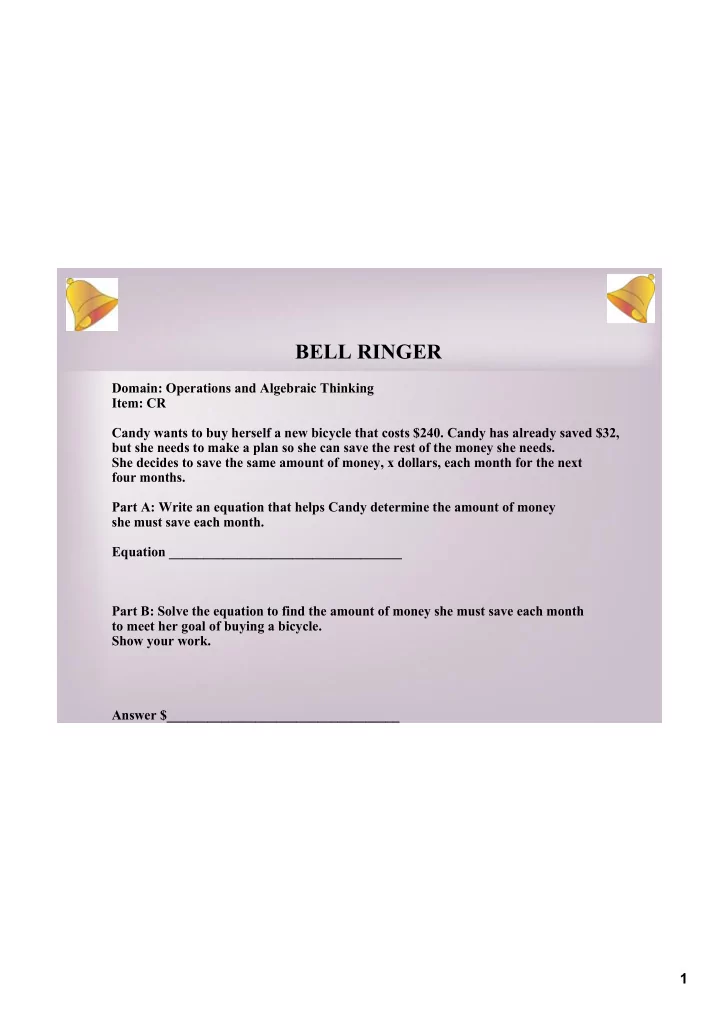
Domain: Operations and Algebraic Thinking Item: CR Candy wants to buy herself a new bicycle that costs $240. Candy has already saved $32, but she needs to make a plan so she can save the rest of the money she needs. She decides to save the same amount of money, x dollars, each month for the next four months. Part A: Write an equation that helps Candy determine the amount of money she must save each month. Equation __________________________________ Part B: Solve the equation to find the amount of money she must save each month to meet her goal of buying a bicycle. Show your work. Answer $__________________________________
SLIDE 2
2
A Brief History
1990s growing concern on the part of governors and business leaders were graduating from school unprepared for college or the workforce 2007 Council of Chief State School Officers and the National Governors Association began to develop national standards based on research and international models 2010 Final version of the CCSS for ELA and math were released 2012 Fortyfive states and 3 territories have adopted the CCSS *States adopting CCSS were able to add more standards
SLIDE 3 3
Why Common Core State Standards?
- Preparation: The standards will help prepare students with the knowledge and
skills they need to succeed in education and training after high school
- Competition: The standards are internationally benchmarked
- Equity: Expectations are consistent for all
- Clarity: The standards are focused, coherent, and clear
- Collaboration: Will create a foundation to work collaboratively across states and
districts, pooling resources and expertise, to create curricular tools, professional development, assessments and other materials
SLIDE 4
4
Main Design Principles CCSS for Mathematics
SLIDE 5 5
Standards define what students should understand and be able to do. Clusters summarize groups of related standards. Note that standards from different clusters may sometimes be closely related, because mathematics is a connected subject. Domains are larger groups of related standards. Standards from different domains may sometimes be closely related.
SLIDE 6
6
CCSS Mathematical Domains Counting & Cardinality Operations & Algebraic Thinking Number & Operations in Base Ten Number & Operations—Fractions Measurement & Data Geometry Ratios & Proportional Relationships The Number System Expressions & Equations Functions Statistics & Probability CCSS for Mathematical Practice Make sense of problems and persevere in solving them. Reason abstractly and quantitatively. Construct viable arguments and critique the reasoning of others. Model with mathematics. Use appropriate tools strategically. Attend to precision. Look for and make use of structure. Look for and express regularity in repeated reasoning.
SLIDE 7
7 http://engageny.org/sites/default/files/resource/attachments/nysmathemphaseskhs.pdf
Emphases in Common Core Standards for Mathematical Content Kindergarten ‐ High School
SLIDE 8
8
The Shifts
There are twelve shifts that the Common Core requires of teachers if we are to be truly aligned with it in terms of curricular materials and classroom instruction. There are six shifts in Mathematics and six shifts in ELA/ Literacy.
http://www.morriscs.org/files/1241289/shiftsforstudentsandparents.pdf
SLIDE 9
9
RESOURCES AND MATERIALS
http://www.morriscs.org/index.cfm
Questions?
SLIDE 10 10
GRADE
REQUIRED FLUENCY
K
Add/Subtract within 5
1
Add/Subtract within 10
2
Add/Subtract within 20* Add/Subtract within 100 (pencil and paper)
3
Multiply/divide within 100** Add/Subtract within 1000
4
Add/Subtract within 1,000,000
5
Multidigit multiplication
6
Multidigit division Multidigit decimal operations
7
Solve px + q = r, p(x + q) = r
8
Solve simple 2x systems by inspection
* By the end of the year, know from memory all sums of two onedigit numbers. **By the end of the year, know from memory all products of two onedigit numbers.