+ Thunderous Thursday 1. Come in, Quietly 2. Find your Assigned Seat - - PowerPoint PPT Presentation

thunderous thursday 1 come in quietly 2 find your
SMART_READER_LITE
LIVE PREVIEW

+ Thunderous Thursday 1. Come in, Quietly 2. Find your Assigned Seat - - PowerPoint PPT Presentation

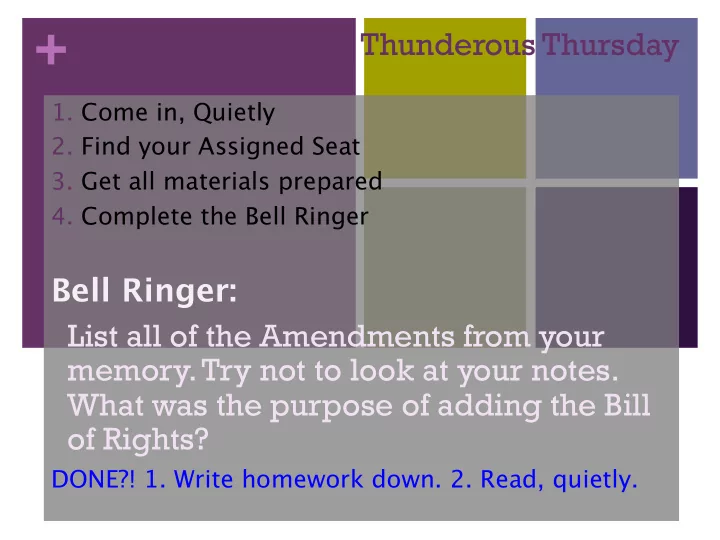
+ Thunderous Thursday 1. Come in, Quietly 2. Find your Assigned Seat 3. Get all materials prepared 4. Complete the Bell Ringer Bell Ringer: List all of the Amendments from your memory. Try not to look at your notes. What was the purpose of


slide-1
SLIDE 1

+

Thunderous Thursday

  • 1. Come in, Quietly
  • 2. Find your Assigned Seat
  • 3. Get all materials prepared
  • 4. Complete the Bell Ringer

Bell Ringer: List all of the Amendments from your

  • memory. Try not to look at your notes.

What was the purpose of adding the Bill

  • f Rights?

DONE?! 1. Write homework down. 2. Read, quietly.

slide-2
SLIDE 2

+

REVIEW

slide-3
SLIDE 3

+

Rule of Law Review

the rule of law cannot ever be entirely separate from the people who make up

  • ur government and our society. The

rule of law is more of an ideal that we strive to achieve, but sometimes fail to live up to.

slide-4
SLIDE 4

+Constitution Understanding

John Locke Thomas Jefferson James Madison

slide-5
SLIDE 5

+The Bill of Rights

n What rights are covered? n Why do these rights matter?

slide-6
SLIDE 6

+ Making the Foldable

  • 1. Follow carefully with
  • Ms. Lowman
  • 2. Draw the lines for

cutting each slit

  • 3. Label sections first
  • 4. Wait for further

directions

slide-7
SLIDE 7

+

slide-8
SLIDE 8

+

Fabulous Friday

  • 1. Come in, Quietly
  • 2. Find your Assigned Seat
  • 3. Get all materials prepared
  • 4. Complete the Bell Ringer

Bell Ringer: What questions about the project do you have? Explain your concerns and excitement around the project.

DONE?! 1. Write homework down. 2. Read, quietly.

slide-9
SLIDE 9

+

Individual Rights from Infringement

(1-3)

slide-10
SLIDE 10

+The first amendment—5 rights mentioned

n Freedom of Speech n Freedom of Religion n Freedom of the Press n Freedom of Assembly n Right to petition the government

slide-11
SLIDE 11

+Freedom of Religion

n “Congress shall make no law respecting an establishment of

religion or prohibiting the free exercise there of”

n Two clauses:

n Establishment clause n Free Exercise clause

slide-12
SLIDE 12

+ Establishment Clause—Government cannot promote religion

slide-13
SLIDE 13

+Free exercise of religion

slide-14
SLIDE 14

+Freedom of speech

n “Congress shall make no laws . . . abridging the freedom of

speech”

slide-15
SLIDE 15

+ Free speech– The individual can:

n Say any political belief n Protest (without getting out of control) n Say things about someone that are true n Burn the flag n Free speech means someone might say

something you disagree with

slide-16
SLIDE 16

+Free speech—limits on the person

n Threaten to blow up airplanes, schools or the president n Any form of harassment n Create too much social chaos n Extremely crude language in a public form n Disrespectful, vulgar language in schools n Hate crimes

slide-17
SLIDE 17

+Freedom of the press

n Congress shall make

no law . . . abridging . . . the freedom of the press.”

slide-18
SLIDE 18

+Freedom of the press-the press Can Cannot

n Print any political position n Make fun of people, especially

politicians

n Expose wrongs by the

government

n Say things you might not agree

with

n Libel– intentionally injuring a

person’s reputation by false facts

n Disclose defense-security

secrets

n Detail how to make a certain

weapons

slide-19
SLIDE 19

+Freedom of Assembly

n Congress shall make no law . . .

Abridging . . . The people to peaceably assemble”

slide-20
SLIDE 20

+ Freedom of Assembly--Individual Can Cannot

n Protest n Parade (with a

permit)

n Parade chanting

hate slogans

n Gang members

can congregate in public

n Protest by

throwing rocks and breaking windows

n Hang out on

private land against owners will—loitering

n Teen curfew

slide-21
SLIDE 21

+Petition the Government

n “Congress shall make no law . . .

Abridging . . . the people. . . to petition the government for a redress of grievances”

slide-22
SLIDE 22

+Petition the government

n You may sue the government for wrongs n You cannot be punished for exposing wrongs by the

government

n The courts decide the wrongs

slide-23
SLIDE 23

+2nd Amendment—Right to bear arms

n “A well-regulated militia, being necessary

to the security of a free state, the right of the people to bear arms shall not be infringed.”

slide-24
SLIDE 24

Gun debate continued

n Thousands of people

die every year because of guns

n Thousands of crimes

are prevented because of guns

Shoes representing gun deaths.

slide-25
SLIDE 25

Third Amendment

n The Government

cannot force you to shelter soldiers in your home without your consent in time of war or peace.

slide-26
SLIDE 26

Rights of Those Accused of Crime #4-8 Important to preserve freedom

slide-27
SLIDE 27

Fourth Amendment

n What does a

policeman need in

  • rder to search

your home?

n A warrant given to

him by a judge

n Probable cause is

also needed

slide-28
SLIDE 28
slide-29
SLIDE 29
slide-30
SLIDE 30

+5th Amendment

n The 5th Amendment protects people from

being held for committing a crime unless they are properly indicted, (accused)

n You may not be tried twice for the same

crime (double jeopardy)

n You don’t have to testify against yourself

in court. (Self-incrimination)

slide-31
SLIDE 31

Sixth Amendment

n Right to

speedy trial by impartial jury— meaning not favoring either side

slide-32
SLIDE 32

Sixth Amendment continued

n You must be told

  • f charges

n Bring n You must be

provided a lawyer if you cannot afford one

slide-33
SLIDE 33

+7th Amendment

n The 7th Amendment guarantees the

right to a speedy civil trial.

n A civil trial differs from a criminal

  • trial. A civil trial is when someone

sues someone else. A criminal trial is when the state tries to convict someone of a crime.

slide-34
SLIDE 34

Eighth Amendment

n No

excessive bail or fines

n No cruel

and unusual punishment

Prisoner kissing his Mom in prison

slide-35
SLIDE 35

+

Giving Power to the People and State

(9-10)

slide-36
SLIDE 36

+9th Amendment

n All rights not stated and not forbidden by

the Constitution belong to the people.

n This means that the states can do what

they want if the Constitution does not forbid it.

slide-37
SLIDE 37

+10th Amendment

n The 10th Amendment states that any

power not granted to the federal government belongs to the states or to the people.

slide-38
SLIDE 38

+

Amendment 13

Passed by Congress January 31, 1865. Ratified December 6, 1865.

n Section 1.

Neither slavery nor involuntary servitude, except as a punishment for crime whereof the party shall have been duly convicted, shall exist within the United States, or any place subject to their jurisdiction.

n Section 2.

Congress shall have power to enforce this article by appropriate legislation.

SLAVERY IS Abolished!!

slide-39
SLIDE 39

+

Amendment 19

Passed by Congress June 4,

  • 1919. Ratified August 18,

1920.

n The right of citizens of

the United States to vote shall not be denied or abridged by the United States or by any State on account of sex.

n Congress shall have

power to enforce this article by appropriate legislation. ALL citizens can VOTE.

First you had to be

  • 21. The voting age

changed by Amendment 26.

slide-40
SLIDE 40

+Rights

n A right is something that is

  • wed a person.

n At school, you have the

right to learn.

slide-41
SLIDE 41

+Responsibilities

n A responsibility is something a person

must do.

n I am responsible for being quiet while

the teacher is talking.

slide-42
SLIDE 42

+Rights or Responsibility?

n Can you list some rights you have? n Can you list some responsibilities you

have at home, at school, and on teams?

slide-43
SLIDE 43

+

slide-44
SLIDE 44

+What do you think?

n Provide evidence of other

nations’ view of human nature and how it impacts their government and citizens. (Ideas: Gaza, Israel, Hamas, Iraq, China, India, Germany, etc.)

slide-45
SLIDE 45

+Exit Slip n How is Founders’ human

nature demonstrated with the laws provided?

slide-46
SLIDE 46

+