Today- 10/4/11 Agenda Expectations Collect Labs Work quietly and - - PowerPoint PPT Presentation

today 10 4 11
SMART_READER_LITE
LIVE PREVIEW

Today- 10/4/11 Agenda Expectations Collect Labs Work quietly and - - PowerPoint PPT Presentation

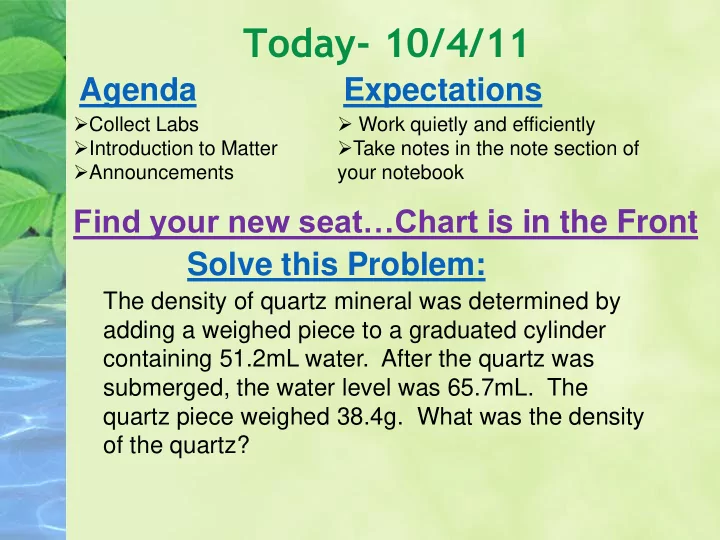
Today- 10/4/11 Agenda Expectations Collect Labs Work quietly and efficiently Introduction to Matter Take notes in the note section of Announcements your notebook Find your new seatChart is in the Front Solve this Problem:


slide-1
SLIDE 1

Today- 10/4/11

Agenda

  • Collect Labs
  • Introduction to Matter
  • Announcements

Expectations

  • Work quietly and efficiently
  • Take notes in the note section of

your notebook

The density of quartz mineral was determined by adding a weighed piece to a graduated cylinder containing 51.2mL water. After the quartz was submerged, the water level was 65.7mL. The quartz piece weighed 38.4g. What was the density

  • f the quartz?

Solve this Problem: Find your new seat…Chart is in the Front

slide-2
SLIDE 2

Matter

slide-3
SLIDE 3

Standard 5

Understand the structure of an atom in terms of its subatomic particles; isotopes and ions; differentiate between the classification and separation of matter (mixtures, pure substances…)

slide-4
SLIDE 4

Matter

Matter: Anything that has mass and takes up space.

slide-5
SLIDE 5

Building blocks of matter. Contains subatomic particles: Electrons Neutrons Protons

Atoms

slide-6
SLIDE 6

Subatomic Particles

Protons and electrons are the only particles that have a charge. Protons and neutrons have essentially the same mass. The mass of an electron is so small we ignore it.

slide-7
SLIDE 7

Symbols of Elements

Elements are symbolized by one or two letters.

C

12 6 Mass number (number of protons plus neutrons) Atomic number (number of protons) Resulting Charge Symbol of the Element

slide-8
SLIDE 8

Atomic Number C

12 6 Mass number (number of protons plus neutrons) Atomic number (number

  • f protons)

Resulting Charge Symbol of the Element

All atoms of the same element have the same number of protons

slide-9
SLIDE 9

Atomic Mass C

12 6 Mass number (number of protons plus neutrons) Atomic number (number of protons) Resulting Charge Symbol of the Element

The mass of an atom in atomic mass units (amu) is the total number of protons and neutrons in the atom.

slide-10
SLIDE 10

Determining Electrons

C

12 6 Mass number (number of protons plus neutrons) Atomic number (number of protons) Resulting Charge Symbol of the Element

In elements the # of protons = the # of electrons, so the element is electrically neutral and no charge is shown. However atoms can gain or lose electrons to become ions and the resulting charge is shown.

slide-11
SLIDE 11

Isotopes

  • Atoms of the same element with different

masses.

  • Isotopes have different numbers of neutrons.

11 6

C

12 6

C

13 6

C

14 6

C

slide-12
SLIDE 12

Practice

Symbol # of Protons # of Neutrons # of Electrons Net Charge

n

79 3+ 17 16 74 8

2-

36 I

115 49

As

75 33
slide-13
SLIDE 13

States of Matter

Deposition Sublimation

slide-14
SLIDE 14

Classification of Matter

slide-15
SLIDE 15

Classification of Matter

slide-16
SLIDE 16

Classification of Matter

slide-17
SLIDE 17

Classification of Matter

slide-18
SLIDE 18

Classification of Matter

slide-19
SLIDE 19

Classification of Matter

slide-20
SLIDE 20

Classification of Matter

slide-21
SLIDE 21

Classification of Matter

slide-22
SLIDE 22

Classification of Matter

slide-23
SLIDE 23

Classification of Matter

slide-24
SLIDE 24

Properties and Changes of Matter

slide-25
SLIDE 25

Properties of Matter

  • Physical Properties:

□ Can be observed without changing a substance into another substance.

  • Boiling point, density, mass, volume, etc.
  • Chemical Properties:

□ Can only be observed when a substance is changed into another substance.

  • Flammability, corrosiveness, reactivity with

acid, etc.

slide-26
SLIDE 26

Changes of Matter

  • Physical Changes:

□ Changes in matter that do not change the composition of a substance.

  • Changes of state, temperature, volume, etc.
  • Chemical Changes:

□ Changes that result in new substances.

  • Combustion, oxidation, decomposition, etc.
slide-27
SLIDE 27

Chemical Reactions

In the course of a chemical reaction, the reacting substances are converted to new substances.

slide-28
SLIDE 28

Chemical Separation of Matter Electrolysis

Compounds can be broken down into more elemental particles.

slide-29
SLIDE 29

Physical Separation of Mixtures

slide-30
SLIDE 30

Distillation:

Separates homogeneous mixture on the basis

  • f differences in

boiling point.

slide-31
SLIDE 31

Filtration:

Separates solid substances from liquids and solutions.

slide-32
SLIDE 32

Chromatography:

Separates substances on the basis of differences in solubility in a solvent.