
SLIDE 1
1
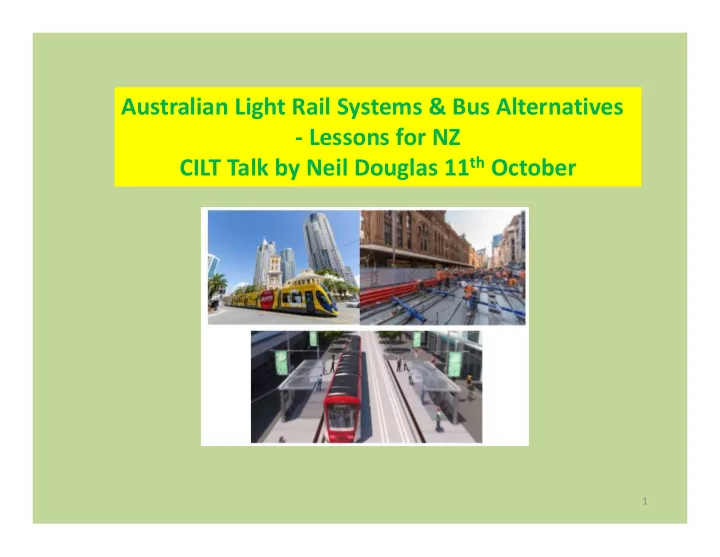
Australian Light Rail Systems & Bus Alternatives
- Lessons for NZ
CILT Talk by Neil Douglas 11th October
Australian Light Rail Systems & Bus Alternatives - Lessons for - - PowerPoint PPT Presentation
Australian Light Rail Systems & Bus Alternatives - Lessons for NZ CILT Talk by Neil Douglas 11 th October 1 DARWIN ATRF DEBATE LRT v BRT Oct/Nov 2018 BRISBANE GOLD COAST PERTH PARRAMATTA NEWCASTLE SYDNEY ADELAIDE MELBOURNE HOBART
1
Australian Light Rail Systems & Bus Alternatives
CILT Talk by Neil Douglas 11th October
GOLD COAST DARWIN
ATRF DEBATE LRT v BRT Oct/Nov 2018
HOBART MELBOURNE PERTH BRISBANE NEWCASTLE SYDNEY PARRAMATTA ADELAIDE
UK Docklands Light Rail - 1980s Land Use effects UK Manchester LRT - 1980s Patronage Forecasts (winning consortium) Midlands LRT – Market Research – UK DoT recommended basis for projects Phoenix LRT - 1980s Patronage Forecasting Wellington Heritage Tram 1995 Johnsonville Light Rail - Patronage Assessment Mid 1990s – Urban Consolidation Wellington Spine Study – Funding Analysis 2012-13 Sydney Pyrmont LRT Patronage Forecasting, Economic Evaluation, Impact on Buses Sydney NWTL - Patronage Review & Economic Evaluation (LRT one option) Sydney CBD LRT: Market Research, Patronage, Economic Evaluation ≈2000, 2004, 2012-14 Parramatta LRT – Review of Applicability of TfNSW Demand Forecasting Model 2016 LRT TfNSW Demand Forecasting of Short Trips & Time Period Modelling 2018 Melbourne – PT Information - Surveys of Tram, Bus and Rail Passengers Perth MAX 2013 Patronage Forecasting & Economic Evaluation Gold Coast LRT 2015 – Funding Study Auckland LRT 2015 – LRT Demand Parameters & Integrating Wider Economic Benefits Canberra June 2016 - Review of the Economic Evaluation for ACT Audit Office
3
4
Some of the Australian politicians who have made LRT happen (or not)
Malcolm Turnbull Ex Liberal Prime Minister on right who is keen on rail and who approved federal funding
Shown with QLD Premier are Annastacia Palaszczuk & Gold Coast Mayor Tom Tate after riding on the Gold Coast LRT (Photo Courier Mail).
NSW Premier Gladys Berejiklian Liberal on left Clover Moore Mayor of Sydney on right
Katy Gallagher ACT Labor on left & Shane Rattenbury Green Party Member for Kurrajong on right Keen cyclist Tony Abbot who was against federal funding of urban rail and pro road funding. In middle, WA Transport Minister who cancelled Perth MAX in 2016 before resigning. On right, Dr Mehreen Faruqi NSW Greens MP who opposed closure of heavy rail into Newcastle & LRT replacement.
5
How much does LRT infrastructure cost! Approx $100 million per km
6
Intersection of Brunswick and Wickham St with the two women walking across the tracks in non safety standard hats with man inspecting tracks Source: State Library of Queensland So much cheaper in the 1920s
7
So much cheaper in the 1920s Source: State Library of Queensland
8
single tram crossing at Gregory Terrace Source. Courier Mail So much cheaper in the 1920s and quicker to build
9
Sydney
10
So much more expensive 100 years later Blame the Americans? Fed Transit Authority funding standards precluded street-cars applications so engineers over-engineered light rail to be heavier than heavy rail!
11
Digging up George St Sydney “more electric/telecoms than another street in the world” and putting in 20cms of concrete and redoing utilities 100 metres up side streets Oct 2017 NJD
12
Near Central Station Photo 1 – October 2017 Eddy Avenue / Elizabeth St Traffic Disruption – and business disruption – Not included in the Business Case – “its a transfer of activity” But ≈$40 million class action by affected businesses.
13
Near to Central Station Photo 2 - November 2018 (Chalmers St) outside Devonshire Street Pedestrian Subway A year on in November 2018 and just a few metres up the road the Foundation work digging gets deeper.
14
Moor Park – not allowed to cut a corner off the park Traffic Disruption towards Randwick
15
Out near the Hospital.
16
Moore Park
17
Redoing the pipes - renewal should be a benefit in the CBA but is usually omitted
18
Parallels with Basin Reserve?
19
Surry Hills – disruption in suburbia
20
Concrete Foundations heading towards Depot
21
Still digging up George St May 2018
22
Interesting Fact: Free in the city centre Patronage increased markedly but survey estimate
23
Initially, tram ran from beach to Victoria Square, which is in the CBD but is not next to the retail heart. In 2000s, tram was extended to the Adelaide Railway Station, which was on the other side of the CBD. Doing so brought the line through the retail centre. A second stage extended the line beyond the railway to the Adelaide Entertainment Centre just past the
Entertainment Centre.
Peter Tisato So four ticks: getting closer to retail centre; and linking with central railway station; linking with key activity node; park-n-ride to maximise effectiveness.
24
Peter Tisato
25
A primary argument used to justify the tram extensions has been that they generated significant land use benefits, over-and-above transport benefits. As I understand it, they increase inner-city development relative to fringe development, with associated benefits. Unfortunately no analyses have been released to support the
little in the way of rigorous evidence-based support has been provided. And there are no ex-post studies yet to test the claims. So is the argument justified?
Peter Tisato
26
Peter Tisato
27
Peter Tisato
This is a question that continues to prick my mind. If buses are run in dedicated corridor like trams, why wouldn’t the supposed land use effects be similar? Even if the land use effects are a mirage, BRT is a fraction of the cost. I suppose the whole debate could change in foreseeable future if new technology trams come on stream at significantly lower costs.
54% were concerned about cost & affordability of LRT in 2016 survey of 1,192 respondents (phone call survey)
28
Public opinion surveys rather than demand forecast market research – a political project?
29
Lots of space for the LRT depot!
Cost Benefit Appraisal of LRT in Wellington versus Canberra
11kms 12kms
30
31
Gold Coast Light Rail Wellington: Interisland Terminal, Cake Tin / Cruise Liner, Railway Station, Cable Car, Te Papa Museum, Courtenay Place, Basin Reserve, Hospital, Zoo, Kilbirnie Shops, Kilbirnie Indoor Sports Arena, Airport. String of Pearls?
32
33
34
35
Broadbeach South
36
Well patronised tram back to Helensvale
37
infrastructure needing renewal; traffic interference in
dominance a pervasive issue.
Investment in higher capacity segregated Right of Way Light Rail has a lot more to do with land use development than transport Trackless tram = interesting new development
Graham Currie
38
Melbourne - How passengers rate their vehicles 2014 Survey by Douglas Economics & Sweeney Research
39
Melbourne - How passengers rate their vehicles 2014 Survey Douglas Economics/Sweeney
40
Melbourne - How passengers rate their vehicles 2014 Survey Douglas Economics/Sweeney
41
Worst Train better than Worst Bus Top Train slightly better than Top Bus
42
Tom Frost – Transport Economics
Director Brisbane
43
risks are high when you don’t know where all the pipes/wires are.
grounds alone, but if they integrate into the transport network i.e. reduce the number of buses and/or allow them to offer more services, they might stack up on transport grounds alone.
been made with the implicit assumption that it will
exception of Canberra (where the government owned much of the land adjacent to the corridor and combined the project with major land use changes) these are difficult to identify.
44
If you are considering an LRT for Wellington because of the perception that it is ‘popular’ you should talk to the people to understand what attributes of a LRT service makes it popular. Make sure that whatever is built provides those attributes. Melbourne is always talked about as the shining light of tram services but these services are on - street services with relatively low capital cost stops. Almost all the new LRT services have much larger more expensive ‘stations’ and these stations lose one of the key perceived benefits of the Melbourne services, which is ‘ease of access’. I would argue that some of the new LRT systems have characteristics which are closer to heavy rail than Melbourne trams and would question whether this is what people were thinking of when they agreed that it was a good idea to build an LRT in first place.
45
Surprisingly cheap to build! $55m for 9kms (existing track) Unusual demand forecasting approach No transfer penalty from bus to LRT and its economic
46
47
BRT has been chosen rather than LRT because of:
Principal Engineer Policy and Strategy BCC
48
BRT has more flexibility in being incorporated into existing street environments (particularly the narrow street environments common in Brisbane, Auckland & Wellington).
BRT has better ability to integrate with traditional bus services so both modes get a benefit. There was a study done by the QLD State Government a few years ago to look at the feasibility of converting the South East Busway to LRT. It found that mixing buses with trams caused a number of operational inefficiencies.
49
Do not have to completely dig up the streets to relocate services and lay track. Works for BRT consists of pavement strengthening only if required.
LRT is limited to being dependent on overhead wiring or third rail traction. BRT can use overhead, electric battery, diesel hybrid, diesel.
A key cost element for an LRT system in Brisbane is the strengthening required on the Victoria Bridge to get trams across the river.
50
Peter Newman
Curtin Uni Perth Stirling
51
“Wellington needs light rail as always. My views have not changed on this but they have changed on the technology to do this and I now believe that a Trackless Tram will do everything I always wanted to achieve with light rail but at one tenth of the price. The TT has six innovations in it from High Speed Rail put into a bus and this makes it a completely different transit system. It has the ride quality of light rail and will attract development around it as occurs with LRT but not BRT. This means it could be paid for by developers in a partnership and we have the first of these being set up now in Australia. It does not destroy the street economy for several years during construction and can be implemented very quickly using a Bus Depot and main roads Control Centre. It has a gradient of 13% rather than 6% with LRT which is very relevant to Wellington”
52
“If you want documentation on any of this I can provide it but the two small videos in this presentation are very powerful”. Reflections on China Trip. And this table summarizes my views…
Peter Newman 11th Oct 2018 Via email
53
Trackless Tram Fixed v Flexible? = Fixed says Peter Newman $5 million versus $50 million for LRT per km $3 - $4 million per set No construction disruption In over a ‘weekend’? CRRC – 1930s Rail Co. 18,000 staff Xi Jenpeng President HSR technology – stabilisers, hydraulic double axles GPS Optics to keep it ‘on track’, Special tyres Battery electric 50kms/recharge takes 10 mins Lighter 9t v 17t for a bus Feels like Light Rail – looks like Light Rail… And can go around an accident Note claims are far from universally accepted
54
Peter Newman 11th Oct 2018 Via email
55
The trial route in Zhuzhou is 6.5 kilometres in length The AKL LRT route from Wynyard to the Airport for example is significantly longer (22km). The operation and longevity of the batteries for longer routes similar to the City to Airport route in Auckland is not yet proven.
56
57
The CBD - Randwick route was a former tram route and heavily patronised So in principle, implementation should have been straightforward. That’s if the traditional route via Anzac Parade - Oxford Street & Elizabeth Street had been retained!
But the route was complicated to satisfy route change priorities
e.g. via George Street through the CBD and to serve the Cricket & Football Stadiums & Racecourse.
Dr Tim Brooker
58
Dr Tim Brooker Sydney Transport Planner
59
The implemented route is half of the length of the main corridor to La Perouse & 85% of the route of the secondary corridor to
distance trips.
So most of the longer distance passengers will still need through buses to & from the CBD but this will be necessary anyway because the LRT peak hour capacity is only sufficient to serve the inner end of the route while providing passengers with a reasonable degree of comfort (i.e. avoiding overcrowding).
Tim Brooker
60
There were contractual issues with the implementation mainly with the relocation of electricity infrastructure and
and delays from which have been much greater than originally budgeted for, with flow on impacts for business along the roads where construction has taken longer than anticipated.
Tim Brooker
61
and was involved with Sydney CBD – SE LRT
Matters considered for CBD-SE Light Rail were like any other major infrastructure project
https://arp.nsw.gov.au/sites/default/files/TPP17-03_NSW_Government_Guide_to_Cost-Benefit_Analysis_0.pdf
Level of scrutiny reflected the size of the project Matters of interest were: Base Case – what happens without LRT? Projects linked to LRT in the CBA e.g. George St Pedestrianization? Construction cost risk? Is it P50 or P90? What escalation is used? How does George St with its major electrical and telecoms cabling get considered? Is there disruption to business and traffic during construction and flow-on economic impacts? Is an appropriate impact included the CBA? Operational costs and comparison with bus – relevant for ongoing funding support Revenue assessment and patronage diversion - how much traffic would be ‘new’ Operational impacts – how is overall road traffic capacity and performance affected? ‘User Benefit’ is a major benefit but its less tangible & reflects input values of time How reasonable are the LRT ‘time savings’? What benefit is there from LRT over a bus and does it justify subsidy?
Strategic Model Project Model G
(Gen- eration)
D
(Dist- ribution)
M
(Mode Split)
A
(Assign- ment)
Land Use Population Socio-economic & demographics Trip Data Freight Data Travel Times & Costs
Growth Factors M
(Mode Split)
A
(Assign- ment)
Observed Trip Data
Sydney ≈ Wellington ≈ Auckland Models
62
Walk Time Access & Egress Time Service Frequency Waiting Time & Timetable Inconvenience Transfer Connection Time In-vehicle Time Crowding at stops & on vehicle Quality of Stops & Stations Quality of Vehicles Fare Travel Time Reliability Value
Time $/hour Perceived Generalized Cost of Travel Intrinsic Modal Preference Time in Actual Minutes Travel Time Weights & Penalties Transfer Penalty
Calculating Generalised Travel Times
63
6,710 Responses 2013
64
65
Sydney public transport users view of their own mode
66
67
68
Sydney public transport users view of bus, LRT and rail
Source LRT Advantage
for a 25 minute trip Implied IVT Multiplier
Comment
Australian TransportCouncil Guidelines 2006
7.5
0.70
Based on a 2001 review for Auckland Regional Council. Incorporates a 2 min constant and 5.5 minute travel time
an IVT multiplier of 0.7 multiplier for a 25 minute trip.
Douglas Review 2014
5
0.81
Estimated at 25 minutes. Based on a review of 15 studies with no significant difference between rail & LRT.
US Federal Transit Authority
5
0.80
Recommended parameter for commuter rail versus bus for 'Quality Control' modelling.
UK Tram Wardman Review
10
0.60
Average of ten UK studies. Trip length was not reported. 25 minutes assumed.
Sydney Market Research Douglas
4
0.84
Separated out intrinsic (-2.8 mins) preference from quality (-1.3 mins) preference.
Median
5
0.80 Mean
6
0.75
Value of LRT compared to Bus
69
70
Transfer Penalty = 5 minutes Rail - LRT = 8 minutes to/from Bus
Wait time 1.5 x in-vehicle time so 5 minute transfer Rail to LRT = 5 + (5 x 1.5 )= 12.5 minutes 5 minute transfer Rail to Bus = 8 +(5 x1.5) = 15.5 minutes
Crowding – increases ‘cost’ of onboard time…. With LRT having greatest load factor (Pax/Seats)
Cost of unreliability Valued 3 times worse than ‘planned’ time Other findings from Sydney Study
71
Very Few before and after studies Croydon TfNSW Walk Trips to LRT – CBD Hop On Hop Offs
72
73
Parramatta Light Rail
May 2015 BCR = 0.73, July 2015 0.66 – 1.06 with WEBs Construction blow out from $1 billion allocated so 2 Stage Dev. Stage 1: 12kms Walk distance between Parramatta rail station & Light rail stop Enforced transfer for Carlingford Line– Sydney CBD passengers
Circuitous route around Parramatta Park High car use by medical staff visitors
Stage 2 9kms LRT catalyst for redevelopment of housing/business
PARK Parramatta Westmead Carlingford Camelia Olympic Park “The light rail corridor will activate a priority growth area and there is an
share in the value uplift that will
Infrastructure Contribution will be implemented, with the levy expected to be set at around $200 per square metre of gross floor area of new residential developments subject to consultation.” TfNSW 2015
BUT Value Capture has practical issues
74
75
NJD Oct 2017 Hamilton Station – transfer to temporary shuttle bus
76
NJD Oct 2017 Temporary Bus Shuttle Hamilton – Newcastle CBD (free)
77
Newcastle Bus Shuttle from Hamilton – until LRT operation
78
NJD Oct 2017 Marking out where the utilities are
79
NJD Oct 2017 What will happen to the disused stations?
80
NJD Oct 2017 Stockpiling the plastic pipes
81
NJD Oct 2017
82
September 17th 2018 – completion of 350m section on budget/time Parliamentary Secretary for the Hunter Scot MacDonald said today was the first day towards the future of Newcastle.
Some good news from TfNSW “We’ve connected Newcastle to its harbour after the heavy rail corridor acted like the Berlin Wall for more than 100 years. Today workers, tourists and families can freely move between the waterfront and the city centre to create more foot traffic and more activity for businesses,” Mr MacDonald said. “Newcastle’s light rail is Australia’s first and only completely wire- free system, and along with the city scape upgrades and landscaping Newcastle is getting the attractive urban space it needs to thrive.
83
Some final thoughts LRT construction costs ludicrously expensive – so difficult to see how LRT can be justified. Why? LRT US ‘20cms of concrete’ instead of German standards? Disruption costs severe. 2 years for Lambton Quay? Each Australian city has differences in ‘context’, priorities, requirements for their public transport system but same old arguments: Steel v rubber wheels, fixed v flexible, diesel/electric Technology is developing rapidly: wireless electricity, lighter batteries, optic guidance, stabilisation, rubber wheels, driverless…. Don’t lead technology but be receptive to it. So Don’t be the first and don’t be the last with technology! The Capacity Problem: Do we want hundreds of thousands more people living in Australasian cities? ‘Business Cases’ should be OPEN not SECRET (NZ pretty good here) but focus reports on the important numbers not waffle.
84
85