Audubon Coastal Bird Survey A Call for Standardized Monitoring - - PowerPoint PPT Presentation

audubon coastal bird survey
SMART_READER_LITE
LIVE PREVIEW

Audubon Coastal Bird Survey A Call for Standardized Monitoring - - PowerPoint PPT Presentation

Photo: Gerry Ellis Audubon Coastal Bird Survey A Call for Standardized Monitoring Outline of Topics History of Audubon Coastal Bird Survey (ACBS) Brief summary of 2010-2011 analysis Update on survey protocol Data entry and data


slide-1
SLIDE 1

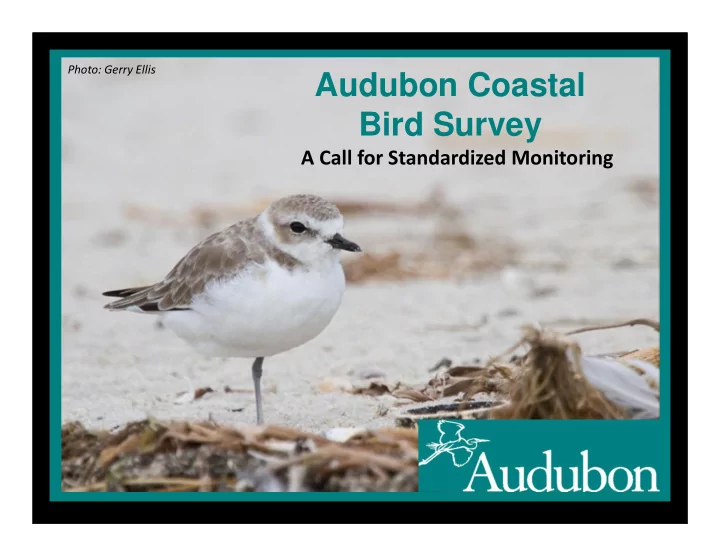
Audubon Coastal Bird Survey

A Call for Standardized Monitoring

Photo: Gerry Ellis
slide-2
SLIDE 2

Outline of Topics

  • History of Audubon Coastal Bird Survey (ACBS)
  • Brief summary of 2010-2011 analysis
  • Update on survey protocol
  • Data entry and data sharing
  • Bird ID (plovers and some sandpipers)

and counting tips

slide-3
SLIDE 3

What is ACBS?

  • A volunteer-based bird survey that has been

designed to maximize the scientific value of bird-watching data

Volunteers learning survey protocols after the BP oil spill A group of Sanderlings at Grand Isle, LA

slide-4
SLIDE 4

ACBS History

  • Dr. Mark LaSalle of Pascagoula River Audubon

Center in Moss Point, MS, developed and launched ACBS in June 2010 in response to the BP oil disaster

  • The protocol for surveying for oiled birds was

developed by Jared Wolfe and Erik Johnson, at LSU, based on U.S. Fish & Wildlife Service oil assessment standards

Miche Walsh and Bart Siegel staring in disbelief at a mat of oil

slide-5
SLIDE 5

Species List of Oiled Birds

Sandpipers and Plovers

  • American Oystercatcher
  • Wilson’s Plover
  • Semipalmated Plover
  • Black-bellied Plover
  • Willet
  • Sanderling
  • Dunlin
  • Western Sandpiper
  • Semipalmated Sandpiper
  • Ruddy Turnstone

Waders

  • Great Egret
  • Great Blue Heron
  • Snowy Egret
  • Tricolored Heron
  • Reddish Egret
  • Cattle Egret
  • White Ibis

Gulls and Terns

  • Laughing Gull
  • Herring Gull
  • Least Tern
  • Royal Tern
  • Caspian Tern
  • Sandwich Tern
  • Forster’s Tern
  • Common Tern
  • Black Skimmer

Other

  • Brown Pelican
  • American White Pelican
  • Osprey
  • Northern Gannet
slide-6
SLIDE 6

ACBS History

  • By November 2010, few oiled birds were still

being seen

  • Subsequently, the program has been

transitioning into a survey for understanding coastal bird populations in space and time

Birds along a beachfront at Grand Isle, LA. How many Laughing Gulls can you count?

slide-7
SLIDE 7

ACBS Moving Forward

  • The timing of surveys have been modified to align

with the International Shorebird Survey (ISS), which provides the best source of information for tracking migratory shorebird populations

  • Breeding Bird Survey and Christmas Bird Count

data have limited value for understanding some waterbird population trends

– ACBS can do this!

slide-8
SLIDE 8

Summary of 1st year

  • 247 surveys at 24 sites!
  • 160 species!
  • >60,000 individual birds counted!

A survey team at Graveline Beach near Ocean Springs, MS (photo: Janet Wright) Willet at Grand Isle, LA

slide-9
SLIDE 9

Seasonal Patterns

Pulse during post-breeding dispersal

slide-10
SLIDE 10

Relating Bird Density to Land Use

slide-11
SLIDE 11

Relating Bird Density to Land Use

Land Use Ocean Springs Pascagoula Beach % Developed 22.5 95.2 % Forest 15.6 1.5 % Wetland 53.3 2.2

Do this for all 24 sites and…

slide-12
SLIDE 12
slide-13
SLIDE 13

ACBS Protocol Changes

  • Shorter intervals between surveys

– Fall: 6 surveys over 10 weeks (10 Aug – 20 Oct) – Winter: 3 surveys over 5 weeks (15 Jan – 20 Feb) – Spring: 6 surveys over 10 weeks (20 Mar – 30 May) – Ideally every 10 days, on the 5’s (Aug 15, 25, Sep 5, etc.), but +/- 3 days is fine

slide-14
SLIDE 14

ACBS Protocol Changes

  • Why shorter intervals between surveys?

– Aligns with International Shorebird Survey (ISS) protocol, which provides the best data we have for tracking most shorebird populations – The Gulf Coast has historically had little ISS coverage; ACBS will fill that void – If 6 surveys can not be completed, there is still value for conducting fewer surveys

slide-15
SLIDE 15

ACBS Protocol

  • Maintain as much consistency between

surveys as possible

  • Best to survey during periods of low human

activity, like early morning

  • Count all birds within ¼ mi, including the start

and end of transect points

– Google Earth can help you identify landmarks to estimate ¼ mi

slide-16
SLIDE 16

eBird Data Entry

  • www.ebird.org
slide-17
SLIDE 17
  • 1. All ACBS participants can view coverage and checklists online

at http://tinyurl.com/ACBS2011

  • 2. Area leaders are responsible for updating the spreadsheet

with survey information and links. Contact Dustin, the program manager, at drenaud@audubon.org for instructions.

  • 3. When in doubt, refer to the “Sharing Your Data” document

that will be emailed to you after this presentation or is available online at http://gulfoilspill.audubon.org/audubon- coastal-bird-survey.

Sharing Your Data

slide-18
SLIDE 18

Target Species of Concern

Dave Patton

Reddish Egret American Oystercatcher Marbled Godwit Piping Plover Black Skimmer Snowy Plover Wilson’s Plover Sanderling Red Knot

Bill Stripling Gregory Breese/USFWS Thomas Halverstadt

slide-19
SLIDE 19

Coastal Bird ID

  • Go beyond field guides

– LSU Bird Resource Center has Lowery (1974) seasonal graph for LA birds (similar to MS and AL)

http://appl003.lsu.edu/natsci/labirdweb.nsf/$Content/Lowery+Graph/$File/Lowery+Seasonal+Graph2.pdf

– eBird can produce output to look at seasonality in your area

  • Plumages do not necessarily follow “summer”

and “winter” seasons

– be familiar with all plumages at all times of year

slide-20
SLIDE 20

Richard Gibbons

Piping Plover Wilson’s Plover Snowy Plover Semipalmated Plover

1. Leg color (orange or grayish/brownish?) 2. Bill shape (heavy, medium, thin?) 3. Back color (pale grayish or brown?)

Small Plovers

Bill Stripling Gary Ellis

slide-21
SLIDE 21

“Peeps”: Sanderling

Become familiar with Sanderlings. They are often seen chasing waves, running to and from the shoreline with each wave. This will be the default small sandpiper on sandy beaches. In fall, they are molting from a brick red color to a sandy gray.

slide-22
SLIDE 22

“Peeps”: Dunlin

Breeding plumage distinctive Winter plumage like an overgrown Western Sandpiper (about the size of a Sanderling), but bill is extra long

John B./flickr

slide-23
SLIDE 23

Small “Peeps”

Sanderling Western Sandpiper

Western, Semipalmated, and Least Sandpipers are smaller than Sanderlings and Dunlin, and are common on beaches and mudflats.

  • Never rely on 1 character to ID
  • Use a suite of characters including leg

color, bill shape/length, overall structure and plumage

  • With practice, the “hunched” foraging

style of Least Sandpipers can clinch ID at great distance

  • If unsure, report “peep sp.”
slide-24
SLIDE 24

Western Sandpiper Semipalmated Sandpiper Least Sandpiper

  • Yellow legs (appear dark if covered in mud)
  • Thin, slightly curved bill
  • Rich brown back
  • Hunch-backed when foraging, rarely lifting

head up

  • Dark legs
  • Bill averages shorter and less curved than

Western

  • Medium brown back
  • Dark legs
  • Bill averages longer and more curved than

Semipalmated

  • Medium brown back
  • Adults and juveniles are different enough to compound the ID challenge
  • Juveniles arrive in fresh plumage, meaning the crisp edging to back and wing feathers is not worn off
  • Adults arrive ratty and worn. By winter, juveniles and adults look the same.

Adult Juvenile

Bill Stripling Dave Patton

slide-25
SLIDE 25

“Peeps”: Red Knot

breeding winter

  • Peep-like, but bulky (> Sanderling and < Willet)
  • About size of dowitcher, but note shorter bill and different

foraging style

  • Beware of less common Calidris sandpipers (Stilt Sandpiper,

Pectoral, Baird’s, White-rumped)

Gregory Breese/USFWS Gregory Breese/USFWS

slide-26
SLIDE 26

Solutions for ID Challenges

  • Important to have a count of all birds, even if

some must be left unidentified

  • Use broader taxonomic groupings:

– Short/Long-billed Dowitcher, Lesser/Greater Yellowlegs, Greater/Lesser Scaup sp., Western/Semipalmated Sandpiper – peep sp., tern sp., gull sp., shorebird sp., white egret sp.

  • Email Erik a photo (ejohnson@audubon.org)
slide-27
SLIDE 27

Counting Birds

CHALLENGES

  • There are too many!
  • Birds won’t hold still!
  • They are all mixed up!
  • …I give up… (no!!)

SOLUTIONS

  • Record as you go in a notebook
  • r data sheet
  • Estimate large groups, counting

by 5, 10, 25, 50, 100, or other convenient groupings

  • Multiply; a flock of 10 tall by 10

wide = 100

  • Divide; use percentages of a

total estimate

– Example: of 500 birds…

  • 10% were Sanderlings = 50
  • 70% were Dunlin = 350
  • 20% were Least Sandpipers = 100
  • Do the best you can
  • Do the best you can

http://ebird.org/content/ebird/news/bird-counting-101 http://ebird.org/content/ebird/news/bird-counting-201

slide-28
SLIDE 28

Thank You!

Contacts

  • Dustin Renaud, Volunteer Programs Manager

– drenaud@audubon.org

  • Erik Johnson, Conservation Biologist*

– ejohnson@audubon.org

  • Mark LaSalle, Director of Pascagoula River

Audubon Center

– mlasalle@audubon.org

* Source of uncredited photographs