Atom to Transistor, 2 1 Reference: QTAT, Chapter 1. Cambridge - - PowerPoint PPT Presentation

atom to transistor 2 1 reference qtat chapter 1 cambridge
SMART_READER_LITE
LIVE PREVIEW

Atom to Transistor, 2 1 Reference: QTAT, Chapter 1. Cambridge - - PowerPoint PPT Presentation

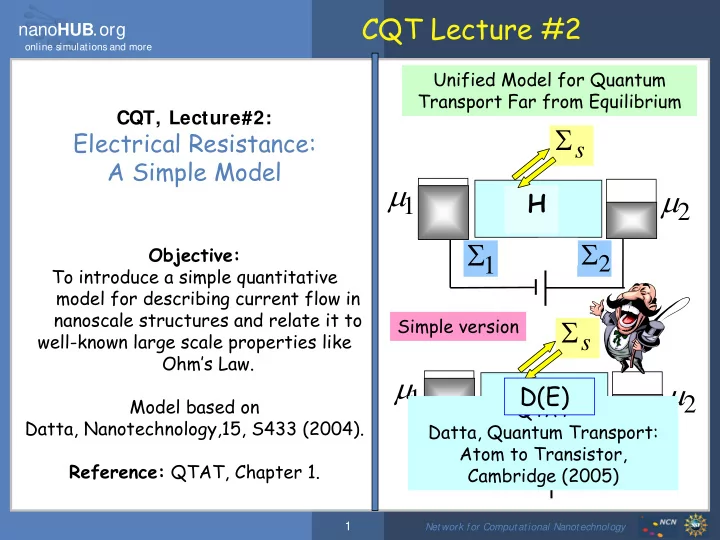
CQT Lecture #2 nano HUB .org online simulations and more Unified Model for Quantum Transport Far from Equilibrium CQT, Lecture#2: s Electrical Resistance: A Simple Model 1 2 H 1 2 Objective: To introduce a simple quantitative


slide-1
SLIDE 1

nanoHUB.org

1

  • nline simulations and more

Network for Computational Nanotechnology

D(E)

1

γ

2

γ

μ1 μ2

Σs

H

Σ1

Σ2

μ1 μ2

Σs

CQT Lecture #2

Unified Model for Quantum Transport Far from Equilibrium

CQT, Lecture#2:

Electrical Resistance: A Simple Model

Objective: To introduce a simple quantitative model for describing current flow in nanoscale structures and relate it to well-known large scale properties like Ohm’s Law. Model based on Datta, Nanotechnology,15, S433 (2004). Reference: QTAT, Chapter 1. “QTAT” Datta, Quantum Transport: Atom to Transistor, Cambridge (2005) Simple version

D(E)

slide-2
SLIDE 2

nanoHUB.org

2

  • nline simulations and more

Network for Computational Nanotechnology

Equilibrium Energy Level Diagram

VG

V = 0

CHANNEL D S

I

<-- L --> Vacuum Level

  • 0.2

0.2 0.4 0.6 0.8 1

  • 0.25
  • 0.2
  • 0.15
  • 0.1
  • 0.05

0.05 0.1 0.15 0.2 0.25

E

Fermi function

f (E) Channel

VG > 0

n-type

VG < 0

p-type

No states

FILLED EMPTY S D

slide-3
SLIDE 3

nanoHUB.org

3

  • nline simulations and more

Network for Computational Nanotechnology

What makes electrons flow?

µ2 µ1

VG VD

CHANNEL D S

I

µ1 µ2

VG VD

CHANNEL D S

I

> 0

slide-4
SLIDE 4

nanoHUB.org

4

  • nline simulations and more

Network for Computational Nanotechnology

Escape rate

µ1 µ2

  • /

1

γ

2 /

γ

  • Rate

Escape : / γ

has dimensions of energy γ

S Channel D

γ 1

Small

slide-5
SLIDE 5

nanoHUB.org

5

  • nline simulations and more

Network for Computational Nanotechnology

Current through a very small conductor

S Channel D

V

  • 0.2

0.2 0.4 0.6

  • 0.2

0.2 0.4 0.6 0.8 1

Normalized Current

V ⇒

µ1 µ2

V I

  • /

1

γ

1 /

γ

  • μ1

μ2

slide-6
SLIDE 6

nanoHUB.org

6

  • nline simulations and more

Network for Computational Nanotechnology

  • 0.2
  • 0.1
0.1 0.2 0.3 0.4 0.5 0.6 0.7
  • 0.2
0.2 0.4 0.6 0.8 1

What is Conductance ?

Normalized Current

V ⇒

  • 0.2
  • 0.1
0.1 0.2 0.3 0.4 0.5 0.6 0.7
  • 0.2
0.2 0.4 0.6 0.8 1

Normalized Conductance

qγ1 2

q T k q V d I d / 4 2 / ~

1

  • γ
  • /

1

γ

γ1 /

μ1

μ2

0.2 0.4 0.6 0.8 1
  • 0.1
  • 0.08
  • 0.06
  • 0.04
  • 0.02
0.02 0.04 0.06 0.08 0.1 0.2 0.4 0.6 0.8 1
  • 0.1
  • 0.08
  • 0.06
  • 0.04
  • 0.02
0.02 0.04 0.06 0.08 0.1

empty full

slide-7
SLIDE 7

nanoHUB.org

7

  • nline simulations and more

Network for Computational Nanotechnology

  • 0.2
  • 0.1
0.1 0.2 0.3 0.4 0.5 0.6 0.7
  • 0.2
0.2 0.4 0.6 0.8 1
  • 0.2
  • 0.1
0.1 0.2 0.3 0.4 0.5 0.6 0.7
  • 0.2
0.2 0.4 0.6 0.8 1

Conductance quantum

Normalized Current

V ⇒

Normalized Conductance

  • /

1

γ

1 /

γ

  • μ1

μ2

q T k q V d I d / ) 4 2 ( 2 / ~

1 1

+ γ γ

  • ~

q2 /4 if γ1 >> k T

2

Conductance quantum ~ / 2 ~ 1/ 25.8 q K π Ω

  • qγ1

2

slide-8
SLIDE 8

nanoHUB.org

8

  • nline simulations and more

Network for Computational Nanotechnology

Conductance: The bottom line

  • 2

Transmission Conductance Quantum

2 q I D V π γ π =

  • I

~ qγ 2

Current per state

  • D qV

Number

  • f states
  • D: Density
  • f states

µ1

  • /

γ

qV

µ2

  • /

γ

D

slide-9
SLIDE 9

nanoHUB.org

9

  • nline simulations and more

Network for Computational Nanotechnology

Bottom to Top: A Short-cut

γ π π D q V I

  • 2

2

=

  • 3

3

/ /

) ( ) (

nm nm eV eV

AL E N E D

=

µ1

  • /

γ

µ2

  • /

γ

Cross-section A ; Length L

D(E) <---- L ---->

  • /

γ

  • /

γ

L A D L / ~ 2 ~

2

γ γ → D

  • A

D L v ~ ~ γ γ →

  • Will show that
slide-10
SLIDE 10

nanoHUB.org

10

  • nline simulations and more

Network for Computational Nanotechnology

Ballistic vs. Diffusive channels

γ γ

<-------- L -------->

time Transit L L n L n electrons Stored Flux

L L

/ 1 ~ 2 2 / / ~

2

= = = = D D

  • γ

nL

x L n Flux ∂ ∂ D ~ − = ⇒

Ballistic

γ γ

<-------- L -------->

Diffusive

time Transit L L n v n electrons Stored Flux

L L

/ 1 = = = = ν γ

  • nL

v n Flux

L

= ⇒

slide-11
SLIDE 11

nanoHUB.org

11

  • nline simulations and more

Network for Computational Nanotechnology

Drift-diffusion equations

γ D q V I

  • 2

2

=

Diffusive transport

V

CHANNEL D R A I N S O U R C E

I

<---- L ---->

= (A/L) q n μ

D = N0 AL

2

~ 2 L D

  • =

γ

IV = (A/L) q2 N0 ˜ D

Non-degenerate

→ (A/L) q2 n kBT ˜ D q T kB = μ D ~

Einstein Relation : conductivity

slide-12
SLIDE 12

nanoHUB.org

12

  • nline simulations and more

Network for Computational Nanotechnology

Transmission

2 Transmission Conductance quantum

2 q I D V π γ π =

  • D(E = ε)

= 1/π γ

1 = γ π D

D(E) = γ /π (E −ε)2 + γ 2

One broadened level :

0.5 1 1.5 2 2.5 3 3.5

  • 0.2
  • 0.15
  • 0.1
  • 0.05

0.05 0.1 0.15 0.2

µ1

  • /

γ

qV

µ2

  • /

γ

slide-13
SLIDE 13

nanoHUB.org

13

  • nline simulations and more

Network for Computational Nanotechnology

Number of modes

  • n

Transmissi quantum ce Conduc

D q V I γ π π

tan 2

2 =

E D(E)

π Dγ = W mν x /2 ≈ W λ /2 2D : D = LW m /2π 2

3D: D = LAm2v/3π2 3

π Dγ ≈ A (λ /2)2

E D(E)

Electrons with effective mass ‘m’

1D : D = L(m /π v) π Dγ = 1

E D(E)

L vx /

  • =

γ

Ballistic transport

V

CHANNEL D R A I N S O U R C E

I

<---- L ---->

slide-14
SLIDE 14

nanoHUB.org

14

  • nline simulations and more

Network for Computational Nanotechnology

Current through one level

:

1 2

γ γ = Set ] [ 2 ~

2 1 1

f f q I − γ

  • µ1

E

  • 0.2 0

0.2 0.4 0.6 0.8 1

  • 0.25
  • 0.2
  • 0.15
  • 0.1
  • 0.05

0.05 0.1 0.15 0.2 0.25

f1(E)

E

  • 0.2 0

0.2 0.4 0.6 0.8 1

  • 0.25
  • 0.2
  • 0.15
  • 0.1
  • 0.05

0.05 0.1 0.15 0.2 0.25

f2(E)

  • /

1

γ

γ2 /

f [ ]

f f q I − =

1 1 1

  • γ

[ ]

2 2 2

f f q I − =

  • γ

I = q

  • γ1γ 2

γ1 + γ 2 f1 − f2

[ ]

1 - 0

I ~ q

  • γ1

2

µ2

slide-15
SLIDE 15

nanoHUB.org

15

  • nline simulations and more

Network for Computational Nanotechnology

Current with Broadening

I = q

  • γ1γ2

γ1 + γ2 f1 − f2

[ ]

⎥ ⎦ ⎤ ⎢ ⎣ ⎡ + + =

2 1 2 2 1 1

γ γ γ γ f f n

) (E D ) (E D

µ1

  • /

1

γ

γ2 /

qV

µ2

VG VD

CHANNEL D S

I

∫ dE ∫ dE

slide-16
SLIDE 16

nanoHUB.org

16

  • nline simulations and more

Network for Computational Nanotechnology

Importance of electrostatics

I = q

  • γ1γ2

γ1 + γ2 f1 − f2

[ ]

  • /

1

γ

γ2 /

μ

1

μ2

  • /

1

γ

γ2 /

μ

1

μ2

  • /

1

γ

γ2 /

μ1

μ2

  • 1
  • 0.8
  • 0.6
  • 0.4
  • 0.2

0.2 0.4 0.6 0.8 1

  • 1
  • 0.8
  • 0.6
  • 0.4
  • 0.2

0.2 0.4 0.6 0.8 1

Normalized Current

D

qV

  • /

1

γ

γ2 /

μ1

μ2

  • 1
  • 0.8
  • 0.6
  • 0.4
  • 0.2
0.2 0.4 0.6 0.8 1
  • 1
  • 0.8
  • 0.6
  • 0.4
  • 0.2
0.2 0.4 0.6 0.8 1

D

qV

  • 1
  • 0.8
  • 0.6
  • 0.4
  • 0.2

0.2 0.4 0.6 0.8 1

  • 1
  • 0.8
  • 0.6
  • 0.4
  • 0.2

0.2 0.4 0.6 0.8 1

D

qV

slide-17
SLIDE 17

nanoHUB.org

17

  • nline simulations and more

Network for Computational Nanotechnology

0.2 0.4 0.6 1 2 3 4 5 6x 10⁻⁴ Voltage (V) ---> Current (A) --->

Why does the current in a transistor saturate ?

VG VD

CHANNEL D S

I

E D(E)

µ1

  • /

γ

qV

µ2

  • /

γ

Drain current Drain voltage

Band Edge

slide-18
SLIDE 18

nanoHUB.org

18

  • nline simulations and more

Network for Computational Nanotechnology

Self-consistent potential

2

= ∇ U

Density Charge U ~

2

L

U U =

[ ]

2 1 2 1 2 1

) ( f f U E D q I − + − = γ γ γ γ

⎦ ⎤ ⎢ ⎣ ⎡ + + − =

2 1 2 2 1 1

) ( γ γ γ γ f f U E D n

VG VD

CHANNEL D S

I D(E)

U ) ( n n U − +

No gate Well-designed gate Potential lowered due to decrease in electrons

slide-19
SLIDE 19

nanoHUB.org

19

  • nline simulations and more

Network for Computational Nanotechnology

Self-consistent field method

⎥ ⎦ ⎤ ⎢ ⎣ ⎡ + + − =

2 1 2 2 1 1

) ( γ γ γ γ f f U E D n

) ( n n U U U

L

− + =

U --> I n --> U U --> n

Self- Consistent Solution

“Poisson” “Schrodinger”

Nanowires / Nanotubes / Molecules

γ 1 γ 2

D(E)

[ ]

2 1 2 1 2 1

) ( f f U E D q I − + − = γ γ γ γ

  • Simplified treatment
  • f a very complicated problem
slide-20
SLIDE 20

nanoHUB.org

20

  • nline simulations and more

Network for Computational Nanotechnology

Modeling “demons”

⎥ ⎦ ⎤ ⎢ ⎣ ⎡ + + − =

2 1 2 2 1 1

) ( γ γ γ γ f f U E D n

) ( n n U U U

L

− + =

γ 1 γ 2

D(E)

[ ]

2 1 2 1 2 1

) ( f f U E D q I − + − = γ γ γ γ

  • s

γ

μ1 μ2

1

γ

2

γ

D(E)

[ ]

f f E D q I − =

1 1 1

) (

  • γ

[ ]

2 2 2

) ( f f E D q I − =

  • γ

s

I I I = − 2

1

slide-21
SLIDE 21

nanoHUB.org

21

  • nline simulations and more

Network for Computational Nanotechnology

AP Spin Valves

[ ]

) (

1 1

= − =

R R

f f E D q I

  • γ

Insulating substrate Channel Source Drain

V

Source Drain

[ ]

) (

2 2

= − = f f E D q I

B B

  • γ

I = q γ1 D(E) f1 − fR

[ ]

= q γ2 D(E) fB − f2

[ ]

= q γs D(E) fR(1− fB)B − fB(1− fR)R ⎡ ⎣ ⎢ ⎤ ⎦ ⎥

1 2 2 1

(1 ) ( ) (1 ) f f B s I q D E f f R γ − ⎡ ⎤ ≈ ⎢ ⎥ − − ⎣ ⎦

slide-22
SLIDE 22

nanoHUB.org

22

  • nline simulations and more

Network for Computational Nanotechnology

The cool demon as a heat engine

  • 0.05

0.05

  • 0.25
  • 0.2
  • 0.15
  • 0.1
  • 0.05

0.05 0.1 0.15 0.2 0.25

TD = 60K TD = 600K TD = 300K

Voltage ---> C u r r e n t

  • >

Q1: heat from contacts Q2: heat to demon Q1 - Q2 : useful work TD

Channel Source Drain 300K 300K

Cooled

E −Δ E

slide-23
SLIDE 23

nanoHUB.org

23

  • nline simulations and more

Network for Computational Nanotechnology

Carnot’s principle

kT Q kT Q

D 1 2 > Carnot’s principle TD

Channel Source Drain 300K 300K

Cooled

1 2 2 1

(1 ) ( ) (1 ) f f B s I q D E f f R γ − ⎡ ⎤ ≈ ⎢ ⎥ − − ⎣ ⎦

  • R

B < f1(1− f2) f2(1− f1)

e−Δ/kTD < e(E−Δ−μ2)/kT e(E−μ1)/kT

Δ kTD > E −μ1 kT − E −Δ −μ2 kT

E −Δ E

slide-24
SLIDE 24

nanoHUB.org

24

  • nline simulations and more

Network for Computational Nanotechnology

Summary

Simple quantitative model For Transport Far from Equilibrium CQT, Lecture#2: Electrical Resistance: A Simple Model

μ1 μ2

1

γ

2

γ

s

γ

D(E-U)

VG VD

SILICON D S

I

VG VD

INSULATOR D R A I N S O U R C E

I Nanowires Nanotubes Molecules