Animation 5: Low over the central United States of America 2002UTC 13 - - PowerPoint PPT Presentation

animation 5 low over the central united states of america
SMART_READER_LITE
LIVE PREVIEW

Animation 5: Low over the central United States of America 2002UTC 13 - - PowerPoint PPT Presentation

Animation 5: Low over the central United States of America 2002UTC 13 th March to 0002UTC 14 th March 2019 anaglyph images (5 FPS animation) Texas image from CONUS imagery presented by Embry-Riddle Aeronautical University Animation 6:


slide-1
SLIDE 1

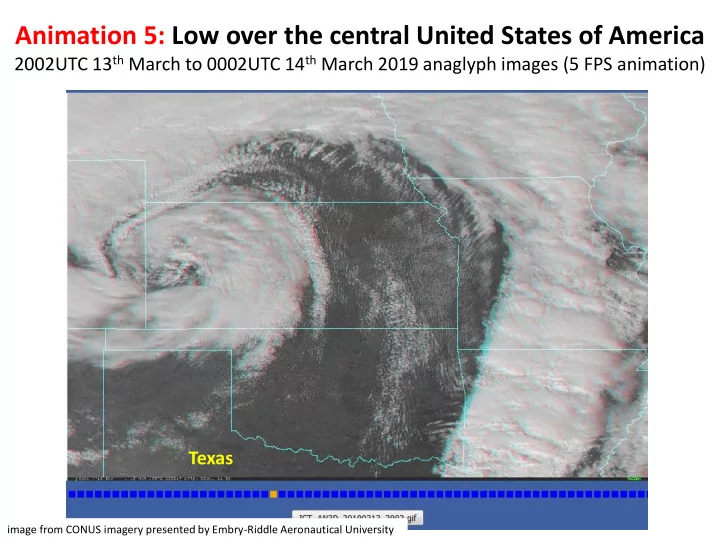
Animation 5: Low over the central United States of America

2002UTC 13th March to 0002UTC 14th March 2019 anaglyph images (5 FPS animation)

image from CONUS imagery presented by Embry-Riddle Aeronautical University
Texas

slide-2
SLIDE 2

Animation 6: Superposition of RADAR and surface

  • bservations on 3D anaglyph satellite data (5 FPS animation)

image from CONUS imagery presented by Embry-Riddle Aeronautical University

Texas

Socrative question 5

slide-3
SLIDE 3

Socrative question 5: How well do the anaglyph 3D satellite, RADAR and surface observations render the 3D stereo effect?

A. The superposition of the observational data enhances the 3D stereo effect B. The superposition of the observational data substantially reduces the 3D stereo effect. C. There is no difference between the two animations. D. I cannot see the 3D stereo effect in either animation

REFERENCE

slide-4
SLIDE 4

Some additional anaglyph 3D case studies for you to examine with your anaglyph glasses

http://www.virtuallab.bom.gov.au/eve nts/aomsuc-training/aomsuc-10- training-event-presentations-and- resources/

slide-5
SLIDE 5

Various ways of presenting 3D stereo satellite imagery

2: Stereo pair images

(cross eyed viewing method) Anaglyph glasses

3: "Anaglyph"animation

(requiring viewing glasses)

1: "3D Wiggle" animation 4: 2 panel image animation played on Smartphone and rendered in a viewer

(eg. Google Cardboard).

slide-6
SLIDE 6

image from Google Earth image from Viri Virtual Reality Melbourne facebook post

Method 4 analogy: Virtual Reality exercise

slide-7
SLIDE 7

Advantages in using 3D stereo satellite imagery

Analysing multilayer cloud, superior AMV's Analysing atmospheric shear and trends in these Analysing the interaction between low and upper levels of the atmosphere Analysing vertical motion of developing thunderstorms Better monitor low cloud below broken higher cloud Detection of minor variations in height for oceanic cellular convection

anaglyph images from CONUS imagery presented by Embry-Riddle Aeronautical University Non-anaglyph images from CIMSS Satellite Blog, case studies produced by Scott Lindstrom SSEC

slide-8
SLIDE 8

Suggested use of 3D stereo satellite imagery within a meteorological forecasting / training centre

Normal animation and Wiggle 3D animation in two panel display Enhanced teaching of meteorological principles to Trainee Meteorologists Selective use by severe weather forecasters to gain greater insight into a difficult situation

slide-9
SLIDE 9

Summary

  • The constellation of geostationary satellites over our

region

  • Utilising limb effects for enhanced forecaster

monitoring

  • Introducing the 3D stereo satellite imagery utilising

Himawari-8, Geo-KOMPSAT 2A, GOES-16 and 17 data