
SLIDE 1
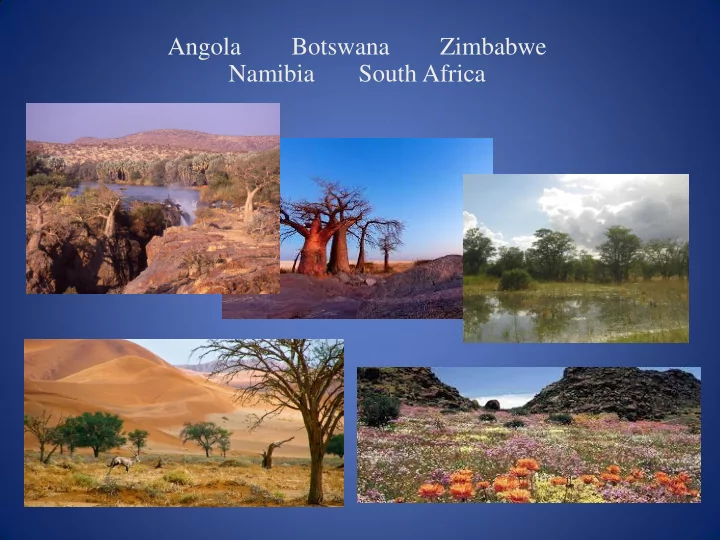
Angola Botswana Zimbabwe Namibia South Africa - - PowerPoint PPT Presentation
Angola Botswana Zimbabwe Namibia South Africa The Khoisan languages of southern Africa: a brief introduction. . Dr Menn du Plessis, Research Associate in the Dept of Linguistics, Stellenbosch University Program Our
Dr Menán du Plessis, Research Associate in the Dept of Linguistics, Stellenbosch University
three main families collectively referred to as southern African
good idea of the diversity of the languages commonly referred to under the umbrella term ‘Khoisan’.
aspects of the phonetics, morphology and syntax of these little-known and for the most part highly endangered African languages.
at conservation and revitalization.
well as some thorny topics in current documentary linguistics.
able to produce at least some of the clicks for which these languages are famous!
Workshop 1 (Fri): Introduction Workshop 2 (Tues): KHOE – Khoekhoe Workshop 3 (Fri): KHOE – Kalahari Workshop 4 (Tues): JU (and ǂ’Amkoe?) Workshop 5 (Fri): TUU - Taa Workshop 6 (Tues): TUU – ǃUi
NB: Assessment exercise should be manageable at this point.
Workshop 7 (Fri): Current issues in documentary linguistics Workshop 8: Review.
Handouts Readings*
Data-based assignment
* You may like to consult Rainer Vossen (ed.), The Khoesan Languages (Routledge, 2013).
Afroasiatic shown in blue.
Berber Chadic Egyptian Cushitic Omotic Semitic Map Gutman and Avanzati (2013)
Nilo-Saharan shown in yellow.
Map from Britannica.
Map from SIL Ethnologue.
Warning: Some people today, especially in South Africa, may find the internationally used term ‘Bantu’ offensive.
vast family of related languages.
the Niger-Congo superfamily.
linguists have tried using Kintu or Sintu, but there has been little uptake.
‘Khoisan’ shown in green.
Hadza Sandawe JU (+ ǂ’Amkoe ~ E. ǂHoan?) TUU (!Ui-Taa) KHOE (+ Kwadi?)
NB: The three main families of southern Africa are thought by most linguists to be unrelated.
a convenient umbrella term for three or four different language groups.
another! Use of the convenient collective term ‘Khoisan’ does not imply any relatedness of the families subsumed under it. Some linguists believe that an areal scenario of contact and diffusion may account for the indisputable similarities occasionally observed across the southern groups.
Sandawe, and also the extinct Angolan language Kwadi as part of a wider Khoisan grouping, or ‘macro-Khoisan’. While there are a few tantalizing minor resemblances between some –but not all– of these languages, there is no conventional evidence to support the idea of an actual relationship between any of them.
Hadza Sandawe Kwadi
Where are the !Ui (TUU) languages ?
as an alternative to ‘Bushman’. It is simply a generic term for hunter-gatherer communities, and does not refer to any family of languages. (There is no such thing as a ‘San language!’)
Africa– were herders, and were in the past referred to by various names that are today considered deeply offensive. Warning: you may encounter some derogatory names in older literature. These can be very hurtful, but try to understand the historical context in which they were used.
formerly Nama-Dama).
speak Nama (Khoekhoe KHOE) in addition to Afrikaans. In recent years the language has been introduced into a few primary schools in the region, and a younger generation is now beginning to learn the language again.
elderly members of the ǂKhomani San still remembered some ǀNuu (!Ui), though they mainly spoke Nama and
decade and a half to document this language, but almost all
still remembered some Kora (Khoekhoe KHOE), although they mainly spoke Afrikaans.
NB: Some linguists believe that the extinct Kwadi of Angola was related to the KHOE languages, and these linguists propose a higher-order entity ‘Khoe-Kwadi’. In this course we will be looking at :
Khoekhoe branch.
NB: Some linguists believe that Eastern ǂHoan (aka ǂ’Amkoe) is related to the JU languages, and they propose a higher-order entity Kx’a. In this course we will be looking (in very broad terms) at:
from each other.
unplaced ǂ’Amkoe (aka E. ǂHoan).
Angolan isolate, Kwadi; and ‘Khoe-Kwadi’ and Sandawe.
SVCs? Perhaps only in some cases?
Kudu, xaib in Nama, n!hoan in Juǀ’hoan, dòõ-ka in !Xoon
distinguishes Khoisan languages from other African languages. A few other African languages (such as Zulu or Dahalo) also make use of clicks, but it is clear that these languages belong to other families (in the case of the examples above, Nguni Bantu and Cushitic Afroasiatic respectively).
semantically contrastive lexical tone melodies.
as nasalisation, glottalisation, breathy-voicing and pharyngealisation.
Wilfrid Haacke gives the following (unusual) set of six Nama words that are distinguished almost exclusively by tone: ǃom [L ̩ L] ‘butt, push’ ǃoms [L ̩ H] ‘udder’ ǃom [LL] ‘force exit from burrow’ ǃom [HL] ‘remove thorn; coagulate’ ǃom [LHˈ] ‘pollard (cut back a tree)’ ǃoms [HˈH] ‘fist’
Niklaas Fredericks (note Nama pronunciation of ‘ai’)
The examples of the four basic Khoekhoe clicks below are from Kora (illustrated by Ouma Jacoba Maclear) ǀamse ‘twice’ ǁamma ‘water’ ǃam ‘kill’ ǂã ‘go in, set (of sun)’ ǂã na soreb ke ‘the sun is setting’ (NB: KHOE languages do not make use of the bilabial click.)
elaborated by a range of features, including voicing, aspiration and ejection. They may also be prenasalised.
Reverting to the topic of present day status of Khoisan languages …
speak Nama (Khoekhoe KHOE) in addition to Afrikaans. In recent years the language has been introduced into a few primary schools in the region, and a younger generation is now beginning to learn the language again.
elderly members of the ǂKhomani San still remembered some ǀNuu (!Ui), though they mainly spoke Nama and
decade and a half to document this language, but almost all
still remembered some Kora (Khoekhoe KHOE), although they mainly spoke Afrikaans.
A short documentary clip (12 mins) about the South African Nama communities of the Richtersveld (far Northern Cape).
An account (30 mins) of the Kora documentation project.