Analysis of Simple CS Amplifier Conditions for using Miller Two - - PowerPoint PPT Presentation

analysis of simple cs amplifier
SMART_READER_LITE
LIVE PREVIEW

Analysis of Simple CS Amplifier Conditions for using Miller Two - - PowerPoint PPT Presentation

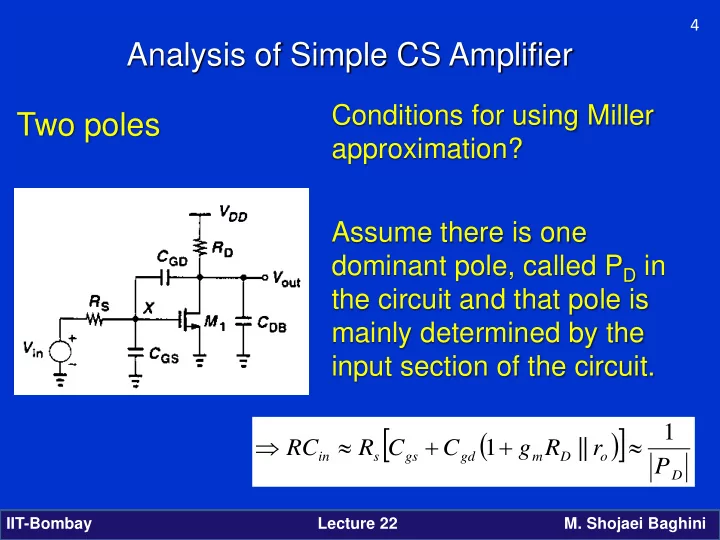
4 Analysis of Simple CS Amplifier Conditions for using Miller Two poles approximation? Assume there is one dominant pole, called P D in the circuit and that pole is mainly determined by the input section of the circuit. [ ] 1 ( )


slide-1
SLIDE 1

4

IIT-Bombay Lecture 22 M. Shojaei Baghini

Conditions for using Miller approximation? Assume there is one dominant pole, called PD in the circuit and that pole is mainly determined by the input section of the circuit. ( )

[ ]

D

  • D

m gd gs s in

P r R g C C R RC 1 || 1 ≈ + + ≈ ⇒

Two poles Analysis of Simple CS Amplifier

slide-2
SLIDE 2

5

IIT-Bombay Lecture 22 M. Shojaei Baghini

( )

[ ]

  • D

m gd gs s in D

r R g C C R RC P || 1 1 1 + + ≈ ≈

Miller approximation:

Assume node X is almost short to AC ground at frequencies close to the second pole (|P2|):

[ ] [ ]

( )

[ ]

1 , || 1 || : || 1 1

2

>> + + << + + ≈ ≈ ⇒

v

  • D

m gd gs s gd db

  • D

gd db

  • D
  • ut

A r R g C C R C C r R Assumption C C r R RC P

Analysis of Simple CS Amplifier (cont’d)

slide-3
SLIDE 3

6

IIT-Bombay Lecture 22 M. Shojaei Baghini

Analysis of Simple CS Amplifier (cont’d)

Even if the assumption is valid it doesn’t mean the transfer function is an all-pole transfer function. NOTE: Miller approximation removes the zero. How to calculate the zero?

slide-4
SLIDE 4

7

IIT-Bombay Lecture 22 M. Shojaei Baghini

( )

5 . 5 5 1 . 1 || 112 , 16 , 10 50 1 . 1 , 200 , 5 = × ≈ = = = Ω = = = = Ω =

  • D

m gs db gd s

  • m

D D

r R g fF C fF C fF C k R r V mA g A I k R µ ) 85 . 8 13 . ( 13 . 26 5 85 . 8 177 50 177 10 5 . 6 112 5 . 6 ns ns ns fF k ns fF k fF C C

gd gs

<< = × = × = × + = +

GHz s Grad Z H R GHz s Grad P MHz s Mrad P

D

9 . 10 ) / ( 75 . 68 . . 2 . 1 ) / ( 7 . 7 18 ) / ( 113

2

⇔ = ⇔ = ⇔ =

Analysis of Simple CS Amplifier with Miller Approximation - Example

slide-5
SLIDE 5

8

IIT-Bombay Lecture 22 M. Shojaei Baghini

( ) ( ) ( ) [ ] 1

1 2 1 ) ( ) (

2 3 1 3 1

+ + + + + +         − =

∑ ∑

= =

s C C R C R C R g R s C C R R R g s C s v s v

DB GD D GS S GD D m S i j i j D S D m GD in

  • ut

( ) ( )

[ ]

( )

[ ]s

C R C R R R g R R C s C C R C R C R g R

DB D GS S D S m D S GD DB GD D GS S GD D m S

+ + + + = + + + + 1

GD DB GS

C C C C C C j i = = = ≠

3 2 1

, , ,

Analysis of Simple CS Amplifier – Exact Transfer Function

slide-6
SLIDE 6

( ) [ ] ( )

∑ ∑ ∑

= = =

= + + + + ≈ ⇒ >> ⇒ << +         + + =         +         + = + + + + + +        

3 1 1 2 1 2 1 2 1 2 1 2 2 1 2 3 1 3 1

1 1 1 1 1 1 1 1 1 1 2 1

i i DB D GS S GD D S m D S DB D GS S GD D S m D S i j i j D S

C R C R C R R g R R P P P P P If s P P P P s p s p s s C R C R C R R g R R s C C R R τ

9

IIT-Bombay Lecture 22 M. Shojaei Baghini

) ( , ,

3 2 1

j i C C C C C C

GD DB GS

≠ = = =

Denominator: Analysis of Simple CS Amplifier – Exact Transfer Function (cont’d)

slide-7
SLIDE 7

10

IIT-Bombay Lecture 22 M. Shojaei Baghini

( )

DB GD D GS S

C C R P C R P + ≈ ≈ 1 2 1 1

Large CGS

Analysis of Simple CS Amplifier – Example of large RS CGS

( )

[ ]

( )

[ ]

( )

DB GD GS DB GS GD D GS GD D m GS GD D m S

C C C C C C R C C R g p C C R g R p + + + + ≈ + + ≈ 1 2 1 1 1

Large RS:

slide-8
SLIDE 8

11

IIT-Bombay Lecture 22 M. Shojaei Baghini

Analysis of Source Follower

RL RL

( )

1 1 2 1 1 1 1 1 ) ( ) (

1 2 3 1 3 1

+       + + + + + +         × +         +         + =

− = = ∑

s g R C R g C R R C R s C C R g R R R g g s C s v s v

m L L L m GS L S GD S i j i j L m L S L m m GS in

  • ut

GD L GS

C C C C C C j i = = = ≠

3 2 1

, , ,

Effect of load resistance and gmb is shown by RL. If RL→∞?