Ambient Light Study This study started off as a vision I had for my - - PowerPoint PPT Presentation

ambient light study
SMART_READER_LITE
LIVE PREVIEW

Ambient Light Study This study started off as a vision I had for my - - PowerPoint PPT Presentation

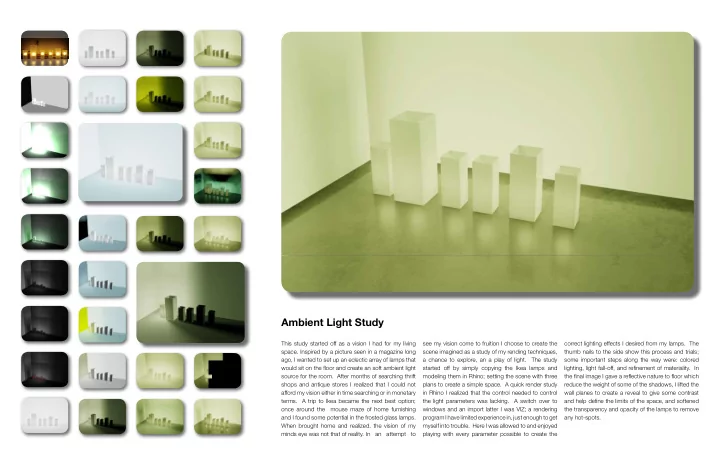
Ambient Light Study This study started off as a vision I had for my living see my vision come to fruition I choose to create the correct lighting effects I desired from my lamps. The space. Inspired by a picture seen in a magazine long scene


slide-1
SLIDE 1

This study started off as a vision I had for my living

  • space. Inspired by a picture seen in a magazine long

ago, I wanted to set up an eclectic array of lamps that would sit on the fm

  • or and create an soft ambient light

source for the room. After months of searching thrift shops and antique stores I realized that I could not afford my vision either in time searching or in monetary

  • terms. A trip to Ikea became the next best option;
  • nce around the mouse maze of home furnishing

and I found some potential in the frosted glass lamps. When brought home and realized, the vision of my minds eye was not that of reality. In an attempt to see my vision come to fruition I choose to create the scene imagined as a study of my rending techniques, a chance to explore, an a play of light. The study started off by simply copying the Ikea lamps and modeling them in Rhino; setting the scene with three plans to create a simple space. A quick render study in Rhino I realized that the control needed to control the light parameters was lacking. A switch over to windows and an import latter I was VIZ; a rendering program I have limited experience in, just enough to get myself into trouble. Here I was allowed to and enjoyed playing with every parameter possible to create the correct lighting effects I desired from my lamps. The thumb nails to the side show this process and trials; some important steps along the way were: colored lighting, light fall-off, and refi nement of materiality. In the fi nal image I gave a refm ective nature to fm

  • or which

reduce the weight of some of the shadows, I lifted the wall planes to create a reveal to give some contrast and help defi ne the limits of the space, and softened the transparency and opacity of the lamps to remove any hot-spots.

Ambient Light Study

slide-2
SLIDE 2
  • Dynamic Shape | Simple Form
  • Layering
  • Refmective Light
slide-3
SLIDE 3
slide-4
SLIDE 4
  • Dynamic Shape | Simple Form
  • Layering
  • Refmective Light
slide-5
SLIDE 5
slide-6
SLIDE 6
  • Dynamic Shape | Simple Form
  • Layering
  • Refmective Light
slide-7
SLIDE 7
slide-8
SLIDE 8
  • Dynamic Shape | Simple Form
  • Layering
  • Refmective Light
slide-9
SLIDE 9
slide-10
SLIDE 10
  • Dynamic Shape | Simple Form
  • Layering
  • Refmective Ambient Light
slide-11
SLIDE 11
slide-12
SLIDE 12
slide-13
SLIDE 13
  • Dynamic Shape | Simple Form
  • Layering
  • Refmective Ambient Light
slide-14
SLIDE 14
slide-15
SLIDE 15

The Futuropolis project was project designed by Daniel Libe- skind as exhibition sculpture for the freshman orientation week at HSG, a renowned business school in St. Gallen Switzerland. The towers that were created were to help the incoming busi- ness students visualize and conceptualize a “City of the Fu- ture.” The wooden sculpture is a composition of 98 towers arranged on a triangular grid ranging in height up to 3.8meters (12.5 ft). The triangular grid pattern of the base was applied to the vertical form at an angle of 25 degrees. This cut the form into approximately 2000 polygons that would be constructed

  • ut of birch wood; using 200 hours of CNC milling time as well

as 500 man-hours for assembly. In order to reduce production time an algorithmic formula was created in VectorWorks, VectorScript, by a group of students at ETH under the direction of CAAD Chair Prof. Dr. Ludger Hove-

  • stadt. By using the parametric functions of the program they

were able to generate the geometry of the 2,164 parts as well as accommodating late-stage design alterations made by Libe-

  • skind. The team generated a stencil that could be manually

Client_ Universtiy of St. Gallen (HSG) Design_ Studio Daniel Libeskind, Libeskind and T. Garbers Consulting and Engineering_ designtoproduction, ETH CNC-Production_ Bach Heiden AG

Futuropolis | Daniel Libeskind

wood sculpture | 2005

slide-16
SLIDE 16

edited but automatically alter and create the assembly pieces. By using the system along with the cooperation and partner- ship of designtoproduciton the cost of the time for the project was cut down to two weeks and a savings of 320,000 Swiss Francs (300,000 US). Designtoproduction is a consulting service that facilitates para- metric planning, detailing, optimization, and digital manufactur- ing for the production of non-standard architecture. In the case

  • f the Futuropolis project they performed three vital steps to

the project; first they developed the connection method of the board, secondly they generate the exact geometry of the parts, and finally translated the geometry information in code for the CNC-milling process (G-Code). The design of the connectors was found to be six variants, of aluminum dovetail connectors, with eleven sub-types; the notices for the aluminum connec- tors could be milled out by the CNC-router. The geometry of the 2,164 parts was created by taking the parametric model for the research done at ETH integrated with the connection details and then numbered and applied to 360 square meters of the 32 mm boards. The final G-code was then outputted, overnight, into two separate scripts since the boards had to be turned around in the middle of the production process. Bach Heiden AG was the producer of finished materials and

  • construction. They specialize in high-tech machinery as well

as wood and solid skills. By using the most current machin- ery, e.g. 5-axis CNC, they are able to do small-scale fabrication at similar price points to large scale ones. Bach Heiden has worked with designtoproduction on other project such as the

slide-17
SLIDE 17

Inventioneering Architecture exhibit, Swissbau Pavillion, and the Zipshape chair. At the end of the process what was truly created was a digital design chain. A design chain is a design and production se- quence with no analogue steps; an uninterrupted digital process form design (determination of shape and structure) to construc- tion (detailing) to production (CNC-manufacturing). This chain integrates the need for dynamic and malleable programs that can be simply modified, but then very quickly moved to a real- ization of the object. What this process allows for is mass cus- tomization; allowing small-scale projects, like Futuropolis, to be quickly produced and constructed on small budgets.

Works Cited Hovestadt, Ludger. Chair of Computer Aided Architectural Design 1st-4th Year. Hovestadt.pdf. ETH Zurich: D-Arch. Web. 2 Mar. 2010. <http://www.arch.ethz.ch/jahrbuch06/hove- stadt.pdf>. Johnson, David, ed. “VectorWorks Plays Key Role IN Designing Swiss ‘Inventioneering Architecture’ Exhibit.” Live Design (11 Jan. 2006). Live Design. Penton Media, INC, 11 Jan. 2006. Web. 25 Feb.

  • 2010. <http://livedesignonline.com/architainment/inventioneering_architecture/>.

“Libeskind’s Futuropolis: St. Gallen, 2005.” Designtoproduction. Designtoproduction. Web. 25 Feb.

  • 2010. <http://www.designtoproduction.ch/content/view/12/41/>.

Sakamoto, Tomoko (ed. )., and Albert (ed. ). Ferré. From Control to Design: Parametric/Algorith- mic Architecture. Barcelona: Actar, 2007. Print. Scheurer, Fabian, Christoph Schindler, and Markus Braach. From Design To Production: Three Complex Structures Materialised In Wood. From Design To Production. Generative Art. Web. 2 Mar.

  • 2010. <http://www.generativeart.com/on/cic/papers2005/36.ScheurerSchindlerBraach_final.

htm>. Schindler, Christoph. “TWiki.D2p.LibeskindFuturopolis.” TWiki.D2p.LibeskindFuturopolis. Web- Home, 20 Aug. 2006. Web. 25 Feb. 2010. <http://wiki.arch.ethz.ch/twiki/bin/view/D2p/Libe- skindFuturopolis.html>.

  • VectorWorks. Case Study. VectorScript and Parametric Modeling Technolgy Bring Daniel Libe-

skind’s Futuropolis to Life. News: Case Study. Nemetschek.net. Web. 25 Feb. 2010. <http://www. nemetschek.net/news/casestudies.php>.