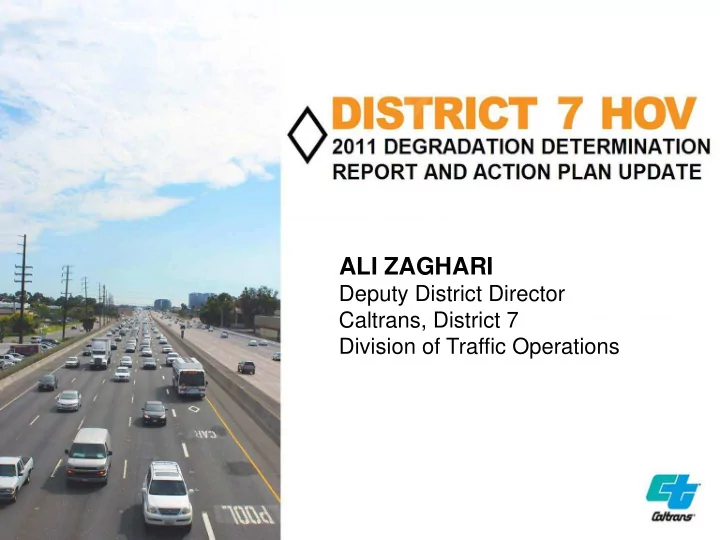
ALI ZAGHARI Deputy District Director Caltrans, District 7 Division - - PowerPoint PPT Presentation

ali zaghari
SMART_READER_LITE
LIVE PREVIEW

ALI ZAGHARI Deputy District Director Caltrans, District 7 Division - - PowerPoint PPT Presentation

ALI ZAGHARI Deputy District Director Caltrans, District 7 Division of Traffic Operations Background California law permits ILEV (Inherently Low Emission Vehicles) and previously hybrid vehicles to access HOV lanes Yellow decals


slide-1
SLIDE 1

ALI ZAGHARI

Deputy District Director Caltrans, District 7 Division of Traffic Operations

slide-2
SLIDE 2
  • California law permits ILEV (Inherently Low Emission

Vehicles) and previously hybrid vehicles to access HOV lanes

  • Yellow decals – hybrid vehicles – 85,000 decals

– Valid until 07/01/11

  • Green Decals - plug-in vehicles 40,000 decals
  • Valid until 01/01/15
  • White decals – ILEVs – 19,300 (as of DEC 2011)

– Valid until 01/01/15

  • Requires performance monitoring and reporting on HOV facilities

that allow single occupancy vehicles (i.e. hybrids and tolled) to access since 2005

  • As required by Title 23 USC § 166, Caltrans prepared the

“2011 California High-Occupancy Vehicle Lane Degradation Determination Report”

  • Analyzes the performance of the HOV network in California

Background

2

slide-3
SLIDE 3
  • Enacted on July 6, 2012
  • Requires State DOTs to remedy degraded HOV/HOT facilities within

180 days

  • Potential sanctions: Loss of Federal funding and project approvals

Definition of Degraded Segment:

  • Speed falls below 45 mph during the morning or evening weekday

peak hour periods for more than 10% of a 180-day period

  • In other word, an HOV facility is considered degraded if its speed falls

below 45 mph for 3 weekdays or more each month

MAP-21 Moving Ahead for Progress in the 21st Century

3

slide-4
SLIDE 4
  • Traffic collected from in-ground loop detectors,

radars, or microwave vehicle detection systems

Freeway Performance Measurement System (PeMS)

  • Separated into multiple segments
  • Each segment = 5 miles maximum
  • Peak Hour Data (typical statewide peak travel delay)
  • Morning – 8:00 am to 9:00 am
  • Evening – 5:00 pm to 6:00 pm
  • Degradation status data include two 180-day

periods (weekday data, including weekday holidays)

The first 180-day period is Jan. 1, 2011 to June 30, 2011

  • 129 weekdays and 52 weekend days

The second 180-day period is July 1, 2011 to Dec. 31, 2011

  • 131 weekdays and 53 weekend days
  • Analysis Methodology

4

slide-5
SLIDE 5

Analysis Methodology (Cont.)

5

Degradation Severity Definitions Degradation Severity Percent of 180 days failing to maintain 45mph for either Morning or Evening peak hours

Federally "Degraded" Extremely Degraded 75% or higher Very Degraded 50%-74% Slightly Degraded 10%-49%

  • Caltrans categorized degradation into three classes
  • Slightly degraded
  • Very degraded
  • Extremely degraded
slide-6
SLIDE 6

Analysis Methodology (Cont.)

6

2011 Statewide HOV Network Degradation Summary

First 180-day Period January to June 2011 Second 180-day Period July to December 2011 Total Degraded 43% 49% Not Degraded 57% 51% Morning Peak Hour Degradation 20% 23% Morning Peak Hour Severity 13% slightly Degraded 7% Very or Extremely Degraded 19% Slightly Degraded 4% Very or Extremely Degraded Evening Peak Hour Degradation 24% 40% Evening Peak Hour Severity 19% Slightly Degraded 15% Very or Extremly Degraded 25% Slightly Degraded 15% Very or Extremely Degraded

slide-7
SLIDE 7

Statewide Degradation Summary by Peak Hour (July 1 - December 31, 2011)

7

Morning only degraded 153.4 lane-miles 12% Morning & evening degraded 141.2 lane-miles 11% Evening only degraded 362.0 lane-miles 27% Not degraded 669.9 lane-miles 50%

slide-8
SLIDE 8

8

Statewide Degraded HOV Lane-Miles Summary by District (July 1 - December 31, 2011)

Note: 1326.5 lane-miles total; numbers may not add up due to rounding

31.7 200.7 187.2 107.2 15.6 127.6 32.4 179.8 260.3 59.3 15.6 109.1 50 100 150 200 250 300 350 400 450 500 District 3 District 4 District 7 District 8 District 11 District 12

Lane-Miles

Degraded Not degraded

slide-9
SLIDE 9

District 7 HOV Degradation Map

14

slide-10
SLIDE 10

Potential Causes of Degradation

18

  • Potential Causes
  • Congestion in general purpose (GP) lanes
  • Weaving conflict at ingress/egress(I/E) locations → congests

the HOV lane due to speed differential

  • Lane drops create congestion on the mainline which effects

the HOV

  • peration
  • Construction activities
  • Faulty vehicle detector system
  • Major Bottlenecks on the mainline
  • Merging Problems
  • HOV volume exceeds capacity
  • HOV violations
slide-11
SLIDE 11

Remediation Strategies District 7

  • Caltrans has been working very closely with FHWA for many years

towards understanding the causes and identifying most effective strategies to remedy degradation levels.

  • The proposed Action Plans Strategies were developed by the District

with input from Caltrans HQ and FHWA-California Division.

  • Remediation Strategies
  • Short Term
  • Improve mainline operation by removing lane drops through

Restriping

  • More assertive ramp and connector metering operation
  • In partnership with Metro, Enhance Freeway Service Patrol (FSP)
  • peration/deployment.
  • Work with CHP to improve enforcement and incident management
  • Improve HOV vehicle detection infrastructure
  • Long Term
  • HOV Direct Connectors
  • Increase occupancy in conjunction with HOT conversion in HOV

facility where adding an additional lane is feasible (I-105)

19

slide-12
SLIDE 12

Conclusion

21

  • In 2011, California HOV lanes carried about 13% of the traffic on the

freeway during the morning peak hour and 15% during the evening peak hour

  • Overall increase in congestion in the latter half of the year, particularly

after school begins in the late summer

  • Recurrent congestion or other factors could be causing degradation
  • The 2011 HOV Degradation Report and Action Plan were developed in

compliance with federal laws

  • The 180-day timeframe to remediate degradation begins when the

report was submitted to the FHWA, on August 1st, 2013

  • Our long record of working closely with FHWA will help us to continue

to find efficient and effective solutions to HOV degradation challenges.

slide-13
SLIDE 13
  • Awaiting for official response from FHWA. Anticipated to be

received in September 2013

  • 2012 Degradation Report is currently in progress
  • Additional studies may be needed .

What’s Next?

22

slide-14
SLIDE 14

THANK YOU

QUESTIONS OR COMMENTS?

Ali Zaghari Deputy District Director, Caltrans District 7 Division of Traffic Operations Email: Ali.Zaghari@dot.ca.gov

23