The Whole Child: Presentation Goals A Blueprint for Success Learn - - PDF document

the whole child
SMART_READER_LITE
LIVE PREVIEW

The Whole Child: Presentation Goals A Blueprint for Success Learn - - PDF document

3/23/2018 The Whole Child: Presentation Goals A Blueprint for Success Learn about the history of WSCC work in New Haven Public Schools and Connecticut. Sandra M. Chafouleas, PhD Describe perceived successes and challenges related Neag


slide-1
SLIDE 1

3/23/2018 1

The Whole Child: A Blueprint for Success

Sandra M. Chafouleas, PhD

Neag School of Education, University of Connecticut

Michele Femc‐Bagwell, PhD

Neag School of Education, University of Connecticut

Althea Marshall Brooks

Waterbury Bridge to Success Community Partnership

Tiffany Rauch

New Haven Public Schools

Bonnie Edmondson, EdD

Southern Connecticut State University March 24, 2018 presentation at ASCD Empower 18 (Boston, MA)

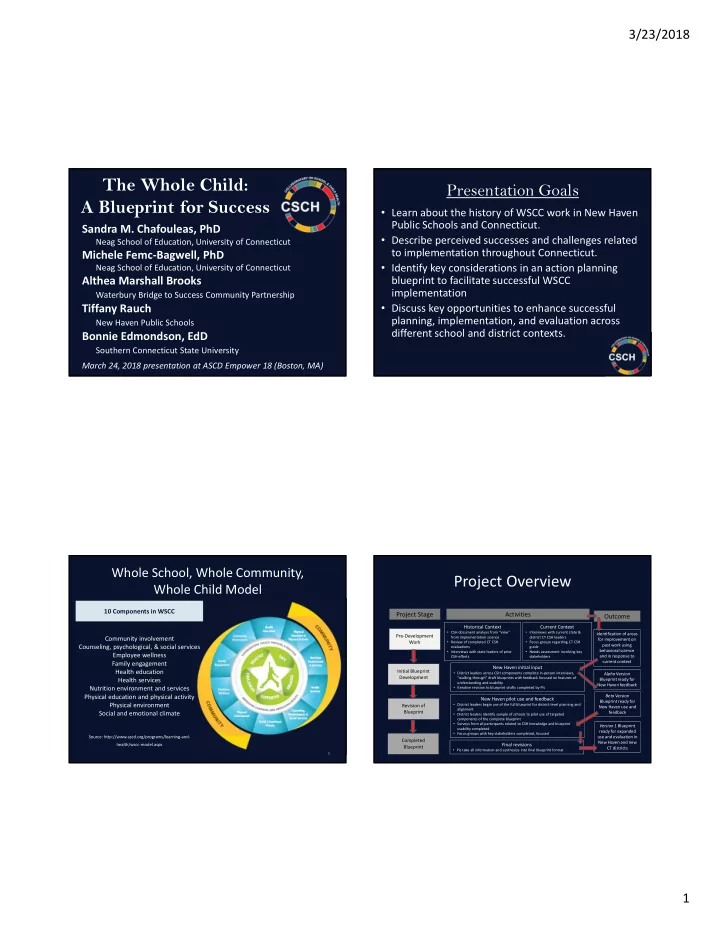
Presentation Goals

  • Learn about the history of WSCC work in New Haven

Public Schools and Connecticut.

  • Describe perceived successes and challenges related

to implementation throughout Connecticut.

  • Identify key considerations in an action planning

blueprint to facilitate successful WSCC implementation

  • Discuss key opportunities to enhance successful

planning, implementation, and evaluation across different school and district contexts.

Whole School, Whole Community, Whole Child Model

10 Components in WSCC Community involvement Counseling, psychological, & social services Employee wellness Family engagement Health education Health services Nutrition environment and services Physical education and physical activity Physical environment Social and emotional climate

Source: http://www.ascd.org/programs/learning‐and‐ health/wscc‐model.aspx 3 Pre‐Development Work Initial Blueprint Development Revision of Blueprint Completed Blueprint Historical Context

  • CSH document analysis from “view”

from implementation science

  • Review of completed CT CSH

evaluations

  • Interviews with state leaders of prior

CSH efforts

Current Context

  • Interviews with current state &

district CT CSH leaders

  • Focus groups regarding CT CSH

guide

  • Needs assessment involving key

stakeholders

Project Stage Activities Outcome

Identification of areas for improvement on past work using behavioral science and in response to current context Version 1 Blueprint ready for expanded use and evaluation in New Haven and new CT districts Alpha Version Blueprint ready for New Haven feedback Beta Version Blueprint ready for New Haven use and feedback New Haven initial input

  • District leaders across CSH components complete in‐person interviews,

“walking through” draft blueprints with feedback focused on features of understanding and usability

  • Iterative revision to blueprint drafts completed by PIs

New Haven pilot use and feedback

  • District leaders begin use of the full blueprint for district‐level planning and

alignment

  • District leaders identify sample of schools to pilot use of targeted

components of the complete blueprint

  • Surveys from all participants related to CSH knowledge and blueprint

usability completed

  • Focus groups with key stakeholders completed, focused on usability

Final revisions

  • PIs take all information and synthesize into final blueprint format

Project Overview

slide-2
SLIDE 2

3/23/2018 2

HISTORY: COORDINATED SCHOOL HEALTH EFFORTS IN CT

Our Vision

Connecticut’s children and adolescents are healthy, learning and succeeding in life.

Our Mission

We will nurture the physical, social and emotional health of our entire school community including students, families and school personnel. We will promote and support full implementation of a coordinated approach to school health in schools and communities.

Lessons Learned

  • Create a systems change approach
  • Establish connections with key educational and

health initiatives

  • Focus on sustainability
  • Showcase success stories

Systems Change

slide-3
SLIDE 3

3/23/2018 3

Connections

ACA SRBI PBIS Chronic absenteeism Safe schools Mental Health Obesity Chronic Disease Accountability

Sustainability

Showcase Success Stories

CURRENT WORK: PERCEIVED SUCCESSES AND CHALLENGES IN WSCC

slide-4
SLIDE 4

3/23/2018 4

The WSCC Blueprint Project

Primary Goal: To build a comprehensive and usable document to support districts in WSCC Implementation New Haven Project: – To better understand strengths, challenges, and

  • pportunities for WSCC Implementation.

4 - Focus Groups

37 NHPS Wellness Coordinators 12 School Principals 30 Members from Connecticut Association of Administrators of Health and Physical Education

21 - Semi-Structured Interviews

(NHPS Central Office Administrators and Community Organizations)

Defining and Connecting the WSCC Model

  • When you hear/say

“meeting the needs of the whole child”, what does it mean to you?

  • How do you think

about the link between learning and health in your work?

Knowledge of Whole Child and Health- Academics Link

  • Overall, participants broadly acknowledged the “whole child” as the

social, emotional, physical, and academic needs of the child

  • Participants also acknowledged the connection between health risks

and student academic outcomes.

Responses included…

“…making sure that children in the New Haven Public School system are being taken care of intellectually, emotionally, and physically” “ If faculty and teachers can’t address their emotional and physical health, how can they teach the kids?” “…health is not just something you do by taking care of yourself physically. If you don’t take care of yourself emotionally, psychologically, spiritually it’s for

  • naught. So, I think you need to have a totally integrated approach”

Integrating Health and Learning

WSCC model emphasizes, that integrating learning and health sectors is critical to success in meeting needs of the whole child.

– Fundamentally, do you believe this is aspirational, actionable,

  • r both?
slide-5
SLIDE 5

3/23/2018 5

Integrating Health and Learning

“Structures are in place, we are ready but not everyone is in action mode.” “I think it needs to be actionable, but I think it’s a precedent that needs to be

  • set. It needs to be managed

from the top down and it needs to be one who sets it. “ “Definitely aspiration and it’s a necessity and I believe that it absolutely can be done.” “I think it’s aspirational…But working together is definitely a way to give kids more

  • pportunities. I think they’re

ready to do it and I think it’s going to be a really good step, but as everything, as any kind

  • f change, it all takes time….”

“It’s got to be both because on the one end you’ve got to have a vision, right? And then you’ve got to have creative ways of bringing about that vision and it’s the creative ways that makes it actionable”

Aspirational Actionable Both

Readiness for Implementation of WSCC

Not Ready Getting Ready Ready

In what “Stage of Change” are:

  • You
  • Your Setting

What Barriers are Preventing Change? What would be needed to overcome these barriers?

Current “Stage of Change”

  • Time
  • Administrator Buy‐In
  • Teacher Buy‐In

Stages varied widely depending on the specific WSCC

  • Component. Factors influencing the current state were:

“I think at first there’s going to be a lot of hesitation…I think it can happen, but I think it’s going to take a very long time to happen just because educators are so used to the idea that it’s only about academics.”

Barriers to Implementation

  • Support, Staffing, and Challenges to

Implementation…

“Some faculty are so stressed that they can’t think conceptually about the whole student when you are struggling yourself.” “If faculty and teachers can’t address their emotional and physical health how can they teach the kids? “I think a major challenge is lifting this issue up as a district level priority… and devoting resources to this, the same way we devote resources to our academic priorities…”

slide-6
SLIDE 6

3/23/2018 6

Overcoming Challenges

Changes to Prioritize Whole Child Efforts:

  • Have administration recognize importance of social

emotional and physical health

  • Work with administrators who have implemented successful

health-learning initiatives

  • Professional development focused on the impact of health on

math and literacy outcomes

“Have a formal department that is committed to this work.”

Overcoming Challenges

Summary of identified Needs For Prioritization:

  • More time in classroom, with families in the home

Support and backing at the district level

  • Each school to have a liaison for wellness
  • Full-time nurse in every building
  • PD for all stakeholders
  • Inclusion of family and student voices
  • Financial support

Project Recommendations

  • District Leadership
  • Building level supports, Clarified policies, Increased collaboration

across stakeholders

  • Professional Development for all Staff
  • Training in embedding WSCC Model in teaching, In collaborative

use of data, Support employee wellness

  • Embracing Differences Across the District
  • Formative assessment of needs and building specific

flexibility, Use data to help prioritize

  • Expanding Voices
  • Increase engagement of family and students when building

actionable plans, Embrace the community and changing community characteristics.

REFLECTIONS ON “THINK ABOUT THE LINK”

From Siloes to Systemic Change

slide-7
SLIDE 7

3/23/2018 7

Paradigm Shift – Reactive to Responsive

Reactive Approach Responsive Approach

Deficit‐Based Orientation Strengths/Asset Based Orientation Transactional Transformative Siloed Systemic Pathogenic Focus Salutogenic Focus Exclusive Equitable Formal/Traditional/Past Practice Relational/Inclusive/ Best Practice

KEY CONSIDERATIONS: A PLANNING BLUEPRINT TO FACILITATE WSCC IMPLEMENTATION

Summary Thoughts on “Pre‐ Development” Workry

  • Somewhat unexpected: the what

– or the degree of request for multi‐media material to build WSCC content knowledge

  • Somewhat expected: the who

– strategy for leadership to sustain efforts

  • Expected: the how

– or the need for support as to “how” to do WSCC implementation

  • E.g. overwhelming to look at it all simultaneously

Lessons from Schoolwide Positive Behavior Intervention and Supports (SWPBIS):

What are challenges associated with accurate, durable, and relevant [WSCC] implementation?

slide-8
SLIDE 8

3/23/2018 8

Embrace Complex Change – Moving from Silo to Integrated

Through collaborations, opportunities are actively sought to enhance the work within individual components and facilitate intersections with others

Embrace Complex Change ‐ Using Implementation Science

Setting the Stage: Initial Exploration

slide-9
SLIDE 9

3/23/2018 9

Building Core Content Knowledge

  • Explaining key concepts
  • Defining “gears” and providing exemplars
  • Proving multiple sources/formats of

information

Building Core Content Knowledge

WSCC KEY CONCEPTS

 WSCC embraces school role and responsibility in integrating learning and health initiatives, building on substantial history of related initiatives in child success and well‐being (CDC coordinated school health, ASCD whole child)  WSCC weaves together efforts in supporting the whole child – which means that although academic indicators do form a critical part to school buy‐in, efforts also attend to social, emotional, behavioral, and physical domains  WSCC requires coordinated leadership across district and school decision making policy, process, practice arenas

  • Examples: school improvement plan, school wellness plans, district strategic plans, mission

statements  WSCC is contextually relevant in that efforts will look different across districts and within schools in the same district

  • Example differing factors: leaders, policies, culture, needs and assets, resources, family

engagement, community involvement  WSCC is a continual process of coordinated decision making about needs, priorities, and actions

  • Not doing it all at once, but systematic coordination of efforts

 WSCC is data‐driven, with data options that include “big” data (scores, attendance, discipline, climate/safety) deemed critical as well as “component” data (reports of chronic illness, behavior plans, family contacts)  WSCC requires school commitment to collaboration with community and families  WSCC must be viewed as the umbrella to school initiatives, cutting across layers to influence common vision

  • To be successful, planful efforts focus on reduction of duplication, inefficiency, and confusion (e.g.

what are the current areas of focus and resource allocation, what is the gap analysis across policies, processes, and practices)

Embracing WSCC work in integrating learning and health initiatives means taking an expanded view of school role and responsibility.

Building Core Content Knowledge

  • Defining “gears” and providing exemplars
slide-10
SLIDE 10

3/23/2018 10 WSCC work weaves together efforts

weaving occurs across domains, settings, and service intensity

emotional, behavioral, physical).

Building Core Content Knowledge

  • Defining “gears” and providing exemplars
  • Proving multiple sources/formats of

information

Understanding Implementation Features Active Implementation Network

  • Using the science of how to do something as

intended

  • Extending questions beyond What evidence‐

based practices have we adopted? to:

– Who is using those practices and do they have the requisite knowledge and skills? – What resources are both needed and allocated to use of those practices? – How well are the practices being implemented as intended?

Understanding Implementation Features Active Implementation Network

slide-11
SLIDE 11

3/23/2018 11

Readiness of the Inner Organization for Implementation

Adapted from Evidence‐Based Practice in School Mental Health (Lyon et al 2018)

Leadership

 Proactive  Knowledgeable  Supportive  Perseverant

Climate

 Focus  Education support  Recognition  Selection  Openness

Citizenship

Helping

  • thers

Keeping informed

Identify Leadership Team – Explore to Do the Work Identify Leadership Team – Explore to Do the Work Who/What is the Leadership Team?

Leadership, Climate, Citizenship Behaviors

Identify Leadership Team – Explore to Do the Work

2011 ASCD report ‐ identified the following “WSCC” levers: (1) principal as leader; (2) active and engaged leadership; (3) distributive leadership; (4) integration with school improvement plan; (5) effective use of data for continuous improvement; (6) embedded professional development; (7) mutually beneficial community collaborations; (8) stakeholder support; and (9) related policy (Source: Rasberry, Slade, Lohrmann, & Valois, 2015).

slide-12
SLIDE 12

3/23/2018 12

Identify Leadership Team – Explore to Do the Work Example Tools

Identify Leadership Team – Initial Planninf to Do the Work Identify Leadership Team – Initial Planning to Do the Work

Exercise: Cascading Logic Model

Complete the table below with regard to the chosen policy, process, or practice ‐ and WSCC domain. After each input, ask “how” 5 times to ensure all possible areas of success and challenge have been explored.

Example Tools

Input (ask How) Desired Output

How will students benefit? How will teachers/staff be supported? How will school implementation teams be developed and supported? How will district supports be developed to support school implementation? How will state and community resources be accessed to support school implementation?

Identify Leadership Team – Initial Planning to Do the Work

  • Now establish the improvement cycle... and

decision points

slide-13
SLIDE 13

3/23/2018 13

Embrace Complex Change ‐ Using Implementation Science

DISCUSSION: KEY OPPORTUNITIES ACROSS DIFFERENT SCHOOL AND DISTRICT CONTEXTS

Panel Discussion

  • How do you emphasize it is a framework, not a
  • ne size fits all approach? How can it look

different across contexts?

  • How important is leadership at different levels –

state, district, building? How to engage leaders as collaborative partners in the work?

  • What are facilitators and barriers to successful

implementation and sustainability?

  • How do you scale up the efforts? What are the

needed resources and the role for partnerships?

Questions, Comments, & Thank You!

Sandra M. Chafouleas Co‐ Director, UConn CSCH sandra.chafouleas@uconn.edu Michele Femc‐Bagwell michele.femc‐bagwell@uconn.edu Althea Marshall Brooks abrooks@unitedwaygw.org Tiffany Rauch TIFFANY.RAUCH@new‐haven.k12.ct.us Bonnie Edmondson edmondsonb1@southernct.edu

csch.uconn.edu