REAP Rural Education Achievement Program Presented by: Mitch - - PowerPoint PPT Presentation

reap rural education achievement program
SMART_READER_LITE
LIVE PREVIEW

REAP Rural Education Achievement Program Presented by: Mitch - - PowerPoint PPT Presentation

REAP Rural Education Achievement Program Presented by: Mitch Parrish Whole Child Whole School Whole Community 1 Illinois State Board of Education Vision Illinois is a state of whole, healthy children nested in whole, healthy


slide-1
SLIDE 1

Whole Child ● Whole School ● Whole Community

1
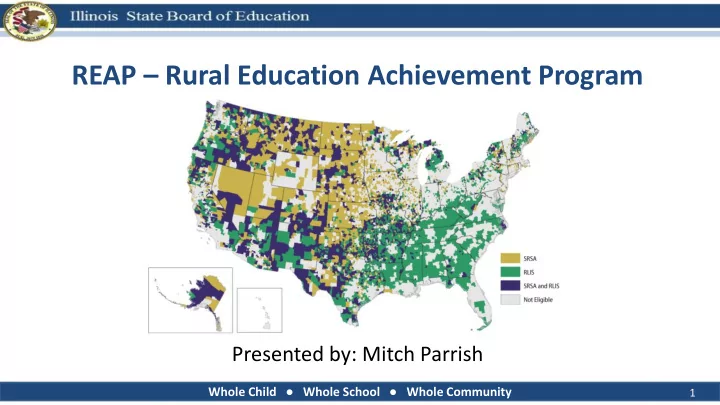
REAP – Rural Education Achievement Program

Presented by: Mitch Parrish

slide-2
SLIDE 2

Whole Child ● Whole School ● Whole Community

2

Illinois State Board of Education

  • Vision

– Illinois is a state of whole, healthy children nested in whole, healthy systems supporting communities wherein all people are socially and economically secure.

  • Mission

– Provide leadership and resources to achieve excellence across all Illinois districts by engaging legislators, school administrators, teachers, students, parents, families, and other stakeholders in formulating and advocating for policies that enhance education, empower districts, and ensure equitable outcomes for all students.

slide-3
SLIDE 3

Whole Child ● Whole School ● Whole Community

3

Illinois State Board of Education

Goals

  • Every child in each public school system in the State of Illinois deserves to

attend a system wherein…

– All kindergartners are assessed for readiness. – Ninety percent or more of third-grade students are reading at or above grade level. – Ninety percent or more of fifth-grade students meet or exceed expectations in mathematics. – Ninety percent or more of ninth-grade students are on track to graduate with their cohort. – Ninety percent or more of students graduate from high school ready for college and career. – All students are supported by highly prepared and effective teachers and school leaders. – Every school offers a safe and healthy learning environment for all students.

slide-4
SLIDE 4

Whole Child ● Whole School ● Whole Community

4

Community Home School

Emotional Physical Social Cognitive

The Whole Child

A child within an ecology of multiple and interconnected parts nested in overlapping systems

4

slide-5
SLIDE 5

Whole Child ● Whole School ● Whole Community

5

Agenda

  • REAP Overview

–RLIS vs. SRSA

  • Changes under ESSA

–Eligibility

  • Application Procedure
  • Use of grant funds
slide-6
SLIDE 6

Whole Child ● Whole School ● Whole Community

6

REAP Overview

  • Title V, Part B, of the Elementary and Secondary Education Act of 1965

(ESEA), as amended by the Every Student Succeeds Act (ESSA) of 2015, authorizes REAP, which comprises two formula grant programs:

  • the Small, Rural Schools Achievement (SRSA) grant [ESSA, Title V, Part B,

Subpart 1]

  • the Rural, Low-Income Schools (RLIS) grant [ESSA, Title V, Part B, Subpart 2]
  • Both grants were designed to supplement funding to help rural local

education agencies (LEAs) increase student academic achievement.

slide-7
SLIDE 7

Whole Child ● Whole School ● Whole Community

7

REAP Overview Continued

  • The RLIS grant targets rural LEAs that serve large numbers of low-income

students.

– The Department makes allocations to SEAs, who in turn make sub-grants to LEAs. – Application in IWAS (71 Eligible School Districts)

  • The SRSA grant provides funds to very small, rural LEAs.

– The Department (DOE) awards these grants directly to eligible LEAs. – SRSA-eligible LEAs also qualify for the Alternative Fund Use Authority [Section 5221 (a) & (c) ] that provides additional flexibility in how they can expend federal education funds (Title IIA & IVA Flexibility)(189 Eligible School Districts)

slide-8
SLIDE 8

Whole Child ● Whole School ● Whole Community

8

Changes Under ESSA: RLIS Eligibility

slide-9
SLIDE 9

Whole Child ● Whole School ● Whole Community

9

Changes Under ESSA: Dual Eligibility

slide-10
SLIDE 10

Whole Child ● Whole School ● Whole Community

10

RLIS/SRSA Consideration for Dual Eligible LEAs

Topic RLIS SRSA Alternative use of funds authority Dual-eligible LEAs may participate All eligible LEAs may participate Award disbursement State Educational Agencies (SEAs) disburse RLIS funds to LEAs U.S. Department of Education (ED) disburses SRSA funds to LEAs Technical Assistance (TA) SEAs provide TA to RLIS grantees ED provides TA to SRSA grantees Applying for the grant LEAs apply for RLIS funds through SEA’s application procedure (IWAS) LEAs apply for SRSA funds according to ED’s application procedure (grants.gov) Type of funding (competitive/formula) SEAs may do either (Illinois uses a funding formula) ED awards SRSA funds according to a funding formula Funding limits Federal statute does not limit the amount of funds an LEA may receive The maximum amount an LEA may receive is $60,000

slide-11
SLIDE 11

Whole Child ● Whole School ● Whole Community

11

Changes Under ESSA: Hold Harmless

LEAs not eligible under this subpart (SRSA) due to amendments made by ESSA, but met eligibility requirements under section 6211(b) shall receive the following:

  • Fiscal Year 2017: 75% of the amount received in Fiscal Year 2015
  • Fiscal year 2018: 50% of the amount received in Fiscal Year 2015
  • Fiscal Year 2019: 25% of the amount received in Fiscal Year 2015
slide-12
SLIDE 12

Whole Child ● Whole School ● Whole Community

12

Use of Grant Funds: RLIS

slide-13
SLIDE 13

Whole Child ● Whole School ● Whole Community

13

REAP Eligibility Spreadsheet

slide-14
SLIDE 14

Whole Child ● Whole School ● Whole Community

14

Application Overview

slide-15
SLIDE 15

Whole Child ● Whole School ● Whole Community

15

Applicant Information

slide-16
SLIDE 16

Whole Child ● Whole School ● Whole Community

16

Amendments

slide-17
SLIDE 17

Whole Child ● Whole School ● Whole Community

17

FFATA Tab

slide-18
SLIDE 18

Whole Child ● Whole School ● Whole Community

18

Program Specific

slide-19
SLIDE 19

Whole Child ● Whole School ● Whole Community

19

Staff Funded With Grant

slide-20
SLIDE 20

Whole Child ● Whole School ● Whole Community

20

Budge Pages - Allotment

slide-21
SLIDE 21

Whole Child ● Whole School ● Whole Community

21

Budget Pages – Budget Detail

slide-22
SLIDE 22

Whole Child ● Whole School ● Whole Community

22

Budget Pages – Indirect Cost Rate

slide-23
SLIDE 23

Whole Child ● Whole School ● Whole Community

23

Budget Pages - Budget

slide-24
SLIDE 24

Whole Child ● Whole School ● Whole Community

24

Final Application Pages

  • Program Risk Assessment
  • GATA Pages
  • Assurance Pages
  • Submit Tab
  • Application History
  • Page Lock Control
  • Application Print
slide-25
SLIDE 25

Whole Child ● Whole School ● Whole Community

25

Resources and Helpful Sites

  • https://www2.ed.gov/programs/reaprlisp/eligibility.html
  • https://nces.ed.gov/ccd/schoolsearch/ - National Center for

Education Statistics

  • https://www2.ed.gov/programs/reapsrsa/faq.html#22 – REAP

FAQ from DOE

  • https://www2.ed.gov/policy/elsec/guid/reap03guidance.doc -

REAP Guidance (2003)

  • https://www2.ed.gov/documents/essa-act-of-

1965.pdf#page=299 – Title V Legislation

  • https://sec1.isbe.net/iwas/asp/login.asp?js=true – IWAS Link
slide-26
SLIDE 26

Whole Child ● Whole School ● Whole Community

26

Contact Information

  • RLIS Grant:

–Mitch Parrish, (217) 782-3950 jparrish@isbe.net

  • SRSA Grant:

–Ms. Corrinne Callins, (202) 453-5795 corrinne.callins@ed.gov

slide-27
SLIDE 27

Whole Child ● Whole School ● Whole Community

27