AIR QUALITY PROGRESS REPORT 2010 Presentation to General Issues - - PowerPoint PPT Presentation

air quality progress report 2010
SMART_READER_LITE
LIVE PREVIEW

AIR QUALITY PROGRESS REPORT 2010 Presentation to General Issues - - PowerPoint PPT Presentation

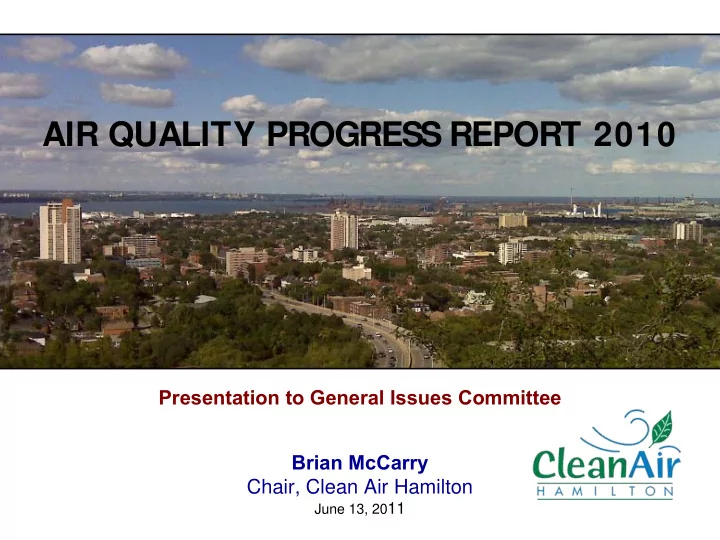
AIR QUALITY PROGRESS REPORT 2010 Presentation to General Issues Committee Brian McCarry Chair, Clean Air Hamilton June 13, 20 11 Clean Air Hamilton Initiated as implementation committee to act on recommendations in 1997 HAQI Reports.


slide-1
SLIDE 1

AIR QUALITY PROGRESS REPORT 2010

Presentation to General Issues Committee Brian McCarry Chair, Clean Air Hamilton

June 13, 2011
slide-2
SLIDE 2

Clean Air Hamilton

  • Initiated as implementation committee to act on

recommendations in 1997 HAQI Reports.

  • Community-based initiatives directed at:

Researching air quality and health issues Developing policies that affect air quality in Hamilton Encouraging emission reductions Educating the public on air quality improvements

  • S

takeholders include:

  • MOE, Environment Canada, Health Canada, ArcelorMittal Dofasco,

US S teel Canada, Green Venture, McMaster University, Citizens of Hamilton, City S taff (Planning, Health & Public Works), Horizon Utilities, Hamilton Industrial Environmental Assn., Environment Hamilton, Rotek Environmental.

slide-3
SLIDE 3

Clean Air Hamilton Strategic Plan

2010-2013

  • Public Health Protection
  • Active and Sustainable Transportation
  • Smart Driver
  • Air Monitoring
  • Air Quality Communication
  • Climate Change
  • Emissions Reductions
  • Energy Conservation
  • Land Use Planning
  • Tree-planting Programs

See details of plans in Appendix A

slide-4
SLIDE 4

Clean Air Hamilton

  • City provides programming support of $80,000 per year,

0.5 FTE staff position and 0.5 FTE co-op student.

  • Leverages expert volunteer support.
  • Leverages funding from various sources.
  • Programs include:
  • Upwind/ Downwind Conferences every two years
  • Mobile monitoring of urban pollutants
  • Hamilton Air Monitoring Network
  • Public health protection programs
  • S

ustainable transportation solutions

  • Climate change and air quality advice
  • Energy conservation and urban planning solutions
  • Emissions reductions and land use planning
slide-5
SLIDE 5

Air Quality Activities in 2010

  • Promoted linkages between air quality and health to public.
  • Provided air quality trends in Hamilton in relation to other

Ontario cities and cities across Canada and around world.

  • Participated in neighbourhood mobile air monitoring studies.
  • Published mobile monitoring data in scientific papers.
  • Performed monitoring in Red Hill Valley and neighbourhoods.
  • Helped develop communications for community smog advisories.
  • Participated in various transportation initiatives:

Car Share, Totally Transit, EcoDriver, Smart Commute, Smart Driver programs (in partnership with Green Venture)

  • Participated in various air quality and climate change consortia

and initiatives across GTA.

slide-6
SLIDE 6

2010 Clean Air Hamilton Report

  • Health impacts of air pollution
  • AQHI – pilot study in Hamilton
  • Trends in air quality data in Hamilton, in Ontario

and worldwide.

  • Mobile monitoring study outcomes
  • Urban Planning – Linkages to Air Quality
  • 2010 and 2012 Upwind/ Downwind Conferences
  • Plans for the future and recommendations
slide-7
SLIDE 7

Hamilton Air Quality Health Assessment, 2003

5 Key Air Pollutants result in health effects outcomes in Hamilton each year of:

  • >100 premature deaths
  • >620 respiratory & cardiovascular

hospital admissions

  • Primary focus of CAH efforts is

reductions in human exposures to:

  • Particulate material (PM10 and PM2.5)
  • Nitrogen oxides (NOx)
  • Ground level ozone (O3)

We are in the process of a comprehensive review of health effects of air pollutants; this review will be included in the 2011 CAH Report.

Hamilton responsible for about 50%

  • f locally measured air pollutants
slide-8
SLIDE 8

Air Quality Information:

Decreases of 35-50% in Levels of Major Air Pollutants (except Ozone)

  • ver Past Decade

Respirable Particulate (PM2.5) Trend

2 4 6 8 10 12 14 00 01 02 03 04 05 06 07 08 09 10 Year Annual Avaerage (μg/m³)

Downtown Mountain West

Nitrogen Dioxide Trend

0.005 0.01 0.015 0.02 0.025 0.03 0.035 00 01 02 03 04 05 06 07 08 09 10 Year Annual Average (ppm)

Beach Blvd (Industry) Downtown (City)

Ground Level Ozone Trend

100 200 300 400 500 600 700

00 01 02 03 04 05 06 07 08 09 10 Year Number hours >50 ppb

  • No. of Hourly Exceeds >50 ppb 3 stn avg
slide-9
SLIDE 9

Air Quality Information:

Comparisons of Hamilton’s Air Quality to some Ontario Cities and Cities around the World

Nitrogen Dioxide Annual Mean for Selected Cities World-Wide (2007)

10 20 30 40 50 60 70 Mexico City Hong Kong New York City Denver Athens Prague Geneva Rotterdam CALGARY TORONTO Cleveland WINDSOR Dallas HAMILTON MONTREAL Milwaukee Berlin Detroit VANCOUVER Pittsburgh Singapore WINNIPEG Sydney Miami YELLOWKNIFE

Cities Concentration (ppb)

U.S. NAAQS = 53 ppb WHO Guidelines = 21 ppb

20-Year Trend for Nitrogen Oxide (Seven Cities)

10 20 30 40 50 60 70 80 1990 1992 1994 1996 1998 2000 2002 2004 2006 2008 2010

Year N O x (ppb)

Hamilton Burlington Toronto Kitchener London Oakville

  • St. Catharines

8-Year Trends for PM2.5 (Ten Ontario Cities)

2 4 6 8 10 12 14 2 3 2 4 2 5 2 6 2 7 2 8 2 9 2 1

Year PM2.5 (μg/m³)

Hamilton Burlington Toronto Kitchener London Oakville

  • St. Catharines

Windsor Chatham Sarnia

All cities showed ‘upturn’ in PM2.5 in 2010

8-Year trend

slide-10
SLIDE 10

Hamilton Air Monitoring Network

  • HAMN: Network of 17 air monitoring stations funded by 17 companies.
  • Air quality data available at www.HAMNair.ca going back three years.
  • HAMN reports to MOE and to Clean Air Hamilton.
  • Network is a model for Ontario and Canada.
slide-11
SLIDE 11

AQI (Air Quality Index) vs. AQHI (Air Quality Health Index)

The AQI is an air pollution scale developed by the Ontario MOE while the AQHI is a health-driven metric developed by Health Canada.

AQI Scale: based on highest single air parameter.

Air pollution impacts increase uniformly, not in ‘steps’. AQHI conveys continuous nature of impacts better than AQI.

AQHI Scale: based on three air parameters.

Correlation: AQI to AQHI

slide-12
SLIDE 12

AQHI – Air Quality Health Index

The AQHI will come to Hamilton this month! The AQHI provides a linkage between index value and health effects. People will calibrate themselves to AQHI values as they do with the UV Index.

Health Risk Air Quality Health Index

Health Messages

At Risk Population* General Population

Low 1 - 3

Enjoy your usual outdoor activities. Ideal air quality for outdoor activities.

Moderate 4 - 6

Consider reducing or rescheduling strenuous activities outdoors if you are experiencing symptoms. No need to modify your usual outdoor activities unless you experience symptoms such as coughing and throat irritation.

High 7 - 10

Reduce or reschedule strenuous activities outdoors. Children and the elderly should also take it easy. Consider reducing or rescheduling strenuous activities outdoors if you experience symptoms such as coughing and throat irritation.

Very High Above 10

Avoid strenuous activities outdoors. Children and the elderly should also avoid outdoor physical exertion. Reduce or reschedule strenuous activities

  • utdoors, especially if you experience symptoms

such as coughing and throat irritation

slide-13
SLIDE 13

Poor Air Days and Smog Advisory Days

5 10 15 20 25 30 35 40 45 50

1 9 9 6 1 9 9 7 1 9 9 8 1 9 9 9 2 2 1 2 2 2 3 2 4 2 5 2 6 2 7 2 8 2 9 2 1

Year Number

# Poor Air Days (AQI > 51)* # Smog Advisory Days

slide-14
SLIDE 14

Climate Change and Greenhouse Gases in Hamilton

886,530 793,635 1,298,469 1,134,666 1,660,499 1,960,442 6,960,083 7,757,526 992,563 964,590 86,965 105,798 43,213 41,995 1,000,000 2,000,000 3,000,000 4,000,000 5,000,000 6,000,000 7,000,000 8,000,000

Tonnes CO2e

Residential Commercial Industrial (minus Steel) Steel Transportation Waste Agriculture 2008 Total CO2e 2006 Total CO2e

Steel (58%) Transportation (8%) Industrial (14%) Commercial (11%) Waste (1%) Residential (7%) Municipal Emissions (1%) Water & Sewage (0%) Agriculture (0%)

slide-15
SLIDE 15

Chapter 6 - Urban Planning Linkages to Air Quality

Sections of Chapter 6 in Report

  • Hamilton Urban Planning History
  • The Land Use Compatibility Guidelines
  • Policy Development
  • Planning Act Administration
  • Emerging Considerations
  • Emerging Issues
  • Clean Air Hamilton recognizes that strong linkages exist between

planning decisions and the resulting air quality in cities.

  • Planning decisions have long-term consequences affecting urban

form, walkability, sustainability and ultimately, public health.

  • The planning acts and policies were not drafted with explicit

environmental outcomes in mind.

slide-16
SLIDE 16

Upwind/Downwind Conferences 2010 and 2012

  • 2010 Conference Theme: ‘Air Knows No Boundaries.’
  • Monday, February 22, 2010 (Convention Centre).
  • Report on 2010 conference in Appendix B.
  • Planning soon underway for 2012 conference.
  • Sub-committee examined format of previous conferences

and has recommended a number of changes for 2012.

slide-17
SLIDE 17

Actions Needed within City

  • Recognize the importance of transportation-based pollutants on

public health.

  • Take steps to factor transportation planning into urban design to

mitigate exposures to pollutants.

  • Work with local industries and the MOE to mitigate emissions

from point sources and area sources of air particulate pollution, particularly dusts from roads and open yards.

  • Promote active lifestyles for all citizens by developing safe bike

corridors and providing sidewalks/ walkways to promote walking.

  • Encourage Hamiltonians to reduce transportation-based

emissions through the use of transportation alternatives including public transit, bicycles, hybrid vehicles, etc.

slide-18
SLIDE 18

Actions Needed within City

  • Encourage physicians to caution patients with respiratory or

cardiac difficulties to avoid areas of higher air pollution.

  • Encourage physicians to warn patients to take special

precautions on smog days and smog advisory days.

  • Continue to reduce fugitive dusts in industrial sectors by

encouraging local site operators to develop best practices to reduce fugitive emissions and track-out.

  • Continue to take a broad suite of actions to improve local air

quality and to increase the level of dialogue with community groups on health impacts of poor air quality.

slide-19
SLIDE 19

CAH’s Plans for the Future

Ten strategic issues have been identified as areas for air quality and climate change actions for the next 3 years:

1. Promote public health protection re air quality (AQHI). 2. Continue mobile monitoring in city. 3. Develop a real-time air quality health map for Hamilton. 4. Promote active and sustainable transportation. 5. Encourage emission reductions strategies. 6. Communicate air quality issues to public – web site/ conferences. 7. Promote climate change and energy conservation actions. 8. Monitor climate change progress. 9. Encourage land-use planning policies that factor air quality into decision-making.

  • 10. Continue tree-planting programs.
slide-20
SLIDE 20

THANK YOU

On behalf of Clean Air Hamilton