Air Quality Friendly Route Recommendation Smart Cities of my - - PowerPoint PPT Presentation

air quality friendly route recommendation
SMART_READER_LITE
LIVE PREVIEW

Air Quality Friendly Route Recommendation Smart Cities of my - - PowerPoint PPT Presentation

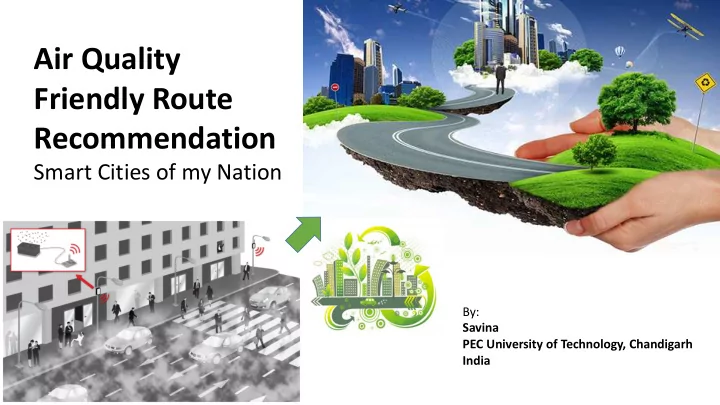
Air Quality Friendly Route Recommendation Smart Cities of my Nation By: Savina PEC University of Technology, Chandigarh India Sm Smar art Cit ity Adding layers of smartness, by balancing the environmental ecosystem. The use of digital

slide-1
SLIDE 1

Air Quality Friendly Route Recommendation

Smart Cities of my Nation

By: Savina PEC University of Technology, Chandigarh India

slide-2
SLIDE 2
slide-3
SLIDE 3
slide-4
SLIDE 4
slide-5
SLIDE 5
slide-6
SLIDE 6

Sm Smar art Cit ity

Adding layers of smartness, by balancing the environmental ecosystem. The use of digital technologies, information and communication technologies (ICT) by individuals make the cities smarter. Along with good and modern infrastructure, protection

  • f environment is important.

Smart Cities ensure healthy citizens. Aim: Quality of life

slide-7
SLIDE 7

Motivation

To curb pollution, Delhi government proposes 'odd/even' number formula for cars from 2016

(Source: CNN-IBN, Posted on: Dec 04, 2015 )

10/01/17 ITRA-Mobile, Evaluation Workshop, Bangalore, Jan 9-11, 2017 7

Source: TNN | Apr 7, 2015, ”Choking India gets air quality index”

slide-8
SLIDE 8

5 10 15 20 25 30 35 40 45 3 6 9 12 15 18 21 24 27 30 33 36 39 42 45 48 51 54 57 60 63 66 69 72 75 78 81 84 87 90 93 96 99 102105108111114117120 PM 2.5 Concentration(in ppm) Time(in seconds) India(Indoor) singapore(Indoor)

Comparison of PM 2.5 Concentration (Mumbai, India and Singapore) at indoor locations

10/01/17 ITRA-Mobile, Evaluation Workshop, Bangalore, Jan 9-11, 2017 8

slide-9
SLIDE 9

Air Quality Index (India)

10/01/17 ITRA-Mobile, Evaluation Workshop, Bangalore, Jan 9-11, 2017 9

slide-10
SLIDE 10

Research Gaps

  • Current Navigation Systems do not consider ”Air Quality” as a metric

for route computation.

  • Real time personalized recommendations are not given based on
  • nes health and activity performed.
  • Air Quality indices vary from country to country and require extensive

investigation.

10/01/17 ITRA-Mobile, Evaluation Workshop, Bangalore, Jan 9-11, 2017 10

slide-11
SLIDE 11

Research Questions

  • Finding the most optimal and cost effective vector V {f1,f2,f3 ... fn },
  • n the basis of which the best route is chosen.
  • To what extent the overall inhalation of the pollutants be reduced.
  • Mapping the most optimal model which meets ones personal health

and conditions, based on different age groups, medical conditions and health sensitivity.

  • How to select suitable subjects, based on their age, medical history

etc.

10/01/17 ITRA-Mobile, Evaluation Workshop, Bangalore, Jan 9-11, 2017 11

slide-12
SLIDE 12

Challenges

  • Portable air monitors are still expensive.
  • Integration with Fixed air monitors and smartphones for

measurements.

  • Identifying factors influencing pollution like humidity, wind speed,

location etc.

  • Finding out users to be experimental subjects based on some medical

expert’s advice or surveys.

  • Maintaining privacy of the user as the medical history of an individual

and his/her movement in the city can be purely confidential.

10/01/17 ITRA-Mobile, Evaluation Workshop, Bangalore, Jan 9-11, 2017 12

slide-13
SLIDE 13

Balancing the Ecosystem

Power of our nation is : The Crowd And the power of the crowd is: ownership of SMART DEVICES CAN THIS POWER BE EXPLOITED IN BUILDING AN ECOSYSTEM ?

And the answer is: YES Collecting the city wide information from the moving users (crowd), and disseminating the information back to the crowd is a brilliant IDEA. Environmental Data like Air Quality Index can be measured at each and every latitude and longitude of the city.

slide-14
SLIDE 14

Methodology

slide-15
SLIDE 15

Im Impac pact

Citizens of the smart city should be aware of the impact of their activities and actions on the environment.

Exploiting the smart devices like phones and tabs:

Smart devices have sensors, and sensors sense all.

Then why not to sense all ?

Yes, Smart devices can be used to make the individuals aware of their activities, and their impact on the environment. Pollution is human created, and humans should know their contribution towards it. This realization can help, to fight against it.

slide-16
SLIDE 16

Expo Exposur sure

Citizens are the assets of a city and the assets are valuable. The information flow in a smart city, should also contain the exposure of an individual to air pollution. Mobile Sensors can again be used to provide such information.

BENEFITS

This information can lead to lifestyle management and taking appropriate decision. Most beneficial for sensitive groups like small children, patients with asthmatic and cardiovascular diseases.

slide-17
SLIDE 17

Use Cases

  • Encourage use of public transportation by providing them indicative comparisons
  • f AQ across various routes.
  • Alternative Bus Boarding Options based on AQI
  • Encourage walking
  • Suggest alternative routes/timings to support better air quality
  • Benefits
  • Personalized Air Quality Monitoring based on individual’s health (asthma,

pregnant women, lungs related diseases)

  • Aid in taking informed decisions about how to move in the city (for Private

Vehicles as well as PTS)

  • Monitor daily levels of inhaled PM levels thus aiding in Lifestyle adjustment.
slide-18
SLIDE 18

Thankyou