SLIDE 1
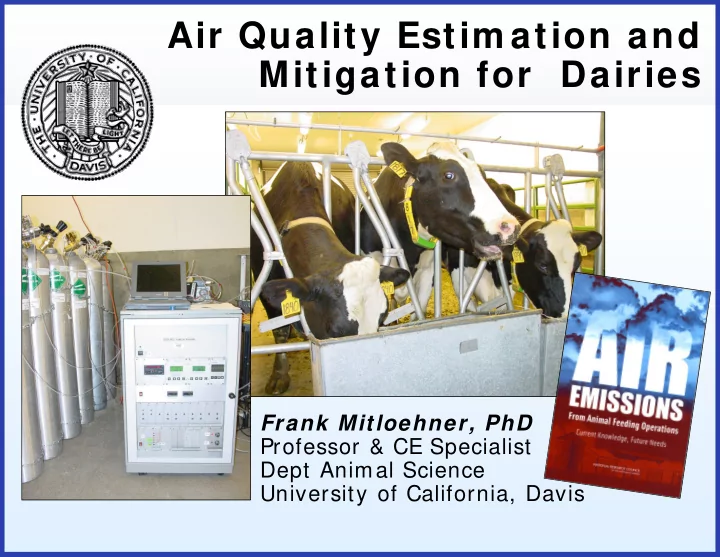
Air Quality Estim ation and Mitigation for Dairies
Frank Mitloehner, PhD Professor & CE Specialist Dept Animal Science University of California, Davis
SLIDE 2
SLIDE 3 Life Cycle Thinking
- Accounts for site-specific design and management practices as
variables and reflects interactions between emission sources
- Reflects mass balance constraints
- Scale specific (e.g., individual AFOs or regional/ national scale)
Manure Soil Crop Feed Herd
Emissions Emissions Emissions
Product I m port/ Export Fertilizer Export I m port/ Export
Emissions Emissions
Bill Schrock; US EPA
SLIDE 4 W hat are the air quality issues?
- National ambient air quality
standards (PM, ozone)
- Hazardous air pollutants (e.g.,
methyl bromide)
- Visibility (regional haze)
- Air deposition (acid rain,
nitrification)
- Global climate change (greenhouse
gases)
- Odors (nuisance complaints)
SLIDE 5 W hat are the pollutants of concern?
- PM10 (directly formed particles)
- PM2.5 (secondarily formed particles)
- Ammonia (potential PM precursor)
- Volatile organic compounds (ozone
precursor)
- Hydrogen sulfide (H2S)
- Methane (“greenhouse” gas)
- Nitrogen Oxides (NOx, an ozone
precursor)
SLIDE 6 Nutrient elem ents and related em issions
NH3 N2O NO H2S CH4 CO2 VOC
N
Nitrogen
C
Carbon
S
Sulfur
Ammonia Nitrous oxide Nitric oxide Hydrogen sulfide Methane Carbon dioxide Volatile organic compound
SLIDE 7
SLIDE 8
Six Subm odels
1.NH3, CH4, N2O and VOC production and emission from animal housing facilities driven by housing climate, production of fresh animal manure, and housing management 2.NH3, CH4, N2O and VOC production, consumption and emission under aerobic storage (e.g., vented manure stacks, compost, silage face) conditions, driven by quantity and quality of the composted manure mass as well as environmental factors 3.NH3, CH4, N2O, H2S and VOC production, consumption and emission under anaerobic storage (e.g. silage stacks, slurry tank, and lagoon), driven by quantity and quality of stored manure and environmental factors
SLIDE 9 Six Subm odels
4.NH3, CH4, N2O and VOC production, consumption and emissions following field application of manure, driven by quantity and quality of the manure applied, other farming practices, and environmental factors;
- 5. Enteric CH4, N2O and VOC production, driven by
quality and quantity of feeding materials as well as animal characteristics; 6.CH4 and VOC production and consumption during anaerobic digestion under digester conditions, driven by quantity and quality of the digested manure as well as environmental factors.
SLIDE 10
Gas emissions resulting from microbial activity in response to environmental drivers (e.g., pH)
SLIDE 11
N transport and transform ation at farm scale
SLIDE 12
Em issions of CH 4, NH 3, N 2O and N 2 are dom inated by different farm com ponents
CH4: >60% from enteric emission N2: 99% from lagoon emission N2O: 60% from field application NH3: 70% from field application
SLIDE 13
SLIDE 14 Freestall em issions FL vs SC
1,000 2,000 3,000 4,000 5,000 6,000 7,000 8,000 9,000 1 2 3 4 5 6 7 8 9 10 11 Ammonia Emissions (mg h-1) Time (h) F3 F6 S3 S6 p-value: < 0.001 SEM: 463.15 Treatments
SLIDE 15 Sources: FAO (2010), for 2007 data; * Univ. Ark (2010), for 2007 data. Note that different studies should not be compared directly.
10.6 10.6 12.2 12.6 12.6 13.5 17.2 28.9 31.9 39.8 64.5 10 20 30 40 50 60 70 lbs CO2e / gal milk
GHG footprint for World Dairy Farms
world average = 20.4
SLIDE 16 Production Efficiency
Dairy CH4 emission factor (kg/ head/ yr) Milk production (kg/ head/ yr) North America 118 6,700 EU 100 4,200 Latin America 57 800 Africa 36 475
(IPCC, 1996)
SLIDE 17
Frank Mitloehner, PhD Professor & CE Specialist Animal Science Department University of California, Davis (530) 752-3936 fmmitloehner@ucdavis.edu
SLIDE 18