Controlling Starlings and Pigeons at Dairies and Feedlots in - - PDF document

controlling starlings and pigeons at dairies and feedlots
SMART_READER_LITE
LIVE PREVIEW

Controlling Starlings and Pigeons at Dairies and Feedlots in - - PDF document

12/12/2016 Controlling Starlings and Pigeons at Dairies and Feedlots in Michigan Using DRC-1339 Tim Wilson USDA APHIS Wildlife Services, Michigan 1 12/12/2016 Issue During the winter large flocks of starlings gather at dairies and feedlots.


slide-1
SLIDE 1

12/12/2016 1

Controlling Starlings and Pigeons at Dairies and Feedlots in Michigan Using DRC-1339

Tim Wilson USDA APHIS Wildlife Services, Michigan

slide-2
SLIDE 2

12/12/2016 2

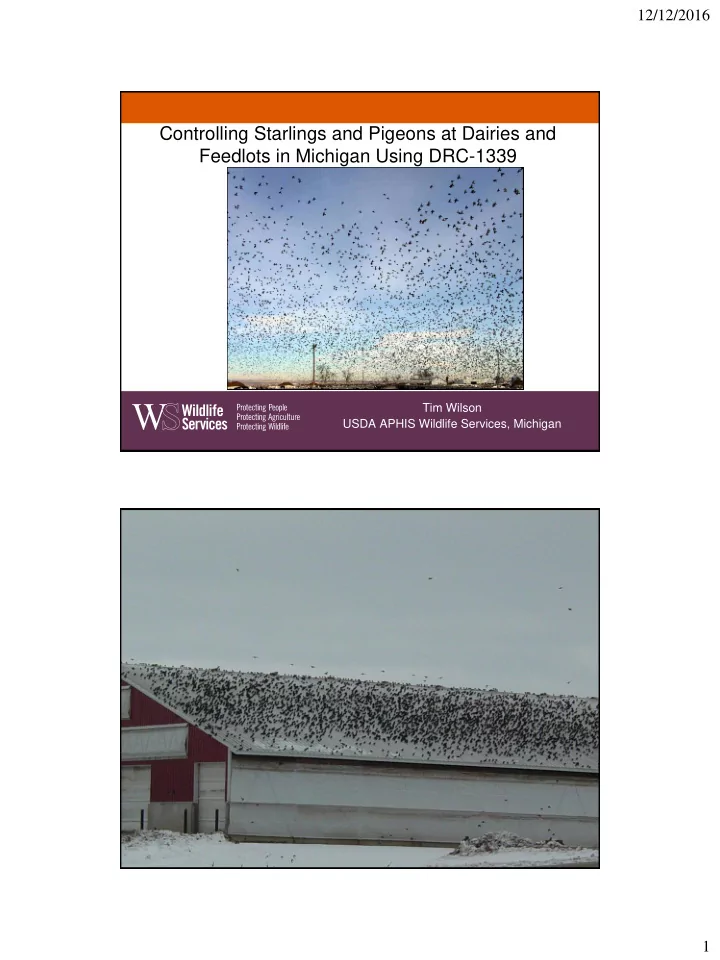
Issue

  • Consuming and

contaminating feed

  • Contributing to the

spread of disease

  • Reducing milk

production During the winter large flocks of starlings gather at dairies and feedlots.

slide-3
SLIDE 3

12/12/2016 3

Program Overview

  • DRC-1339

– Slow acting toxicant – Registered for USDA use only – Selective – Minimal risk of secondary poisoning

Methods-Prebait

  • Site selection

– Not accessible to cattle – Inside barns

  • Minimize non-targets
  • Shelter from weather

– Prefer drive-thru style barns

  • Producers conduct pre-baiting

– Coincides with feeding of livestock

slide-4
SLIDE 4

12/12/2016 4

Notification

  • Producers notify neighbors
  • WS notifies several agencies prior to treatment date to

alleviate concern about dead birds – Michigan Department of Agriculture – Michigan Department of Natural Resources – Michigan State University Extension Service – Local Health Departments

slide-5
SLIDE 5

12/12/2016 5

Methods - Bait Drop

  • WS Responsibilities

– Remain on site 4-8 hours

  • Monitor starling activity
  • Ensure non-targets do not interfere

– Placed out the same as pre-bait – Clean up left-over bait

  • Producers Responsibilities

– Carcass pick up

  • Found in sheltered locations
  • Disposal by burial or incineration
slide-6
SLIDE 6

12/12/2016 6

Results

  • Since 1998, 820 DRC-1339 applications to control

starlings

  • Average 45 farms treated per year
  • Majority of farms experience >75% reduction in starlings
slide-7
SLIDE 7

12/12/2016 7

Effects of Starling Control on Milk Production at a Clinton County Dairy (700 Head)

66 68 70 72 74 76 78 80 82 84 3 2 1 Bait Drop 1 2 3 Weeks Before - Weeks After

  • Ave. Pounds per Cow

Feb.2002

  • Oct. 2002
  • Feb. 2003

Keys to Success

  • Pre-baiting

– Starlings need to be “on bait” for at least 3 days

  • Weather

– Cold, snowy, overcast weather preferable

  • Minimal distractions on day of treatment

– Avoid scheduling activities that may disrupt birds

  • i.e, construction, hoof trimmers, etc.
slide-8
SLIDE 8

12/12/2016 8

Pigeon Control with DRC-1339

  • Pre-baiting

– Similar to starlings, only use corn

  • Hot bait/bait drop

– Same

  • Mode of action

– Same, pigeons will expire at roost sites

Costs

  • No federal funds for program
  • Charge only for labor, mileage, and supplies (i.e, bait,

toxicant)

  • Farms < 1000 head of cattle = $650 per treatment
  • Farms >1000 head of cattle = $1000 per treatment
  • Additional cost to treat pigeons

– $200-$400 depending upon number of pigeons

slide-9
SLIDE 9

12/12/2016 9

Contact Info:

209 Unique Farms 335 Total Treatments 7 Years

  • Tim Wilson

USDA Wildlife Services 2803 Jolly Road, Suite 100 Okemos, MI 48864 (517) 336-1928 ext. 26 timothy.s.wilson@aphis.usda.gov