
SLIDE 1
Agencies of Agriculture & Natural Resources Collaborative Laboratory Presentation to HCIC and SIC August 27, 2014
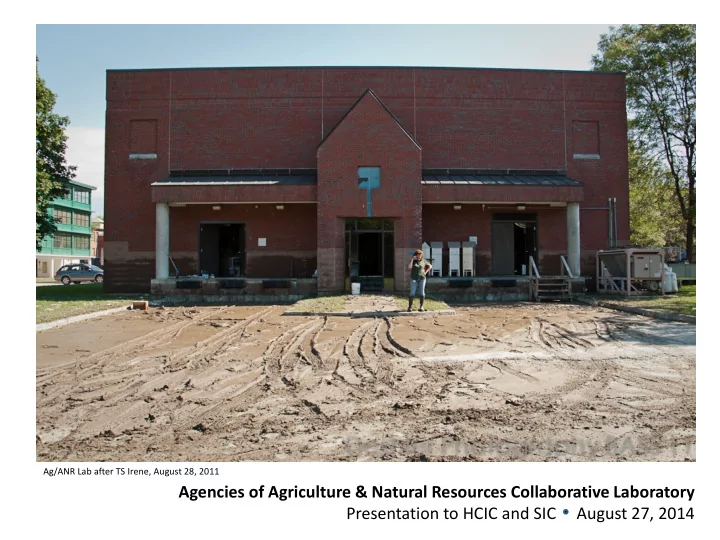
Ag/ANR Lab after TS Irene, August 28, 2011
Agencies of Agriculture & Natural Resources Collaborative - - PowerPoint PPT Presentation
Ag/ANR Lab after TS Irene, August 28, 2011 Agencies of Agriculture & Natural Resources Collaborative Laboratory Presentation to HCIC and SIC August 27, 2014 All programs are now in rented space in five locations. Forest Biology
Agencies of Agriculture & Natural Resources Collaborative Laboratory Presentation to HCIC and SIC August 27, 2014
Ag/ANR Lab after TS Irene, August 28, 2011
= Remote duty stations Forest Biology Core Chemistry And Biology; Fish & Wildlife Animal Pathology Watershed Management Fish & Wildlife Air Quality Plant Industry Weights & Measures
detailed program already developed
+ final adjustments due to location detailed site analysis (testing and assessments)
Example: Berlin Regional Library
Example: Berlin Regional Library
Example: Berlin Regional Library
Example: Berlin Regional Library
Example: Berlin Regional Library
Example: Berlin Regional Library
Example: Berlin Regional Library
Permitting Summary
Municipal Zone: Town Center. Laboratory use is prohibited. There is a precedent established in Berlin to honor Title 24. 15’ front yard setback; 10’ side and rear yard setback. Building height 45’ Lot coverage 75% State Wastewater – The project will rely upon the timely construction of the extension of municipal sewer to this portion of the Town of Berlin. This is scheduled to occur in the near future. A modest water and sewer allocation will be required to be acquired from the Town for this
Water Supply – The project may require the acquisition of a Permit to Construct from the Water Supply Division if a hydrant is required on the property. Fire Flow Capacity may become an issue as this is located at the higher portion of the proposed distribution system. Construction Stormwater – The project may qualify for a Low Risk Authorization under the State Construction Stormwater General Permit. Operational Stormwater – Coverage under the State Operation Stormwater General Permit will be required as amount of impervious area
modifying the Stormwater Rules to require additional on-site retention of storm events. Wetlands – The project does extend into the wetland buffer thereby requiring the acquisition of a State Wetland Permit. Stream Alteration – not applicable Act 250 – Currently the parcel is less than 10 acres and barring any other jurisdictional triggers associated with the creation of residential units or lots within the last 15 years and 5 miles of this site, Act 250 jurisdiction should not attach to this project. Federal Corps of Engineers – The project is not proposing any wetland impact, therefore no authorization should be required. NEPA – Many of the criterions otherwise handled within the Act 250 process will need to be addressed as part of the NEPA review. Items
traffic impacts.
Acquisition cost was not considered in the scoring.
Example: Berlin Regional Library
Example: Berlin Regional Library
Example: Berlin Regional Library
a) On or before August 15, 2014, the Department of Buildings and General Services, the Agency of Agriculture, Food and Markets, and the Agency of Natural Resources shall submit a site location proposal for a shared laboratory to the House Committee
intent of the General Assembly that when evaluating site locations, preference shall be given to State-owned property. (b) With approval of the Speaker of the House and the President Pro Tempore, as appropriate, the House Committee on Corrections and Institutions and the Senate Committee on Institutions may meet up to one time when the General Assembly is not in session to evaluate the proposal described in subsection (a) of this section and make a recommendation on the site location to the Joint Fiscal Committee. … (c) The Joint Fiscal Committee shall review the recommendation of the Committees described in subsection (b) of this section at its September 2014 meeting. If the Joint Fiscal Committee so determines, it shall approve the proposal as recommended by the Committees. (d) On or before December 1, 2014, the Department of Buildings and General Services, in consultation with the Agency of Agriculture, Food and Markets and the Agency of Natural Resources, shall develop a detailed proposal on the site location recommended by the Committees if approved by the Joint Fiscal Committee. The proposal shall include programming, size, design, and preliminary cost estimates for a shared laboratory.