Justice Involvement For Jobs, Education And More Understanding - - PDF document

justice involvement for jobs
SMART_READER_LITE
LIVE PREVIEW

Justice Involvement For Jobs, Education And More Understanding - - PDF document

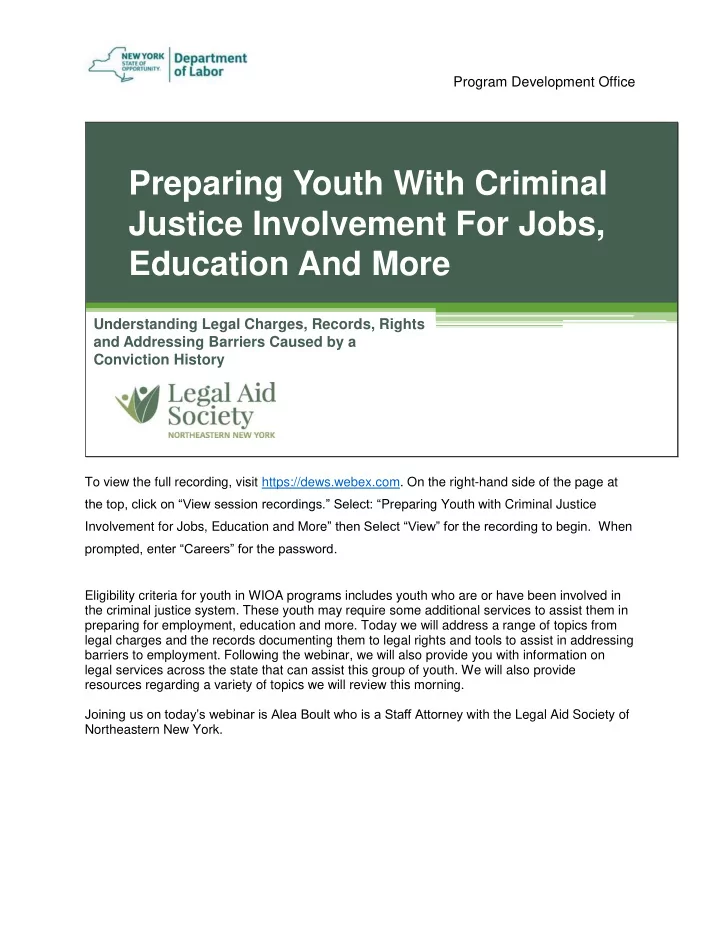
Program Development Office Preparing Youth With Criminal Justice Involvement For Jobs, Education And More Understanding Legal Charges, Records, Rights and Addressing Barriers Caused by a Conviction History To view the full recording, visit


slide-1
SLIDE 1

Program Development Office

Understanding Legal Charges, Records, Rights and Addressing Barriers Caused by a Conviction History

Preparing Youth With Criminal Justice Involvement For Jobs, Education And More

To view the full recording, visit https://dews.webex.com. On the right-hand side of the page at the top, click on “View session recordings.” Select: “Preparing Youth with Criminal Justice Involvement for Jobs, Education and More” then Select “View” for the recording to begin. When prompted, enter “Careers” for the password. Eligibility criteria for youth in WIOA programs includes youth who are or have been involved in the criminal justice system. These youth may require some additional services to assist them in preparing for employment, education and more. Today we will address a range of topics from legal charges and the records documenting them to legal rights and tools to assist in addressing barriers to employment. Following the webinar, we will also provide you with information on legal services across the state that can assist this group of youth. We will also provide resources regarding a variety of topics we will review this morning. Joining us on today’s webinar is Alea Boult who is a Staff Attorney with the Legal Aid Society of Northeastern New York.

slide-2
SLIDE 2

Youth Issues Webinar November 2017 Page 2 of 79

Alea Boult Staff Attorney

Housing Eviction Foreclosure Prevention Public Benefits Family Law Consumer Law Clinic Low Income Tax Clinic Children’s Law Project Domestic Violence Legal Assistance HIV/AIDS Legal Consortium Immigration Law Project Reentry Project Medical-Legal Partnership Senior Legal Services Nutrition Outreach and Education

We have a lot of ground to cover today so we are going to ask you to place questions that you have into the chat section or write them down if you would like to present them live at the end of the webinar., We have poll questions throughout the webinar so please join us in answering them. First question……………………………………

slide-3
SLIDE 3

Youth Issues Webinar November 2017 Page 3 of 79

 Youth do not generally disclose their legal history  Youth do not understand their legal history enough to discuss it  My staff are afraid to work with youth who have legal history  Staff are not familiar with the (juvenile) criminal justice system  Staff are unsure how they can assist these youth  We are not familiar with Legal Services in our local area  Other challenges….(Write in Chat)

What challenges do you face when working with youth with criminal history? (Select All that Apply)

Poll

slide-4
SLIDE 4

Youth Issues Webinar November 2017 Page 4 of 79

 < 5%  5 – 15%  16 – 30%  31 – 50%  > 50%

What percent of all the youth your local area serves have been involved with the criminal justice system?

Poll

slide-5
SLIDE 5

Youth Issues Webinar November 2017 Page 5 of 79

Youthful Offender Categories Probation and Parole “Conditions” of Probation/Parole RAP Sheets: Obtaining and Correcting

Content of Workshop

  • Why is it important that we review the topic of legal involvement and youth ?
  • Information we will review is not common knowledge
  • WIOA staff are not always aware of legal issues and supports
  • Youth are not always familiar with the details of their specific legal history
  • Youth are not always comfortable discussing their legal history
  • There are several tools/activities that can make a huge different in employment outcomes for

these youth

  • Know Alea’s expertise / My experience/expertise in this area:
  • Working with individuals with legal history for 9 years in a previous role
  • Worked last two years in youth office at DOL
  • Obtained OWDS (Offender Workforce Development Specialist) certification last spring
slide-6
SLIDE 6

Youth Issues Webinar November 2017 Page 6 of 79

Sealing Legal Records Certificates of Rehabilitation Rights and Legal Protections Legal History and the Job Search Reducing Barriers Created by a Legal History

Content of Workshop

slide-7
SLIDE 7

Youth Issues Webinar November 2017 Page 7 of 79

Definitions

I want to begin by reviewing a few legal definitions- so we all on an even playing field. We will be referring to many of these terms during today’s webinar.

slide-8
SLIDE 8

Youth Issues Webinar November 2017 Page 8 of 79

Probation

A sentence of the court imposed for a specific time Permits the offender to remain in the community under supervision Can be given in addition to or instead of incarceration

  • Probation is a county function in New York State –except in NYC where it is under the

jurisdiction of city government.

  • Conditions are set by the county and Probation Officers
  • Sometimes probation only / sometimes incarceration AND probation
slide-9
SLIDE 9

Youth Issues Webinar November 2017 Page 9 of 79

Parole

The conditional release of an inmate from a federal or state correctional facility prior to the completion of a conviction sentence Parole is granted by a decision of an administrative body – The Parole Board

  • Parole is a function of the state
  • Conditions are set by courts and Parole Officers
  • General Conditions of Community Supervision

Examples: Remain in the state, Report changes in work/residence, Reply to communication by community supervision officer……

  • Specific Conditions of Community Supervision

Examples: Avoid specific work environments, Curfews, Pay fines or restitution, Participate in a specific treatment program: substance abuse, anger management, domestic violence, mental health etc. Why is this important? – to understand needs of the youth, to understand any restrictions placed

  • n the youth that would impact the kind of employment the youth chooses (curfew, fraternization

with others with criminal history, participation in school/training, required programs and time commitment) If any of an individual’s conditions are violated there could be different repercussions including incarceration.

slide-10
SLIDE 10

Youth Issues Webinar November 2017 Page 10 of 79

Offense

Infraction = a non-criminal offense charged in the form of a summons which does not require arrest Violation = a non-criminal offense that can be charged in the form of a summons, arrest, or incarceration (jail) of 15 days or less

There are two different types of offenses – neither of these is a criminal charge but could show up on an individual’s record Infraction – Ex. a traffic or parking ticket – summons to court Violation – Ex. disorderly conduct or trespassing

slide-11
SLIDE 11

Youth Issues Webinar November 2017 Page 11 of 79

Misdemeanor

Crime punishable by a fine and/or time in county jail for 15 days up to a year Misdemeanors are tried in the lowest courts There are three classes of misdemeanors: A, B, and U (Unclassified)

Examples: shoplifting, public intoxication, reckless driving

slide-12
SLIDE 12

Youth Issues Webinar November 2017 Page 12 of 79

Felony

Serious crime characterized under federal and state law as an offense punishable by death or incarceration of one year or more in prison There are five classes of felonies: A, B, C, D, & E

Felonies mean that an individual has done at least one year of prison. Examples: homicide, kidnapping, rape, arson ……. An A class felony is the most serious category

slide-13
SLIDE 13

Youth Issues Webinar November 2017 Page 13 of 79

Adjudication

A formal finding by a juvenile court (judge) after a hearing or by entering of a plea of guilt or admission. After the adjudication, a disposition hearing determines the services and/or sanctions that a youth will receive.

Adjudications apply to youth ONLY and they are NOT convictions. However, they do come with specific requirements and restrictions for youth

slide-14
SLIDE 14

Youth Issues Webinar November 2017 Page 14 of 79

Juvenile Delinquent (JD) – youth between 7 and 16 who committed an act that would be considered criminal if committed by an adult. Leads to Adjudication and record can be sealed. Youthful Offender (YO) –youth between the ages of 16 and 18 who have been granted this status to be spared having an adult criminal record. ( A YO adjudication may be granted by a judge to younger offenders who would otherwise have an adult record.) Leads to Adjudication and record can be sealed. Juvenile Offender (JO) – youth between 13 and 15 who have committed a serious or violent felony such as murder, rape or arson etc. This IS a conviction and the record will not be able to be sealed. Alea: Discuss the “Raise the Age” legislation in New York State which will change the facility that youth will be housed in.

slide-15
SLIDE 15

Youth Issues Webinar November 2017 Page 15 of 79

RAP Sheets

Talk about what a RAP sheet is and why they are important to obtain and understand. Record of an individual’s legal history Story: RSD Employment Program

  • Participant had previously lived in California and had a Misdemeanor charge there
  • He had obtained RAP sheet from California and it was incorrect and impacting

employment

  • Referred him to legal services where they assisted him in getting RAP sheet corrected

Important because the error would show up on a background check done by an employer

slide-16
SLIDE 16

Youth Issues Webinar November 2017 Page 16 of 79

“RAP” = Record of Arrest and Prosecution RAP sheet is a record containing every arrest, prosecution, and disposition (outcome) of a legal case

What is a RAP sheet?

Today we are talking about RAP sheets in New York State (every state has them) FBI RAP sheet exists

slide-17
SLIDE 17

Youth Issues Webinar November 2017 Page 17 of 79

This is an example of a RAP Sheet. Information included on it includes:

  • Identifying information (name, DOB, sex, race, address…)
  • Arrest/Charge Information
  • Date of Crime
  • Place of Crime
  • Charges (Type of crime and class)
  • Court Information
  • Disposition

We will identify some of the common errors found on this particular RAP sheet in a moment.

slide-18
SLIDE 18

Youth Issues Webinar November 2017 Page 18 of 79

If a youth has been arrested they have a RAP sheet.

True or False?

Poll

Reads Poll Question

slide-19
SLIDE 19

Youth Issues Webinar November 2017 Page 19 of 79

If a youth has been arrested they have a RAP sheet.

Reads Poll Question

slide-20
SLIDE 20

Youth Issues Webinar November 2017 Page 20 of 79

Youth have a RAP sheet if they have been arrested and fingerprinted

slide-21
SLIDE 21

Youth Issues Webinar November 2017 Page 21 of 79

Two types of RAP sheets obtained through Department of Criminal Justice Services (DCJS): Suppressed – does not contain sealed information Unsuppressed – contains sealed information

RAP Sheets

slide-22
SLIDE 22

Youth Issues Webinar November 2017 Page 22 of 79

3 - Some employers/agencies

1 - Youth 2 - Criminal Justice/Law Enforcement agencies and staff

Police Departments Courts Prosecutors Defense Attorneys Parole and Probation Departments Correctional Officials Judges

Who can get an unsuppressed RAP Sheet?

Clarify employers/agencies obtaining RAP Sheets

slide-23
SLIDE 23

Youth Issues Webinar November 2017 Page 23 of 79

Name and NYSID Number Arrest Information Prosecution Charges Arrest Warrants Issued Dispositions

What is found in a RAP Sheet?

slide-24
SLIDE 24

Youth Issues Webinar November 2017 Page 24 of 79

Incarceration and Parole and/or Probation Information Determination if Case Has Been Sealed Certificate of Relief from Disabilities Received Certificate of Good Conduct Received

What is found in a RAP Sheet?

slide-25
SLIDE 25

Youth Issues Webinar November 2017 Page 25 of 79

A plea of guilty counts as a conviction.

True or False?

Poll

Reads Polling question

slide-26
SLIDE 26

Youth Issues Webinar November 2017 Page 26 of 79

A plea of guilty counts as a conviction.

slide-27
SLIDE 27

Youth Issues Webinar November 2017 Page 27 of 79

A plea of guilty has the same weight as a finding of guilt by a judge or jury

Story: Here experience with individuals who plea guilty for specific reasons

slide-28
SLIDE 28

Youth Issues Webinar November 2017 Page 28 of 79

Why obtain a copy of a RAP Sheet?

Know what information is on it Be prepared to discuss legal history in an interview Identify and correct errors To understand what information should be sealed

Story: Information not sealed on individual’s record / Domestic Violence example

slide-29
SLIDE 29

Youth Issues Webinar November 2017 Page 29 of 79

Incomplete entries

(arrest but no disposition)

Incorrect entries

(Penal Code 125.25 murder vs.155.25 petit larceny)

Double entries

(same charge entered twice)

Open warrants

(warrant was not vacated)

Information that should be sealed (Adjudications)

Common RAP Sheet errors

Story: Warrant never vacated on an Individual’s RAP Sheet

slide-30
SLIDE 30

Youth Issues Webinar November 2017 Page 30 of 79

There are three RAP sheet errors on this slide 1- The first error involves a case that was dismissed – this charged should have been sealed and should not have appeared on this RAP Sheet 2- The second error involves lack of a disposition (outcome) on a charge. It simply states “No court reported Information” 3- Last, there is no indication that a bench warrant is not active. The bench warrant is not vacated (closed) on this RAP sheet which would lead someone reading it to believe that it is still in place.

slide-31
SLIDE 31

Youth Issues Webinar November 2017 Page 31 of 79

Requesting a RAP Sheet

Fingerprints are required to obtain a RAP Sheet Cost for RAP Sheet and fingerprints = $ 61.75 $50.00 DCJS Fee and $11.75 Fingerprint Charge Request Suppressed or Unsuppressed RAP Sheet

slide-32
SLIDE 32

Youth Issues Webinar November 2017 Page 32 of 79

Fee Waiver:

Complete Notarized Financial Statement OR provide a copy of a public assistance benefits card (Medicaid or SNAP card) for fee waiver

Email to get a copy of the fee waiver application packet go to:

RecordReview@dcjs.ny.gov

Get Fingerprints:

Schedule with MorphoTrust/USA: https://uenroll.identogo.com/ $11.75 for fingerprints

Requesting a Fee Waiver

slide-33
SLIDE 33

Youth Issues Webinar November 2017 Page 33 of 79

www.criminaljustice.ny.gov/ojis/recordreview.htm

New York State Division of Criminal Justice Services Record Review Unit Alfred E. Smith Building 80 Swan Street Albany, New York 12210 Email: RecordReview@dcjs.ny.gov

Requesting a RAP Sheet

slide-34
SLIDE 34

Youth Issues Webinar November 2017 Page 34 of 79

The New York State Division of Criminal Justice Services (DCJS) can correct mistakes on a RAP sheet Contact a Legal Services Office to assist with obtaining and correcting a RAP Sheet Reference:

https://lac.org/wpcontent/uploads/2014/12/Your_New_York_State_Rap_Sheet_2013.pdf

Correcting RAP Sheet Errors

slide-35
SLIDE 35

Youth Issues Webinar November 2017 Page 35 of 79

Sealed Cases

slide-36
SLIDE 36

Youth Issues Webinar November 2017 Page 36 of 79

If enough time has passed since a conviction, a record can be expunged.

True or False?

Poll

Reads Poll question:

slide-37
SLIDE 37

Youth Issues Webinar November 2017 Page 37 of 79

If enough time has passed since a conviction, a record can be expunged.

slide-38
SLIDE 38

Youth Issues Webinar November 2017 Page 38 of 79

Certain types of cases can be sealed If a case is sealed, that means that the information is hidden but not removed from a record Most cases that can be sealed are automatically sealed, but obtaining a RAP sheet is the best way to make sure that cases that should be sealed actually are

NO expungement in New York

slide-39
SLIDE 39

Youth Issues Webinar November 2017 Page 39 of 79

What kinds of cases can be sealed?

Cases that ended in an individual’s favor:

Dismissal Declination to prosecute Acquittal Adjourned in Contemplation of Dismissal or ACOD (After the adjournment period has ended)

slide-40
SLIDE 40

Youth Issues Webinar November 2017 Page 40 of 79

What kinds of cases can be sealed?

Violations

“Non-criminal offenses” Examples: ✓Disorderly Conduct ✓Trespassing ✓Loitering

slide-41
SLIDE 41

Youth Issues Webinar November 2017 Page 41 of 79

What kinds of cases can be sealed?

Certain substance abuse related felonies and misdemeanors under Rockefeller Drug Law Reform To qualify: ✓An individual must have completed a court-sanctioned substance abuse treatment program; ✓Individual must have completed any other sentence imposed following that treatment program; and ✓Individual must have no pending charges

slide-42
SLIDE 42

Youth Issues Webinar November 2017 Page 42 of 79

What kinds of cases can be sealed?

✓ Juvenile Delinquency (JD) Adjudications

and ✓ Youthful Offender (YO) Adjudications

slide-43
SLIDE 43

Youth Issues Webinar November 2017 Page 43 of 79

Some Violations  Driving While Ability Impaired  Loitering for the Purpose of Prostitution

What kinds of cases cannot be sealed?

slide-44
SLIDE 44

Youth Issues Webinar November 2017 Page 44 of 79

NYS Sealing Law: Corrections Law 160.59

Who is eligible?

✓Individuals who have been convicted of up to two crimes ✓Individuals who have only 1 felony conviction ✓Individual has had a clean record for 10 years ✓If this criteria is met record will be eligible for sealing 10 years after the most recent conviction or release from incarceration, whichever is most recent

Why is this important to youth? What is happening to adults with previous legal history (10 or more years old) today? Individuals call about the Federal Bonding Program. Previous convictions still preventing entry into employment even with recent work history and references.

slide-45
SLIDE 45

Youth Issues Webinar November 2017 Page 45 of 79

Certain offenses will NOT be eligible for sealing: Sex Offenses Homicide Violent Felony Offenses Class A Felonies Conspiracy or attempt to commit an exempted felony offense Offenses that require registration as a Sex Offender

NYS Sealing Law: Corrections Law 160.59

How does someone get this done? We will provide information/forms for this after the webinar.

slide-46
SLIDE 46

Youth Issues Webinar November 2017 Page 46 of 79

Rights and Legal Protections

slide-47
SLIDE 47

Youth Issues Webinar November 2017 Page 47 of 79

If an individual has a felony conviction, they permanently lose the right to vote.

True or False?

Poll

slide-48
SLIDE 48

Youth Issues Webinar November 2017 Page 48 of 79

If an individual has a felony conviction, they permanently lose the right to vote.

slide-49
SLIDE 49

Youth Issues Webinar November 2017 Page 49 of 79

✓Youth are unable to vote if they have a felony conviction AND are still serving time or still on parole ✓As soon as a sentence is over or the individual completes parole (whichever comes later) the right to vote is automatically restored ✓The ability to vote can be restored sooner if an individual obtains:

Certificate of Relief from Disabilities OR Certificate of Good Conduct

Youth do not permanently lose right to vote in New York State

slide-50
SLIDE 50

Youth Issues Webinar November 2017 Page 50 of 79

Certificates of Rehabilitation restore rights that are lost due to a conviction Examples: the right to serve on a jury, getting certain types

  • f employment, certain occupational licenses…….

Certificate of Relief from Disabilities Certificate of Good Conduct

Now we will talk about Certificates of Rehabilitation:

  • Restore rights that are lost
  • Represent rehabilitation
  • Individuals are eligible for one or the other depending on their legal history
slide-51
SLIDE 51

Youth Issues Webinar November 2017 Page 51 of 79

Certificate of Relief from Disabilities Certificate of Good Conduct

✓These certificates create a “presumption of rehabilitation” and must be considered by businesses and government agencies in deciding whether to hire or grant a license to an individual ✓These certificates will show up on a RAP sheet and background check if obtained

Why is it beneficial to obtain one of these certificates: 1 – Employers will inquire as to whether someone has one 2 – Must be taken into consideration by businesses and agencies 3 – Will show up on a RAP sheet

slide-52
SLIDE 52

Youth Issues Webinar November 2017 Page 52 of 79

Certificate of Relief from Disabilities Certificate of Good Conduct

It is possible that Certificates may not be needed if: ✓ A youth has no misdemeanor or felony convictions ✓ All youth offenses and convictions are sealed ✓ All charges have been dismissed

There are youth that may not need a certificate.

slide-53
SLIDE 53

Youth Issues Webinar November 2017 Page 53 of 79

There are differences in eligibility: Certificate of Relief from Disabilities

  • 1 felony and any number of misdemeanors
  • Misdemeanors only
  • No mandated waiting period / Recommended wait to demonstrate personal rehabilitation
  • Provided by sentencing court

Certificate of Good Conduct

  • 2 or more felonies and any number of misdemeanors
  • Waiting period of 3-5 years depending on the class of felony conviction
  • Provided by Department of Corrections and Community Supervision (DOCCS)
slide-54
SLIDE 54

Youth Issues Webinar November 2017 Page 54 of 79

Apply for a CRD if one felony conviction and/or any number of misdemeanors or misdemeanors only Must apply for separate CRDs for each conviction received (If convicted of two felonies in the same case, that will count as one conviction for these purposes) Youth can apply for a CRD at the time of sentencing

Certificate of Relief from Disabilities (CRD)

A judge can issue a Certificate of Relief from Disabilities at the time of sentencing. CRD remains temporary until sentence is completed.

slide-55
SLIDE 55

Youth Issues Webinar November 2017 Page 55 of 79

Apply for a CGC if 2 or more felony convictions and/or any number of misdemeanors The waiting period begins from the date of release from prison, OR the date of the last criminal conviction, whichever was most recent ▫ For A and B felonies → waiting period is 5 years ▫ For C,D, and E felonies → waiting period is 3 years CGCs cover all convictions in one certificate

Certificate of Good Conduct (CGC)

slide-56
SLIDE 56

Youth Issues Webinar November 2017 Page 56 of 79

Certificates of Rehabilitation

www.doccs.ny.gov/certrelief.html

✓Frequently Asked Questions on both certificates ✓Application and Instructions for both certificates ✓Contact Legal Services to assist with obtaining certificates of rehabilitation

Some Legal Services will assist with the application process, however, individuals can do this

  • n their own.
slide-57
SLIDE 57

Youth Issues Webinar November 2017 Page 57 of 79

Evidence of Rehabilitation

Without a Certificate of Rehabilitation: Youth can still improve chances of getting a job or overcoming barriers by gathering evidence of rehabilitation This is a way to show details of the positive changes someone has made since a previous conviction or incarceration

slide-58
SLIDE 58

Youth Issues Webinar November 2017 Page 58 of 79

Evidence of Rehabilitation

✓Transcripts from schools attended or Resume ✓Licenses or certifications obtained ✓Letters from a job training program, volunteer work, or employment ✓Letters from parole or probation officer noting compliance with program requirements ✓Letters from a religious leader/character reference about positive involvement in the community ✓Documentation of successful completion of treatment programs: substance abuse, anger management, mental health, etc.

These are a few examples of how rehabilitation can be indicated. Following the webinar we will provide a handout with a very comprehensive list of examples of evidence of rehabilitation.

slide-59
SLIDE 59

Youth Issues Webinar November 2017 Page 59 of 79

NYS Corrections Law Article 23-A NYS Executive Law Article 15 (Human Rights Law) NYS General Business Law Article 25 (NYS Fair Credit Reporting Act) 15 USCA 1681 (Federal Fair Credit Reporting Act)

Laws that offer protections to people with criminal records

First two – Employment and Licensing Last two – Protections Regarding Background Checks

slide-60
SLIDE 60

Youth Issues Webinar November 2017 Page 60 of 79

Legal History and Employment

slide-61
SLIDE 61

Youth Issues Webinar November 2017 Page 61 of 79

True or False?

Poll

Youth are required to tell employers about past arrests if asked.

slide-62
SLIDE 62

Youth Issues Webinar November 2017 Page 62 of 79

Youth are required to tell employers about past arrests if asked.

slide-63
SLIDE 63

Youth Issues Webinar November 2017 Page 63 of 79

This is true on applications and in interviews - throughout the employment or licensing process Courts have held that if an employer asks about an arrest (and the case did not lead to a conviction), it is legal and appropriate to answer NO!

Disclose only arrests that led to conviction

slide-64
SLIDE 64

Youth Issues Webinar November 2017 Page 64 of 79

Arrests that ended favorably Youthful Offender adjudications Sealed convictions

It is unlawful for anyone to ask about or take adverse action for:

I have seen situations where individuals were denied employment regarding a previous arrest that never led to a conviction.

slide-65
SLIDE 65

Youth Issues Webinar November 2017 Page 65 of 79

Employers and licensing agencies are not permitted to deny an application for any occupational license or employment,

  • r to treat someone adversely, based on that person’s

criminal record unless:

✓There is a direct relationship between a conviction and the specific

  • ccupational license or employment sought;

OR ✓Granting or continuing the license or employment would create an unreasonable risk to property or persons

Prohibited Discrimination (Article 23-A)

Evidence of rehabilitation becomes very valuable

slide-66
SLIDE 66

Youth Issues Webinar November 2017 Page 66 of 79

NYS public policy to encourage the licensure and employment

  • f people with criminal histories

Specific duties and responsibilities related to the license or employment, and the bearing, if any, of conviction(s) on a person’s ability to perform such duties or responsibilities Period of time since a conviction(s)

Employers and licensing agencies are required to consider:

slide-67
SLIDE 67

Youth Issues Webinar November 2017 Page 67 of 79

An individual’s age at the time of the offense(s) Seriousness of the offense(s) Interest in protecting property or persons Evidence of rehabilitation Certificates of Rehabilitation obtained

Employers and licensing agencies are required to consider:

slide-68
SLIDE 68

Youth Issues Webinar November 2017 Page 68 of 79

✓Youth should be prepared to discuss all unsealed misdemeanor and/or felony convictions with prospective employers ✓It is important to be honest about convictions due to protections from discrimination for people with criminal

  • records. Protections are lost if one lies or does not
  • disclose. In addition this can be grounds for being

denied a job or being terminated from a job.

Please discuss criminal record

Often individuals will call about the Federal Bonding program stating that they cannot get hired. After asking some questions, it becomes clear that the individual is not disclosing any legal history on an application or in an interview. It then comes up on a background check and the individual is not hired.

slide-69
SLIDE 69

Youth Issues Webinar November 2017 Page 69 of 79

✓It is best for youth to explain the circumstances around what happened and anything that might help the employer understand the youth’s perspective ✓Inform the interviewer of any activity considered proof

  • f rehabilitation such as: school, training, employment,

volunteer work, involvement in the community, etc.

Please discuss your criminal record

Story: Foster Grandparent Application

slide-70
SLIDE 70

Youth Issues Webinar November 2017 Page 70 of 79

Employment and Occupational Licensing

Department of Health and Department of Education Each have their own criminal history review process Each allow the individual an opportunity to provide information and documentation of why their criminal record should not prevent them from getting licensed Best to have certificate of rehabilitation and LOTS of evidence of rehabilitation if looking in these areas

  • DOE and DOH have their own review process
  • Tend to be stricter regarding convictions due to the nature of the jobs (children, vulnerable

individuals)

  • Do allow individuals to contest decisions

Story: Individual wanting to be a Teachers Aide

slide-71
SLIDE 71

Youth Issues Webinar November 2017 Page 71 of 79

1- Request - in writing - why hiring did not occur (Employer has 30 days to respond in writing) 2- If employer does not respond or the employer’s response does not appear to include consideration of Article 23-A factors, the job seeker may raise a discrimination complaint with the Division of Human Rights - unless the denial was made by a public agency

If a job or license is denied and discrimination is suspected…

slide-72
SLIDE 72

Youth Issues Webinar November 2017 Page 72 of 79

File a Complaint

www.dhr.ny.gov/how-file-complaint New York State Division of Human Rights 1-888-392-3644

➢ If an individual is denied a job by a private employer, they can file a discrimination

complaint with the N.Y.S. Division of Human Rights. https://dhr.ny.gov/how-file- complaint (same as above)

➢ If an individual is denied a job or occupational license by a public agency, it would be

best to contact an attorney for assistance.

slide-73
SLIDE 73

Youth Issues Webinar November 2017 Page 73 of 79

$5,000 to $25,000 Federal Bonding Program

The Federal Bonding Program is a unique hiring incentive to help a number of “at-risk” job

  • seekers. There are several categories of people who are eligible:

➢ felony or misdemeanor conviction ➢ active recovery from substance abuse ➢ youth who have been in a summer/year round employment program ➢ little or no work history ➢ receiving public assistance ➢ poor credit history or declared bankruptcy ➢ dishonorable discharge from military

If an individual is hired, the hiring business receives a free, six-month fidelity bond that that protects an employer from any loss of money or property at the workplace or offsite depending

  • n the job.

Fidelity Bonds Cover → theft, forgery, larceny, embezzlement Theft of: Cash, Product, Equipment Not covered: liability , injury , accidents (Not a bail, license, contract or performance bond) The bonding that is issued through the FBP typically cannot be secured by an employer through private insurance (hires were considered too risky). Bonding can be issued starting at

slide-74
SLIDE 74

Youth Issues Webinar November 2017 Page 74 of 79

$5,000.00. There is no cost to the hiring business (not even a deductible) and no paperwork to be done. In most cases, bonding can be extended for an additional 6 months if the employer requests it. Individuals who are self-employed are not eligible for the bonding program. The bonding process begins by having the job seeker meet with a Local Bonding Coordinator at a local Career Center. Almost every Career Center has a Bonding Coordinator. Information

  • n the program will be provided following the webinar.
slide-75
SLIDE 75

Youth Issues Webinar November 2017 Page 75 of 79

Resources

slide-76
SLIDE 76

Youth Issues Webinar November 2017 Page 76 of 79

✓ Legal Aid Services in New York State ✓ Occupational Licensing Guide ✓ RAP Sheet Error Examples ✓ Examples of Evidence of Rehabilitation

Resources

slide-77
SLIDE 77

Youth Issues Webinar November 2017 Page 77 of 79

✓ NYSDOL Website Resources ✓ NYS Record Sealing Law ✓ The Federal Bonding Program ✓ Preparing Youth for Interviews

Resources

slide-78
SLIDE 78

Youth Issues Webinar November 2017 Page 78 of 79

QUESTIONS ????

Questions?? Open it up to anyone who wants to pose a question live then we will move to all questions in our chat box.

slide-79
SLIDE 79

Youth Issues Webinar November 2017 Page 79 of 79

Contact SpecialPopulations@labor.ny.gov YouthOffice@labor.ny.gov Alea Boult aboult@lasnny.org www.lasnny.org