Advances in Multi-scale Multi-model Simulation for Ship - - PowerPoint PPT Presentation

advances in multi scale multi model simulation for ship
SMART_READER_LITE
LIVE PREVIEW

Advances in Multi-scale Multi-model Simulation for Ship - - PowerPoint PPT Presentation

Advances in Multi-scale Multi-model Simulation for Ship Hydrodynamics Shiqiang Yan, Qingwei Ma Research Centre for Fluid-Structure Interaction City, University of London Northampton Square, London EC1V 0HB, United Kingdom CMHL Symposium,


slide-1
SLIDE 1

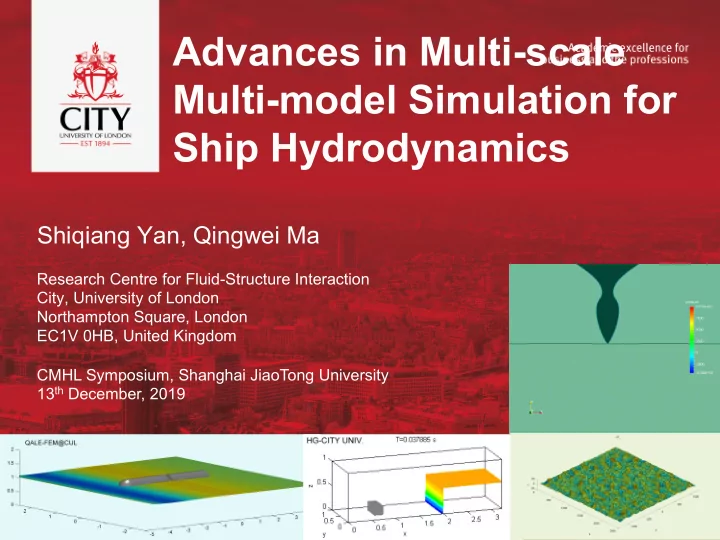
Advances in Multi-scale Multi-model Simulation for Ship Hydrodynamics

Shiqiang Yan, Qingwei Ma

Research Centre for Fluid-Structure Interaction City, University of London Northampton Square, London EC1V 0HB, United Kingdom CMHL Symposium, Shanghai JiaoTong University 13th December, 2019

slide-2
SLIDE 2

Harbours and breakwaters Submarine and subsea system

Fixed & Floating Surface & Subsea Coastal, Marine and Offshore

Advances in Multi-scale Multi-model Simulation for Ship Hydrodynamics CMHL Symposium, SJTU, 4th June, 2019

slide-3
SLIDE 3

Advances in Multi-scale Multi-model Simulation for Ship Hydrodynamics CMHL Symposium, SJTU, 4th June, 2019

WSI problems: multi-scale, multi-physics problems

Different spatial scales

  • Turbulent mixing and bubbles in centimetre
  • Vortex shedding in meters
  • Wave length in hundred meters
  • Change of energy spectrum in kilometres
  • Wind wave generation in kilometres

Different physical features

  • Viscos effect is less significant for nonbreaking

waves but significant for breaking waves

  • Compressibility is important for impact; but not

for others

  • Air entrapment may be considerable near free

surface but not otherwise Different temporal scales

  • Impacts measured by millisecond
  • Structural natural periods in centi-seconds
  • Water wave periods in a few seconds
  • Internal waves in minutes
  • Tide and tidal current in hours to days
slide-4
SLIDE 4

Potential Theory

  • Laplace Eq. + BCs
  • May + Body Eqs.
  • Linear, 2nd order, FNPT
  • BEM, FEM, HOS, SBI, SEM
  • Cannot model viscous effects,

unless appropriate artificial damping is included

  • Failed to model breaking

waves

  • Efficient for large-domain

simulation

  • Less computational cost

Viscous Flow

  • NS + Continuity Eqs + BCs
  • May + Body Eqs
  • Single or multiple phases
  • FVM, FEM, FDM and meshless
  • VOF, Level Set…
  • Can model viscous/turbulent

effects

  • Two-phase viscous model can

deal with wave breaking

  • May suffer from undesirable

numerical damping for large- domain simulation

  • High computational cost

Many models available for different problems

Advances in Multi-scale Multi-model Simulation for Ship Hydrodynamics CMHL Symposium, SJTU, 4th June, 2019

Hybrid models shall take advantage and overcome the difficulty of these models

slide-5
SLIDE 5

Multi-scale Multi-model Simulations (MMS) at City

Hybrid potential models Potential + NS

Hybrid ESBI (TS) Laminar/ turbulent (FS) MLPG-SPH

Hybrid NS models

Time (TS) or space (SS) domain splitting Functional splitting (FS)

ESBI/ QALE-FEM (SS) Inviscid/ Turbulent (FS) FEM/Meshl ess (SS) FEM/StarCD (SS) FEM/OpenFoam (SS)

Advances in Multi-scale Multi-model Simulation for Ship Hydrodynamics CMHL Symposium, SJTU, 4th June, 2019

slide-6
SLIDE 6

Potential Theory

  • Steady regular waves

(Linear, 2nd order, 5th order)

  • Enhanced Nonlinear

Schrödinger Equation (ENLSE)

  • 3rd-order Spectral Boundary

Integral Method (QSBI)

  • Enhanced Spectral Boundary

Integral Method (ESBI)

  • QALE-FEM

Viscous Flow

  • Single- and two-phase

MLPG-R

  • ISPH/SPH
  • OpenFOAM
  • StarCD/StarCCM+

Available Models at City

Advances in Multi-scale Multi-model Simulation for Ship Hydrodynamics CMHL Symposium, SJTU, 4th June, 2019

One-way coupling QALE-FEM with StarCD

Yan, S, Ma, QW (2010) “Numerical simulation of interaction between wind and 2D freak waves”, European Journal of Mechanics, B/Fluids, 29(1), 18-31.

slide-7
SLIDE 7

Focusing waves

Potential Theory

  • Steady regular waves

(Linear, 2nd order, 5th order)

  • Enhanced Nonlinear

Schrödinger Equation (ENLSE)

  • 3rd-order Spectral Boundary

Integral Method (QSBI)

  • Enhanced Spectral Boundary

Integral Method (ESBI)

  • QALE-FEM

Viscous Flow

Available Models at City

Advances in Multi-scale Multi-model Simulation for Ship Hydrodynamics CMHL Symposium, SJTU, 4th June, 2019

Two-way coupling QALE-FEM with MLPG-R

Sriram, V, Ma, QW, Schlurmann, T (2014) “A hybrid method for modelling two dimensional non-breaking and breaking waves”, Journal of Computational Physics, 272, pp. 429–454.

  • Single- and two-phase

MLPG-R

  • ISPH/SPH
  • OpenFOAM
  • StarCD/StarCCM+
slide-8
SLIDE 8
  • Single- and two-phase

MLPG-R

  • ISPH/SPH
  • OpenFOAM
  • StarCD/StarCCM+

Potential Theory

  • Steady regular waves

(Linear, 2nd order, 5th order)

  • Enhanced Nonlinear

Schrödinger Equation (ENLSE)

  • 3rd-order Spectral Boundary

Integral Method (QSBI)

  • Enhanced Spectral Boundary

Integral Method (ESBI)

  • QALE-FEM

Viscous Flow

Available Models at City

Advances in Multi-scale Multi-model Simulation for Ship Hydrodynamics CMHL Symposium, SJTU, 4th June, 2019

Two-way coupling QALE-FEM with ISPH

Fourtakas, G, Stansby, PK, Rogers, BD, Lind, SJ, Yan, S, Ma, QW (2018). “On the coupling of incompressible SPH with a finite element potential flow solver for nonlinear free- surface flows.” International Journal of Offshore and Polar Engineering, 28(3), 248–254.

slide-9
SLIDE 9
  • Single- and two-phase

MLPG-R

  • ISPH/SPH
  • OpenFOAM
  • StarCD/StarCCM+

Potential Theory

  • Steady regular waves

(Linear, 2nd order, 5th order)

  • Enhanced Nonlinear

Schrödinger Equation (ENLSE)

  • 3rd-order Spectral Boundary

Integral Method (QSBI)

  • Enhanced Spectral Boundary

Integral Method (ESBI)

  • QALE-FEM

Viscous Flow

Available Models at City

Advances in Multi-scale Multi-model Simulation for Ship Hydrodynamics CMHL Symposium, SJTU, 4th June, 2019

Two-way coupling QALE-FEM with SPH

Zhang, NB, Yan, S, Zheng, X, Ma, QW (2019) “A 3D hybrid model coupling SPH and QALE-FEM for simulating nonlinear wave-structure interaction”, the Twenty-ninth International Ocean and Polar Engineering Conference, Honolulu, Hawaii, USA.

slide-10
SLIDE 10
  • Single- and two-phase

MLPG-R

  • ISPH/ISPH
  • OpenFOAM
  • StarCD/StarCCM+

Potential Theory

  • Steady regular waves

(Linear, 2nd order, 5th order)

  • Enhanced Nonlinear

Schrödinger Equation (ENLSE)

  • 3rd-order Spectral Boundary

Integral Method (QSBI)

  • Enhanced Spectral Boundary

Integral Method (ESBI)

  • QALE-FEM

Viscous Flow

Available Models at City

Advances in Multi-scale Multi-model Simulation for Ship Hydrodynamics CMHL Symposium, SJTU, 4th June, 2019

Time splitting NLSE-QSBI-ESBI

Wang, J., Ma, Q.W. and Yan, S. (2016). A hybrid model for simulating rogue waves in random seas on a large temporal and spatial scale. Journal of Computational Physics, 313, pp. 279–309. doi:10.1016/j.jcp.2016.02.044.

Domain size: 64L016L0(~12 km 3 km) Duration: 1000Tp (~3 hours) JONSWAP spectrum ; Gaussian spreading function Intel(R) Xeon(R) CPU E5-2680 v4 @ 2.40GHz, 8-core CPU time: ESBI (52.2h), QSBI(22.6h) and ENLSE-5F(19.3h)

slide-11
SLIDE 11
  • Single- and two-phase

MLPG-R

  • ISPH/SPH
  • OpenFOAM
  • StarCD/StarCCM+

Potential Theory

  • Steady regular waves

(Linear, 2nd order, 5th order)

  • Enhanced Nonlinear

Schrödinger Equation (ENLSE)

  • 3rd-order Spectral Boundary

Integral Method (QSBI)

  • Enhanced Spectral Boundary

Integral Method (ESBI)

  • QALE-FEM

Viscous Flow

Available Models at City

Advances in Multi-scale Multi-model Simulation for Ship Hydrodynamics CMHL Symposium, SJTU, 4th June, 2019

Functional Splitting method using OpenFOAM

slide-12
SLIDE 12

Potential Theory

  • Steady regular waves

(Linear, 2nd order, 5th order)

  • Enhanced Nonlinear

Schrödinger Equation (ENLSE)

  • 3rd-order Spectral Boundary

Integral Method (QSBI)

  • Enhanced Spectral Boundary

Integral Method (ESBI)

  • QALE-FEM

Viscous Flow

  • Single- and two-phase

MLPG-R

  • ISPH
  • OpenFOAM
  • StarCD/StarCCM+

Available Models at City

qaleFOAM

Advances in Multi-scale Multi-model Simulation for Ship Hydrodynamics CMHL Symposium, SJTU, 4th June, 2019

slide-13
SLIDE 13

QALE-FEM OpenFOAM

v Governing equation v Velocity-pressure coupling v Continuity equation v Two-phase incompressible/compressible NS v FVM v Volume of Fraction (VOF) v RANS or LES for turbulent modelling

2 =

Ñ f

f Ñ = u !

gz t p

  • Ñ

  • =

2 /

2

f f r

Ø Time-consuming Two- phase NS solver(OpenFOAM) covers small zone near the structures Ø The majority solved by the QALE-FEM Ø Overlap area: a robust quadric interpolation scheme is developed and used

Advances in Multi-scale Multi-model Simulation for Ship Hydrodynamics CMHL Symposium, SJTU, 4th June, 2019

slide-14
SLIDE 14

Advances in Multi-scale Multi-model Simulation for Ship Hydrodynamics CMHL Symposium, SJTU, 4th June, 2019

Coupling Approach in qaleFOAM

Ø OpenFOAM domain is placed inside the FNPT domain (Overset)

QALE-FEM OpenFOAM

!, ∇$ ,

gz t p

  • Ñ

  • =

2 /

2

f f r

%, &, '()* +,&-./01) Ø Translational zone: smooth the solution + convenience for gradient calculation + absorbing wave reflection (one-way coupling) Ø Wave outlet of NS domain: free passage of the wave into FNPT domain (two-way coupling); or smoothed from NS solver to FNPT solver(one-way coupling)

slide-15
SLIDE 15

Coupling Approach in qaleFOAM

Advances in Multi-scale Multi-model Simulation for Ship Hydrodynamics CMHL Symposium, SJTU, 4th June, 2019

Ø Couple the QALE-FEM with OpenFOAM through inlet boundaries

ü Improved passive wave absorber based on the feedback of the recorded wave elevation

Overall accuracy depends on

  • Accuracy of the data (velocity,

pressure and surface elevation) transmit from the QALE-FEM domain (large domain) into the internal domain;

  • Size of the relaxation zone

!" # = % &(#) cosh - .(#) / + 1 sinh - .(#)1 4 5 # 6 7" 8!9 87 = 0

Sampling the instantaneous 4 5(#)

slide-16
SLIDE 16

Wave Generation in qaleFOAM

Physical Models and Validations

Ø Linear( regular and irregular) Ø Stokes 2nd and 5th (regular) Ø 2nd order wave theory (regular and irregular, unidirectional and directional) Ø Fully-Nonlinear Potential Theory (QALE-FEM) - regular and irregular with or without current ü Considering seabed geometry ü Highly nonlinear up to wave

  • verturning

ü Directional and uni-directional wave ü Wave-wave interaction in crossing sea (swell and wind-wave) ü Wind and current effects on water waves ü Self-correction and self-adaptive wavemaker theories

3D overturning waves 3D crossing-sea Wind/current effects

Advances in Multi-scale Multi-model Simulation for Ship Hydrodynamics CMHL Symposium, SJTU, 4th June, 2019

slide-17
SLIDE 17

Wave Generation examples

Physical Models and Validations

0.5 1 1.5 2 2.5 3 3.5 4

  • 0.02
  • 0.01

0.01 0.02 0.03 Gauge location:14.5m 0.5 1 1.5 2 2.5 3 3.5 4

  • 0.02
  • 0.01

0.01 0.02 0.03 Gauge location:19m

Advances in Multi-scale Multi-model Simulation for Ship Hydrodynamics CMHL Symposium, SJTU, 4th June, 2019

slide-18
SLIDE 18

Physical Models and Validations

Wave Generation examples

Advances in Multi-scale Multi-model Simulation for Ship Hydrodynamics CMHL Symposium, SJTU, 4th June, 2019

slide-19
SLIDE 19

Physical Models and Validations

Ø Reproducing objective wave using self-correction wavemaker technique

Using the gauge signal at WG1 as the target signal Assign the wavemaker motion using linear wavemaker theory and run QALE-FEM modelling Compare the numerical prediction with target signal, to correct the wavemaker motion Using the corrected signal to un the QALE-FEM modelling

42 43 44 45 46 47 48 49 50 51 52

t(s)

  • 0.1
  • 0.05

0.05 0.1

(m) (c) 13BT1 WG1

experimental qaleFOAM

42 43 44 45 46 47 48 49 50 51 52

t(s)

  • 0.1
  • 0.05

0.05 0.1

(m) (d) 12BT1 WG1

experimental qaleFOAM

Wave time history recorded at WG1 in the cases without FPSO (cases 12BT1 and 13BT1)

Wave Generation examples

Advances in Multi-scale Multi-model Simulation for Ship Hydrodynamics CMHL Symposium, SJTU, 4th June, 2019

slide-20
SLIDE 20

42 43 44 45 46 47 48 49 50 51 52

t(s)

  • 0.1
  • 0.05

0.05 0.1

(m) (a) 13BT1 WG16

experimental qaleFOAM 42 43 44 45 46 47 48 49 50 51 52

t(s)

  • 0.1
  • 0.05

0.05 0.1

(m) (b) 12BT1 WG16

experimental qaleFOAM

Wave time history recorded at WG16 in the cases without FPSO (cases 12BT1 and 13BT1)

Ø Reproducing objective wave using self-correction wavemaker technique

Wave Generation examples

Advances in Multi-scale Multi-model Simulation for Ship Hydrodynamics CMHL Symposium, SJTU, 4th June, 2019 Using the gauge signal at WG1 as the target signal Assign the wavemaker motion using linear wavemaker theory and run QALE-FEM modelling Compare the numerical prediction with target signal, to correct the wavemaker motion Using the corrected signal to un the QALE-FEM modelling

slide-21
SLIDE 21

Case Studies and Benchmark Tests

Advances in Multi-scale Multi-model Simulation for Ship Hydrodynamics CMHL Symposium, SJTU, 4th June, 2019

  • Nonlinear (extreme) wave modelling
  • Case 1: Fixed horizontal cylinder (2D) under the

actions of wave and current

  • Case 2 (Blind Test): fixed FPSO subjected to

extreme waves

  • Case 3: Gap resonance
  • Case 4: freely-floating barges in waves
  • Case 5 (Blind Test): point absorber WECs in

waves

  • Case 6: Offshore wind turbine in waves
  • Case 7: Vertical cylinder moving in focusing waves
  • Case 8: trimaran moving in waves with different

heading

Fixed Forward speeding Free floating moored

slide-22
SLIDE 22

Blind Test 1: fixed FPSO in Focusing waves

  • A fixed FPSO-like structure subjected to extreme waves
  • Uni-directional focusing waves with
  • Different wave steepness and directionalities
  • Wave elevation and pressure measurements are taken into account

Advances in Multi-scale Multi-model Simulation for Ship Hydrodynamics CMHL Symposium, SJTU, 4th June, 2019

DIFFRACTION

slide-23
SLIDE 23

§ Wave runup on the FPSO surface

45 46 47 48 49 50 51 52 53 54 55

(s)

  • 0.1
  • 0.05

0.05 0.1 0.15

(m) (a) WG16

Exp QALE-FEM LES qaleFOAM

45 46 47 48 49 50 51 52 53 54 55

(s)

  • 0.1
  • 0.05

0.05 0.1

(m) (c) WG24

Exp QALE-FEM LES qaleFOAM 45 46 47 48 49 50 51 52 53 54 55

(s)

  • 0.1
  • 0.05

0.05 0.1

(m) (b) WG17

Exp QALE-FEM LES qaleFOAM

45 46 47 48 49 50 51 52 53 54 55

(s)

  • 0.1
  • 0.05

0.05 0.1 0.15

(m) (d) WG18

Exp QALE-FEM LES qaleFOAM

Advances in Multi-scale Multi-model Simulation for Ship Hydrodynamics CMHL Symposium, SJTU, 4th June, 2019

Blind Test 1: fixed FPSO in Focusing waves

slide-24
SLIDE 24

§ Pressure on FPSO

surface

Time histories of the pressure recorded at different positions on the FPSO surface(Case 12BT1)

Blind Test 1: fixed FPSO in Focusing waves

Advances in Multi-scale Multi-model Simulation for Ship Hydrodynamics CMHL Symposium, SJTU, 4th June, 2019

slide-25
SLIDE 25

v The QALE-FEM has highest robustness within all methods participating into the Blind test v The performance of the qaleFOAM may be at the similar level as SWENSE and wave2Foam v the qaleFOAM has been

  • ptimised for more effective

parallel computing and time step-marching technique. The CPU time for this case can be saved by at least 50%.

Advances in Multi-scale Multi-model Simulation for Ship Hydrodynamics CMHL Symposium, SJTU, 4th June, 2019

Blind Test 1: fixed FPSO in Focusing waves

slide-26
SLIDE 26

FNPT domain NS domain Self-adaptive wavemaker Self-correction wavemaker

Blind Test 2: Point Absorber WECs in focusing wave

Advances in Multi-scale Multi-model Simulation for Ship Hydrodynamics CMHL Symposium, SJTU, 4th June, 2019

Passive wave absorber

MOTION RESPONSES

slide-27
SLIDE 27

Blind Test 2: Point Absorber WECs in focusing wave

Advances in Multi-scale Multi-model Simulation for Ship Hydrodynamics CMHL Symposium, SJTU, 4th June, 2019

slide-28
SLIDE 28

§ Wave Generation in the empty tank test

30 35 40 45 50 55 60

t(s)

  • 0.2
  • 0.1

0.1 0.2

(m)

exp qaleFOAM

30 35 40 45 50 55 60

t(s)

  • 0.2
  • 0.1

0.1 0.2

(m)

exp qaleFOAM

30 35 40 45 50 55 60

t(s)

  • 0.2
  • 0.1

0.1 0.2

(m)

exp qaleFOAM

Case 1BT Case 2BT Case 3BT

Blind Test 2: Point Absorber WECs in focusing wave

Advances in Multi-scale Multi-model Simulation for Ship Hydrodynamics CMHL Symposium, SJTU, 4th June, 2019

slide-29
SLIDE 29

§ Wave Generation in the empty tank test

Case 1BT Case 2BT Case 3BT

30 35 40 45 50 55 60

t(s)

  • 0.2
  • 0.1

0.1 0.2

(m)

exp qaleFOAM 30 35 40 45 50 55 60

t(s)

  • 0.2
  • 0.1

0.1 0.2

(m)

exp qaleFOAM

30 35 40 45 50 55 60

t(s)

  • 0.2
  • 0.1

0.1 0.2

(m)

exp qaleFOAM

Blind Test 2: Point Absorber WECs in focusing wave

Advances in Multi-scale Multi-model Simulation for Ship Hydrodynamics CMHL Symposium, SJTU, 4th June, 2019

slide-30
SLIDE 30

§ Wave Generation in the empty tank test

Case 1BT Case 2BT Case 3BT

30 35 40 45 50 55 60

t(s)

  • 0.2
  • 0.1

0.1 0.2

(m)

exp qaleFOAM 30 35 40 45 50 55 60

t(s)

  • 0.2
  • 0.1

0.1 0.2

(m)

exp qaleFOAM

30 35 40 45 50 55 60

t(s)

  • 0.2
  • 0.1

0.1 0.2

(m)

exp qaleFOAM

§ NS domain terminated at WG8

with developed passive wave absorber

Blind Test 2: Point Absorber WECs in focusing wave

Advances in Multi-scale Multi-model Simulation for Ship Hydrodynamics CMHL Symposium, SJTU, 4th June, 2019

slide-31
SLIDE 31

§ Why develop passive wave absorber based on feedback

signal from the NS simulation

20 22 24 26 28 30 32 34 36 38 40

t(s)

  • 0.3
  • 0.2
  • 0.1

0.1 0.2 0.3 0.4

(m)

Exp present absorber L NS=15m present absorber L NS=10m present absorber L NS=7m damping zone Ld=6m LNS = 15m

20 22 24 26 28 30 32 34 36 38 40

t(s)

  • 0.3
  • 0.2
  • 0.1

0.1 0.2 0.3 0.4

(m)

Exp present absorber L NS=15m present absorber L NS=10m present absorber L NS=7m damping zone Ld=6m LNS = 15m

Comparison of the wave elevation recorded at different locations in the cases with different tank length(case 3BT3)

Blind Test 2: Point Absorber WECs in focusing wave

Advances in Multi-scale Multi-model Simulation for Ship Hydrodynamics CMHL Symposium, SJTU, 4th June, 2019

slide-32
SLIDE 32

Blind Test 2: Point Absorber WECs in focusing wave

Advances in Multi-scale Multi-model Simulation for Ship Hydrodynamics CMHL Symposium, SJTU, 4th June, 2019

Motion and mooring force of Model 1 subjected to Wave 2BT3 Motion and mooring force of Model 2 subjected to Wave 2BT3

The qaleFOAM well predict the surge, heave and mooring force time history and well capture the extreme values

slide-33
SLIDE 33

Blind Test 2: Point Absorber WECs in focusing wave

Advances in Multi-scale Multi-model Simulation for Ship Hydrodynamics CMHL Symposium, SJTU, 4th June, 2019

0.2 0.4 0.6 0.8 1 1.2 1.4 1.6 1.8 2

f (Hz)

0.1 0.2 0.3

Amp.(m) (a) Surge

Model 1 Exp Model 1 Num Model 2 Exp Model 2 Num

0.2 0.4 0.6 0.8 1 1.2 1.4 1.6 1.8 2

f (Hz)

0.05 0.1

Amp.(m) (b) Heave

Model 1 Exp Model 1 Num Model 2 Exp Model 2 Num

0.2 0.4 0.6 0.8 1 1.2 1.4 1.6 1.8 2

f (Hz)

2 4 6 8

Amp.(Deg) (c) Pitch

Model 1 Exp Model 1 Num Model 2 Exp Model 2 Num

0.2 0.4 0.6 0.8 1 1.2 1.4 1.6 1.8 2

f (Hz)

0.05 0.1

amp.(m) (d) Wave at WG5

exp qaleFoam

Amplitude spectra of responses of WECs to Wave 2BT3 and corresponding wave spectra at WG5

The agreement between the qaleFOAM results and the experimental data is not as close as other motion modes and the mooring load

slide-34
SLIDE 34

Blind Test 2: Point Absorber WECs in focusing wave

Advances in Multi-scale Multi-model Simulation for Ship Hydrodynamics CMHL Symposium, SJTU, 4th June, 2019

heave surge pitch RMS error on wave generation RMS error on motion

v Better accuracy in wave generation à higher accuracy on predicting motions and mooring load v qaleFOAM well reproduce the incident waves and, consequently, delivers a high accuracy on others

slide-35
SLIDE 35

Blind Test 2: Point Absorber WECs in focusing wave

Advances in Multi-scale Multi-model Simulation for Ship Hydrodynamics CMHL Symposium, SJTU, 4th June, 2019

v Potential models take short time but the error are relatively high v The error of the qaleFOAM is similar for all 6 cases -- RELIABLE v Within the same accuracy level, the qaleFOAM is the fastest method in the blind test

slide-36
SLIDE 36

Forwarding trimaran in waves with different heading

Advances in Multi-scale Multi-model Simulation for Ship Hydrodynamics CMHL Symposium, SJTU, 4th June, 2019

SEAKEEPING & ADDED RESISTANCE

v QALE-FEM domain covers a large space v Small OpenFOAM domain surrounding the trimaran moves in the FNPT domain at the forwarding speed v One-way coupling with translational zone technique

slide-37
SLIDE 37

Forwarding trimaran in waves with different heading

Advances in Multi-scale Multi-model Simulation for Ship Hydrodynamics CMHL Symposium, SJTU, 4th June, 2019

0.5 1.0 1.5 2.0 2.5 5 10 15 20 25 30 35 Raw/(ρ ga

2BWL 2/LWL)

λ /LWL

  • Exp. (HEU)
  • Cal. (QaleFOAM)

0.5 1.0 1.5 2.0 2.5 0.0 0.3 0.6 0.9 ξ 3/a λ /LWL

  • Exp. (HEU)
  • Cal. (QaleFOAM)
  • Exp. (HEU)
  • Cal. (QaleFOAM)

0.5 1.0 1.5 2.0 2.5 0.0 0.3 0.6 0.9 1.2 1.5 ξ 5/(ak) λ /LWL

Added resistance Heave RAO Pitch RAO

Validation: Trimaran model in head sea, Fr = 0.35 ka = 0.047~0.065) v Satisfactory agreement between the qaleFOAM results and the experimental data has been achieved

slide-38
SLIDE 38

Summary

  • Outline the hybrid models developed at City with focuses on the

development and applications of the qaleFOAM

  • Blind tests on the wave diffraction and motion responses in

extreme sea have demonstrated the satisfactory robustness of the qaleFOAM

  • The accuracies of WSI problems closely correlate to the accuracy
  • f the wave generation and the QALE-FEM in the qaleFOAM

provides a good basis securing the accuracy of the qaleFOAM for modelling WSI

  • With its relatively high computational efficiency, the qaleFOAM

may be applied to wide range of ship hydrodynamic problems

Advances in Multi-scale Multi-model Simulation for Ship Hydrodynamics CMHL Symposium, SJTU, 4th June, 2019

slide-39
SLIDE 39

Dr Shiqiang Yan City, University of London Northampton Square London EC1V 0HB United Kingdom T: +44 (0)20 7040 3330 E: Shiqiang.yan@city.ac.uk

Acknowledgement

  • Supported by EPSRC projects (EP/L01467X/1,

EP/N008863/1 and EP/M022382/1)

  • Some results are produced by Prof Qingwei Ma, Prof.

Sriram V (IIT Madras, India), Dr. Jinghua Wang, Dr. Juntao Zhou, Dr. Liang Yang Qian Li and Junxian Wang in the same team

slide-40
SLIDE 40

Forwarding trimaran in waves with different heading

Advances in Multi-scale Multi-model Simulation for Ship Hydrodynamics CMHL Symposium, SJTU, 4th June, 2019

Nonlinear effects

v Nonlinear effect is more significant when incident wave angle ! is larger than 120o

90 120 150 180 5 10 15 20 25 30 Raw/(ρ ga

2BWL 2/LWL)

Fr=0.35, ak=0.135, λ =1.09LWL Fr=0.35, ak=0.096, λ =1.09LWL Fr=0.35, ak=0.058, λ =1.09LWL β (° ) 90 120 150 180 0.0 0.3 0.6 0.9 1.2 1.5 Fr=0.35, ak=0.135, λ =1.09LWL Fr=0.35, ak=0.096, λ =1.09LWL Fr=0.35, ak=0.058, λ =1.09LWL ξ 3/a β (° ) 90 120 150 180 1 2 3 Fr=0.35, ak=0.135, λ =1.09LWL Fr=0.35, ak=0.096, λ =1.09LWL Fr=0.35, ak=0.058, λ =1.09LWL ξ 4/(ak) β (° ) 90 120 150 180 0.0 0.3 0.6 0.9 1.2 1.5 Fr=0.35, ak=0.135, λ =1.09LWL Fr=0.35, ak=0.096, λ =1.09LWL Fr=0.35, ak=0.058, λ =1.09LWL ξ 5/(ak) β (° )

Added resistance heave Roll Pitch

v Less sensitive to the wave steepness when the wave incident angle is near 90o (beam sea)
slide-41
SLIDE 41

Forwarding trimaran in waves with different heading

Advances in Multi-scale Multi-model Simulation for Ship Hydrodynamics CMHL Symposium, SJTU, 4th June, 2019

Local wave pattern

For the wave incident angle of ! = 135o v Significant asymmetry in the gap elevation results in a larger roll motion v Green water

  • ccurrence explains

more significant heave motion

Snapshots of the free surface around trimaran with "/$%&= 1.09

slide-42
SLIDE 42

Forwarding trimaran in waves with different heading

Advances in Multi-scale Multi-model Simulation for Ship Hydrodynamics CMHL Symposium, SJTU, 4th June, 2019

v all the quantities near the beam sea are much less sensitive to the wavelength than in the cases with the incident wave angle larger than 100o. v significant roll lies in 110o≤ " ≤ 155o, not at the beam sea

Effects of wavelength

slide-43
SLIDE 43

Case Study 3: Gap Resonance

v Viscous effects play important role in the gap resonance v The QALE-FEM can simulate the gap resonance with appropriate artificial viscous damping

Advances in Multi-scale Multi-model Simulation for Ship Hydrodynamics CMHL Symposium, SJTU, 4th June, 2019

slide-44
SLIDE 44

Case Study 3: Gap Resonance

Advances in Multi-scale Multi-model Simulation for Ship Hydrodynamics CMHL Symposium, SJTU, 4th June, 2019

2D fixed structures with small gap in regular waves Comparison on wave elevation in gap(regular wave)

1 2 3 4 5 6 7 8 9 10

kh

1 2 3 4 5

Ag(kh)/Ai(kh)

present present (smooth) exp.[4]

WAVE HEIGHT (Hg) AT THE CENTRE OF THE GAP IN THE CASE WITH DIFFERENT WAVE STEEPNESS (Bg =3cm, d = 25.2cm; Nx = 160, Nz = 15)