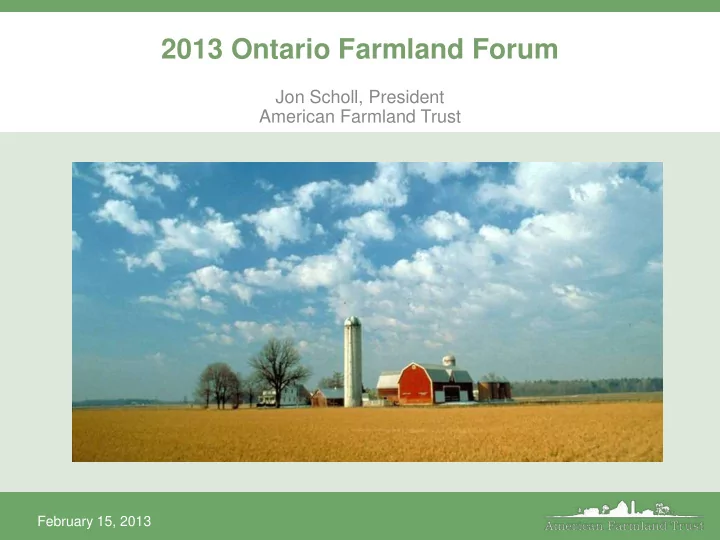
SLIDE 1 2013 Ontario Farmland Forum
Jon Scholl, President American Farmland Trust
February 15, 2013
SLIDE 2 What I Want to Cover
1. What is the American Farmland Trust?
- 2. What opportunities and challenges does agriculture
face?
- 3. How can agriculture be part of the solution?
SLIDE 3
AFT Mission
The mission of American Farmland Trust is to save farmland, promote sound farming practices and keep farmers on the land.
SLIDE 4
What is AFT?
Founded in 1980 Focused on protection of working lands 50 staff in 12 locations across the U.S $10 million annual budget
SLIDE 5 AFT Program Priorities
Permanently protect farm and ranch land. Reduce the rate of agricultural land converted to development. Grow farming and ranching on threatened land. Reduce nutrients loss, replicate models and scale-up. Engage agriculture in climate change mitigation and adaptation. Enact Federal, State and local policies supporting our
SLIDE 6
AFT Strategies
Position – between agriculture and environment
Research – give us the facts Collaborate – grow partnerships Demonstrate – “on the ground” credibility Balance – environment and economic compatibility
SLIDE 7
Opportunities Ahead!
SLIDE 8
Population Growth
SLIDE 9
Growth in Middle Class
“It took al all of human an hist story to bu build d the se seven-trillio rillion-do dollar llar world d economy of 19 1950; 0; toda day economic c ac activity ity grows s by by that at am amount every de decad ade.”
James Gustave Speth The Bridge at the Edge of the World Yale University
SLIDE 10 Demand Growth
20 40 60 80 100 120 140 160 1990 1995 2000 2005 2010 2015 2020 China & HK EU 1/ Other Africa & M. East Mexico Latin America FSU & OE 2/ East Asia
SLIDE 11
Energy Demand
Renewable Fuel Standard – 36 billion gallons of renewable fuels by 2022, 15 billion from ethanol. 29 of 50 states have Renewable Portfolio Standards covering 54% of total U.S. retail electricity sales in 2012. Wind energy alone could provide 80,000 new jobs and $1.2 billion in new income for farmers and rural landowners by 2020.
SLIDE 12
Growing Interest in Food
SLIDE 13 Strong Headwinds!
- 1. Less land
- 2. More demand for water
- 3. Changing climate
- 4. More public scrutiny
- 5. Fewer public resources
SLIDE 14
Farmland Conversion
SLIDE 15 Runoff
USDA Study of Upper Mississippi River Basin:
- N and P loss reduced 45% in last 5 years.
- 15% of cultivated cropland has a high level of
need for additional conservation treatment.
- Another 45% has a moderate level of need.
SLIDE 16
Water Availability
SLIDE 17
SLIDE 18 Climate Change
U.S. Geological Survey (2012):
- By 2050, will triple the fraction of counties in the U.S. that
are at a high or extremely high risk of outstripping their water supplies will triple. University of Tennessee – Study of eastern U.S. (2012):
- By 2057-2059, up to 3 degree Celsius temperature rise
- 35 percent increase in precipitation
- Duration of heat waves will increase from 4 to 6 days.
SLIDE 19 Status of U.S. Climate Debate
“We will respond to the threat of climate change, knowing that the failure to do so would betray our children and future generations. Some may still deny the
- verwhelming judgment of science, but note can avoid
the devastating impact of raging fires and crippling drought and more powerful storms.” Barack Obama Second Inaugural Address January 21, 2013
SLIDE 20
U.S. Public Opinion
“ …strikingly high numbers of Americans accept that the climate is changing, but support for market-based approaches such as a carbon tax and a system of tradable emissions are not popular...” “ Support rises when asked about more familiar concepts of regulation, such as performance standards, but respondents appear to have little or no knowledge about the possible use of a cap-and-trade system to address climate change.” Sarah Adair Duke University Nicholas Institute for Environmental Policy Studies January 2013
SLIDE 21
Farm Bill: Fewer Resources
SLIDE 22
Ag as the Solution!
SLIDE 23 Ag as the Solution!
A study done for Greater Miami Conservancy District in Ohio found that point source upgrades averaged $62.62/lb P and $18.97/lb N whereas ag BMPs averaged $14.19/lb P and $7.06/N. If agriculture widely implemented GHG mitigation/reduction strategies, we could achieve a 9-26% reduction in nitrous oxide and a 15-56% reduction in methane. Wetlands can remove up to 68% of the nitrate-nitrogen draining from tile lines and 43% of the P - but are more effective if they are large relative to the drainage area.
SLIDE 24
Ag as the Solution!
SLIDE 25
www.farmland.org