ACHIEVERS 1. Teboho Malisebo Mokela Authoriser 2. Maleshoane - - PowerPoint PPT Presentation

achievers
SMART_READER_LITE
LIVE PREVIEW

ACHIEVERS 1. Teboho Malisebo Mokela Authoriser 2. Maleshoane - - PowerPoint PPT Presentation

TEAM LESOTHO-THE ACHIEVERS 1. Teboho Malisebo Mokela Authoriser 2. Maleshoane Lekomola Chief Budget Officer 3. Masetsibi Macheli Senior Budget Officer 4. Nthabiseng Tarumbiswa Senior Economist 5. Marethabile Tsoeu Senior


slide-1
SLIDE 1

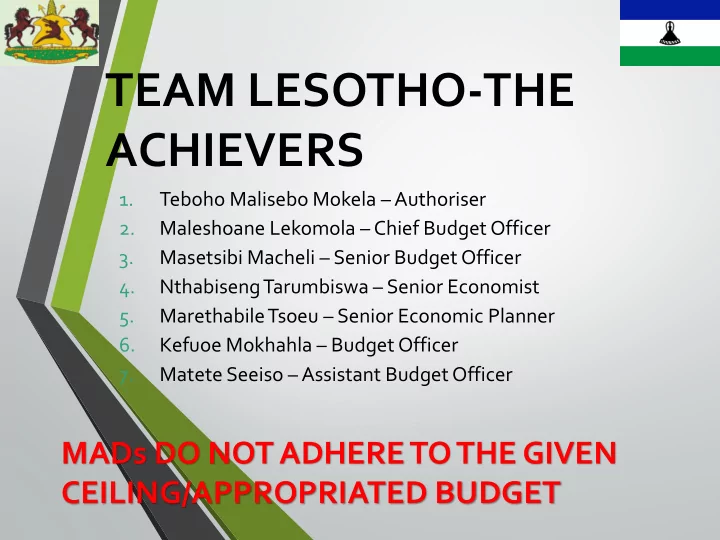
TEAM LESOTHO-THE ACHIEVERS

MADs DO NOT ADHERE TO THE GIVEN CEILING/APPROPRIATED BUDGET

1. Teboho Malisebo Mokela – Authoriser 2. Maleshoane Lekomola – Chief Budget Officer 3. Masetsibi Macheli – Senior Budget Officer 4. Nthabiseng Tarumbiswa – Senior Economist 5. Marethabile Tsoeu – Senior Economic Planner 6. Kefuoe Mokhahla – Budget Officer 7. Matete Seeiso – Assistant Budget Officer

slide-2
SLIDE 2

INITIAL PROBLEM

Budget process is not credible as far as a PFM processes are concerned. This has led to multiple fundamental flaws in the country’s economic development, governance and PFM system

slide-3
SLIDE 3

BEGINNING

  • At the framing workshop held in Johannesburg we

reformulated a new problem statement

  • Identified the key entry points which we thought were

quick wins

  • The team came home and presented the problem

statement to the HODs, departments/key people for their inputs and endorsement.

slide-4
SLIDE 4

INVOLVEMENT

  • Authorisers
  • Colleagues from:

▪ Budget, Macroeconomic Policy and Management, Project Cycle

Management, Treasury and MDA`s.

  • For departments to be on the same page with the Team to

understand and appreciate the problem;

  • MDA`s to understand the problem and their involvement

towards resolving it.

  • Consult all stakeholders to probe the scope of the problem
slide-5
SLIDE 5
slide-6
SLIDE 6

AUTHORISERS

slide-7
SLIDE 7

CONSULTATIONS

  • Extensive consultative process, with

MDA and numerous departments within treasury.

  • They came in with a new perspective

which the Team was not aware of.

slide-8
SLIDE 8

REVISED PROBLEM AND FISHBONE

MDAs do not Adhere to the giv iven ceil ilin ings/ / appropria iated Budget

Limited involvement by Macro to MDAs Limited dissemination

  • f information

Lack of understanding by MDAs Reliance on preliminary GDP results Lack of Capacity & Capability Lack of discipline in spending There are arrears No Budget Regulations Conflicting Law With SOEs Laws

LES ESOTHO TEA EAM – FISHBONE E ANALYS YSIS

MDAs sign MOUs that have financial implementation without MOF knowledge

slide-9
SLIDE 9

ACHIEVEMENTS ON THE FISHBONE

slide-10
SLIDE 10

MACROECONOMIC CONSTRAINTS NOT TAKEN INTO ACCOUNT

 To start the action, team secured funding

for the training of MDAs to be conducted from the Ministry of Finance.

 The trainings was conducted from 14-17

August 2017;

 Conducted a training sessions for all 35

MDAs in groups for four days;

 Participants included Deputy Principal

Secretaries, Directors of Planning Units and Human Recourses, Procurement and Finance Managers;

 MDA`s have shown a more

understanding of the fiscal framework and where the overall envelop come from;

  • The credibility of the MoF ceilings is

compromised – due time consistency

 They appreciated and recommended to

have regular consultations on the macro issues;

slide-11
SLIDE 11

CONTINUE…

  • Prepared a training report and circulated it to colleagues;
  • Conducted an induction presentation to Cabinet about

the Budget Process and MTFF as well as the challenges

  • n the 27th August 2017; and
  • Disseminated Macroeconomic related information

through the 2018/19 BSP which was approved by Cabinet and published on the MoF website.

slide-12
SLIDE 12
slide-13
SLIDE 13

THE ECONOMIC ASSUMPTIONS UNDERLYING THE FORECASTS ARE WEAK

  • Firstly Technical Working Group (TWG) was formed,

consisting of the following offices (Macro, Budget, MDP, BOS, LRA, CBL, LNDC, IMF Resident Office)

  • The Group met for the first time on the 25/07/2017 and

the following are the outputs of the meeting:

  • Resolved some data inconsistencies;
  • Paved a smooth working relationship in data sharing as

compilers and users;

  • Agreed on an addendum to correct the published 2015/2016

GDP data to improve future data forecasts; and

  • BOS has started work on quarterly GDP under the project

called Public Sector Modernisation, the TOR for the consultant who will assist BOS on this have been drafted and submitted to the project coordination unit.

slide-14
SLIDE 14

CONTINUE…

  • Improved working relationship for data sharing;
  • Agreed on an addendum to correct the published 2015/16 GDP

data to improve future data forecasts;

  • Published the agreed 2015/16 GDP;
  • BoS begun work on quarterly GDP under the Public Sector

Modernisation Project, the TOR for the consultant who will assist BOS on this have been drafted and submitted to the World Bank for a no objection;

  • Preliminary quarterly GDP has been released/shared with

stakeholders for both first and second quarters;

  • Actual figures will be released in March 2018, so that fiscal

forecast will be more accurate.

slide-15
SLIDE 15

LACK OF COMPLIANCE TO THE BUDGET LAWS AND BUDGET RULES

  • Budget Regulations have been

presented to the Budget department for approval;

  • MoF is in the process of amending

the PFMA Act, All relevant departments have consolidated and send their proposed amendments to the Act to Legal Department;

  • Submitted the proposed

amendments to Cabinet for policy clearance.

slide-16
SLIDE 16
slide-17
SLIDE 17

INSUFFICIENT REPORTING OF EXPENDITURE AND REVENUE

  • Organised a meeting with Treasury Department to discuss the

2016/17 annual accounts as part of reporting. In that meeting we discussed:

  • Issues leading to reporting problems that included misappropriation of

funds, spending outside the system and too many bank accounts which are not reconciled; and

  • working relationship between Treasury and Budget departments were

improved.

  • Treasury reported some actions that have been undertaken in

respect of the different parts of the bone as follows:

slide-18
SLIDE 18

CONTINUE…

Insufficient Reconciliation in IFMIS - lack of understanding by MDAs; the following action has been made:

  • Developed a training task team within Treasury department;
  • Trainings were undertaken in May 2017 to inform ministries of

the importance and impact of non-reconciliation regarding the 2016/2017 annual financial accounts report.

  • Follow up workshops were also conducted to discuss the

preliminary findings of the 2016/2017 Auditor General Report.

  • Treasury also intends to have this type of trainings on annual

basis to keep up the momentum with MDAs. MDAs do not Keep Proper Books of Accounts:

  • MDAs were trained from 1st – 3rd November 2017 about

keeping the proper books of accounts and its importance which will also assist in reconciliation.

slide-19
SLIDE 19

CONTINUE…

Lack of capacity and capability; incompatibility of Central Bank of Lesotho (CBL) statements with IFMIS/Treasury request:

  • CBL changed its banking system without proper consultation with

GOL thereby leading to non-reconciliation in Treasury main accounts;

  • CBL then met the requirements of GOL by mapping the GOL format,

testing it and then finally being able to produce the weekly statements in the format that GOL requires from October 2017 to present without any technical hiccups. Lack of capacity to remit revenue by MDAs: Treasury management formed a Task Team which conducted trainings to MDAs in May to tackle issues of remitting revenue in the IFMIS; Following the training, a realisable impact of up to date revenue remittances and reconciliation has been noticed; and The plan is to continue with quarterly trainings to keep up the energy

  • f the MDAs.
slide-20
SLIDE 20

CONTINUE…

Revenue collected manually; insufficient capacity and support

  • n revenue receipting system:
  • GOL decided to do away with the receipting system as it had

no technical support from the vendor and it proved to be problematic with the few MDAs that were used for pilot.

  • Second option was to introduce a digital pen and digital

receipts which are connected to the telephone lines and directly communicate with the IFMIS server

  • With this revenue collection improved.
  • Advantage of this system is that it works even at the remote

areas where there is no internet access.

slide-21
SLIDE 21

CONTINUE…

Insufficient reporting of SOEs; No standard reporting format:

  • First step that was taken here was to call all SOEs in one room

to discuss the importance of reporting on an annual basis

  • Established a working relationship with SOEs which never

existed. COA does not allow proper reporting:

  • MOF has taken lead in reviewing the current COA and the draft

prototype structure has been developed.

  • The structure presented to both department of Treasury and

Budget as they are the main stakeholders.

  • COA presented to MOF management and was approved for

implementation in 2019/2020 with the IFMIS upgrade.

  • Plan is to hand over this problem to Treasury Team with

assistance from this team.

slide-22
SLIDE 22
slide-23
SLIDE 23

MISUSE OF VIREMENTS, REALLOCATIONS AND CONTINGENCY

No proper planning and budget

  • Introduced and customized central budget management system;
  • Trained 180 people in 35 MDAs on how to use the new system;
  • Budget will be presented for the first time using programmes to

Parliament thereby implementing the law;

  • The system will not allow MDAs to go above the ceiling and therefore

MDAs will prioritise what should fit within the ceiling;

  • Clear costing guidelines and methodology have been designed;
  • System will also assist in uninformed budget cuts
slide-24
SLIDE 24

CONTINUE…

IFMIS allows many virements than it should Team collected virement data and the following are the

  • bservations:
  • There are a few entities that vire significantly:
  • Engage MDA using the data;
  • There are a few items in which we see lots of virement

and the following are some of the findings:

slide-25
SLIDE 25

0,0000% 5,0000% 10,0000% 15,0000% 20,0000% 25,0000%

  • 50 000 000,00

100 000 000,00 150 000 000,00 200 000 000,00 250 000 000,00 300 000 000,00 350 000 000,00 400 000 000,00 450 000 000,00 500 000 000,00

Publice Service Public Service Commission Ombudsman Auditor Generals Office Foreign Affairs & International Relations Senate Interest Charges Public Service Directorate of Corruption & Economic… Gender,Youth ,Sport and Recreation Forestry,Range and Soil Conservation Labour & Employment Mininig Juduciary Statutory Salaries & Allowances Tourism,Arts and Culture National Assembly Water Energy and Meteorology Trade & Industry Agriculture and Food Security Law and Constitutional Affairs Social Development Communication,Science & Technology Home Affairs Justice,Human Right & Correctional… Local Government & Chieftainship Finance His Majesty's Office Defence & National Security Police and Public Safety Small Business, Development… Public Works & Transport Prime Ministers Office Health Independent Electoral Commission Educationa and Training Development Planning Centralisised Items Contingencies Fund

Virements by organization (where money is vired from)
slide-26
SLIDE 26
  • 100 000 000,00

200 000 000,00 300 000 000,00 400 000 000,00 500 000 000,00 600 000 000,00

Virement by organization (where money is vired to)

slide-27
SLIDE 27
  • 50 000 000,00

100 000 000,00 150 000 000,00 200 000 000,00 250 000 000,00 300 000 000,00 350 000 000,00 400 000 000,00 450 000 000,00 500 000 000,00

Contingencies Consultancies Salaries-Established Post Fuel and Lubricants Student Grants - National Manpower Dev. Vhehicle Maintenance and Repair Vehicle Maintenance and Repairs Other Dwellings Grants in Aid to Extra Budgetary Units CapitalTransfers - Non Financial Corps Other Structures Subsistence Local Short Term Hire of Vehicles Office Equipment Communication Fares Local Purchases or Production of Materials Other Non Residential Buildings Books and Publication Rent and Lease of Building Vehicle, Cycles & Equine Non-life Insurance Premiums Allowances-Non Statutory Posts Printing Minor Works Subsidies - Non Financial Public Corps Fares International Sewerage and Sanitation Maintenance of Public Assets Wages - Established Posts Software licenses Motor Milleage Allowance Stationery Non - Office Equipment Power Current Grant Paid to Central Government Vehicle , Cycles & Equine Subsistence International Food, Fodder and Beverage Supplies Multilateral Interest Freight Charges Training Costs Official Entertainment Water Supply Private Hire of Vehicles

Items vired from

slide-28
SLIDE 28
  • 50 000 000,00 100 000 000,00

150 000 000,00 200 000 000,00 250 000 000,00 300 000 000,00 350 000 000,00 400 000 000,00 450 000 000,00

Contingencies Short Term Hire Of Vehicles Consultancies Subsidies - Non Financial Public Corps Salaries-Established Post Other Structure Current Grants to Paid to Extra Budgetary Units Purchases of Health Services Motor Milleage Allowance Subsistence International Vehicle, Cycles & Equine Wages - Established Posts Purchases or Production of Material Printing Power Minor Works Fares International Grants in Aid to Extra Budgetary Units Maintance of Public Assets Communication Subsistence Local Office Equipment Motor Vehicle Assurance Office/Residential Furniture Allowances-Non Statutory Posts Vehicle Mantenance and Repairs Other Dwellings Rent and Lease of Building for Govt Use Gratuties Training Costs Official Entertainment Non- Office Equipment Multilateral Interest Software licences Membership Subscriptions Fares Local Freight Charges Official Gifts Water Supply Non-life Insurance Premiums Privete Hire of Vehicles Equine Hire

Items vired to

slide-29
SLIDE 29

SUCCESSES

1 = May 2 = June 3= July 4 = Aug 5 = Sept 6 = Oct 7 = Nov 8 = Dec 9 = Jan 10 = Feb 11 = Mar 12-Apr Period Highlight: 1 Plan Duration Actual Start % Complete Actual (beyond plan) % Complete PERIODS 1 2 3 4 5 6 7 8 9 10 11 12

The Economic Assumptions Underlying the Forecast are Weak

1 12 4 12 55% Reliance on Preliminary GDP 1 12 4 12 50% Delays in fiscal framework Submission/ Budget Calendar not followed 2 6 4 7 60% Macroeconomic Constraints are not Taken into Account in the Budget 4 4 4 4 100% Lack of Understanding by MDAs 4 4 4 4 100% Limited involvement by Macro Department to MDAs 4 4 4 4 100% Limited Dissemination of Macro information 4 4 4 4 100% Lack of Compliance to Budget Laws and rules 6 5 6 7 33% No Budget Regulations 1 8 3 12 55% Gaps in PFMA Act 1 12 1 12 45% Conflicting Laws with SOEs Laws 0% Insufficient Reporting of Expenditures and Revenues 9 3 9 1 65% Funds Spend Outside IFMIS System 1 12 1 12 45% Revenue Collected Manually 1 2 1 12 50% COA does not Allow Proper Reporting 1 7 1 12 90% Lack of Capacity to Remit Revenue by MDAs 1 8 1 8 95% Insufficient Reporting by SOEs 1 12 7 12 45% Misuse of Virements, Budget Reallocations and Contingencies 1 2 2 11 43% No Proper Planning and Budgeting 1 10 1 10 65% Insufficient Controls in the IFMIS 2 2 2 12 30% Uninformed Budget Cuts 4 9 4 9 35% MDAs Do not Prioritise 4 9 4 9 40% MDAs sign MOUs without MOF knowledge 4 9 4 9 80% Lack of Discipline in Spending 4 11 4 12 10% IFMIS Allows More Virements than it Should 4 11 4 11 50% Closing 12 1 12 11 0% Continue working and Improving on the work already done. 12 1 12 11 0% PERCENT COMPLETE

MDAs Do not Adhere to the Given Ceiling/Appropriated Budget

ACTIVITY PLAN START PLAN DURATION ACTUAL START ACTUAL DURATION

slide-30
SLIDE 30

LESSONS LEARNED

  • Collaboration with other departments in the ministry is

essential for the success of this programme. Working together is fundamental to the success of any PFM system;

  • Team work requires dedication from each member in
  • rder to achieve set goals or targets;
  • Time management is critical for the success of every

team work;

  • It is not the magnitude of how much has been achieved

but all the small steps taken towards achieving the goal counts;

slide-31
SLIDE 31

CONTINUE…

  • Reforms need dedicated teams;
  • PFM reforms are usually a huge challenge because the

primary beneficiaries of virements are the authorities;

  • Bottom-up driven reforms proven to be successful;
  • For change to happen, the story must be told with hard

data of incidences, trends etc.

slide-32
SLIDE 32

CONCLUSIONS…

  • MOF should work with MDAs to seriously address the virement and

reporting issues :

  • Speak to MDAs and try to find out why they vire
  • See if this is a pattern across years or just a factor in the year in question
  • Perhaps follow these items specifically each year to see what’s going on
  • Motivate and or sanction them to control their virements
  • Bring them into monthly reporting protocol to
  • Ensure they report on all virement
  • Learn why they vire
  • Develop strategies to control virements
  • Unfortunately there is still a lot to be done and eventually achieve

the set targets and spread the word as the champions of change.

  • Its been agreed that Treasury will fully address this problem with

assistance of the achievers

  • We truly thank CABRI and Harvard University for the opportunity
slide-33
SLIDE 33
slide-34
SLIDE 34

Khotso, Pula, Nala!