MOST LIKELY AMONG : High achievers . It is most often found among - - PDF document

most likely among
SMART_READER_LITE
LIVE PREVIEW

MOST LIKELY AMONG : High achievers . It is most often found among - - PDF document

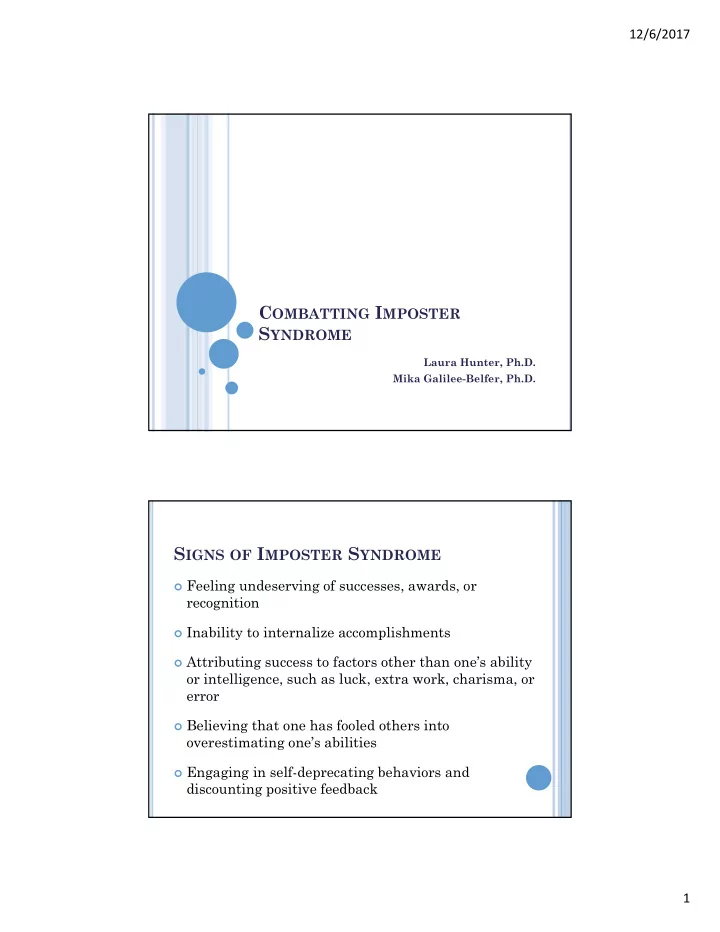
12/6/2017 C OMBATTING I MPOSTER S YNDROME Laura Hunter, Ph.D. Mika Galilee-Belfer, Ph.D. S IGNS OF I MPOSTER S YNDROME Feeling undeserving of successes, awards, or recognition Inability to internalize accomplishments Attributing


slide-1
SLIDE 1

12/6/2017 1

COMBATTING IMPOSTER SYNDROME

Laura Hunter, Ph.D. Mika Galilee-Belfer, Ph.D.

SIGNS OF IMPOSTER SYNDROME

 Feeling undeserving of successes, awards, or

recognition

 Inability to internalize accomplishments  Attributing success to factors other than one’s ability

  • r intelligence, such as luck, extra work, charisma, or

error

 Believing that one has fooled others into

  • verestimating one’s abilities

 Engaging in self-deprecating behaviors and

discounting positive feedback

slide-2
SLIDE 2

12/6/2017 2

SIGNS OF IMPOSTER SYNDROME

 Seeing failure perpetually looming on the horizon  Doubting ability to repeat past accomplishments

– each success is unrelated to others, making success feel tenuous

 Fearing exposure as an imposter or fraud  Feeling relief rather than joy when succeeding  Do you chalk up your success up to luck, timing, or

error?

 Do you believe “if I can do it, anyone can”?  Do you agonize over the smallest flaws in your work?  Are you crushed by constructive criticism, seeing it as

evidence of your ineptness?

 When you succeed, do you secretly feel like you fooled

them again?

 Do you worry that it’s a matter of time before you’re

“found out”?

slide-3
SLIDE 3

12/6/2017 3

IT’S COMMON

 In a study of successful people, 70% reported

experiencing imposter feelings at some point in their life.

 In a study of graduate students, 25% of men and

39% of women scored high on feelings of imposterism. MOST LIKELY AMONG:

 High achievers. It is most often found among

extremely capable individuals, not people who are actually impostors.

 Perfectionists. Perfectionism is highly correlated

with imposter syndrome.

 Women. Though both men and women can suffer

from imposter syndrome, it’s more common among women.

slide-4
SLIDE 4

12/6/2017 4

REASONS WHY PEOPLE MAY FEEL LIKE

IMPOSTERS:

 How people were raised.

 Discouraging messages can impact self-

expectations, confidence, and feelings of competence.

For example, did accomplishments go

unnoticed?

How was success defined?

REASONS WHY PEOPLE MAY FEEL LIKE

IMPOSTERS:

 Working in an organizational culture that

feeds self-doubt.

 For example, in academia, criticism is the

norm and adversarial language is often used. Scholarly debate can turn hostile, leading to competitiveness and isolation.

slide-5
SLIDE 5

12/6/2017 5

REASONS WHY PEOPLE MAY FEEL LIKE

IMPOSTERS:

 Being an “outsider.”

 When you’re an outsider, it’s easy to sense that

you’re wearing a mask.

Examples: Working outside of your native country First-generation college student Woman in a male-dominated field Person of color on a predominately white

campus

POTENTIAL IMPACTS ON MENTAL

HEALTH

Anxiety Self- Doubt Depression Stress Discomfort Emotional Exhaustion Shame Life Dissatisfaction

slide-6
SLIDE 6

12/6/2017 6

REFLECTION MOMENT:

 Write a specific imposter thought you’ve had or

witnessed.

 What imposter thoughts were you able to identify

in yourself or your colleagues/students?

slide-7
SLIDE 7

12/6/2017 7

IMPACT OF IMPOSTER SYNDROME ON

BEHAVIOR:

 Over preparing and hard work

 Rely on extraordinary effort and obsessing

  • ver details to avoid detection

 When hard work pays off:

For non-imposters, it enhances confidence. Imposters mostly experience a sense of

relief.

IMPACT OF IMPOSTER SYNDROME ON

BEHAVIOR:

 Holding back

 Since effort and new opportunities makes

people vulnerable, people may hold back

Don’t apply for promotions Don’t apply for grants Don’t offer opinions

slide-8
SLIDE 8

12/6/2017 8

IMPACT OF IMPOSTER SYNDROME ON

BEHAVIOR:

 Procrastination

 Associated with perfectionism

 It’s hard to meet impossible standards

 Gives people an excuse for failure

 I didn’t have enough time

IMPACT OF IMPOSTER SYNDROME ON

BEHAVIOR:

 Never finishing

 People shield themselves from possible

detection or criticism

slide-9
SLIDE 9

12/6/2017 9

IMPACT OF IMPOSTER SYNDROME ON

BEHAVIOR:

 Self-sabotage

 People may subconsciously do things to

undermine their success when they feel they don’t deserve it

Show up late or unprepared Drink too much before a big event

IMPACT OF IMPOSTER SYNDROME ON

BEHAVIOR:

 Maintaining a lower or ever-changing

profile

 Choosing a inconspicuous field  Moving jobs frequently to avoid being discovered as

imposters

slide-10
SLIDE 10

12/6/2017 10

IMPACT OF IMPOSTER SYNDROME ON

BEHAVIOR:

 Using charm to win approval

 Using social skills or humor to win approval,

and then assuming success is because people like them, rather than due to ability

POTENTIAL IMPACTS ON CAREERS:

 Taking jobs below abilities or aspirations  Failing to seek advancement or promotion  Avoiding self-promotion  Failing to negotiate  Aiming lower  Abandoning dreams  Leaving a job or school  Maintaining a low profile, not giving opinions or

speaking up

 Feeling unbalanced in work-life

slide-11
SLIDE 11

12/6/2017 11

REFLECTION MOMENT:

 Write a specific way imposter syndrome has

impacted your career or the career of someone close to you.

 What are some specific ways in which imposter

syndrome has impacted your behavior or careers,

  • r those of your colleagues/students?

 What opportunities have been or might be

missed?

slide-12
SLIDE 12

12/6/2017 12

STRATEGIES FOR OVERCOMING IMPOSTER SYNDROME

TALK ABOUT IT

 Research shows that one of the best things we

can do is name imposter syndrome

 Talk about it with colleagues, friends, and

mentors/mentees

 Recognize that it is common  Recognize that it strikes highly capable people

slide-13
SLIDE 13

12/6/2017 13

RECOGNIZE IMPOSTER MOMENTS

 Recognize when you’re having an imposter

moment

 Remove emotion from the situation and approach

it more objectively

 Be aware of how stereotypes might impact how

you see yourself

STRENGTHEN LINK BETWEEN YOU AND

ACCOMPLISHMENTS

 List your successes and DON’T explain them away.  List evidence and don’t think of qualifiers -- just proof

(e.g., school, degrees, awards, etc.).

 Everyone can be lucky. Successful people use luck and

connections to their advantage.

 Go through list and own successes: persistence,

initiative, making use of contacts, etc.

 Write down actions you took to take advantage of these

contributions.

 Outside factors take nothing from your achievements.

slide-14
SLIDE 14

12/6/2017 14

ACCEPT RECOGNITION

 Stop minimizing compliments.  Say “thank you.”  Eventually start saying things like:

 “I really appreciate you saying that.”  “It makes me feel good that my hard work paid off.”

 Saying these words can help you internalize

accomplishments more fully.

USE REWARDS

 Reward yourself when you accomplish something.  Learn to appreciate your accomplishments.

slide-15
SLIDE 15

12/6/2017 15

GET A DIFFERENT PERSPECTIVE

 Write a letter of recommendation for yourself.  Ask your friends what they think of you.  Usually, other people have a more realistic opinion

  • f your work.

DROP PERFECTIONISM

 Perfectionists believe they must deliver an

unblemished performance 100% of the time. Anything less is met with deep shame and harsh inner criticism.

 This standard is impossible.  It’s not a matter of if you will err, but when.  If you wait for everything to be perfect, you’ll

never get going.

slide-16
SLIDE 16

12/6/2017 16

BE SELECTIVE WITH EFFORT

 Be selective about where you put your efforts.  Don’t waste time over routine tasks where

adequate effort will suffice.

 Sometimes good is good enough.

CHANGE TO A GROWTH MINDSET

 Fixed mindset: believe in inherent intelligence and

ability

 Growth mindset: intelligence is malleable and ability

can be built.

 Don’t think: “I’m unqualified.”  Think: “I may be inexperienced but I’m capable of

growing into the role.”

 Research: Growth mindset is important for persistence,

and people who excel in fields devote the most time engaged in practice.

slide-17
SLIDE 17

12/6/2017 17

RECOGNIZE YOUR EXPERTISE

 Even as an expert, you likely don’t see yourself as

  • ne.

 Never feel like you have enough experience  Prevents you from offering opinions or attempting things  Recognize that you don’t have to (and can’t possibly)

know everything.

 Be smart and figure out who does  Knowing your knowledge limitations = sign of competence  Even when you don’t know something, still project

confidence.

POSITIVELY RESPOND TO FAILURES

 Don’t personalize failures and don’t allow them to

affect your sense of self.

 If a presentation bombs, it’s one thing to say “I

skimped on prep time” versus “I’m incompetent.”

 You have recourse for the former, but not the

latter.

slide-18
SLIDE 18

12/6/2017 18

THERAPY

 If feelings are debilitating, Cognitive Behavioral

Therapy has been shown to be effective in treating imposter syndrome.

REFLECTION MOMENT:

 Write a specific strategy you intend to use to

combat imposter syndrome.

slide-19
SLIDE 19

12/6/2017 19

 What other strategies have you found helpful to

address imposter syndrome?

FINAL QUESTIONS OR COMMENTS