About Earth Systems Environmental/Social Consultancy and - - PowerPoint PPT Presentation

about earth systems
SMART_READER_LITE
LIVE PREVIEW

About Earth Systems Environmental/Social Consultancy and - - PowerPoint PPT Presentation

About Earth Systems Environmental/Social Consultancy and Technology developer Established 1993 ~50 employees in Australia, Europe, Africa and Asia Service sectors Energy and Carbon Water Management and Treatment


slide-1
SLIDE 1
slide-2
SLIDE 2

About Earth Systems

  • Environmental/Social Consultancy and Technology developer
  • Established 1993
  • ~50 employees in Australia, Europe,

Africa and Asia

Service sectors

  • Energy and Carbon
  • Water Management and Treatment
  • Environmental Management and Assessment
  • International Aid and Development

Competitive advantage

  • Small company – develop and engineer technical solutions - proven

track record

  • Global reach
slide-3
SLIDE 3

Earth Systems’ Technologies

  • Passive and active Water

Treatment Systems;

  • Hydrothermal Processing of Biosolids
  • Acid and Metalliferous Drainage (AMD)
slide-4
SLIDE 4

Our Bioenergy Strategy

Our goal is to be a global leader in novel, specialised bioenergy

  • technologies. Our target applications include:
  • Waste management (including certain types of contaminated biomass)
  • Carbon products (incl “Biochar”)
  • Heat and power generation
  • Specialty chemicals production

The MPP20 technology presented today is one of a suite of complementary novel technologies we are currently developing, which include fixed and mobile configurations of pyrolysis, gasification and hydrothermal processes. We have selected these technologies to address a number of emerging market opportunities in the environmental and renewable energy sectors.

slide-5
SLIDE 5

MPP20 Technology Background

  • MPP20 was developed for the North East Catchment Management

Authority (NECMA) via a grant from the Victorian Government’s Market Validation Program.

  • NECMA wanted to beneficially use their wood waste rather than burning

it in the field, and identified biochar as a potential option to reduce their costs and also offset organisational emissions through char production.

slide-6
SLIDE 6

MPP20 – Mobile Biochar Production

In-field conversion of unchipped wood residues to biochar for agriculture and other uses

Woody waste

(Stable long term carbon sink which improves soils) (Residues which would either be burned or rot down)

MPP20 Biochar

slide-7
SLIDE 7

First Commercial Unit

  • Batch system capable of 4 - 8 tonnes biomass per run
  • Run time 4 – 5 hours
  • Typical yield 0.8 – 1.2 tonnes biochar
  • Fuel consumption – 5 to 10 L diesel per hour
  • Water requirements – approximately 1 m3 per run for quenching process
  • Currently operating in North East Victoria
  • Currently building a demonstration electric power generation system
  • perating from the energy by-product.
slide-8
SLIDE 8

Second Generation Units

  • Increased throughput 6 - 9 tonnes biomass per run
  • Reduced fuel usage (<5L diesel per hour)
  • Increased yield 0.8 – 1.6 tonnes biochar
  • Ability to capture other by-products (syngas, smokewater)
slide-9
SLIDE 9

CharMaker MPP20 Case Study

First commercial unit:

  • >20,000 km travelled
  • >40 feedstocks
  • >150 tonnes biochar
  • ~ 440 tCO2e abated

Current units in operation

  • 1 in Queensland
  • 1 in Victoria
  • 1 in Northern Territory
slide-10
SLIDE 10

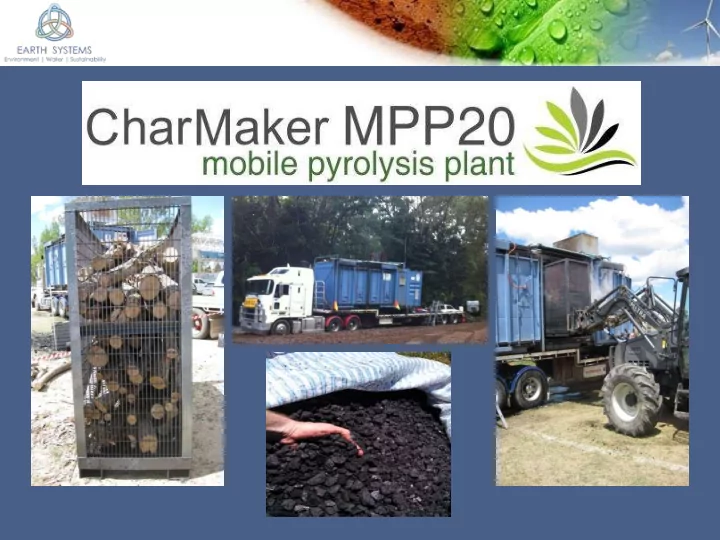
CharMaker in action!

slide-11
SLIDE 11

Novel Aspects of the Technology

  • Patented pyrolysis technology, developed and owned by Earth Systems
  • Mobile, fully self contained unit, yet with significant throughput
  • Much lower setup costs and regulatory hurdles than a fixed plant
  • Designed to be integrated with existing operator equipment (tractor,

loader, excavator etc)

  • Minimal processing of wood feedstock required (no chipping)
  • Can be operated or monitored remotely with PC, laptop, tablet or phone
  • Treatment temperatures and times are adjustable allowing biochar

properties to be fine-tuned to different applications.

  • Have recently tested and proved a modified MPP20 system capable of

processing contaminated wood into clean char without any harmful emissions

slide-12
SLIDE 12

Feedstock Types

Feedstocks tested:

Greenwaste Invasive species Transfer station waste Vine thinnings Tomato stalk residues Railway sleepers African Mahogany Pine Native pine Willow Cottonwood Poplar Blue gum

slide-13
SLIDE 13

The Biochar Product

  • Meets IBI Guidelines for Class A

biochar;

  • Up to 600 m2/gram surface area;
  • ~ 80 to 90% fixed carbon;
  • Highly stable (>1000 years);
  • High water/nutrient retention;
  • Has shown outstanding results in a

variety of agricultural and horticultural applications;

  • Excellent filter material;
  • Now being sold in bulk (to farmers,

fertilizer companies and research groups) as well as in 5-30L bags at gardening retailers.

slide-14
SLIDE 14

Earth Systems’ Biochar Case Studies

James Cook University Federal Government Territory Natural Resources Management / Northern Territory Farmers Association Victorian Government/Northeast Catchment Management Authority

Earth Systems / Royal Melbourne Institute of Technology

slide-15
SLIDE 15

Live cross to CharMaker unit in Victoria, Australia

slide-16
SLIDE 16

Benefits

  • Woody waste disposal
  • Cost-effective and environmentally beneficial disposal of waste

biomass.

  • Turns a waste management problem into a high value resource
  • Beneficial product
  • Clean biochar product suitable for soil amendment, stock feed or

filtration applications

  • Energy output
  • A source of high-grade heat for various applications
  • Electricity generation pilot being tested now
  • Carbon sequestration

Provides a means for an entity to directly sequester atmospheric CO2 to offset organisational emissions

slide-17
SLIDE 17

Benefits - Mobility

slide-18
SLIDE 18

Benefits – Significant Throughput

slide-19
SLIDE 19

Benefits – Low Operational Costs

Human Resources

  • 1 person on-site during loading/unloading. Can monitor remotely during
  • peration. (2 people may be needed for OHS requirements)

Auxiliary machinery

  • Required to load/unload MPP20 and process biochar (e.g. tractor or

loader, MISU or Keenan feeder)

Running costs

  • Minimal. Approximately 20 to 40L of diesel per run, operator needed for

load/unload.

slide-20
SLIDE 20

Benefits - Sequestration Potential

  • One CharMaker MPP20, operating full time (250 days per year) can

produce around 500 tonnes of biochar per annum or 1,500m³, bio- sequestering around 1600 to 2000 tCO2e per annum.*

*In Australia the current carbon price per tonne is ~$25/tonne

  • Earth Systems has identified multiple feasible opportunities for MPP20

deployment in Australia, based on waste management scenarios (thus 75 to 100 kt CO2e/annum could be sequestered in commercial applications).

slide-21
SLIDE 21

Business Case

Business case for potential partners:

  • How much (woody) waste requires disposal and what type?
  • What are the current disposal costs? (incl landfill charges, transport,

H&S costs);

  • Grade, characteristics and value of biochar product – multiple end use

applications;

  • Product transport and handling costs;
  • Does this process allow different classification or regulatory

environment?;

  • Other waste streams; and
  • £ or corporate reputational value or carbon sequestration.
slide-22
SLIDE 22

Potential Income Streams

Reduced volume and transport costs

  • ~7-8 times weight reduction and ~5 times volume reduction

Avoidance of landfill disposal costs

  • $50 to $100 per tonne in landfill gate fees in Australia
  • £25 to >£150 per tonne UK gate fees – quality dependent

Revenue from biochar sales

  • ~£2,950 per tonne according to IBI State of the biochar market 2013

Carbon credits

  • Methodology for biochar from biomass under development in Australia. Moves to

establish equivalent in the UK

Energy production

  • Reduction of site fuel costs where relevant (e.g. at a sawmill or greenhouse)
  • Renewable Heat Incentive and Renewable Obligation Certificates (ROCs)
slide-23
SLIDE 23

Potential Technology Users

  • Riparian management – EA, British Waterways and land owners
  • Local Authorities
  • Estate and forest management
  • Waste contractors
  • Contaminated wood management
  • Agricultural - larger farms, farmer groups
  • Construction / demolition
  • Linear Infrastructure and utilities
  • Anyone with oversized waste woody biomass that needs biomass

diversion / heat / char / electricity

slide-24
SLIDE 24

The Future

The CharMaker MPP20 is a proven, patented, commercial technology capable of converting a waste management problem into a high value resource.

Next Steps:

  • Actively pursuing strategic partnerships in the UK and Europe; and
  • Leverage our expertise and existing (patented) IP to develop larger-

scale continuous processing.

slide-25
SLIDE 25

Questions?

Contact Earth Systems Earth Systems (Vientiane) Chris Smithies – Country Manager E: chris.smithies@earthsystems.com.au T: +856 20 7851 6650 Earth Systems (Bristol) Peter Hughes – Principal Environmental Scientist Beth England - Senior Environmental & Social Consultant E: peter.hughes@earthsystemseurope.com / beth.england@earthsystemseurope.com T: +44 (0) 117 373 6153