Formation of the Earth Formation of the Earth s Atmosphere s - - PDF document

formation of the earth formation of the earth s
SMART_READER_LITE
LIVE PREVIEW

Formation of the Earth Formation of the Earth s Atmosphere s - - PDF document

Formation of the Earth Formation of the Earth s Atmosphere s Atmosphere and Oceans and Oceans EAS 302 Lecture 10 Questions about Earth s Atmosphere s Atmosphere Questions about Earth and Hydrosphere and Hydrosphere When


slide-1
SLIDE 1

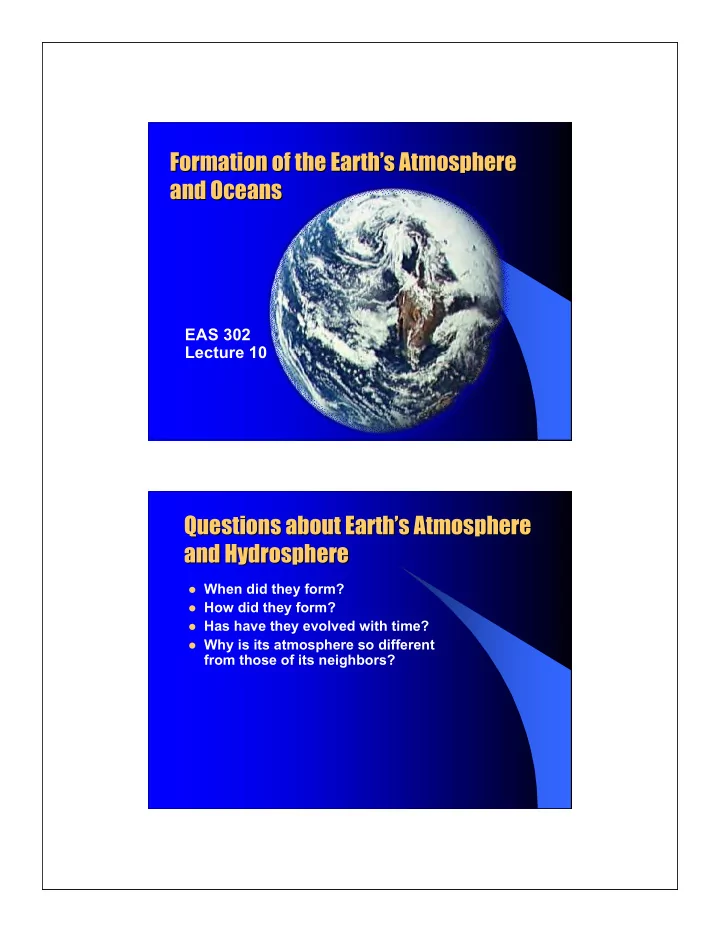
Formation of the Earth Formation of the Earth’ ’s Atmosphere s Atmosphere and Oceans and Oceans

EAS 302 Lecture 10

Questions about Earth Questions about Earth’ ’s Atmosphere s Atmosphere and Hydrosphere and Hydrosphere

 When did they form?  How did they form?  Has have they evolved with time?  Why is its atmosphere so different

from those of its neighbors?

slide-2
SLIDE 2

Comparing the Earth with its Comparing the Earth with its neighbors neighbors

0.2 92.5 1 x 10⁻³ 5.3 x 10⁻⁵ H2 7.2 2 x 10⁻³ 5.2 x 10⁻⁴ He 3 0.1 6 x 10⁻⁵ 1.7 x 10⁻⁴ CH4 1 x 10⁻³ 2.8 x 10⁻⁴ 1.5 x 10⁻³ 1.8 x 10⁻³ Ne <0.02 3 x 10⁻² 2 x 10⁻² 0 to 4 H2O 95.3 96.5 3.6 x 10⁻² CO2 12 1.6 7 x 10⁻³ 0.93 Ar 0.13 2 x 10⁻³ 20.95 O2 82 2.7 3.5 78.1 N2 (percent) 0.162 .00061 9.12 0.101

Surface Pressure (MPa)

Titan Jupiter Mars Venus Earth (But, Earth’s hydrosphere is 200 times more massive than its atmosphere)

Isotopes Again! Isotopes Again!

 Since our questions involve time, it should not be

too surprising that we turn again to Nature’s time-keepers, radioactive and radiogenic isotopes, for answers.

 Decay systems of interest:

 129I to 129Xe (half-life 16 Ma)  40K to 40Ar (half-life 1.25 Ga)  244Pu to 136Xe (via fission - half life 82 Ma)  4He (all alpha decays, mainly U and Th)

 In addition, Ne isotopes provide some useful

constraints

 (Notice the focus on noble gases)

slide-3
SLIDE 3

Hypotheses: Hypotheses:

 (1) The atmosphere formed as gas from

the solar nebula accreted to the Earth (i.e., gravitationally attracted)

 (2) The atmosphere (& hydrosphere)

formed immediately by degassing of the Earth’s interior.

 (i.e., about the same time the Earth formed).

 (3) The atmosphere (& hydrosphere)

formed slowly over geological time by degassing of the Earth’s interior.

 (4) Atmosphere added by accreting

comets through geologic time.

What do the hypotheses predict? What do the hypotheses predict?

 During degassing (I.e., formation of the

atmosphere), the daughters (Xe, and Ar) go into the atmosphere, while the parents remain in the solid Earth.

 Hypothesis (1)

 Atmosphere should have a “solar” composition

 Hypothesis (2)

 If the atmosphere formed before 129I completely decayed

away (80-160 Ma), we would expect 129Xe/130Xe to be higher in the solid Earth than in atmosphere (because of subsequent decay of 129I to 129Xe).

 Hypothesis (3) predicts the opposite of (2)

 Atmosphere formation after complete 129I decay leads to

identical 129Xe/130Xe in Earth and atmosphere.

 Hypothesis (4)

 Atmospheric should have cometary composition (it does

not).

slide-4
SLIDE 4

Comparing the Atmosphere to Solar Comparing the Atmosphere to Solar Wind Wind

 Compared to the

solar wind (and presumably the Sun and solar nebula), Earth’s atmosphere shows progressive depletion in lighter noble gases.

 If the Earth

accreted an atmosphere from the solar nebula, it was likely lost.

Ne Ne Isotopes suggest Isotopes suggest atmospheric atmospheric catastrophy catastrophy

 The atmosphere is

strongly depleted in the lightest Ne isotope -

20Ne - compared to the

solar wind, but also compared to Ne from the Earth’s interior.

 The only plausible

explanation is massive atmospheric loss

 Which preferentially removed the lightest isotopes (those most likely to reach escape velocity).

slide-5
SLIDE 5

Atmopshere Atmopshere and Volcanic Gases: A and Volcanic Gases: A better match better match Earth Earth’ ’s s “ “grow your own grow your own” ” atmosphere atmosphere

 Dissimilarity of noble gas concentrations and Ne

isotopes between the atmosphere and the solar wind suggests that even if the Earth managed to accrete an atmosphere from the solar nebula, that primordial atmosphere was lost.

 (Perhaps primitive atmosphere lost in Giant Impact.)

 The most likely source of the Earth’s

atmosphere is outgassing of the Earth’s interior

 (An alternative hypothesis, that comets colliding with the Earth have created the atmosphere, has some serious problems and has lost support).

slide-6
SLIDE 6

Hypotheses (Again) Hypotheses (Again)

 (1) The atmosphere formed as gas from

the solar nebula accreted to the Earth (i.e., gravitationally attracted)

 (2) The atmosphere (& hydrosphere)

formed immediately by degassing of the Earth’s interior.

 (i.e., about the same time the Earth formed).

 (3) The atmosphere (& hydrosphere)

formed slowly over geological time by degassing of the Earth’s interior.

When did Degassing Occur? When did Degassing Occur?

 Xe in magmatic gases from the Earth interior

(e.g., volcanic gases) does have “excess” 129Xe (i.e., higher 129Xe/130Xe than atmosphere).

 Therefore much of the atmosphere must have formed within

80-160 Ma of time 0 (last nucleosynthetic event).

 However(!)

 Most of the Ar in the atmosphere is radiogenic (i.e., the

product of 40K decay).

 40Ar/36Ar ratio is ~300 in atmosphere (compared to <1 in Sun).

 Most of this 40Ar would have been produced after

after the first 80-160 Ma). Therefore, significant degassing must have also occurred later!

 “Consensus” view is that >85%of atmosphere

was produced by “early catastrophic degassing”; the rest through “continual” degassing.

slide-7
SLIDE 7

Argon and Xenon Degassing Argon and Xenon Degassing Our unique atmosphere Our unique atmosphere

 Why does our atmosphere have so much

O2 when Venus and Mars have hardly any?

 Why is our atmosphere so poor in CO2

compared to that of our neighbors?

 Where has all the carbon gone?

 Answers to these questions are related.

slide-8
SLIDE 8

Inventory of Oxidants and Inventory of Oxidants and Reductants Reductants in Earth in Earth’ ’s Crust & Atmosphere s Crust & Atmosphere Where has all the carbon gone? Where has all the carbon gone?

 Amount of reduced organic carbon in sediments

exceeds the amount of carbon in the atmosphere (as CO2) by a factor of 200.

 How did the carbon get there?

 This carbon represents the remains of once living

  • rganisms (almost entirely plants).

 In other words, life, through photosynthesis, is partly

responsible for the low levels of CO2 in the atmosphere.

 Corollary: life is entirely responsible for the presence of

free oxygen in the atmosphere.

 Far more carbon than this is stored in sediments

as carbonate rocks.

 Oxidants and reductants don’t balance.

 Oxidants (ferric iron) must have been “exported” to mantle.
slide-9
SLIDE 9

When did the oceans form? When did the oceans form?

 H2O would have been degassed from the

Earth’s interior simultaneously with gases of atmosphere.

 But, when was the Earth’s surface cool

enough for oceans to form?

 The 4.4 Ga zircon has δ18OSMOW up to 9‰.

 This suggests the magma reacted with or

contained material that had reacted with liquid water.

 Earth’s surface was apparently cool enough for

  • ceans to form at 4.4 Ga!