A Study on Treatment of Concentrated Radwaste Water in NPPs Yeom - - PDF document

a study on treatment of concentrated radwaste water in
SMART_READER_LITE
LIVE PREVIEW

A Study on Treatment of Concentrated Radwaste Water in NPPs Yeom - - PDF document

Transactions of the Korean Nuclear Society Virtual Spring Meeting July 9-10, 2020 A Study on Treatment of Concentrated Radwaste Water in NPPs Yeom Yu-Sun a , Lee Doo Hee a , Kang Jung Gi a , Kim Jung Keun a , Kang Jin-Wook a , Yeom Jun-Gi b a


slide-1
SLIDE 1

A Study on Treatment of Concentrated Radwaste Water in NPPs

Yeom Yu-Sun a, Lee Doo Hee a, Kang Jung Gi a, Kim Jung Keun a, Kang Jin-Wook a, Yeom Jun-Gi b

aLCgenCo., 12, Seotan 2-fo, Pyongtark-si, Gyonggi-do Korea, 17701 bKHNPCo., 1655 Bulguk-ro, Yangbuk-myon, Gyongju-si, Gyongsanbuk-do, Korea, 38120 *Corresponding author: ldhee14@gmail.com

  • 1. Introduction

The LRS(Liquid Radwaste System) of the NPP consists of "Liquid Waste Evaporator and CWDS (Concentrated Waste Drying System)" or "RO(Reverse Osmosis Membrane) & LRDPS(Liquid Radwaste Demineralization Processing System)". Due to insufficient ability to remove radioactive and conductive materials from LRS, additional MF(Micro Filtration) and RO facilities were introduced, but liquid radioactive wastes are stored in drums because of deterioration of the demineralizer, the main treatment

  • facility. Although many NPPs in Korea are adapting the

CTS(Concentrate Treatment System) for drying CLW(concentrated nuclear liquid wastes) and polymer- adding solidifying, the particle size of dried powder is not suitable for domestic disposal admission standards(1 to 13mm), and the scattered powder can cause internal and external exposure by the workers’ breathing. In this study, therefore, a portable/compact Centrifugal Thin- film Drying Facility(p-CTDF) was developed for treating CLW produced in NPPs. This facility is believed to help reduce radiation exposure to workers and secure disposal safety.

  • 2. Methods and Results

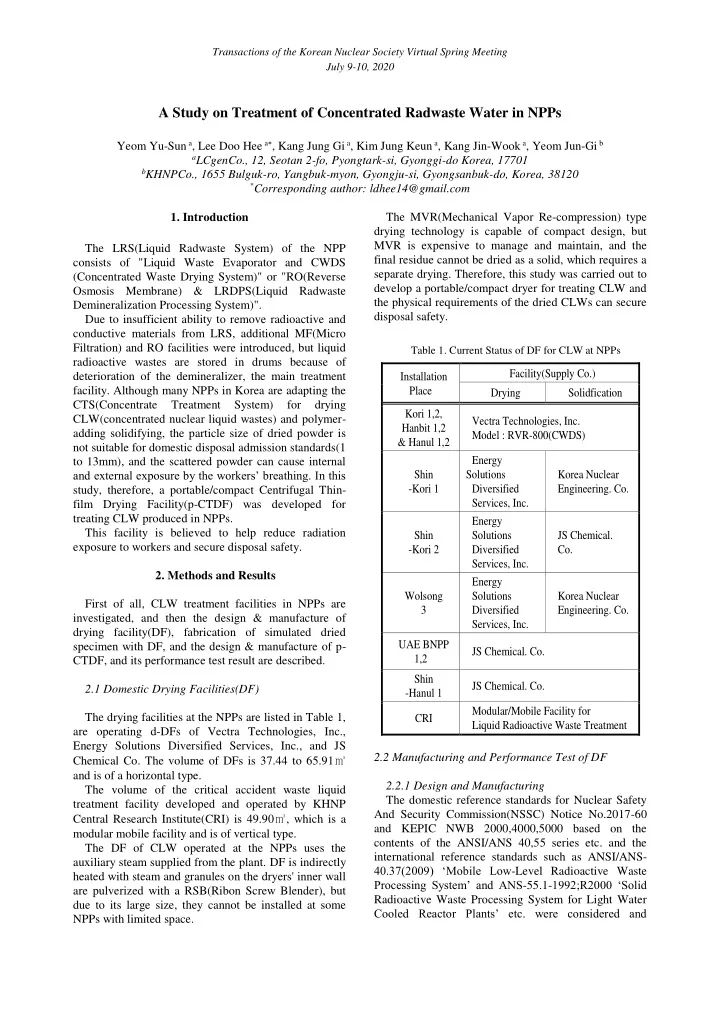
First of all, CLW treatment facilities in NPPs are investigated, and then the design & manufacture of drying facility(DF), fabrication of simulated dried specimen with DF, and the design & manufacture of p- CTDF, and its performance test result are described. 2.1 Domestic Drying Facilities(DF) The drying facilities at the NPPs are listed in Table 1, are operating d-DFs of Vectra Technologies, Inc., Energy Solutions Diversified Services, Inc., and JS Chemical Co. The volume of DFs is 37.44 to 65.91㎥ and is of a horizontal type. The volume of the critical accident waste liquid treatment facility developed and operated by KHNP Central Research Institute(CRI) is 49.90㎥, which is a modular mobile facility and is of vertical type. The DF of CLW operated at the NPPs uses the auxiliary steam supplied from the plant. DF is indirectly heated with steam and granules on the dryers' inner wall are pulverized with a RSB(Ribon Screw Blender), but due to its large size, they cannot be installed at some NPPs with limited space. The MVR(Mechanical Vapor Re-compression) type drying technology is capable of compact design, but MVR is expensive to manage and maintain, and the final residue cannot be dried as a solid, which requires a separate drying. Therefore, this study was carried out to develop a portable/compact dryer for treating CLW and the physical requirements of the dried CLWs can secure disposal safety.

Table 1. Current Status of DF for CLW at NPPs Installation Place Facility(Supply Co.) Drying Solidfication Kori 1,2, Hanbit 1,2 & Hanul 1,2 Vectra Technologies, Inc. Model : RVR-800(CWDS) Shin

  • Kori 1

Energy Solutions Diversified Services, Inc. Korea Nuclear

  • Engineering. Co.

Shin

  • Kori 2

Energy Solutions Diversified Services, Inc. JS Chemical. Co. Wolsong 3 Energy Solutions Diversified Services, Inc. Korea Nuclear

  • Engineering. Co.

UAE BNPP 1,2 JS Chemical. Co. Shin

  • Hanul 1

JS Chemical. Co. CRI Modular/Mobile Facility for Liquid Radioactive Waste Treatment

2.2 Manufacturing and Performance Test of DF 2.2.1 Design and Manufacturing The domestic reference standards for Nuclear Safety And Security Commission(NSSC) Notice No.2017-60 and KEPIC NWB 2000,4000,5000 based on the contents of the ANSI/ANS 40,55 series etc. and the international reference standards such as ANSI/ANS- 40.37(2009) ‘Mobile Low-Level Radioactive Waste Processing System’ and ANS-55.1-1992;R2000 ‘Solid Radioactive Waste Processing System for Light Water Cooled Reactor Plants’ etc. were considered and

Transactions of the Korean Nuclear Society Virtual Spring Meeting July 9-10, 2020

slide-2
SLIDE 2

reflected in the design and manufacture of DFs. The devices such as container pressure, piping & valves and pumps are designed in accordance with the Technical standard of NWB 2000 and ANSI/ANS– 40.37 Equipment Codes. For piping, KEPIC-MDF type 304 or 316 stainless steel(or suitable corrosion resistant material) was used, in accordance with the piping specifications (NWB 2000 and ANSI/ANS-40.37), the inside diameter of the piping is less than 3/4 inches and less than 2 1/2 inches and the inside diameter of the piping is at least 1 1/2 inches when transporting slurry. In addition, conditions

  • f instrumentation and control are applied in p-CTDF

using mechanical device of NWB 2000 and ventilation

  • r discharge valves are designed in accordance with

ANSI/ANS-40.37.

(a) (b)

  • Fig. 1. Design Drawing (P&ID / LAY-OUT)
  • Fig. 2. Drying Facility of Centrifugal Thin-Film Type

The p-CTDF developed is a device that uses cyclone to dry thin films of concentrated waste solution, which is smaller than 15m3 in size and can handle 500L/Day (8 hours). 2.2.2 Performance Testing a) Fabrication of Simulation Specimen Based

  • n

the results

  • f

the KHNP prior study(Feasibility Study for the Glassification of Boric Acid Concentrated Waste, 2009 Analysis of the Components of CLW), the simulation specimen of CLW was concentrated in the L-TVC(low-temperature vacuum concentrator) and then performance of p-CTDF was tested.

Table 2. Weight by Element of Simulation Specimen(1L base)

Reagent Element Content (ppm) Solute Weight (g) H3BO3 B 195333 1117.2469 NaOH Na 76000 132.2314 KOH K 2333 3.3481158 CaCl2 Ca 1600 4.4305604 ZnCl2 Zn 583 1.2152759 MgCl2 Mg 495 1.9390843 SiO2 Si 391 0.8364351 Fe2O3 7H2O Fe 230 1.1766264 LiOH Li 127 0.4382781 AlCl3 6H2O Al 77 0.6889819 MnCl2 4H2O Mn 38 0.1368465 NiCl2 6H2O Ni 35 0.1416858 a) Vacuum Concentrator b) Solvent(water) Heating c) Specimen Injection d) Concentration

  • Fig. 3. Process of L-TVC

Transactions of the Korean Nuclear Society Virtual Spring Meeting July 9-10, 2020

slide-3
SLIDE 3

b) Drying of a Simulation Specimen The result of using L-TVC to concentrate the simulation sample of CLW solution and drying it for

  • ne to two hours using p-CTDF developed was that the

moisture content was dried in the form of fine powder

  • f not more than 10%.
  • Fig. 4. Drying of Simulating Specimen

Measurement of boron content of powder dried in the developed p-CPDF by using ICP-OES(Inductively Coupled Plasma-Optical Emission Spectrometry) indicates that boron content difference was about 2.6% compared to the analysis results of the CLW at the

  • NPPs. The average size of the simulation specimen

powder was observed up to 162μm in measured using FE-SEM(Field Emission Scanning Electron Microscope).

  • Fig. 5. Size of Drying Powder

c) Measurement of the moisture content for the drying powder The moisture content of the dried powder was measured by the moisture meter (BEL, I-THERMO) at 2.65 to 7.81 %, three times lower than the moisture content of dry powder (approximately 8 to 18 %) with the conventional concentration waste dryer (CWDS).

Table 3. Measurement Results for Moisture Content

Drying Time Start Weight(g) End Weight(g) Moisture Content(%) 1hr 3.505 3.231 7.81 1hr 15m 3.504 3.251 7.22 1hr 30m 3.494 3.274 6.28 1hr 45m 3.514 3.325 5.38 2hr 3.488 3.396 2.65 2.3 Fabrication of CF(Compression Forming) The physical(structural) characteristics for disposal of radioactive wastes shall be treated and packaged in such a way that particles less than 0.01 mm in diameter of the waste are non-dispersive if they comprise more than 1%

  • f the weight of the waste or less than 0.2 mm in

diameter of if they comprise more than 15%. Methods for treating dry powder include wet and dry granulation, injection, and tablet. In this study, the CF(compression forming) facilities of tablet-type were used because they were manufactured with a certain size and weight, easy to store, wide range of pressure to use, widely used in industrial and medical fields, and quality guaranteed. Problems such as capping, stitching, and lamination were caused with commercial CF, therefore, in this study, the upper and lower punch of developed CF was coated DLC(Diamond Like Carbon), and the die was also coated with DLC after tapping on the Super-hard

  • die. The test results showed that the shape of pellet was
  • good. Also, the compressive strength of the CF was very

good, at 23.7 to 35.7 kgf, which was higher than the paraffin solidified waste strength criterion. Therefore, it is judged that the non-dispersive required by the physical(structural) characteristic of radioactive waste disposal can be satisfied. (a) (b) (C)

  • Fig. 6. (a) CF Facilities and (b) Punch / (c) Die

Table 4. Results for CF

Filling Depth (mm) Main Pressure Position (Lower)(mm) Pressure (kgf) Thickness (mm) 14 7.0 500~600 6.0 13 7.0 500~650 6.0 12 7.0 800~1000 5.8 11 7.0 600~800 6.0 10 7.0 600~700 5.8 9.0 6.5 600~800 5.0 8.5 6.5 350~450 5.0

Transactions of the Korean Nuclear Society Virtual Spring Meeting July 9-10, 2020

slide-4
SLIDE 4
  • Fig. 7. Sample of CF

Table 5. The Results of Measuring Compressive strength for CF Sample

Filling Depth (mm) Main Pressure Position (Lower)(mm) Pressure (kgf) Compressive Strength (kgf) 14 7.0 500~600 35.7 13 7.0 500~650 33.6 12 7.0 800~1000 31.2 11 7.0 600~800 31.2 10 7.0 600~700 27.6 9.0 6.5 600~800 23.7 8.5 6.5 350~450 22.8

  • 3. Conclusions

The facility for treatment CLW was developed in consideration of domestic and international reference

  • standards. Tests of performance on this facility showed

that pellets contain 2.65 to 7.81 percent moisture content when dried for one to two hours, fine powder(av. size 162μm) was produced. The results of compressing the dry powder of the simulation specimen in the CF Facilities, which is widely used in the industrial and medical fields, confirmed that the forming condition was good at 350 to 1,000 kgf pressure without causing any problems such as capping, stitching and lamination. In addition, the compressive strength of the CF was 23.7 to 35.7 kgf, which was higher than the paraffin solidification strength criterion, and the CF can produce very good pellets. It is believed that if the CLW is dried using developed p-CTDF and the pellet is made in the CF, the disposal safety can be secured, and if treated in an automated process, it will contribute to reducing radiation exposure dose to the workers. ACKNOWLEDGMENTS This study was conducted as a research and development project for the Small Business Cooperation of the KHNP. REFERENCES [1] Ho-Yeon Yang and Ju-Youl Kim, “A Feasibility Study on the Polymer Solidification of Evaporator Concentrated Wastes”, J. of the Korean Radioactive Waste Society, Vol.5(4), P293~308, 2007. [2] KORAD, Regulations for the Acquisition of Low and Medium-Level Radioactive Wastes, 2009. [3] KEPIC, NWB 2000, Solid Radioactive Wastes Disposal System, 2009. [4] KEPIC, NWB 4000, Liquid Radioactive Wastes Disposal System, 2009. [5] KEPIC, NWB 5000,

Low-Level Radioactive Wastes/Mixed Radioactive Wastes Reduction Facility, 2009.

[6] DEO, 10 CFR 61.56, Licensing Requirements for Land Disposal of Radioactive Waste. [7] ANSI/ANS-40.37, Mobile Low-Level Radioactive Waste Processing System, 2009. [8] ANS-55.1-1992;R2000, Solid Radioactive Waste Processing System for Light Water Cooled Reactor Plants, 1992.

Transactions of the Korean Nuclear Society Virtual Spring Meeting July 9-10, 2020