A Southern European perspective on the Euro crisis: what its really - - PowerPoint PPT Presentation

a southern european perspective on the euro crisis
SMART_READER_LITE
LIVE PREVIEW

A Southern European perspective on the Euro crisis: what its really - - PowerPoint PPT Presentation

A Southern European perspective on the Euro crisis: what its really about and why it wont go away Alexandre Abreu ISEG, TU Lisbon Heinrich Bll Foundation, 26/03/2013 1. Europes core and periphery: not just about


slide-1
SLIDE 1

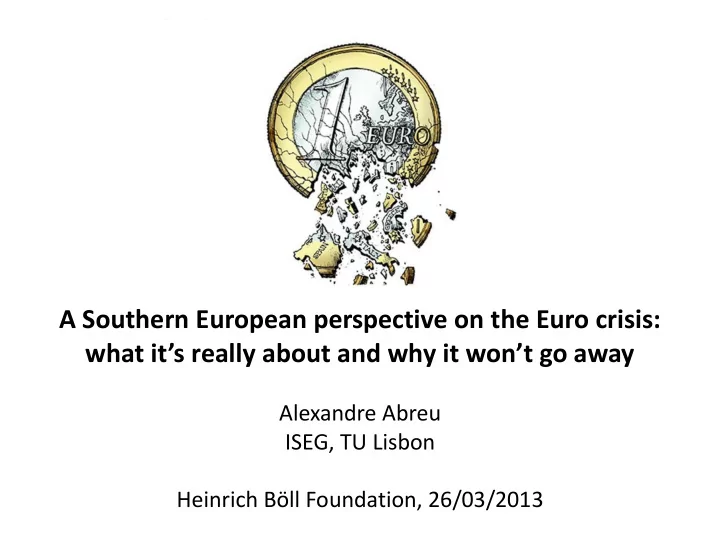
A Southern European perspective on the Euro crisis: what it’s really about and why it won’t go away

Alexandre Abreu ISEG, TU Lisbon Heinrich Böll Foundation, 26/03/2013

slide-2
SLIDE 2
  • 1. Europe’s “core” and “periphery”: not just about

geography

slide-3
SLIDE 3

Exports by complexity group for selected Eurozone countries, 2000-2007 (1=most complex; 6=least complex)

Source: Data from Felipe and Kumar (2011): http://www.voxeu.org/article/internal-devaluations-eurozone-mismeasured-and- misguided-argument

0% 10% 20% 30% 40% 50% 60% 70% 80% 90% 100%

Germany France Spain Portugal Greece

1 2 3 4 5 6

slide-4
SLIDE 4
  • 2. Building up to the storm
slide-5
SLIDE 5
  • 1. Maastricht (1992): nominal convergence, then Euro  loss
  • f monetary/exchange rate policy autonomy

The Portuguese case:

Historical exchange rates: PTE/FFR (blue, left scale) and PTE/DEM (red, right-hand scale)

Source: Cabral (2012) “Dívida”: http://www.ffms.pt/xxi-ter-

  • piniao/artigo/428/divida
slide-6
SLIDE 6

…and the Greek one (GRD/DEM):

Source: http://www.riskwatchdog.com/2012/05/29/a-new-drachma-would- have-a-long-way-to-fall/

slide-7
SLIDE 7
  • EU-Morocco free trade agreement (2000)
  • China’s WTO accession (2001)
  • EU Eastern enlargements (2004, 2007)

… implying drastically increased competition in the least complex product segments.

  • 2. Asymmetric shocks aplenty…
  • 3. Wage compression in the core
slide-8
SLIDE 8
  • 4. A very “strong” Euro, as a consequence of the ECB mandate.
slide-9
SLIDE 9

Between a rock and a hard place:

  • Sudden opening up to direct international competition in the

least complex market segments

  • Externally over-valued Euro

…led to peripheral “low-complexity” industries being systematically undercut.

  • Loss of key policy instruments
  • Wage compression in the core

…blocked the periphery’s process of industrial upgrade and diversification onto more complex product segments.

slide-10
SLIDE 10

The consequence :

Source: Lapavitsas et al (2010). http://www.researchonmoneyandfinance.org/media/reports/eurocrisis/full report.pdf

Current account balance

slide-11
SLIDE 11

A storm in disguise: inflows of capital (EMU) kept these economies afloat, but in a non-sustainable manner

Source: http://www.edmundconway.com/2013/01/the-best-charts-of- 2012/

International investment position (net external debt)

slide-12
SLIDE 12
  • 3. The latent storm breaks out
slide-13
SLIDE 13

Enter the 2007-? “global” crisis:

  • Exports contracted further
  • External finance dried up

…and the latent structural problems turned into an actual recession, which turned into a public debt crisis:

  • Automatic stabilisers
  • Bank bail-outs
  • Counter-cyclical

policies in the early stages (widely adopted and encouraged across Europe)

  • Speculation as self-fulfilling prophecy
slide-14
SLIDE 14

The Portuguese case:

52 53.9 56.5 58.1 60.8 66 67.5 66.6 68.9 78.8 87.8 102.3 20 40 60 80 100 120 2000 2001 2002 2003 2004 2005 2006 2007 2008 2009 2010 2011

Government debt as a % of GDP First austerity package: March 2010

Source: Pordata. http://www.pordata.pt/Portugal/Estado+stock+da+divida+directa+em+perc entagem+do+PIB-989

Currently >120%! (2013) MoU with EC-ECB- IMF: May 2011

slide-15
SLIDE 15
  • 4. The rescue package, why it will not work, and the

prospects for the future

slide-16
SLIDE 16

The rescue packages (Portugal, Greece):

  • Large-scale financial assistance temporarily avoiding default
  • Austerity = “Washington Consensus” conditionality minus currency

devaluation The consequences:

  • Government debt keeps escalating  recurrent haircuts/default

inevitable (European taxpayers to pay the bill)

  • Widespread unemployment, falling wages  domestic market

depressed, bankruptcies, poverty, break-up of social cohesion

  • Dismantling of Welfare State
  • Shift in income distribution from labour to capital, increasing

inequality

  • “Treating” the symptom, worsening the underlying causes
  • Feed-back effects upon European core
slide-17
SLIDE 17

So what would be required to avoid permanent decline within the Euro?

  • Debt service tied to economic performance (esp. employment)
  • External depreciation of the Euro (change in ECB mandate?)
  • Expansionary fiscal and incomes policies in the European core
  • Enhanced policy autonomy in the periphery (trade protection,

much more active industrial policy)

  • Greater intra-European transfers targetting industrial upgrade

Is this realistic? Economically, yes. Politically, not at all – and that is a major problem for Europe.

slide-18
SLIDE 18

Is the Euro at risk of breaking apart? In the short term, no:

  • Current governments not interested in leaving (the

crisis as pretext);

  • ‘Disguised’ creditor-led defaults will keep occurring.

In the long-run, definitely so: electorates will sooner or later vote into office governments on an “exit” platform. Will the Euro break Europe apart? Hopefully, not. But the current prospects are grim.

slide-19
SLIDE 19

Key points from this presentation:

  • Public debt crisis is a symptom, not a cause
  • Underlying cause is economic (sudden exposure to

direct competition, over-valued Euro, loss of key instruments, policies in the core)

  • Current levels of public debt impossible to repay

anyway – default is inevitable, but who pays the bill is still at stake

  • Austerity is only making the problem worse, while

benefitting vested interests

  • Absent major changes in policy, the Euro will eventually

break apart

  • and it may bring the EU crumbling down with it.
slide-20
SLIDE 20

Thank you. alexjabreu@gmail.com alexabreu@cesa.iseg.utl.pt