
8
COMMERCE • www.commercemagnj.com
continued on page 10
A
EROFARMS, A NEWARK-BASED vertical farming company, grows its produce in an urban ware- house using no sunlight or soil. It uses zero pesticides, herbicides and fungi- cides, and employs a rigorously moni- tored, sophisticated system of LED lights, filtration, and HVAC units and pumps. Its productivity, measured by output per square foot, is 130 times greater than a traditional field farm, while using 95 percent less water. Plans are in the works to open 25 more farms over the next five years in New Jersey and New York. In this exclusive interview with COMMERCE, AeroFarms CEO David Rosenberg discusses urban farming and its potential to change Newark and the
- world. Here are his key thoughts and
insights on his company’s innovative business and plans for future growth. Vertical Farming. “It’s such a new
- industry. We are head and shoulders
better than anyone else in the space, which is good and bad. The bad is that there is no one to look left and right with and copy. We are paving the way.” Defining AeroFarms. “We are a tech- nology company, as well as an operating
- company. We realized that because the
industry is so new, we needed to be farmers and get good data to inform
- ur technology.”
Reinventing the Supply Chain. “With leafy greens, there is almost 70 percent food spoilage after the product comes
- ff a farm. In traditional farms, leafy
greens can be grown in 30 days, but they only have three harvests a year because of seasonality. With AeroFarms, we can grow and distribute fresh pro- duce year-round—which makes vertical farming so vital.” Tasting Success. “People constantly say that what AeroFarms produces—the watercress, the arugula—is the best they’ve ever tasted. Using plant biology, we can change plant bitterness, softness, hardness, size, height and nutritional
- density. We create a better-quality plant
that also tastes great—and we are USDA-certified. We do not use GMO.” Making Agriculture Matter. “Popula- tion growth, urbanization and depletion
- f arable land have consequences. By
some estimates, we will need 50 percent more food by 2050 given the rising mid- dle class. AeroFarms and vertical farming is one of the solutions.” Planning for the Future. “We are building a company not just to change Newark and expand access to fresh food in this city, but to change the world as
- well. Our mission is to build farms all
- ver the world so everyone has access
to fresh, great-tasting, safe produce.”
***
Making U.S. Cities More Sustainable & Resilient
By Dr. Colette Santasieri, NJII Director, Policy and Planning Innovation for Civil Infrastructure and Environment With more than 50 percent of the world’s population living in cities, we recognize that the challenges being faced by our civil infrastructure are
- mounting. This multi-layered system
- f transportation, utilities, water and
wastewater, and buildings exists in the context of varying and ever-changing social, economic, political and cultural conditions. The pressures of an increased popula- tion, the advanced age of existing infra- structure, fiscal constraints, climate change, and natural and manmade disasters all threaten these societal life-
- lines. In addition, the natural environ-
ment continues to be adversely impact- ed by past developments and natural
- disasters. Our goals for the next four
years and beyond are to turn those com- plexities and constraints into opportuni- ties and to think differently, to plan dif- ferently, and to be innovative. There has been considerable debate in this country, especially in the political arena, over the issue of climate change. While that debate rages on, the reality is that communities are facing the negative impacts of more frequent and stronger storms, flooding, heat waves and drought conditions. These, as well as
- ther climate change-related impacts
threaten our infrastructure, coastlines, natural ecosystems, water supply, agricul- ture and fisheries, and vulnerable popu- lations. The challenge lies in our ability to move past the debates and develop inno- vative ways for communities to become more sustainable and resilient. This chal- lenge presents our thought leaders, poli- cymakers, scientists, planners and engi- neers with opportunities to not only be innovative and creative, but to transform those innovations into guidance, tools, strategies, processes and technologies
BY SAMANTHA J. HENRY
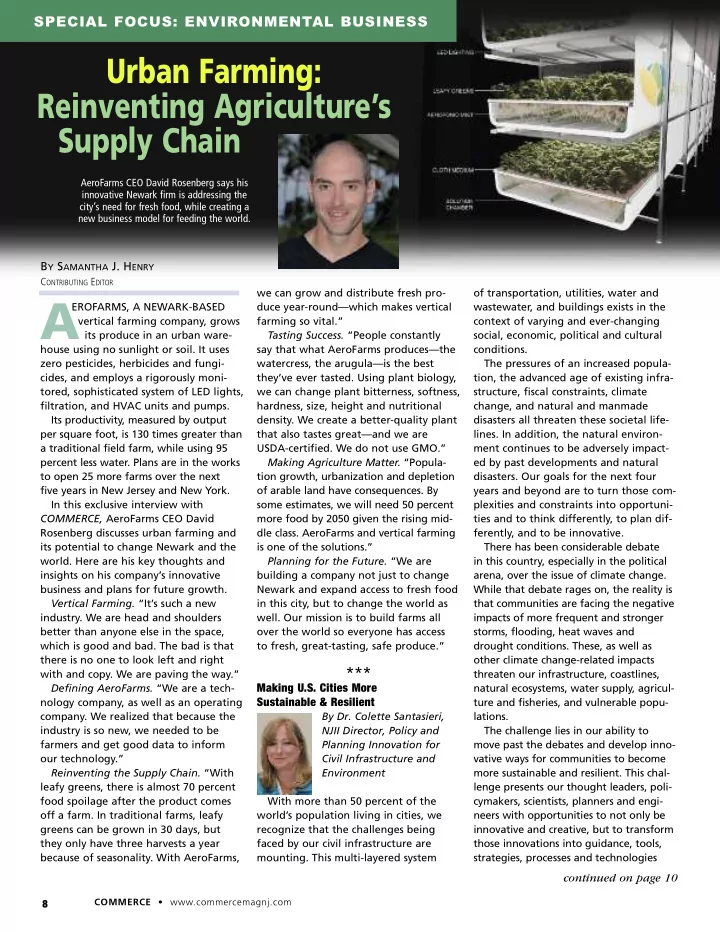
CONTRIBUTING EDITOR AeroFarms CEO David Rosenberg says his innovative Newark firm is addressing the city’s need for fresh food, while creating a new business model for feeding the world.
Urban Farming: Reinventing Agriculture’s Supply Chain
SPECIAL FOCUS: ENVIRONMENTAL BUSINESS