
SLIDE 1
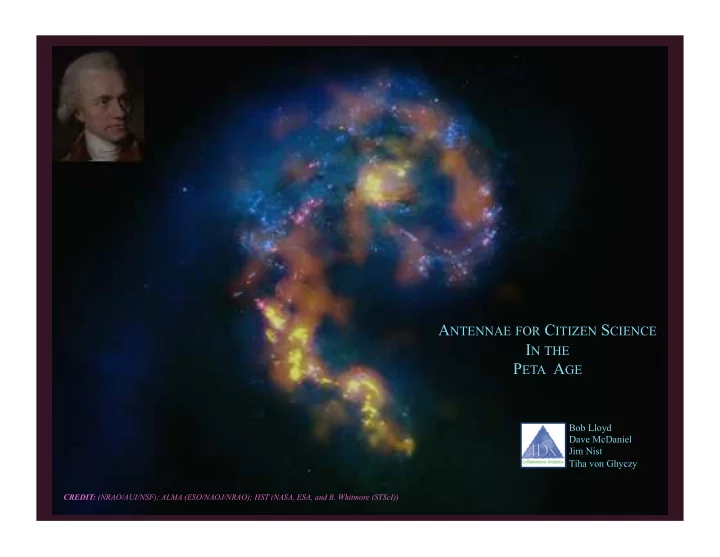
CREDIT: (NRAO/AUI/NSF); ALMA (ESO/NAOJ/NRAO); HST (NASA, ESA, and B. Whitmore (STScI))
ANTENNAE FOR CITIZEN SCIENCE IN THE PETA AGE
Bob Lloyd Dave McDaniel Jim Nist Tiha von Ghyczy
A NTENNAE FOR C ITIZEN S CIENCE I N THE P ETA A GE Bob Lloyd Dave - - PowerPoint PPT Presentation
A NTENNAE FOR C ITIZEN S CIENCE I N THE P ETA A GE Bob Lloyd Dave McDaniel Jim Nist Tiha von Ghyczy CREDIT: (NRAO/AUI/NSF); ALMA (ESO/NAOJ/NRAO); HST (NASA, ESA, and B. Whitmore (STScI)) The Pulsar Search Collaboratory (PSC) partners the
CREDIT: (NRAO/AUI/NSF); ALMA (ESO/NAOJ/NRAO); HST (NASA, ESA, and B. Whitmore (STScI))
ANTENNAE FOR CITIZEN SCIENCE IN THE PETA AGE
Bob Lloyd Dave McDaniel Jim Nist Tiha von Ghyczy
(not crowd sourcing)
Observation
Classification
Algorithms
Optimization
Hanny’s voorwerp
…started humorously, soon it became clear that some of these unusual objects were a distinct group of galaxies. Enthusiasts , calling themselves the "Peas Corps", collected over a hundred of these Peas in a dedicated thread. The collection, once refined, provided values that could be used in a systematic computer search of the GZ database of one million objects. The search resulted in a sample of 251 Green Peas.
Source: Wikipedia
Alongside its main pages allowing users to classify galaxies, GZ has an online forum. On this forum, users get to ask questions and post interesting images, ideas or unusual objects. In July 2007, a few days after the start of GZ, a thread was started by Hanny van Arkel called:
Galaxy Zoo: Bar Lengths in Local Disk Galaxies‡
Ben Hoyle, Karen. L. Masters, Robert C. Nichol, Edward M. Edmondson, Arfon M. Smith, Chris Lintott, Ryan Scranton, Steven Bamford, Kevin Schawinski, Daniel Thomas.
‡ This publication has been made possible by the participation of more than 200,000 volunteers in the Galaxy Zoo project.
More specically, this work would have been impossible without the help of the following GZ2 volunteers: [ca. 90-100 names follow] and 69 other volunteers.
3150 galaxies; “Zoo measurements” per galaxy: 3-10 Article addresses bias and robustness of this method in comparison to algorithmic estimates.
Galaxy Zoo launched on July 11, 2007. BBC online article that same day. Cassifications coming in crashed Johns Hopkins U. hosting the site. Beefed up site: 20,000 classification per hour. Two days later: 60,000/hr. Less than one year later: 100,000 “zooites” had classified 900,000 galaxies 38 x. (About 1 galaxy day-1 zooite-1) Deluge of e-mails: internet forum. “Senior” zooites do most moderation. Blog for linking scientists to zooites. April 2009: forum has 11,000 members; blog attracts 25,000 unique visitors per month. Zooites off on highly eccentric orbits… GZ1 results were compared against three sets of independent galaxy classifications. In all cases, GZ1 classifications agree remarkably well. Conclusion was that using data from volunteers:
– GALAXY ZOO: MORPHOLOGICAL CLASSIFICATION AND CITIZEN SCIENCE
“[ETHNO-]GENESIS OF GALAXY ZOO”
Not the typical diffusive (sigmoidal) trajectory but explosive early growth combined with late steady increase… Big Bang + inflation + steady growth What about the bump(s)?
Galaxy Team H0
Raddick e.a. study (2010)
Extrinsic Intrinsic
Theresa Amabile
About IDx