CIENCE P P OLICY OLICY AND AND I I NTERNA TIONAL NTERNATIONAL S - - PowerPoint PPT Presentation

cience p
SMART_READER_LITE
LIVE PREVIEW

CIENCE P P OLICY OLICY AND AND I I NTERNA TIONAL NTERNATIONAL S - - PowerPoint PPT Presentation

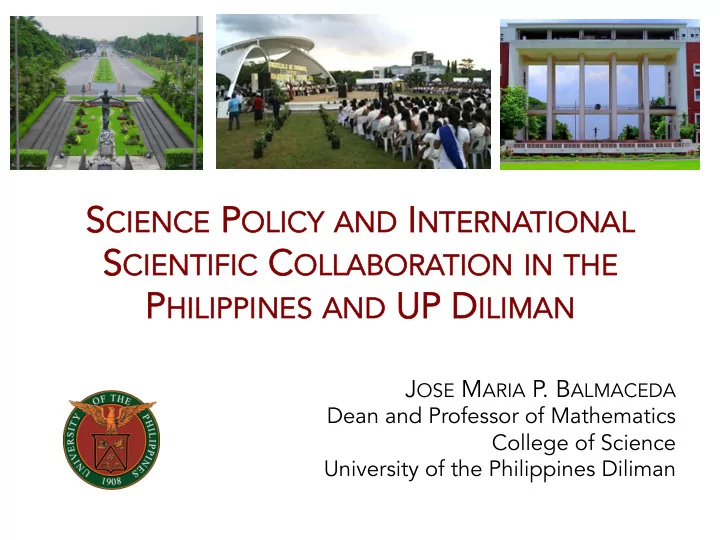
S CIENCE CIENCE P P OLICY OLICY AND AND I I NTERNA TIONAL NTERNATIONAL S CIENTIFIC CIENTIFIC C C OLLABORA TION IN IN THE THE OLLABORATION P HILIPPINES HILIPPINES AND AND UP UP D ILIMAN ILIMAN J OSE M ARIA P . B ALMACEDA Dean and Professor of


slide-1
SLIDE 1

SCIENCE

CIENCE P

POLICY

OLICY AND AND I

INTERNA

NTERNATIONAL TIONAL

SCIENTIFIC

CIENTIFIC C

COLLABORA

OLLABORATION TION IN IN THE THE

PHILIPPINES

HILIPPINES AND AND UP

UP DILIMAN

ILIMAN

JOSE MARIA P . BALMACEDA

Dean and Professor of Mathematics College of Science University of the Philippines Diliman

slide-2
SLIDE 2

OUTLINE

I. THE UNIVERSITY OF THE PHILIPPINES

– UP System – UP Diliman – College of Science

  • II. PHILIPPINE SCIENCE AND TECHNOLOGY POLICY

– Department of Science and Technology (DOST) – Commission on Higher Education (CHED)

  • III. OUTLOOK AND PROSPECTS

– Bright Spots – Constraints and Challenges

slide-3
SLIDE 3
  • I. ¡ ¡UNIVERSITY ¡OF ¡THE ¡PHILIPPINES ¡ ¡ ¡ ¡

¡ ¡SYSTEM ¡(UP) ¡AND ¡UP ¡DILIMAN ¡

slide-4
SLIDE 4

SOUTHEAST ¡ASIA ¡

slide-5
SLIDE 5

The ¡University ¡of ¡the ¡Philippines ¡System ¡

  • UP is a system of 8 constituent universities and 1

constituent college:

– UP Diliman (comprehensive) – UP Manila (health sciences, medicine) – UP Los Baños (agriculture, forestry, veterinary science) – UP Baguio – UP Visayas (fisheries) – UP Cebu* – UP Mindanao – UP Open University

*CONSTITUENT ¡COLLEGE ¡

slide-6
SLIDE 6

UP ¡ ¡ SYSTEM ¡ ¡ ¡

  • 8 constituent

universities (including UP Open Univ)

  • Located in 12

campuses

  • Flagship unit

is UP DILIMAN

¡ ¡

UP ¡ DILIMAN ¡

UP ¡ MINDANAO ¡ UP ¡ BAGUIO ¡ UP ¡ MANILA ¡ UP ¡ VISAYAS ¡ UP ¡LOS ¡ BAÑOS ¡ UP ¡ CEBU ¡

slide-7
SLIDE 7

UP ¡System ¡ ¡

  • Established in 1908
  • A new charter was passed by Congress in 2008,

declaring UP as the (only) National University the (only) National University

  • Student population (system): 50,000+
  • UP Diliman: 16,000 undergrad; 8,000 post-grad
  • Over 80,000 take the annual UP College Admission Test

~4,000 are admitted to UP Diliman ~7,000 to the rest (excluding the UP Open Univ)

  • 246 undergraduate and 362 graduate programs

¡

slide-8
SLIDE 8

UP ¡Diliman ¡

  • Flagship university
  • Programs:

~100 undergrad programs ~120 masters programs ~55 doctoral programs

  • 26 degree granting

units (Colleges/ Schools)

  • Faculty members:

~1,500

The National Science Complex, UP Diliman, 2016

slide-9
SLIDE 9

ACADEMIC CLUSTERS OF UP DILIMAN

ARTS

TS AND AND

LETTERS

ETTERS

SOCIAL

OCIAL S

SCIENCES

CIENCES AND AND L

LAW

AW

MANAGEMENT

ANAGEMENT AND AND E

ECONOMICS

CONOMICS

SCIENCE

CIENCE AND AND

TECHNOLOGY

ECHNOLOGY

College of Arts and Letters College of Fine Arts College of Human Kinetics College of Mass Communications College of Music Asian Center College of Education Institute of Islamic Studies College of Law College of Social Work and Community Development College of Social Sciences and Philosophy

Asian Institute of Tourism College of Business Administration School of Economics School of Labor and Industrial Relations School of Urban and Regional Planning National College of Public Administration and Governance Archaeological Studies Program College of Architecture College of Engineering College of Home Economics Institute of Library and Information Science College of Science College of Science School of Statistics

slide-10
SLIDE 10

COLLEGE

OLLEGE OF OF S

SCIENCE

CIENCE, U

, UNIVERSITY

NIVERSITY OF OF THE THE P

PHILIPPINES

HILIPPINES D

DILIMAN

ILIMAN www.science.up.edu.ph ¡

slide-11
SLIDE 11
  • Established as a separate college in 1983
  • Biology, Chemistry and Mathematics departments were

established in 1910

  • 310 full-time faculty members with 165 PhDs
  • 1,000 post-graduate students; 1,900 undergraduates
  • Operates a Marine Laboratory, Library, Computational Sciences

Research Center, Technology Incubation Core Facility

  • Runs two programs: Materials Science and Engineering, Science

and Society

  • Occupies a 21-hectare area declared by the national government

as the “National Science Complex”

slide-12
SLIDE 12

INSTITUTES OF THE COLLEGE

IB ¡– ¡InsBtute ¡of ¡Biology ¡ I-­‑CHEM ¡– ¡InsBtute ¡of ¡Chemistry ¡ IESM ¡– ¡InsBtute ¡of ¡Environmental ¡Sciences ¡ ¡ ¡ ¡ ¡ ¡ ¡ ¡ ¡ ¡and ¡Meteorology ¡ I-­‑MATH ¡– ¡InsBtute ¡of ¡MathemaBcs ¡ MSI ¡– ¡Marine ¡Science ¡InsBtute ¡ NIP ¡– ¡NaBonal ¡InsBtute ¡of ¡Physics ¡ NIGS ¡– ¡NaBonal ¡InsBtute ¡of ¡Geological ¡Sciences ¡ ¡ NIMBB ¡– ¡NaBonal ¡InsBtute ¡of ¡Molecular ¡ ¡ ¡ ¡ ¡ ¡ ¡ ¡ ¡Biology ¡and ¡Biotechnology ¡ NSRI* ¡– ¡Natural ¡Sciences ¡Research ¡InsBtute ¡

*non-­‑degree ¡granBng ¡

All ¡InsBtutes ¡have ¡been ¡declared ¡as ¡Centers ¡of ¡ Excellence ¡by ¡the ¡Commission ¡on ¡Higher ¡EducaBon ¡

slide-13
SLIDE 13

COLLEGE OF SCIENCE ACADEMIC PROGRAMS

  • BS, MS and PhD degree programs in:

– Biology, Chemistry, Math/Applied Math, Physics/Applied Physics, Geology, Molecular Biology and Biotechnology

  • MS and PhD programs in:

– Marine Science, Environmental Science, Meteorology, Materials Science, Microbiology

  • Other graduate programs offered:

– Professional Masters in Applied Math (Actuarial Science) – Professional Masters in Tropical Marine Ecosystems Management – Post-baccalaureate diploma programs in Biology, Math, Chemistry and Physics

slide-14
SLIDE 14

Key ¡Offices ¡for ¡Science ¡Policy ¡and ¡ InternaNonal ¡CollaboraNon ¡in ¡UP ¡

UP SYSTEM UP DILIMAN Science Policy

  • Office of the Vice

President for Academic Affairs (OVPAA)

  • Office of the Vice

Chancellor for Research and Development (OVCRD)

  • Office of the Vice

Chancellor for Academic Affairs International Collaboration

  • Office of International

Linkages (under OVPAA)

  • UPD Office of

International Linkages (under OVCAA) Intellectual Property, Technology Transfer, Legal Issues

  • Technology Transfer and

Business Development Office (under OVPAA)

  • UP System Legal Office
  • OVCRD Technology

Transfer Office

  • OVCRD Project

Management Office

slide-15
SLIDE 15
  • II. ¡SCIENCE ¡& ¡TECHNOLOGY ¡POLICY ¡
slide-16
SLIDE 16

Key ¡Government ¡Agencies ¡

  • Department of Science and Technology (DOST)

– Central government agency for science and technology policy, programs and initiatives. – Headed by the DOST Secretary with Undersecretaries for

  • Research and Development
  • Science and Technology Services
  • Regional Operations
  • Commission on Higher Education (CHED)

– Governing body covering both public and private higher (tertiary) educational institutions. Also implements large bi/ multilateral academic cooperation programs (e.g. Philippines-California Advanced Research Institutes, 5-year €60 million program).

slide-17
SLIDE 17
slide-18
SLIDE 18
slide-19
SLIDE 19

Harmonized ¡NaBonal ¡R&D ¡Agenda ¡ 2013-­‑2020 ¡

  • Harmonizing S & T research and development

to alleviate poverty, promote inclusive growth, mitigate disasters and adapt to climate change

  • National R & D agenda outcomes:

– A better life for the Filipino through science, technology and innovation. – Globally competitive capacity for science, technology and innovation.

slide-20
SLIDE 20
slide-21
SLIDE 21
slide-22
SLIDE 22
slide-23
SLIDE 23
slide-24
SLIDE 24
slide-25
SLIDE 25

Persistent ¡and ¡Emerging ¡Problems ¡

  • Worsening ¡traffic ¡and ¡

mobility ¡

– DOST ¡SoluBon: ¡ Sustainable ¡Mass ¡ Transport ¡Systems ¡

  • Poor ¡sanitaBon ¡

– DOST ¡SoluBon: ¡Eco-­‑ sepBc ¡tank ¡

  • Lack ¡of ¡potable ¡water ¡

– DOST ¡SoluBon: ¡ Ceramic ¡Water ¡Filter ¡

slide-26
SLIDE 26

2015 ¡Science ¡Technology ¡and ¡InnovaNon ¡ Polices ¡by ¡DOST ¡

  • Data sharing policy
  • IP policy
  • Technology transfer protocols for R&D

institutions

  • Fairness opinion report guidelines
  • IP management
slide-27
SLIDE 27
  • III. ¡OUTLOOK ¡AND ¡PROSPECTS ¡
slide-28
SLIDE 28

Improved ¡S&T ¡research ¡climate ¡

  • UP science policy and programs are generally aligned with

government thrusts and priorities

  • DOST and UP have embarked on massive S&T infrastructure

and human resource development

  • Dramatic increase in government S & T support

– Establishment of the Engineering Research and Development for Technology (consortium headed by UP Diliman College of Engineering, €60 million, 2007-2014) – Infrastructure development of the National Science Complex (UP Diliman College of Science, €60 million, 2006-2014)

  • DOST is the biggest funding source of UP for science and

technology projects. Most of the major S & T projects of DOST are implemented by UP units

slide-29
SLIDE 29
  • Project NOAH (Nationwide Operational Assessment of

Hazards) – geo-hazard maps, flood, storm surge early warning

  • DREAM-LiDAR technology to map 18 major river basins

and many minor rivers for hazard/flood inundation forecasting (€32 M)

– DREAM: Disaster Risk and Exposure Assessment and Mitigation – LiDAR: Lighting Detection and Ranging Tech for mapping

  • Cessna planes carry LiDAR equipment which generate

high resolution 3D flood hazard maps to create flood forecasting models

  • NOAH and DREAM-LiDAR are led by UP’s geologists,

engineers and marine scientists

UP ¡partners ¡with ¡DOST ¡in ¡Disaster ¡Management

DREAM-LiDAR won the Geospatial World Excellence in Policy Implementation Award for 2014 in Geneva, Switzerland. The Director of Project NOAH Dwas awarded the 2015 Plinius Medal by the European Geosciences Society for accomplishments in the field of Natural Hazards.

slide-30
SLIDE 30

Natural Sciences at UP Diliman’s College of Science

New methods for acquisition of images and

  • ther signals (NIP)

Transcriptome sequencing encoding neuroactive peptides in Conus snails (MSI) Bioactive constituents

  • f Philippine medicinal

plants (IC) Synthesis of polymers for food additives (IC) Detection and early warning system for Philippine harmful algal blooms (MSI) Physical properties of high temperature superconductors (NIP) Geological, geochemical and geophysical investigations of the Philippine archipelago (NIGS) Microbial ¡genomics ¡for ¡taxonomy, ¡ enzyme ¡and ¡natural ¡products ¡ discovery ¡and ¡producNon ¡ ¡(MSI ¡& ¡ NIMBB) ¡ Understanding biodiversity at various scales: From genes to ecosystems (IB) BioacNve ¡marine ¡natural ¡products ¡and ¡ drug ¡discovery ¡from ¡invertebrates ¡and ¡ associated ¡microbial ¡symbionts ¡(MSI) ¡

¡ ¡ ¡ ¡ ¡NIP-­‑Physics, ¡IC-­‑Chemistry, ¡NIMBB-­‑Molecular ¡Biology, ¡IB-­‑Biology, ¡NIGS-­‑Geology, ¡MSI-­‑ ¡Marine ¡Science ¡ ¡

Terahertz ¡emission ¡from ¡thin ¡film ¡ photovoltaic ¡materials ¡excited ¡by ¡ femtosecond ¡laser ¡pulses ¡(NIP) ¡ Entanglement ¡spectrum ¡and ¡ number ¡fluctuaNons ¡in ¡the ¡ spin-­‑parNNoned ¡BCS ¡ground ¡ state ¡(NIP) ¡

slide-31
SLIDE 31

Emer Emerging Inter ging Interdisciplinary Resear disciplinary Research (EIDR): ch (EIDR): UP’ UP’s new R&D framework for long-ter s new R&D framework for long-term m pr productivity and pr

  • ductivity and progr
  • gress

ess

  • Hubs & Spokes framework

Hubs & Spokes framework (UP Constituent Universities as Hubs, Philippine and foreign Higher Education Institutions, goverment agencies, industries, NGOs as Spokes)

  • 3 categories of R&D Hubs & Spokes by priority ar

3 categories of R&D Hubs & Spokes by priority areas: eas:

– national gover national government priorities (public good) nment priorities (public good) – industry priorities (private good, job cr industry priorities (private good, job creation for public good) eation for public good) – academic and basic “pie-in-the-sky” r academic and basic “pie-in-the-sky” resear esearch priorities ch priorities

  • Aims to build strong, competent research groups
  • r clusters led by expert senior faculty mentoring

junior faculty and postgraduate and UG students for long-term capacity building

  • Encourages collaborations between science and

engineering fields and the arts, culture and humanities ¡

Building ¡Human ¡Knowledge ¡Capital: ¡ “Suprastructures” ¡of ¡Hubs ¡and ¡Spokes ¡ ¡

slide-32
SLIDE 32

Constraints ¡and ¡Challenges ¡

  • Lagging in publications and patents
  • Lack of FTE researchers (only 81 per million, way below

UNESCO standard of 380 per million)

  • Procurement laws and processes – major obstacle for efficient

research implementation

  • Little investment from industry; only few companies

undertaking advanced R&D

  • Only few higher education institutes engaging or capable of

advance S&T research

  • Newly-elected Philippine President – not much information
  • n science policy directions and programs (threat or
  • pportunity?)
slide-33
SLIDE 33

COUNTR COUNTRY Y

  • No. of FTE
  • No. of FTE

Resear Researchers per chers per million population million population Total No. of FTE

  • tal No. of FTE

resear esearchers chers Total Head Count

  • tal Head Count
  • f Resear
  • f Researchers

chers

Singaporea 6,088 27,301 31,657 Malaysiab 372 9,694 19,021 Thailandc 311 20,506 34,084 Indonesiae 205 42,722 Vietnamd 115 9,328 41,117 Philippines Philippinesc 81 81 6,896 6,896 10,690 10,690

  • NO. OF RESEARCHERS, 2010
  • NO. OF RESEARCHERS, 2010

a= ¡2007, ¡b ¡= ¡2006, ¡c ¡=2005, ¡d=2002, ¡e=2001; ¡Source: ¡UNESCO ¡Ins+tute ¡for ¡Sta+s+cs ¡(2010) ¡

slide-34
SLIDE 34

COUNTR COUNTRY Y GERD AS % of GDP GERD AS % of GDP GERD per capita (PPP GERD per capita (PPP $) $) Singaporea 2.61 1,341.80 Malaysiab 0.64 79.90 Thailandc 0.25 18.10 Indonesiae 0.19 3.10 Vietnamd 0.12 3.40 Philippines Philippinesc 0.05 0.05 1.60 1.60

R & D EXPENDITURES, 2010 R & D EXPENDITURES, 2010

a= ¡2007, ¡b ¡= ¡2006, ¡c ¡=2005, ¡d=2002, ¡e=2001; ¡Source: ¡UNESCO ¡Ins+tute ¡for ¡Sta+s+cs ¡(2010) ¡

slide-35
SLIDE 35

ISI-WEB OF SCIENCE PUBLICA ISI-WEB OF SCIENCE PUBLICATIONS, 2010 TIONS, 2010

Rank Rank Country Country

No.of No.of Publications Publications % % Shar Share e

  • No. of FTE
  • No. of FTE

Resear Researchers chers

  • No. of
  • No. of

Publications Publications per FTE per FTE Resear Researcher cher

1 U.S.A. 304,670 26.40 1,393,520a 0.22 2 Japan 77,263 6.40 677,206a 0.11 5 China 70,962 5.96 926,252a 0.08 11 South Korea 26,434 2.22 156,220a 0.17 30 Singapore 6,528 0.55 21.359a 0.3 43 Thailand 2,625 0.22 18,114b 0.14 50 Malaysia 1,596 0.13 12,670a 0.12 66 Vietnam 590 0.05 9,328c 0.06 68 Indonesia 586 0.05 42,722d 0.01 72 72 Philippines Philippines 520 520 0.04 0.04 5,860 5,860b 0.09 0.09

a= ¡2004, ¡b ¡= ¡2003, ¡c ¡=2002, ¡d=2001; ¡Source: ¡ISI-­‑Web ¡of ¡Science ¡Cita+on ¡Databases; ¡ UNESCO ¡Ins+tute ¡for ¡Sta+s+cs ¡(2010) ¡

slide-36
SLIDE 36
slide-37
SLIDE 37

THANK YOU FOR LISTENING THANK YOU FOR LISTENING