T HE R OLE OF C ITIZEN S CIENTISTS IN THE R ESTORATION OF T ROUT B - - PowerPoint PPT Presentation

t he r ole of c itizen s cientists in
SMART_READER_LITE
LIVE PREVIEW

T HE R OLE OF C ITIZEN S CIENTISTS IN THE R ESTORATION OF T ROUT B - - PowerPoint PPT Presentation

T HE R OLE OF C ITIZEN S CIENTISTS IN THE R ESTORATION OF T ROUT B ROOK Maine Water & Sustainability Conference April 1, 2014 Kate McDonald, Cumberland County SWCD Project Scientist Fred Dillon, South Portland Stormwater Program


slide-1
SLIDE 1

THE ROLE OF CITIZEN SCIENTISTS IN

THE RESTORATION OF TROUT BROOK

Kate McDonald, Cumberland County SWCD Project Scientist Fred Dillon, South Portland Stormwater Program Coordinator
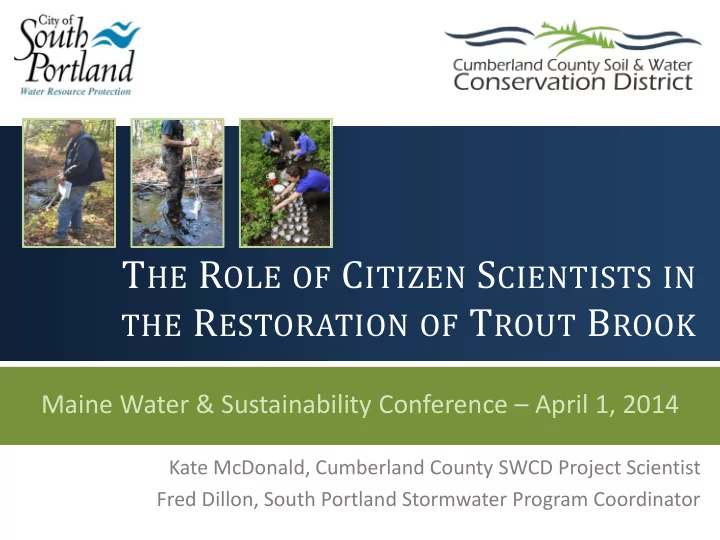
Maine Water & Sustainability Conference – April 1, 2014

slide-2
SLIDE 2

Presentation Overview

  • Partners
  • WMP Overview
  • Basis / rationale for method
  • Process to date
  • Method / Results
  • Technology transfer
  • Discussion / Questions
slide-3
SLIDE 3

Stakeholder Involvement is Critical!

  • Dr. Lois Ongley

Unity College Fred Dillon City of South Portland Wendy Garland Maine DEP Tom Mikulka Cape Elizabeth Resident Carolyn Gleason Cape Elizabeth Student Kathy Bock Cape Elizabeth H.S. Ryan Messier U.S.M. Kate McDonald CCSWCD

slide-4
SLIDE 4

Trout Brook Watershed

  • Stream bank erosion
  • Inadequate buffers
  • Yard waste dumping
  • Stream channel

alteration

  • Decreased dissolved
  • xygen
  • Elevated chloride
  • Elevated nutrients
slide-5
SLIDE 5

Problem Identification

How can we leverage our watershed stakeholders’ expertise to monitor watershed recovery?

slide-6
SLIDE 6

Plan Conception

  • Service learning project

with Unity College (2011)

  • Water quality internship

(2012)

  • “We need more data!”
  • Management Plan

Finalized (2012)

slide-7
SLIDE 7

Citizen Monitoring

  • Bug sampling
  • Led by Tom Mikulka – local resident & citizen scientist
  • Kathy Bock & CEHS Senior AP Enviro. Science Students
slide-8
SLIDE 8

Importance of “Bug” Sampling

Benthic Macroinvertebrates

  • Key WQ / habitat standard
  • Found in most surface

waters

  • V. good indicators of long-

term impacts to WQ

slide-9
SLIDE 9

DEP ROCK BAGS

  • Deploy for 4-8

weeks once every 5 years

  • Sampling season

from July-Sept

  • Robust assessment

for determination

  • f WQ compliance
slide-10
SLIDE 10

TB KICK NETS

  • ~4 hrs to collect &

analyze samples

  • Rapid screening

tool to determine improvements from BMPs

  • Corresponds well

with rock bags

slide-11
SLIDE 11

TB KICK NETS

  • ~4 hrs to collect &

analyze samples

  • Rapid screening

tool to determine improvements from BMPs

  • Corresponds well

with rock bags

1 1 1 2

slide-12
SLIDE 12

TB KICK NETS

  • ~4 hrs to collect &

analyze samples

  • Rapid screening

tool to determine improvements from BMPs

  • Corresponds well

with rock bags

slide-13
SLIDE 13

TB KICK NETS

  • ~4 hrs to collect &

analyze samples

  • Rapid screening

tool to determine improvements from BMPs

  • Corresponds well

with rock bags

1 1 1 2 4 3 2 2 5 11 5 11 2.2 CEHS Enviro. Science 5/30/13 TB#1

slide-14
SLIDE 14

Trout Brook Kick Nets

slide-15
SLIDE 15

1 2 3 4 5 1-K

Kick Nets vs. Rock Bags

slide-16
SLIDE 16

1 2 3 4 5 1-K

Kick Nets vs. Rock Bags

NOT a replacement method for

regulatory compliance, but…

slide-17
SLIDE 17

1 2 3 4 5 1-K

Kick Nets vs. Rock Bags

…does correspond pretty well with DEP rock bag method

Date Sample Site Kick Net Biotic Index Stream Water Quality Maine DEP Method 5/30/13 TB Site 1 2.2 Fair Impacted 6/5/13 TB Site 1 1.9 Poor Impacted 10/21/13 TB Site 1 2.2 Fair Impacted 10/21/13 TB Site 1 2.4 Fair Impacted 6/5/13 TB Site 2 2.2 Fair Impacted 6/5/13 TB Site 3 2.4 Fair Impacted 6/5/13 TB Site 4 2.1 Fair Impacted 6/6/13 TB Site 5 2.2 Fair Impacted 6/6/13 TB Site 6 2.3 Fair Impacted 6/12/13 RB Site 1 2.6 Good Non-impacted 10/30/13 KB Site 1 2.1 Fair Impacted

slide-18
SLIDE 18

Implications for Use Elsewhere

  • Excellent service learning opportunity, but…
  • Tech. expertise for sample program design*

and bug id. critical

  • Potential resources:
  • MEDEP
  • S&WCDs
  • Interlocal SW groups (ISWG, BASWG, etc)
  • Universities
  • Trout Unlimited

*Timing also important – ideally in Sept to correspond w/ DEP rock bags

slide-19
SLIDE 19

Acknowledgments

slide-20
SLIDE 20

QUESTIONS / DISCUSSION