WINERY PRESENTATION ITALY Emilia Romagna, Scandiano, Reggio Emilia - - PDF document

winery presentation italy emilia romagna
SMART_READER_LITE
LIVE PREVIEW

WINERY PRESENTATION ITALY Emilia Romagna, Scandiano, Reggio Emilia - - PDF document

WINERY PRESENTATION ITALY Emilia Romagna, Scandiano, Reggio Emilia Emilia Romagna region is actually two regions in one: Emilia is the part located north of the town of Bologna, and is the Lambrusco grape terroir, encompassing Reggio


slide-1
SLIDE 1

VinUS Inc. GEMMA RUBIA PRESENTATION 1 WINERY PRESENTATION ITALY  Emilia Romagna, 

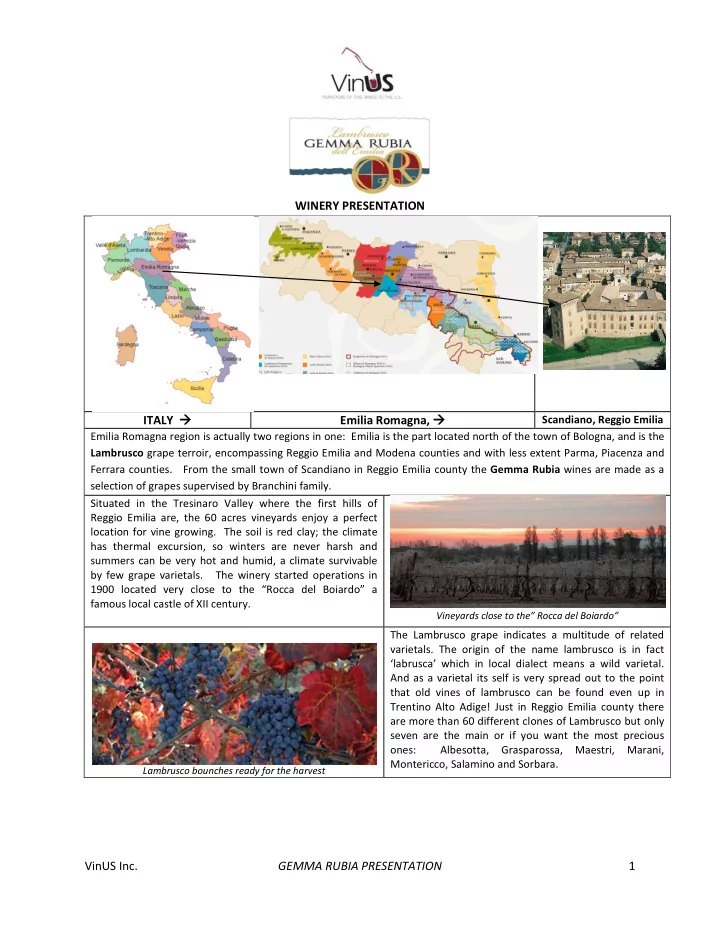
Scandiano, Reggio Emilia Emilia Romagna region is actually two regions in one: Emilia is the part located north of the town of Bologna, and is the Lambrusco grape terroir, encompassing Reggio Emilia and Modena counties and with less extent Parma, Piacenza and Ferrara counties. From the small town of Scandiano in Reggio Emilia county the Gemma Rubia wines are made as a selection of grapes supervised by Branchini family. Situated in the Tresinaro Valley where the first hills of Reggio Emilia are, the 60 acres vineyards enjoy a perfect location for vine growing. The soil is red clay; the climate has thermal excursion, so winters are never harsh and summers can be very hot and humid, a climate survivable by few grape varietals. The winery started operations in 1900 located very close to the “Rocca del Boiardo” a famous local castle of XII century.

Vineyards close to the” Rocca del Boiardo” Lambrusco bounches ready for the harvest

The Lambrusco grape indicates a multitude of related

  • varietals. The origin of the name lambrusco is in fact

‘labrusca’ which in local dialect means a wild varietal. And as a varietal its self is very spread out to the point that old vines of lambrusco can be found even up in Trentino Alto Adige! Just in Reggio Emilia county there are more than 60 different clones of Lambrusco but only seven are the main or if you want the most precious

  • nes:

Albesotta, Grasparossa, Maestri, Marani, Montericco, Salamino and Sorbara.

slide-2
SLIDE 2

VinUS Inc. GEMMA RUBIA PRESENTATION 2

The different clones bring in different aspects and characteristics to lambrusco wines. As a varietal though the lambrusco grape has a common denominator besides the region of provenance it is one of the richest grapes in poliphenols and anthocyanin with values that are double for example of a merlot (which by itself is one of the richest compared to the average): a proof? Look at the color the very dark color of the wine. Marani – Maestri – Grasparossa grapes Vineyards during the summer The winery focus on the production of lambrusco from varietals Marani Maestri and Grasparossa, plus, depending of the style of wine, Ancelotta Montericco (secco or the dry) and Malbo Gentile (amabile or sweet). The soil is various but it is mainly red clay with calcareous pebbles. The vineyards are all cared for with minimal human intervention. The use of spraying is reduced therefore to a minimum and they are following the 2078 Reg. UE making the winery sustainable1. Harvest happens at the end of September first half of

  • October. The grape clusters get destalked and soft

pressed, left in cold maceration, after that the fermentation takes place. The base wine is then stored in stainless steel

  • tanks. In order to make the final lambrusco a second

fermentation is required by the use of the charmat method with different durations depending if the wine will be in an amabile (sweeter) style or secco (dry).

Fermentation tanks

1 Sustainable is a “quasi-organic farming”. Called also 'lutte raisonnée', 'lutte intégrée' (France), “lotta integrata” (Italian) it is

regulated by European Community Rule 2078. Some growers, especially those in marginal areas opt for a regime that does include the option to use chemicals but they significantly reduce the amount required by monitoring the health of the vines and the

  • weather. In humid or damp conditions, converting to organic in short time can mean an increased risk of rot-affected grapes. Also
  • rganic producers use copper in the vineyards. That is a matter of concern for many producers though and must be carefully taken

in consideration as copper does not degrade into the soil (it takes 5 times more to get rid of copper than sulfites for example in the soil) with damages, in area where copper must be used that can be heavier than conventional growing practices.

slide-3
SLIDE 3

VinUS Inc. GEMMA RUBIA PRESENTATION 3 Notes: _____________________________________________________________________________________ _____________________________________________________________________________________ _____________________________________________________________________________________ _____________________________________________________________________________________ _____________________________________________________________________________________ _____________________________________________________________________________________ _____________________________________________________________________________________ _____________________________________________________________________________________ _____________________________________________________________________________________ _____________________________________________________________________________________ _____________________________________________________________________________________ _____________________________________________________________________________________ _____________________________________________________________________________________ _____________________________________________________________________________________ _____________________________________________________________________________________ _____________________________________________________________________________________ _____________________________________________________________________________________ _____________________________________________________________________________________ _____________________________________________________________________________________ _____________________________________________________________________________________ _____________________________________________________________________________________ _____________________________________________________________________________________ _____________________________________________________________________________________ _____________________________________________________________________________________ Wines Lambrusco Amabile: Made of mainly Marani and

Maestri grapes with some Malbo Gentile and Albesotta, this wine has 4 days maceration at controlled temperature in order to extract the freshness and

  • complexity. The fermentation is stopped at 7% alcohol.

Tasting profile: ruby red with gentle and persistent foam

has a bright refreshing acidity with intense blueberries dark cherry flavors. To be paired with charcuterie, chicken, turkey dishes and quiches.

Lambrusco Secco : Made of mainly Marani and

Maestri grapes with some Grasparossa and Albesotta, this wine see 4 days of cold maceration in order to extract the complexity and freshness. The charmat process here gets carried completely out to reach an alcohol content of 11%.

Tasting profile: The wine has a deep purple color with

refreshing fragrance of violets. The mouth is sapid and slightly tannic. It is the perfect companion for the Emilia Romagna dishes. Red meat with polenta, all lasagna with ragu, charcuterie and game dishes.