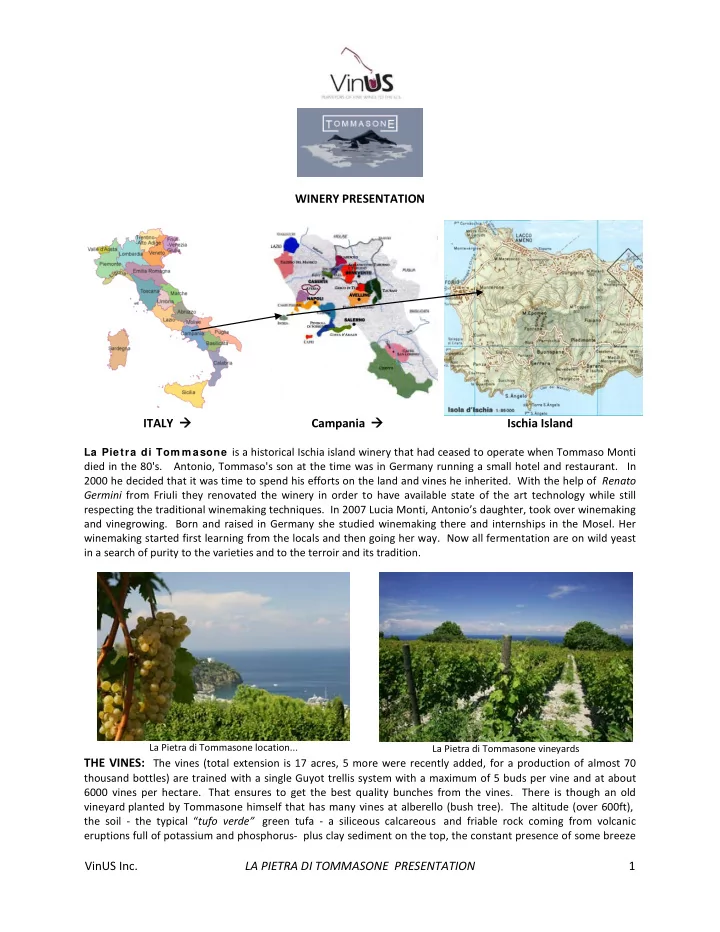
WINERY PRESENTATION ITALY Campania Ischia Island La Pietra di Tom - - PDF document

winery presentation italy campania ischia island
SMART_READER_LITE
LIVE PREVIEW

WINERY PRESENTATION ITALY Campania Ischia Island La Pietra di Tom - - PDF document

WINERY PRESENTATION ITALY Campania Ischia Island La Pietra di Tom m asone is a historical Ischia island winery that had ceased to operate when Tommaso Monti died in the 80's. Antonio, Tommaso's son at the time was in Germany running a


slide-1
SLIDE 1

VinUS Inc. LA PIETRA DI TOMMASONE PRESENTATION 1 WINERY PRESENTATION ITALY  Campania  Ischia Island

La Pietra di Tom m asone is a historical Ischia island winery that had ceased to operate when Tommaso Monti

died in the 80's. Antonio, Tommaso's son at the time was in Germany running a small hotel and restaurant. In 2000 he decided that it was time to spend his efforts on the land and vines he inherited. With the help of Renato Germini from Friuli they renovated the winery in order to have available state of the art technology while still respecting the traditional winemaking techniques. In 2007 Lucia Monti, Antonio’s daughter, took over winemaking and vinegrowing. Born and raised in Germany she studied winemaking there and internships in the Mosel. Her winemaking started first learning from the locals and then going her way. Now all fermentation are on wild yeast in a search of purity to the varieties and to the terroir and its tradition.

La Pietra di Tommasone location... La Pietra di Tommasone vineyards

THE VINES: The vines (total extension is 17 acres, 5 more were recently added, for a production of almost 70

thousand bottles) are trained with a single Guyot trellis system with a maximum of 5 buds per vine and at about 6000 vines per hectare. That ensures to get the best quality bunches from the vines. There is though an old vineyard planted by Tommasone himself that has many vines at alberello (bush tree). The altitude (over 600ft), the soil - the typical “tufo verde” green tufa - a siliceous calcareous and friable rock coming from volcanic eruptions full of potassium and phosphorus- plus clay sediment on the top, the constant presence of some breeze

slide-2
SLIDE 2

VinUS Inc. LA PIETRA DI TOMMASONE PRESENTATION 2

and sun are all indications of wines with great potential.

THE WINES: The wines truly respect the Ischia terroir

recognized for solid white wines varieties. Two indigenous varieties are typical of Ischia Island and are Forastera and Biancolella. Plus Fiano indigenous to Campania is also grown here as well as some Falanghina. But the surprise is the reds. Indigenous to the island is the Piedirosso which is grown with the Aglianico and the Montepulciano di Abruzzo. Antonio Monti reminds us that Ischia was in fact one of the first places where those wines were grown even before the Romans. The Greek called this island Pithecusa and therefore his first two wines were called Pithecusa red (blending aglianico, piedirosso and montepuciano di abruzzo) and white (blending fiano with biancolella). After that Antonio and Lucia worked on making a 100% Biancolella then a typically local blend of forastera and biancolella called Terradei. The reds are mixing the flavor of the island and given the soil the potential is outstanding. All reds were oak aged in tonneaux and barriques but now they go in chestnut (from Avellino) casks. Whites are just stainless steel.

White Wines Crazy Angels (Angeli Matti): from the recently

acquired vines at Tenuta Fiorio this wine is made of Biancolella, Fiano and Falanghina. Fermentation is made

  • n native yeast with little control of temperature. In
  • rder to avoid adding sulfites Lucia decided to use a

screwcap instead of cork. This wine truly tells you what the vintage has been at La Pietra di Tommasone. The name Crazy Angels comes from Luigi Veronelli who several times used this expression referred to artisanal winemakers.

Tasting profile: Straw like color with some golden

  • hues. The nose is of spices and brushwood. The

mouth is tied to the vintage and the ageing. Flinty tones are from uncontrolled fermentation and soil; floral acacia and zesty flavors are coupled with fiano that as the wine ages gets predominant and smokey.

Terradei: Terradei is made of Biancolella and Forastera

grapes two varieties indigenous to Ischia island. The blend is half and half, wild yeast used but control of temperature as well, with and a long rest on fine

  • lees. Vineyards in Colle di Sopra (Biancolella) and in

Tasting profile: Straw like color. The nose is complex

citric with some brushwood and acacia hints. The taste is of tangerines and lemons bringing together all the characteristics for a perfect seafood and salad companion.

slide-3
SLIDE 3

VinUS Inc. LA PIETRA DI TOMMASONE PRESENTATION 3

Piellero (Forastera).

Biancolella: A pure version of this grape variety grown

almost exclusively on Ischia island and in the Sorrento

  • Gulf. This Biancolella wine is very refreshing and
  • versatile. The winemaking style is now on native yeast

fermentation at controlled temperature and then a long rest (battonage) on fine lees in stainless steel. Vineyard is in Colle di Sopra.

Tasting profile: The color is a bright yellow with

some green reflection. The nose is complex and goes from rosemary and mint then changes to apricot and peach all typical scents of a marine environment. In the palate the wine is dry and goes from peach and apricot to cedar and lemon with a hazelnut finish.

Pithecusa bianco: Almost a red for structure. It is a

typical Campania wine where the Fiano's opulence and smokeyness gets smoothed out by the zestiness of

  • Biancolella. A very versatile wine that can go with fish

(any kind) or with a carpaccio as well when young to important dishes after some years. Vines are from Tenuta Spadara and partially from the Vigna del Parroco (which is also made as a separate wine, but oak fermented). Fermentation on native yeast of the masses together at controlled temperature. Long rest on fine lees.

Tasting profile: Pithecusa Bianco (white) has a

straw-yellow color an appealing perfume of grapefruit, pears, mineral and spice, toasted hazelnuts, apples and notes of honey; Full and rich on the palate with a little lemony spritz on the tongue, where the citric fruit is carried on a good body with fresh deep apple fruit and herbal tea with an acidity that becomes almost sharp in the long finish when young. When aged the wine shows honey hints with an underlying smokiness unique to the fiano.

Red Wines Rosamonti : Made in the same fashion of the Crazy

Angels, Rosamonti uses the first press from selected Aglianco bunches. The fermentation is wild but at controlled temperature. The wine ferments and age in

  • stainless. Released normally in April.

Tasting profile: Made from the very first selection

  • f Aglianico grapes, this rose' is made on run juice

from the pneumatic press. Fermented and aged in stainless steel this is a wine that has a delicious cherry flavor and goes very well served as an appetizer with fish dishes. It pairs great also with buffalo mozzarella.

Per E Palummo : Per E Palummo (pronounced as par a

paloummo) is a way to call Piedirosso grape; it means the pigeon foot, referring to the curious shape on which piedirosso pedicels attach to the stem. Piedirosso is the everyday red wine in Ischia and along Campania' coast. At Tommasone they harvest the piedirosso from their vineyards in Montezunta, Sant Angelo and Serrana Fontana at the end of September early October. Spontaneous fermentation takes place in stainless steel. After the malolactic is done, wine rests for 6 months before bottling.

Tasting profile: Ruby red with garnet hues this wine

has ripe red and black berries aromas that carries in the mouth with a vibrant acidity. Great with tomato sauce dishes, fish soups, white meat and roasted potatoes.

Pithecusa Rosso : Pithecusa Rosso is made from three

southern Italian varieties; Aglianico the most famous red grape of Campania, Montelpulciano di Abruzzo and

  • Piedirosso. The vineyard was planted in the mid 60’ as

blend field and it is harvested practically at the same

  • time. The three varieties are blended together and age

for one year in chestnut casks. Fermentation is natural.

Tasting profile: The result is ruby red with garnet

  • hues. The nose is fine, intense of violet cherries and
  • spices. The taste is warm and dry with black fruits

cherries and tobacco and harmoniously tannic.

slide-4
SLIDE 4

VinUS Inc. LA PIETRA DI TOMMASONE PRESENTATION 4

Maceration is about 10 days.

Pignanera: Pignanera is made from Montepulciano and

  • Aglianico. The oldest vines. The maceration is of two

weeks and fermentation is left to its own yeast. Wine once racked is aged for two years in chestnut and oak casks refined for six months minimum in the bottle.

Tasting profile: The nose is full of black fruits and

  • cherries. The palate has an elegant texture well

balanced with spices, leather and black currant and a long finish. This wine goes well first rich courses roasted lamb, pork or beef tenderloin and braised shallots and/or aged cheeses.

Notes: _____________________________________________________________________________________ _____________________________________________________________________________________ _____________________________________________________________________________________ _____________________________________________________________________________________ _____________________________________________________________________________________ _____________________________________________________________________________________ _____________________________________________________________________________________ _____________________________________________________________________________________ _____________________________________________________________________________________ _____________________________________________________________________________________ _____________________________________________________________________________________ _____________________________________________________________________________________ _____________________________________________________________________________________ _____________________________________________________________________________________ _____________________________________________________________________________________ _____________________________________________________________________________________ _____________________________________________________________________________________ _____________________________________________________________________________________