A multicriteria decision analysis as an innovative approach to - - PowerPoint PPT Presentation

a multicriteria decision analysis as an innovative
SMART_READER_LITE
LIVE PREVIEW

A multicriteria decision analysis as an innovative approach to - - PowerPoint PPT Presentation

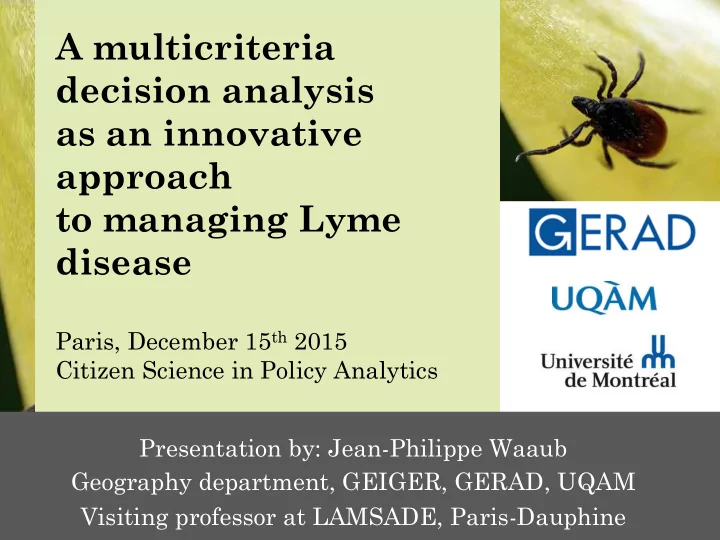
A multicriteria decision analysis as an innovative approach to managing Lyme disease Paris, December 15 th 2015 Citizen Science in Policy Analytics Presentation by: Jean-Philippe Waaub Geography department, GEIGER, GERAD, UQAM Visiting


slide-1
SLIDE 1

A multicriteria decision analysis as an innovative approach to managing Lyme disease

Paris, December 15th 2015 Citizen Science in Policy Analytics Presentation by: Jean-Philippe Waaub Geography department, GEIGER, GERAD, UQAM Visiting professor at LAMSADE, Paris-Dauphine

slide-2
SLIDE 2

Content ¡

  • 1. Introduc.on ¡
  • 2. Decision-­‑Making ¡in ¡Public ¡Health: ¡A ¡Need ¡for ¡

Par.cipatory ¡Mul.-­‑Criteria ¡Decision ¡Analysis ¡

  • 3. The ¡Case ¡of ¡Lyme ¡Disease ¡
  • 4. Interac.ve ¡Workshop ¡on ¡Mul.-­‑Criteria ¡

Decision ¡Aid ¡in ¡Public ¡Health: ¡Case ¡study ¡on ¡ Lyme ¡disease ¡preven.on ¡

  • 5. Conclusions ¡

2 ¡

slide-3
SLIDE 3
  • 1. ¡Introduc.on ¡
  • This ¡presenta.on ¡synthe.zes ¡the ¡results ¡from ¡

two ¡projects ¡financed ¡by ¡Public ¡Health ¡Canada, ¡ with ¡a ¡common ¡core ¡team: ¡

– Programme ¡du ¡projet ¡pilote ¡de ¡système ¡d’impact ¡et ¡ de ¡réac.on ¡aux ¡maladies ¡infec.euses ¡(PPSIRMI); ¡ Projet: ¡Informa.on ¡pour ¡l’adapta.on ¡aux ¡risques ¡aux ¡ maladies ¡vectorielles ¡(10/02/2010 ¡to ¡09/02/2012) ¡ – Preventa.ve ¡Public ¡Health ¡Systems ¡and ¡Adapta.on ¡to ¡ a ¡Changing ¡Climate ¡Program; ¡Project: ¡Knowledge ¡ Transfer ¡and ¡Capacity ¡Building ¡in ¡the ¡Area ¡of ¡Decision ¡ Aid ¡Tools ¡to ¡Manage ¡Lyme ¡Disease ¡and ¡Other ¡Vector-­‑ Borne ¡Diseases, ¡in ¡the ¡Context ¡of ¡Adapta.on ¡to ¡ Climate ¡Change ¡(10/2014 ¡to ¡31/03/2015) ¡ ¡

3 ¡

slide-4
SLIDE 4

Plan ¡

Project ¡1: ¡Informa0on ¡pour ¡l’adapta0on ¡ aux ¡risques ¡aux ¡maladies ¡vectorielles

4 ¡

¡ ¡

Thanks to all stakeholders and experts and the Lyme-MCDA Consortium: Nathalie Côté Annie Doucet Cécile Ferrouillet Anne Fortin Francis Girard Pierre Gosselin François Milord Louise Trudel Nick Ogden Patrick Leighton Jules Koffi Catherine Bouchard Anne-Laure Bouvier

The realization of this project was made possible by financial contribution of the Public Health Agency of Canada (PHAC). The sights expressed here do not reflect the official position of the PHAC.

4

slide-5
SLIDE 5

Project ¡1 ¡team ¡

Project ¡leaders ¡

  • Dre ¡Denise ¡Bélanger, ¡Université ¡de ¡Montréal ¡ ¡ ¡
  • Dr ¡Jean-­‑Philippe ¡Waaub, ¡Université ¡du ¡Québec ¡à ¡Montréal ¡

Coordina0on ¡

  • Caroline ¡Guénefe ¡ ¡

Team ¡

  • Aenishaenslin, ¡Cécile, ¡Université ¡de ¡Montréal ¡
  • Bouvier, ¡Anne-­‑Laure, ¡Université ¡du ¡Québec ¡à ¡Montréal ¡
  • Cissé, ¡Hassane, ¡Université ¡du ¡Québec ¡à ¡Montréal ¡
  • Gatewood ¡Hoen, ¡Anne, ¡Université ¡McGill ¡
  • Hongoh, ¡Valerie, ¡indépendant ¡
  • Léveillé, ¡Johanne, ¡Université ¡du ¡Québec ¡à ¡Montréal ¡
  • Michel, ¡Pascal, ¡Université ¡de ¡Montréal ¡
  • Samoura, ¡Karim, ¡Université ¡du ¡Québec ¡à ¡Montréal ¡

5 ¡

slide-6
SLIDE 6

Plan ¡

Results

6 ¡

slide-7
SLIDE 7

Project ¡2: ¡Mul.-­‑Criteria ¡Decision ¡Aid ¡ Tools ¡in ¡Public ¡Health, ¡workshops ¡

  • Organized ¡by ¡the ¡Group ¡for ¡Research ¡in ¡

Decision ¡Analysis ¡(GERAD), ¡HEC ¡Montréal, ¡ Polytechnique ¡Montréal, ¡McGill ¡University, ¡ UQAM ¡

  • In ¡partnership ¡with ¡the ¡Université ¡de ¡

Montréal's ¡Veterinary ¡Medicine ¡Faculty ¡

7 ¡

slide-8
SLIDE 8

Project ¡2 ¡team ¡(1/2) ¡

  • Project ¡leader ¡

– Jean-­‑Philippe ¡Waaub, ¡Professor ¡with ¡the ¡Geography ¡ Department ¡at ¡UQAM; ¡GERAD ¡Director ¡ – Denise ¡Bélanger, ¡Professor ¡with ¡the ¡Pathology ¡and ¡ Microbiology ¡Department ¡at ¡Université ¡de ¡Montréal ¡ ¡ ¡

  • Public ¡health ¡component ¡ ¡

– Cécile ¡Aenishaenslin, ¡Veterinarian, ¡PhD ¡candidate: ¡ Consultant ¡ ¡ – Valerie ¡Hongoh, ¡Epidemiologist, ¡PhD ¡candidate: ¡ Consultant ¡ ¡

8 ¡

slide-9
SLIDE 9

Project ¡Team ¡(2/2) ¡

  • Mul.-­‑criteria ¡decision ¡aid ¡component ¡ ¡

– Camille ¡Fertel, ¡PhD ¡Economics: ¡Consultant ¡ – Bertrand ¡Mareschal, ¡Professor ¡at ¡the ¡Solvay ¡Brussels ¡ School ¡of ¡Economics ¡and ¡Management, ¡Université ¡Libre ¡ de ¡Bruxelles, ¡Belgium: ¡Consultant ¡

  • Organiza.onal ¡and ¡ins.tu.onal ¡analysis ¡component ¡

– Camille ¡Fertel, ¡PhD ¡Economics: ¡Consultant ¡ – Johanne ¡Léveillée, ¡Faculty ¡of ¡Environmental ¡Design: ¡ Consultant ¡

  • Project ¡management ¡

– Rebecca ¡Sueur, ¡MA ¡Public ¡Administra.on: ¡Consultant ¡

9 ¡

slide-10
SLIDE 10

¡ ¡

  • 2. ¡DECISION-­‑MAKING ¡IN ¡PUBLIC ¡

HEALTH: ¡A ¡NEED ¡FOR ¡PARTICIPATORY ¡ MULTI-­‑CRITERIA ¡DECISION ¡ANALYSIS ¡ (MCDA) ¡

10 ¡

slide-11
SLIDE 11

Public ¡Health: ¡At ¡the ¡Interface ¡of ¡ Science ¡and ¡Public ¡Ac.on ¡

  • Evidence ¡based ¡public ¡health ¡ ¡

– Omen ¡quan.ta.ve ¡appraisal ¡

  • However, ¡there ¡is ¡recogni.on ¡that ¡there ¡are ¡
  • ther ¡factors ¡that ¡influence ¡decision-­‑making ¡
  • …………………………………………….Beyond ¡evidence ¡

11 ¡

slide-12
SLIDE 12

Public ¡Health ¡and ¡Mul.disciplinarity ¡

  • Complex ¡mul.disciplinary ¡process ¡that ¡

includes ¡several ¡sectors ¡of ¡society ¡

  • In ¡order ¡to ¡grasp ¡a ¡problem ¡globally ¡and ¡

coherently, ¡it ¡may ¡be ¡necessary ¡to ¡use ¡various ¡ mul.disciplinary ¡approaches ¡

12 ¡

slide-13
SLIDE 13

The ¡Last ¡Few ¡Decades ¡in ¡Public ¡Health ¡

  • Approaches ¡have ¡been ¡developed, ¡including ¡

evidence-­‑based ¡public ¡health ¡(inspired ¡from ¡ evidence-­‑based ¡medicine), ¡burden ¡of ¡disease ¡ analysis, ¡cost-­‑effec.veness ¡analysis, ¡equity ¡ analysis, ¡etc. ¡

  • However, ¡these ¡approaches ¡are ¡based ¡on ¡only ¡

ONE ¡criteria ¡

13 ¡

slide-14
SLIDE 14

Mul.ple ¡Criteria ¡

  • In ¡simplifying ¡complexity, ¡we ¡may ¡lose ¡

important ¡informa.on ¡

  • Decision-­‑makers ¡must ¡take ¡into ¡account ¡

mul.ple ¡criteria ¡simultaneously ¡

  • Mul.-­‑criteria ¡approach ¡for ¡priori0za0on ¡

(preferences) ¡is ¡therefore ¡very ¡relevant, ¡and ¡ even ¡necessary ¡

  • Support ¡for ¡the ¡decision: ¡ra.onal ¡and ¡

transparent ¡approach ¡

14 ¡

slide-15
SLIDE 15

Vector-­‑Borne ¡Diseases: ¡ What ¡makes ¡the ¡decision ¡difficult ¡rela0ve ¡to ¡poten0al ¡ interven0ons ¡for ¡control, ¡for ¡example? ¡

  • Complexity ¡– ¡mul.disciplinarity ¡
  • Uncertainty ¡(ex: ¡WNV) ¡ ¡
  • Importance ¡of ¡public ¡percep.on ¡(control ¡

interven.ons ¡could ¡be ¡controversial, ¡ref. ¡WNV) ¡ A ¡lot ¡of ¡informa.on ¡(omen ¡with ¡uncertainty) ¡to ¡ manage ¡in ¡order ¡to ¡make ¡a ¡decision! ¡

15 ¡

slide-16
SLIDE 16

Emergence maladie de Lyme au Québec 2004: 2 cas 2013: près de 140 cas

  • 3. The Case of Lyme

Disease

16 16

Environmental Social Economic A complex ecology

What are the best public health actions for Quebec?

slide-17
SLIDE 17

Plan ¡

Research objectives of the Pilot Project

17 17

  • 1. To prioritize potential Lyme disease

management actions using a multicriteria decision analysis (MCDA)

  • 2. To evaluate the opportunities and challenges

associated with the use of MCDA for public health planning

slide-18
SLIDE 18

How ¡Is ¡the ¡Preven0on ¡of ¡Vector-­‑Borne ¡Diseases ¡ Complex? ¡

18 ¡

Increase ¡in ¡human ¡cases ¡ Mobiliza.on ¡of ¡resources ¡ according ¡to ¡the ¡problem's ¡ priority ¡level ¡ Priori.za.on ¡of ¡preven0on ¡ interven.ons ¡based ¡on ¡their ¡ effec.veness ¡ Implementa.on ¡of ¡ interven.ons ¡ ¡ Minimiza.on ¡of ¡cases ¡

Priority? ¡

  • Mul.ple ¡stakeholders, ¡ ¡

mul.ples ¡perspec.ves ¡ Effec.veness? ¡

  • High ¡number ¡of ¡

components ¡ ¡

  • Uncertainty ¡

Problema0cs' ¡Dynamism ¡

slide-19
SLIDE 19

MCDA ¡ ¡

  • 1. ¡Allows ¡the ¡integra.on ¡of ¡mul.ple ¡decision ¡criteria ¡ ¡

¡ ¡ ¡Complexity ¡and ¡mul0disciplinarity ¡ ¡

  • 2. ¡Makes ¡it ¡possible ¡to ¡integrate ¡and ¡compare ¡the ¡interven0ons ¡ ¡

based ¡on ¡criteria ¡that ¡are ¡both ¡quan0ta0ve ¡(impact ¡on ¡incidence ¡

  • f ¡human ¡cases) ¡and ¡qualita.ve ¡(ex: ¡public ¡acceptability) ¡

Uncertainty ¡ ¡

  • 3. ¡Allows ¡the ¡integra.on ¡of ¡data ¡that ¡capture ¡public ¡opinion ¡and ¡

percep.on ¡in ¡the ¡choice ¡of ¡interven.ons ¡ Importance ¡of ¡public ¡percep0on ¡ ¡ Transparency ¡– ¡Coherence ¡– ¡Legi0macy ¡ ¡

19 ¡

slide-20
SLIDE 20

MCDA ¡

  • 4. Takes ¡into ¡considera.on ¡human, ¡organiza.onal ¡and ¡social ¡

factors ¡ – Helps ¡in ¡decision-­‑making ¡when ¡several ¡viewpoints, ¡omen ¡ conflic.ng, ¡must ¡be ¡taken ¡into ¡account ¡ ¡ – MCDA…P ¡

  • 5. Formalizes ¡the ¡preferences ¡of ¡the ¡various ¡actors ¡
  • 6. Helps ¡make ¡more ¡informed ¡decisions ¡ ¡

20 ¡

slide-21
SLIDE 21

Plan ¡

Methods

21 21

  • 1. ¡Define ¡the ¡problem ¡
  • 2. ¡Iden0fy ¡stakeholders ¡
  • 3. ¡Iden0fy ¡important ¡ ¡issues ¡
  • 4. ¡Define ¡criteria ¡and ¡indicators ¡
  • 5. ¡Iden0fy ¡alterna0ves ¡
  • 6. ¡Evaluate ¡performance ¡of ¡alterna0ves ¡
  • 7. ¡Weight ¡criteria ¡
  • 8. ¡Conduct ¡decision ¡analysis ¡
  • 9. ¡Perform ¡sensi0vity ¡analysis ¡
  • 10. ¡Interpret ¡the ¡results ¡

Problem ¡structuring ¡ Decision ¡analysis ¡

slide-22
SLIDE 22

Results

22 22

What public health actions should be prioritized in a context of LD emergence in the province of Quebec?

  • Québec National Institute of Public Health
  • National Public Health Laboratory
  • Ministry of Agriculture, Fisheries and Food
  • Ministry of Natural Resources and Wildlife
  • Montérégie Regional Board of Health and Social

Services

  • Academic Expert

1- What surveillance actions are the most appropriate? 2- What control actions are the most appropriate?

slide-23
SLIDE 23

Plan ¡

23 23

Public health

  • PHC1 Reduction in incidence of human cases
  • PHC2 Reduction in entomological risk
  • PHC3 Impacts of adverse health effects

Animal and environmental health

  • AEC1 Impact on habitat
  • AEC2 Impact on wildlife

Social impact

  • SIC1 Level of public acceptance
  • SIC2 Proportion of population benefitting from

intervention Strategic, economic and operational impact

  • SEC1 Cost to the public sector
  • SEC2 Cost to the private sector
  • SEC3 Delay before results
  • SEC4 Complexity
  • SEC5 Impact on organisation’s credibility

(1) days; (2) weeks; (3) months; (4) years

slide-24
SLIDE 24

Plan ¡

24 ¡

Results

24 24 CONT0 Basic risk communications CONT1a Small scale acaricide application CONT1b Large scale acaricide application CONT2 Application of insecticidal soap CONT3a Small scale Landscaping CONT3b Large scale Landscaping CONT4 Topical acaricide to deer (4-poster) CONT5 Feed-administered ivermectin to deer CONT6a Deer hunting CONT6b Deer culling CONT7 Exclusion of deer by fencing CONT8 Topical acaricide to rodents (Damminix) CONT9 Topical acaricide to rodents (Bait boxes) CONT10 Excluding people from high-risk public areas CONT11 Human vaccination CONT12 Making available special Lyme disease clinics

Inclusion of control actions

  • riented toward:
  • Environment
  • Vector hosts
  • Human populations

Performance matrix

24

slide-25
SLIDE 25

Plan ¡

Results

Individual weighting of each criteria Stakeholders weights for each category of criteria

Public health Animal and environmental Social impacts Strategic & operationnal

25

slide-26
SLIDE 26

Plan ¡

Results

Actions Rank Score CONT0 Basic risk communications 1 0.43 CONT11 Human vaccination 2 0.31 CONT3a Small scale landscaping 3 0.28 CONT10 Excluding people from high-risk public areas 4 0.25 CONT12 Making available special Lyme disease clinics 5 0.23 CONT4 Topical acaricide to deer (4-poster) 6 0.03 CONT7 Exclusion of deer by fencing 7

  • 0.04

CONT1a Small scale acaricide application 7

  • 0.04

CONT3b Large scale Landscaping 8

  • 0.07

CONT1b Large scale acaricide application 9

  • 0.08

CONT2 Application of desiccants 10

  • 0.14

CONT5 Feed-administered ivermectin to deer 11

  • 0.15

CONT8 Topical acaricide to rodents (Damminix) 12

  • 0.22

CONT9 Topical acaricide to rodents (Bait boxes) 12

  • 0.22

CONT6a Deer hunting 13

  • 0.25

CONT6b Deer culling 14

  • 0.33

Group ranking of actions

26

slide-27
SLIDE 27

Plan ¡

Results

27 ¡

Actions profiles

Public health Animal and environmental Social impacts Strategic & operationnal

Small scale landscaping Human vaccination

Aenishaenslin et al.,2013. Multi-criteria decision analysis as an innovative approach to managing zoonoses: results from a study on Lyme disease in Canada. BMC Public Health, 13:897.

27

slide-28
SLIDE 28

Plan ¡

MCDA strengths

28 ¡

MCDA Quantitative & qualitative Participatory approach Complexity Knowledge gaps One Health Rank alternatives Multiple decision criteria Institutional empowerment

28

slide-29
SLIDE 29

Added ¡value ¡of ¡MCDA ¡

29 ¡

  • Helps ¡structure ¡and ¡systema.cally ¡document ¡the ¡

different ¡components ¡of ¡a ¡health ¡problem ¡

  • Allows ¡an ¡evalua.on ¡of ¡the ¡poten.al ¡strengths ¡and ¡

weaknesses ¡of ¡mul.ple ¡op.ons ¡

  • Can ¡help ¡iden.fy ¡poten.al ¡points ¡of ¡consensus ¡and ¡

conflict ¡between ¡the ¡various ¡par.cipa.ng ¡ stakeholders ¡

  • Helps ¡documents ¡knowledge ¡gaps ¡
  • Each ¡MCDA ¡step ¡produces ¡a ¡valuable ¡result ¡
  • The ¡tool ¡can ¡be ¡adapted ¡to ¡various ¡management ¡

contexts ¡

slide-30
SLIDE 30
  • 4. ¡INTERACTIVE ¡WORKSHOP ¡ON ¡

MULTI-­‑CRITERIA ¡DECISION ¡AID ¡IN ¡ PUBLIC ¡HEALTH ¡ ¡

CASE ¡STUDY ¡ON ¡LYME ¡DISEASE ¡PREVENTION ¡

30 ¡

slide-31
SLIDE 31

Objec.ves ¡

By ¡means ¡of ¡a ¡prac0cal ¡case ¡study ¡on ¡Lyme ¡disease ¡preven0on: ¡

  • Understand ¡the ¡added ¡value ¡of ¡using ¡mul.-­‑criteria ¡

decision ¡aid ¡tools ¡(MCDA) ¡to ¡priori.ze ¡interven.ons ¡in ¡ public ¡health; ¡

  • Understand ¡the ¡different ¡steps ¡of ¡an ¡MCDA ¡process ¡

when ¡applied ¡to ¡vector-­‑borne ¡disease ¡preven.on; ¡

  • Experience ¡the ¡weigh.ng ¡of ¡criteria ¡and ¡understand ¡the ¡

added ¡value; ¡ ¡

  • Gain ¡a ¡basic ¡understanding ¡of ¡the ¡types ¡of ¡results ¡that ¡

can ¡be ¡obtained ¡via ¡mul.-­‑criteria ¡decision ¡analyses ¡ performed ¡with ¡the ¡Visual ¡PROMETHEE ¡somware. ¡

¡

31 ¡

slide-32
SLIDE 32

Hypothe0cal ¡Problem ¡Seing ¡

32 ¡

Given ¡the ¡steady ¡increase ¡in ¡annual ¡Lyme ¡ disease ¡cases ¡and ¡a ¡limited ¡budget, ¡a ¡ discussion ¡group ¡is ¡being ¡set ¡up ¡to ¡ provide ¡recommenda.ons ¡regarding ¡ Lyme ¡disease ¡preven0on ¡strategies ¡ (op0ons, ¡alterna0ves) ¡in ¡regions ¡most ¡ strongly ¡affected ¡by ¡the ¡disease. ¡

slide-33
SLIDE 33

Exercise ¡1: ¡Iden0fying ¡Stakeholders ¡ ¡

33 ¡

In ¡groups ¡of ¡3 ¡or ¡4, ¡please ¡discuss ¡ which ¡stakeholders ¡(organiza.ons, ¡ experts, ¡others) ¡should ¡be ¡involved ¡ in ¡the ¡discussion ¡process. ¡ ¡ ¡

slide-34
SLIDE 34

Exercise ¡1: ¡Discussion ¡

34 ¡

  • Who ¡would ¡you ¡include ¡as ¡stakeholders ¡in ¡

the ¡process? ¡

  • What ¡concerns ¡or ¡advantages ¡do ¡you ¡see ¡in ¡

including ¡one ¡group ¡of ¡stakeholder ¡versus ¡ another? ¡

slide-35
SLIDE 35

Exercise ¡1 ¡: ¡Take-­‑Away ¡Points ¡

35 ¡

  • Public ¡health ¡decisions ¡tradi.onally ¡made ¡primarily ¡

by ¡public ¡health ¡alone. ¡

  • Vector-­‑borne ¡disease ¡management ¡has ¡implica.ons ¡

for ¡a ¡number ¡of ¡organiza.ons: ¡environmental, ¡animal ¡ health, ¡outdoor ¡recrea.onal ¡organiza.ons, ¡camps, ¡ advocacy ¡groups. ¡

  • Ac.ve ¡par.cipa.on ¡of ¡diverse ¡stakeholders ¡in ¡

management ¡discussions ¡allows ¡a ¡variety ¡of ¡ perspec.ves ¡and ¡concerns ¡to ¡be ¡taken ¡into ¡account ¡ from ¡the ¡onset ¡and ¡can ¡help ¡improve ¡acceptance ¡and ¡ ¡ compliance, ¡and ¡improve ¡the ¡efficacy ¡of ¡eventual ¡ interven.on ¡decisions. ¡

slide-36
SLIDE 36

Exercise ¡2: ¡Iden0fying ¡Alterna0ves ¡

36 ¡

In ¡your ¡current ¡discussion ¡groups, ¡please ¡ make ¡1-­‑2 ¡sugges.ons ¡on ¡the ¡most ¡effec.ve ¡ preven.ve ¡strategy ¡that ¡should ¡be ¡used ¡to ¡ help ¡manage ¡Lyme ¡disease. ¡ ¡

e.g.: ¡Acaricide ¡applica.on ¡to ¡control ¡.ck ¡popula.ons ¡

¡ ¡

slide-37
SLIDE 37

Exercise ¡2 ¡: ¡Discussion ¡

37 ¡

  • Do ¡the ¡proposed ¡alterna.ves ¡address ¡the ¡

problem ¡? ¡ ¡

  • What ¡addi.onal ¡informa.on ¡would ¡you ¡

have ¡wanted ¡to ¡help ¡facilitate ¡this ¡ discussion? ¡ ¡

  • How ¡did ¡you ¡find ¡this ¡exercise: ¡easy ¡or ¡

difficult? ¡

slide-38
SLIDE 38

Exercise ¡2 ¡: ¡Take-­‑Away ¡Points ¡

38 ¡

  • The ¡list ¡of ¡poten.al ¡management ¡strategies ¡that ¡is ¡

suggested ¡is ¡highly ¡dependent ¡on ¡who ¡is ¡around ¡the ¡ discussion ¡table. ¡

  • Reminder: ¡itera.ve ¡process. ¡
  • The ¡idea ¡of ¡the ¡"best" ¡management ¡strategy ¡is ¡highly ¡

dependent ¡on ¡what ¡criteria ¡are ¡used ¡to ¡judge ¡

  • performance. ¡
  • Consensus ¡can ¡be ¡difficult ¡to ¡obtain. ¡
slide-39
SLIDE 39

Exercise ¡3: ¡Role ¡Playing ¡

39 ¡

  • 1. A ¡ci.zen/user ¡of ¡public ¡parks ¡
  • 2. A ¡public ¡park ¡administrator ¡
  • 3. A ¡public ¡health ¡representa.ve ¡
slide-40
SLIDE 40

Exercise ¡3: ¡Priori0zing ¡Criteria ¡

40 ¡

Within ¡your ¡mul.-­‑role ¡groups, ¡please ¡put ¡ yourself ¡in ¡the ¡role ¡given ¡to ¡you, ¡in ¡order ¡to: ¡ ¡

¡

  • Discuss ¡the ¡issues ¡that ¡most ¡concern ¡you ¡

with ¡regard ¡to ¡Lyme ¡disease ¡management ¡ and ¡translate ¡these ¡into ¡criteria ¡

  • Afempt ¡to ¡obtain ¡a ¡consensus ¡on ¡the ¡

three ¡most ¡important ¡criteria ¡for ¡all ¡group ¡ members ¡ ¡

slide-41
SLIDE 41

Exercise ¡3: ¡Discussion ¡

41 ¡

  • What ¡issues ¡or ¡criteria ¡did ¡you ¡not ¡agree ¡on? ¡
  • What ¡issues ¡or ¡criteria ¡did ¡everyone ¡agree ¡on? ¡
  • How ¡did ¡you ¡find ¡this ¡exercise: ¡easy ¡or ¡difficult? ¡

¡ Mul.ple ¡perspec.ves, ¡values, ¡mandates… ¡

slide-42
SLIDE 42

42 ¡

A ¡Simplified ¡Example ¡

Lyme ¡Disease ¡

¡

¡

  • 5 ¡op.ons ¡or ¡alterna.ves ¡
  • 6 ¡criteria ¡
  • 3 ¡actors ¡

– A ¡ci.zen/user ¡of ¡public ¡parks ¡ – A ¡public ¡park ¡administrator ¡ – A ¡public ¡health ¡representa.ve ¡

¡

slide-43
SLIDE 43

Several ¡Ques.ons ¡

43 ¡

  • 1. What ¡is(are) ¡the ¡best ¡op.on(s)? ¡

Ø PROMETHEE ¡Rankings ¡

  • 2. Why ¡is ¡it ¡a ¡good ¡op.on? ¡

Ø GAIA, ¡Profiles, ¡Rainbow ¡

  • 3. What ¡about ¡the ¡weights ¡of ¡the ¡criteria? ¡

Ø GAIA, ¡Walking ¡Weights ¡

  • 4. Why ¡not ¡another ¡op.on? ¡

Ø GAIA, ¡Profiles, ¡Rainbow ¡

  • 5. Are ¡there ¡any ¡missing ¡criteria? ¡

Ø Brainstorming ¡

  • 6. Is ¡the ¡proposed ¡op.on ¡a ¡robust ¡one? ¡

Ø Visual ¡Stability ¡Intervals ¡

slide-44
SLIDE 44

44 ¡

Mul.-­‑Stakeholders ¡Model ¡ in ¡Visual ¡PROMETHEE ¡

  • Stakeholders ¡

– Points ¡of ¡view ¡ – Hypotheses, ¡etc. ¡

  • Evalua.ons ¡

– "Objec.ve" ¡criteria: ¡common ¡evalua.ons ¡ – "Subjec.ve" ¡criteria: ¡scenario-­‑dependent ¡ evalua.ons ¡

  • Specific ¡preference ¡structures ¡

– Weights, ¡preference ¡func.ons, ¡threshholds, ¡

  • etc. ¡
slide-45
SLIDE 45

45 ¡

Mul.-­‑Stakeholder ¡Model ¡ in ¡Visual ¡PROMETHEE ¡

  • Adapta.on ¡of ¡PROMETHEE ¡

– Comparison ¡of ¡individual ¡rankings ¡ – Global ¡(group) ¡ranking ¡(with ¡possible ¡weighing ¡

  • f ¡the ¡scenarios) ¡
  • Adapta.on ¡of ¡GAIA ¡

– Three ¡different ¡analyses ¡

  • GAIA-­‑Criteria ¡
  • GAIA-­‑Scenarios ¡
  • GAIA-­‑Unicriterion ¡
slide-46
SLIDE 46

46 ¡

Lyme ¡Example ¡

  • Three ¡stakeholders ¡(“scenarios”) ¡
  • A ¡ci.zen/user ¡of ¡public ¡park ¡
  • A ¡public ¡park ¡administrator ¡
  • A ¡public ¡health ¡representa.ve ¡
  • Three ¡mul.-­‑criteria ¡tables ¡

– Different ¡weigh.ngs ¡of ¡the ¡criteria ¡ – Common ¡evalua.ons ¡

slide-47
SLIDE 47

Several ¡Stakeholder-­‑Related ¡Ques.ons ¡

  • 1. Is ¡there ¡a ¡consensus ¡about ¡the ¡best ¡op.on? ¡

Ø PROMETHEE ¡Group ¡ranking, ¡GAIA-­‑Scenarios ¡

  • 2. Who ¡disagrees ¡with ¡the ¡proposed ¡op.on? ¡

Why? ¡

  • 3. How ¡do ¡the ¡stakeholders ¡individually ¡

influence ¡the ¡op.on? ¡

  • 4. Is ¡it ¡a ¡robust ¡op.on? ¡

47 ¡

slide-48
SLIDE 48

Exercise ¡4 ¡

48 ¡

Keeping ¡your ¡assigned ¡role ¡in ¡mind, ¡and ¡using ¡ the ¡distributed ¡cards ¡and ¡weigh.ng ¡form, ¡ please ¡weight ¡the ¡list ¡of ¡criteria. ¡ ¡ Allocate ¡100 ¡points ¡according ¡to ¡your ¡ percep<on ¡of ¡their ¡rela<ve ¡importance. ¡ ¡ ¡

slide-49
SLIDE 49

Exercise ¡4: ¡Discussion ¡

49 ¡

  • Was ¡it ¡easy ¡to ¡obtain ¡a ¡consensus? ¡ ¡
  • Are ¡you ¡surprised ¡by ¡the ¡differences ¡or ¡

similari.es ¡in ¡weigh.ngs ¡given ¡by ¡different ¡ roles? ¡ ¡

slide-50
SLIDE 50

Discussion ¡Ques0ons ¡

50 ¡

  • Do ¡you ¡find ¡this ¡exercise/tool ¡useful ¡for ¡

structuring ¡reflec.on ¡about ¡vector-­‑borne ¡ disease ¡management? ¡ ¡ ¡

  • Do ¡you ¡see ¡a ¡use ¡for ¡this ¡type ¡of ¡approach ¡in ¡

your ¡organiza.on? ¡

slide-51
SLIDE 51
  • 5. ¡Conclusions ¡
  • Importance ¡of ¡training ¡workshops ¡not ¡only ¡at ¡

the ¡beginning ¡but ¡all ¡along ¡the ¡decision ¡ process ¡at ¡key ¡moments ¡

  • Implementa.on ¡schedule ¡of ¡ci.zen ¡

par.cipa.on ¡according ¡the ¡contexts ¡(hitorical, ¡ poli.cal, ¡complexity, ¡etc.) ¡and ¡poten.al ¡ impacts ¡

  • SWOT ¡analysis ¡of ¡innova.on ¡penetra.on ¡in ¡
  • rganiza.ons, ¡ins.tu.ons, ¡and ¡society. ¡ ¡

51 ¡

slide-52
SLIDE 52

Thank ¡you ¡for ¡your ¡afen.on ¡

Ques.ons? ¡ ¡

Waaub.jean-­‑philippe@uqam.ca ¡ ¡ Jean-­‑philippe.waaub@gerad.ca ¡ ¡ ¡

¡

52 ¡

slide-53
SLIDE 53

Speaker ¡

  • Jean-­‑Philippe ¡Waaub: ¡ ¡
  • Full ¡professor, ¡Geography ¡department, ¡UQAM ¡
  • Group ¡for ¡Research ¡in ¡Decision ¡Analysis ¡(GERAD; ¡

HEC ¡Montreal; ¡Polytechnique ¡Montreal; ¡McGill; ¡ UQAM): ¡member ¡

  • Group ¡for ¡Interdisciplinary ¡Studies ¡in ¡Geography ¡

and ¡Regional ¡Environment ¡(GEIGER, ¡UQAM): ¡

  • Member. ¡ ¡
  • Waaub.jean-­‑philippe@uqam.ca ¡
  • Jean-­‑philippe.waaub@gerad.ca ¡ ¡ ¡

53 ¡