Reference Point Methods and Approximation in Multicriteria - - PowerPoint PPT Presentation

reference point methods
SMART_READER_LITE
LIVE PREVIEW

Reference Point Methods and Approximation in Multicriteria - - PowerPoint PPT Presentation

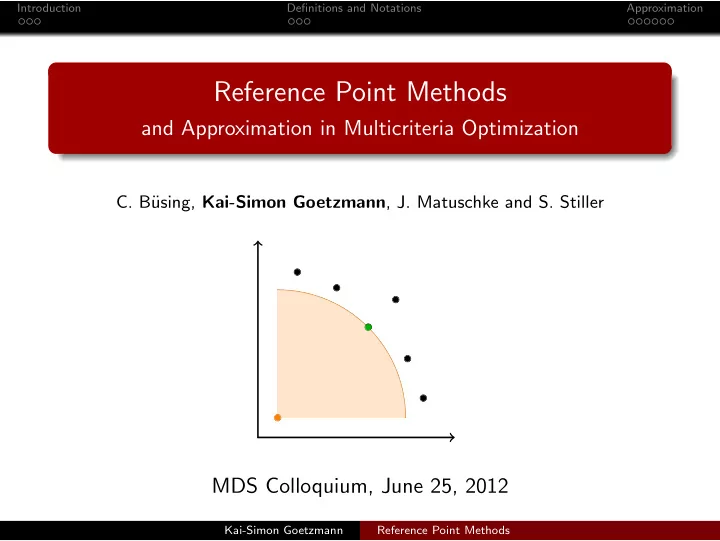
Introduction Definitions and Notations Approximation Reference Point Methods and Approximation in Multicriteria Optimization C. B using, Kai-Simon Goetzmann , J. Matuschke and S. Stiller MDS Colloquium, June 25, 2012 Kai-Simon Goetzmann


slide-1
SLIDE 1

Introduction Definitions and Notations Approximation

Reference Point Methods

and Approximation in Multicriteria Optimization

  • C. B¨

using, Kai-Simon Goetzmann, J. Matuschke and S. Stiller

MDS Colloquium, June 25, 2012

Kai-Simon Goetzmann Reference Point Methods

slide-2
SLIDE 2

Introduction Definitions and Notations Approximation

Multicriteria Optimization

Kai-Simon Goetzmann Reference Point Methods

slide-3
SLIDE 3

Introduction Definitions and Notations Approximation

Multicriteria Optimization

Kai-Simon Goetzmann Reference Point Methods

slide-4
SLIDE 4

Introduction Definitions and Notations Approximation

Multicriteria Optimization

Kai-Simon Goetzmann Reference Point Methods

slide-5
SLIDE 5

Introduction Definitions and Notations Approximation

Multicriteria Optimization

Kai-Simon Goetzmann Reference Point Methods

slide-6
SLIDE 6

Introduction Definitions and Notations Approximation

Multicriteria Optimization

min{y ∶ y ∈ Y} where Y ⊆ ❩k

Kai-Simon Goetzmann Reference Point Methods

slide-7
SLIDE 7

Introduction Definitions and Notations Approximation

Pareto Optimality

Definition A solution y ∈ Y of miny∈Y y is Pareto optimal if there is no y′ ∈ Y ∖ {y} with y′ ≤ y. Y y1 y2

Kai-Simon Goetzmann Reference Point Methods

slide-8
SLIDE 8

Introduction Definitions and Notations Approximation

Pareto Optimality

Definition A solution y ∈ Y of miny∈Y y is Pareto optimal if there is no y′ ∈ Y ∖ {y} with y′ ≤ y. y1 y2

Kai-Simon Goetzmann Reference Point Methods

slide-9
SLIDE 9

Introduction Definitions and Notations Approximation

Pareto Optimality

Definition A solution y ∈ Y of miny∈Y y is Pareto optimal if there is no y′ ∈ Y ∖ {y} with y′ ≤ y. YP y1 y2

Kai-Simon Goetzmann Reference Point Methods

slide-10
SLIDE 10

Introduction Definitions and Notations Approximation

Reference Point Solutions

Motivation: ▸ identify a single, Pareto optimal, balanced solution ▸ reference point methods: part of many state-of-the-art MCDM tools, little theoretical background

Kai-Simon Goetzmann Reference Point Methods

slide-11
SLIDE 11

Introduction Definitions and Notations Approximation

1 Introduction 2 Definitions and Notations 3 Approximation

Kai-Simon Goetzmann Reference Point Methods

slide-12
SLIDE 12

Introduction Definitions and Notations Approximation

1 Introduction 2 Definitions and Notations 3 Approximation

Kai-Simon Goetzmann Reference Point Methods

slide-13
SLIDE 13

Introduction Definitions and Notations Approximation

Definition (Ideal Point) Given a multicriteria optimization problem miny∈Y y, the ideal point yid = (yid

1 ,...,yid k ) is defined by

yid

i = min y∈Y yi

∀ i.

sub-ideal reference points

y1 y2 Y yid

Kai-Simon Goetzmann Reference Point Methods

slide-14
SLIDE 14

Introduction Definitions and Notations Approximation

Definition (Compromise Solution, Yu 1973) Given a multicriteria optimization problem miny∈Y y with the ideal point yid ∈ ◗k, and a norm ∥⋅∥ on ❘k, the compromise solution w.r.t. ∥⋅∥ is ycs = min

y∈Y ∥y − yid∥.

yid y1 y2

Kai-Simon Goetzmann Reference Point Methods

slide-15
SLIDE 15

Introduction Definitions and Notations Approximation

Definition (Compromise Solution, Yu 1973) Given a multicriteria optimization problem miny∈Y y with the ideal point yid ∈ ◗k, and a norm ∥⋅∥ on ❘k, the compromise solution w.r.t. ∥⋅∥ is ycs = min

y∈Y ∥y − yid∥. sub-ideal reference points

yid y1 y2

Kai-Simon Goetzmann Reference Point Methods

slide-16
SLIDE 16

Introduction Definitions and Notations Approximation

Definition (Reference Point Solution) Given a multicriteria optimization problem miny∈Y y, a sub-ideal reference point yrp ∈ ◗k, and a norm ∥⋅∥ on ❘k, the reference point solution w.r.t. ∥⋅∥ is yrps = min

y∈Y ∥y − yrp∥.

yrp y1 y2

Kai-Simon Goetzmann Reference Point Methods

slide-17
SLIDE 17

Introduction Definitions and Notations Approximation

Definition (Reference Point Solution) Given a multicriteria optimization problem miny∈Y y, a sub-ideal reference point yrp ∈ ◗k, and a norm ∥⋅∥ on ❘k, the reference point solution w.r.t. ∥⋅∥ is yrps = min

y∈Y ∥y − yrp∥.

yrp y1 y2

Kai-Simon Goetzmann Reference Point Methods

slide-18
SLIDE 18

Introduction Definitions and Notations Approximation

The norms we consider: ∥y∥p ∶= (

k

i=1

yp

i )

1/p

, p ∈ [1,∞) (ℓp-Norm) ∥y∥∞ ∶= max

i=1,...,k yi

(Maximum (ℓ∞-)Norm) ⟨ ⟨y⟩ ⟩p ∶= ∥y∥∞ + 1 p ∥y∥1 , p ∈ [1,∞] (Cornered p-Norm) ℓp-Norm

1 1

Cornered p-Norm

1 1

p = 1 p = 2 p = 5 p = ∞ Degree of balancing controlled by adjusting p.

Kai-Simon Goetzmann Reference Point Methods

slide-19
SLIDE 19

Introduction Definitions and Notations Approximation

The norms we consider: ∥y∥p ∶= (

k

i=1

yp

i )

1/p

, p ∈ [1,∞) (ℓp-Norm) ∥y∥∞ ∶= max

i=1,...,k yi

(Maximum (ℓ∞-)Norm) ⟨ ⟨y⟩ ⟩p ∶= ∥y∥∞ + 1 p ∥y∥1 , p ∈ [1,∞] (Cornered p-Norm) Weighted version: For any norm and λ ∈ ◗k,λ ≥ 0,λ ≠ 0 ∶ ∥y∥λ = ∥(λ1y1,λ2y2,...,λkyk)∥. General properties: Norms we consider are ▸ monotone (if y ≥ y′ then ∥y∥ ≥ ∥y′∥) ▸ decidable (∥y∥ can be computed in polynomial time)

Kai-Simon Goetzmann Reference Point Methods

slide-20
SLIDE 20

Introduction Definitions and Notations Approximation

1 Introduction 2 Definitions and Notations 3 Approximation

Kai-Simon Goetzmann Reference Point Methods

slide-21
SLIDE 21

Introduction Definitions and Notations Approximation

Approximate Pareto sets

Definition (α-approximate Pareto set) Let YP be the Pareto set of miny∈Y y, and let α > 1. Yα ⊆ Y is an α-approximate Pareto set if for all y ∈ YP there is y′ ∈ Yα such that y′

i ≤ αyi

∀i = 1,...,k

Kai-Simon Goetzmann Reference Point Methods

slide-22
SLIDE 22

Introduction Definitions and Notations Approximation

How to find approximate Pareto sets

Theorem (Papadimitriou&Yannakakis,2000) Gap(y,α) tractable for all y ∈ ◗k ⇒ α2-approximation for the Pareto set. α-approximation for the Pareto set ⇒ Gap(y,α) tractable for all y ∈ ◗k. ◗

Kai-Simon Goetzmann Reference Point Methods

slide-23
SLIDE 23

Introduction Definitions and Notations Approximation

How to find approximate Pareto sets

Theorem (Papadimitriou&Yannakakis,2000) Gap(y,α) tractable for all y ∈ ◗k ⇒ α2-approximation for the Pareto set. α-approximation for the Pareto set ⇒ Gap(y,α) tractable for all y ∈ ◗k. Gap(y,α): Given y ∈ ◗k and α > 1.

y1 y2 y

Kai-Simon Goetzmann Reference Point Methods

slide-24
SLIDE 24

Introduction Definitions and Notations Approximation

How to find approximate Pareto sets

Theorem (Papadimitriou&Yannakakis,2000) Gap(y,α) tractable for all y ∈ ◗k ⇒ α2-approximation for the Pareto set. α-approximation for the Pareto set ⇒ Gap(y,α) tractable for all y ∈ ◗k. Gap(y,α): Given y ∈ ◗k and α > 1.

y′ y1 y2 y

Kai-Simon Goetzmann Reference Point Methods

slide-25
SLIDE 25

Introduction Definitions and Notations Approximation

How to find approximate Pareto sets

Theorem (Papadimitriou&Yannakakis,2000) Gap(y,α) tractable for all y ∈ ◗k ⇒ α2-approximation for the Pareto set. α-approximation for the Pareto set ⇒ Gap(y,α) tractable for all y ∈ ◗k. Gap(y,α): Given y ∈ ◗k and α > 1.

y′ y1 y2 y

1 α y

no sol’n y y1 y2

Kai-Simon Goetzmann Reference Point Methods

slide-26
SLIDE 26

Introduction Definitions and Notations Approximation

Approximate Pareto sets ⇔ approximate CS

Kai-Simon Goetzmann Reference Point Methods

slide-27
SLIDE 27

Introduction Definitions and Notations Approximation

Approximate Pareto sets ⇔ approximate CS

Relate objective value to size of the vectors: min

y∈Y ∥y − yid∥ + ∥yid∥

ÜÜÜÜÜÜÜÜÜÜÜÜÜÜÜÜÜÜÜÜÜÜÜÜÜÜÜÜÜÜÜÜÜÜÜÜÜÜÜÜÜÜÜÜÜÜÜÜÜÜÜÜÜÜÜÜÜÜÜÜÜÜÜÜÜÜÜÜÜÜÜÜÜÜÜÜÜÜÜÜÜÜÜÜ

r(y)

We call r(y) the relative distance. ◗

Kai-Simon Goetzmann Reference Point Methods

slide-28
SLIDE 28

Introduction Definitions and Notations Approximation

Approximate Pareto sets ⇔ approximate CS

Relate objective value to size of the vectors: min

y∈Y ∥y − yid∥ + ∥yid∥

ÜÜÜÜÜÜÜÜÜÜÜÜÜÜÜÜÜÜÜÜÜÜÜÜÜÜÜÜÜÜÜÜÜÜÜÜÜÜÜÜÜÜÜÜÜÜÜÜÜÜÜÜÜÜÜÜÜÜÜÜÜÜÜÜÜÜÜÜÜÜÜÜÜÜÜÜÜÜÜÜÜÜÜÜ

r(y)

We call r(y) the relative distance. Theorem α-approximation of the Pareto set ⇒ α-approximation for miny∈Y r(y). ◗

Kai-Simon Goetzmann Reference Point Methods

slide-29
SLIDE 29

Introduction Definitions and Notations Approximation

Approximate Pareto sets ⇔ approximate CS

Relate objective value to size of the vectors: min

y∈Y ∥y − yid∥ + ∥yid∥

ÜÜÜÜÜÜÜÜÜÜÜÜÜÜÜÜÜÜÜÜÜÜÜÜÜÜÜÜÜÜÜÜÜÜÜÜÜÜÜÜÜÜÜÜÜÜÜÜÜÜÜÜÜÜÜÜÜÜÜÜÜÜÜÜÜÜÜÜÜÜÜÜÜÜÜÜÜÜÜÜÜÜÜÜ

r(y)

We call r(y) the relative distance. Theorem α-approximation of the Pareto set ⇒ α-approximation for miny∈Y r(y). Theorem α-approximation for miny∈Y r(y) ⇒ Gap(y,β) tractable for all y ∈ ◗k, β ∈ Θ(α). ⇒ β2-approximation for the Pareto set.

Kai-Simon Goetzmann Reference Point Methods

slide-30
SLIDE 30

Introduction Definitions and Notations Approximation

Equivalences of approximability

Pareto set Gap(y, α) ∀ y ∈ ◗k CS(∥⋅∥), ∥⋅∥ monotone & decidable CS(∥⋅∥p) and CS(⟨ ⟨⋅⟩ ⟩p), p ≥ 1 CS(∥⋅∥∞) P&Y

Kai-Simon Goetzmann Reference Point Methods

slide-31
SLIDE 31

Introduction Definitions and Notations Approximation

Equivalences of approximability

Pareto set Gap(y, α) ∀ y ∈ ◗k CS(∥⋅∥), ∥⋅∥ monotone & decidable CS(∥⋅∥p) and CS(⟨ ⟨⋅⟩ ⟩p), p ≥ 1 CS(∥⋅∥∞) P&Y

Kai-Simon Goetzmann Reference Point Methods

slide-32
SLIDE 32

Introduction Definitions and Notations Approximation

Equivalences of approximability

Pareto set Gap(y, α) ∀ y ∈ ◗k CS(∥⋅∥), ∥⋅∥ monotone & decidable CS(∥⋅∥p) and CS(⟨ ⟨⋅⟩ ⟩p), p ≥ 1 CS(∥⋅∥∞) RPS(∥⋅∥), ∥⋅∥ monotone & decidable RPS(∥⋅∥p) and RPS(⟨ ⟨⋅⟩ ⟩p), p ≥ 1 RPS(∥⋅∥∞) P&Y

Kai-Simon Goetzmann Reference Point Methods

slide-33
SLIDE 33

Introduction Definitions and Notations Approximation

Equivalences of approximability

Pareto set Gap(y, α) ∀ y ∈ ◗k miny λTy (weighted sum) CS(∥⋅∥), ∥⋅∥ monotone & decidable CS(∥⋅∥p) and CS(⟨ ⟨⋅⟩ ⟩p), p ≥ 1 CS(∥⋅∥∞) RPS(∥⋅∥), ∥⋅∥ monotone & decidable RPS(∥⋅∥p) and RPS(⟨ ⟨⋅⟩ ⟩p), p ≥ 1 RPS(∥⋅∥∞) P&Y

  • bin. search
  • add. factor k
  • add. factor k

Kai-Simon Goetzmann Reference Point Methods

slide-34
SLIDE 34

Introduction Definitions and Notations Approximation

Approximation through LP-rounding

Extend approximation algorithms based on LP-rounding (e.g. Set Cover, Scheduling) to compromise programming ✶ ✶ ◗ ◆

Kai-Simon Goetzmann Reference Point Methods

slide-35
SLIDE 35

Introduction Definitions and Notations Approximation

Approximation through LP-rounding

Extend approximation algorithms based on LP-rounding (e.g. Set Cover, Scheduling) to compromise programming ▸ LP-relaxation: min cTx ✶ s.t. Ax ≤ b ✶ ▸ rounding procedure R ∶ ◗n

≥0 → ◆n with

cTR(x) ≤ αcTx

Kai-Simon Goetzmann Reference Point Methods

slide-36
SLIDE 36

Introduction Definitions and Notations Approximation

Approximation through LP-rounding

Extend approximation algorithms based on LP-rounding (e.g. Set Cover, Scheduling) to compromise programming ▸ LP-relaxation: min cTx min ∆ + 1

p ⋅ ✶TCx + ∥yid∥∞

s.t. Ax ≤ b s.t. Ax ≤ b Cx − yid ≤ ∆ ⋅ ✶ ∆ ≥ 0 ▸ rounding procedure R ∶ ◗n

≥0 → ◆n with

cTR(x) ≤ αcTx

Kai-Simon Goetzmann Reference Point Methods

slide-37
SLIDE 37

Introduction Definitions and Notations Approximation

Approximation through LP-rounding

Extend approximation algorithms based on LP-rounding (e.g. Set Cover, Scheduling) to compromise programming ▸ LP-relaxation: min cTx min ∆ + 1

p ⋅ ✶TCx + ∥yid∥∞

s.t. Ax ≤ b s.t. Ax ≤ b Cx − yid ≤ ∆ ⋅ ✶ ∆ ≥ 0 ▸ rounding procedure R ∶ ◗n

≥0 → ◆n with

cTR(x) ≤ αcTx ⇒ r(CR(x)) ≤ α ⋅ r(Cx)

Kai-Simon Goetzmann Reference Point Methods

slide-38
SLIDE 38

Introduction Definitions and Notations Approximation

Approximation through dynamic programming

Extend result from min-max-regret robustness (Aissi et al. 2006) (e.g. Shortest Path, MST) to compromise programming

Kai-Simon Goetzmann Reference Point Methods

slide-39
SLIDE 39

Introduction Definitions and Notations Approximation

Approximation through dynamic programming

Extend result from min-max-regret robustness (Aissi et al. 2006) (e.g. Shortest Path, MST) to compromise programming ▸ exact solution by dynamic programming in pseudopolynomial time ▸ upper and lower bounds on optimal value ▸ scale and round the instance to achieve polynomial running time ▸ x∗,x∗ compromise solutions for original and rounded instance. ∥Cx∗ − yid∥∞ ≤ (1 + ε) ⋅ ∥Cx∗ − yid∥∞

Kai-Simon Goetzmann Reference Point Methods

slide-40
SLIDE 40

Introduction Definitions and Notations Approximation

Approximation through dynamic programming

Extend result from min-max-regret robustness (Aissi et al. 2006) (e.g. Shortest Path, MST) to compromise programming ▸ exact solution by dynamic programming in pseudopolynomial time ▸ upper and lower bounds on optimal value ▸ scale and round the instance to achieve polynomial running time ▸ x∗,x∗ compromise solutions for original and rounded instance. ∥Cx∗ − yid∥∞ ≤ (1 + ε) ⋅ ∥Cx∗ − yid∥∞ ⟨ ⟨Cx∗ − yid⟩ ⟩p + ⟨ ⟨yid⟩ ⟩p ≤ (1 + ε) ⋅ (⟨ ⟨Cx∗ − yid⟩ ⟩p + ⟨ ⟨yid⟩ ⟩p)

Kai-Simon Goetzmann Reference Point Methods

slide-41
SLIDE 41

Introduction Definitions and Notations Approximation

Summary

Pareto set Gap(y, α) ∀ y ∈ ◗k miny λTy (weighted sum) CS(∥⋅∥), ∥⋅∥ monotone & decidable CS(∥⋅∥p) and CS(⟨ ⟨⋅⟩ ⟩p), p ≥ 1 CS(∥⋅∥∞) RPS(∥⋅∥), ∥⋅∥ monotone & decidable RPS(∥⋅∥p) and RPS(⟨ ⟨⋅⟩ ⟩p), p ≥ 1 RPS(∥⋅∥∞) P&Y

  • bin. search
  • add. factor k
  • add. factor k

Approximation Algorithms: ▸ Approximations based on LP-relaxations ▸ FPTAS based on dynamic programming

Kai-Simon Goetzmann Reference Point Methods

slide-42
SLIDE 42

Introduction Definitions and Notations Approximation

Summary

Pareto set Gap(y, α) ∀ y ∈ ◗k miny λTy (weighted sum) CS(∥⋅∥), ∥⋅∥ monotone & decidable CS(∥⋅∥p) and CS(⟨ ⟨⋅⟩ ⟩p), p ≥ 1 CS(∥⋅∥∞) RPS(∥⋅∥), ∥⋅∥ monotone & decidable RPS(∥⋅∥p) and RPS(⟨ ⟨⋅⟩ ⟩p), p ≥ 1 RPS(∥⋅∥∞) P&Y

  • bin. search
  • add. factor k
  • add. factor k

Approximation Algorithms: ▸ Approximations based on LP-relaxations ▸ FPTAS based on dynamic programming Thank you for your attention.

Kai-Simon Goetzmann Reference Point Methods