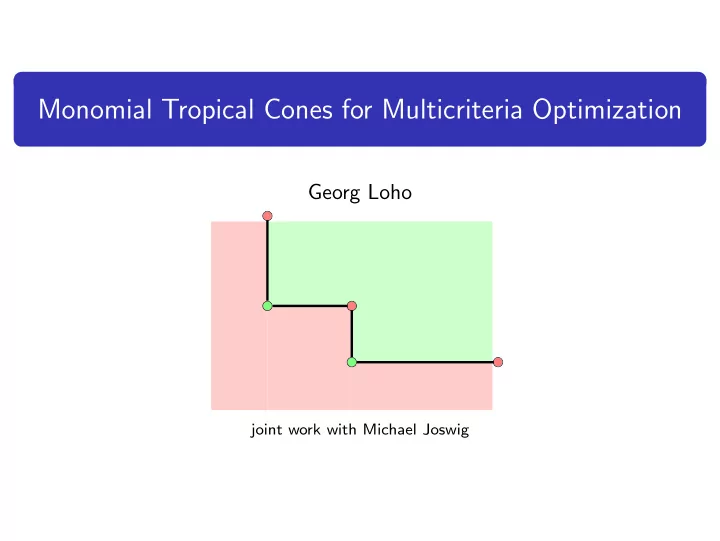
SLIDE 1
Monomial Tropical Cones for Multicriteria Optimization
Georg Loho
joint work with Michael Joswig
SLIDE 2 Multicriteria optimization
- multicriteria optimization problem:
min f(x) =
- f1(x), . . . , fd(x)
- subject to
x ∈ X .
- outcome space: Z = f(X) ⊆ Rd
- w ≦ z: if wi ≤ zi for all i ∈ [d], partial ordering on Rd.
- for S ⊂ Rd the minimal elements with respect to ≦ form the
nondominated points.
Observation
The set dominated by N ⊆ Rd is exactly
≥0
We think of Z = f(X) as a discrete set.
SLIDE 3 Tropical Geometry and Optimization
Interplay of Tropical Geometry and Optimization
- Geometric methods for mean-payoff games and complexity of classical
linear programming through tropical linear programming (Akian et al. ’12, Allamigeon et al. ’14+)
- Computing tropical determinants by Hungarian method (Butkoviˇ
c ’10) We want to enumerate all nondominated points.
Previous Work
- testing different regions of the search space (Sylva, Crema 2008)
- generating all n non-dominated points with O(nd) scalarizations
(Kirlik, Sayın 2014)
- assymptotically tight number of scalarizations Θ(n⌊d/2⌋) (D¨
achert, Klamroth, Lacour, Vanderpooten 2016)
SLIDE 4 Key ideas
≥0 are tropically convex
- Tropical double description for ’monomial tropical cones’ is an efficient
algorithm to generate nondominated points
- Works for arbitrary number of objective functions
- Duality between ’local upper bounds’ and nondominated points (local
minima)
SLIDE 5
Tropical basics
Definition
Tropical numbers Tmax = R ∪ {−∞} Addition s ⊕ t := max(s, t) = − min(−s, −t) Multiplication s ⊙ t := s + t Operations are extended componentwise to Td+1
max
SLIDE 6
Tropical basics
Definition
Tropical numbers Tmax = R ∪ {−∞} Addition s ⊕ t := max(s, t) = − min(−s, −t) Multiplication s ⊙ t := s + t Operations are extended componentwise to Td+1
max
Also: Dual tropical numbers Tmin = R ∪ {∞} with dual addition s ⊕ t = min(s, t).
SLIDE 7
Tropical basics
Definition
Tropical numbers Tmax = R ∪ {−∞} Addition s ⊕ t := max(s, t) = − min(−s, −t) Multiplication s ⊙ t := s + t Operations are extended componentwise to Td+1
max
Also: Dual tropical numbers Tmin = R ∪ {∞} with dual addition s ⊕ t = min(s, t).
Example
(5 ⊕ −7) ⊙ 10 ⊕ −100 = 15 (−3) ⊙ x ⊕ 1 = 9 valid for x = 12 But: (−3) ⊙ x ⊕ 9 = 9 valid for every x ≤ 12
SLIDE 8
Determining nondominated points with scalarizations
h = (−3, 2) M(h) M (h)
SLIDE 9
Determining nondominated points with scalarizations
h = (−3, 2) M(h) M (h)
SLIDE 10
Determining nondominated points with scalarizations
h = (−3, 2) M(h) M (h)
SLIDE 11
Determining nondominated points with scalarizations
g = (0, 0) h = (−3, 2) M(h) M (h)
SLIDE 12
Determining nondominated points with scalarizations
g = (0, 0) h = (−3, 2) M(g, h) M (g, h)
SLIDE 13
Determining nondominated points with scalarizations
g = (0, 0) h = (−3, 2) M(g, h) M (g, h)
SLIDE 14
Determining nondominated points with scalarizations
g = (0, 0) h = (−3, 2) M(g, h) M (g, h)
SLIDE 15
Determining nondominated points with scalarizations
g = (0, 0) h = (−3, 2) M(g, h) M (g, h)
SLIDE 16
Adaptation of the generic method
(Klamroth et al. 2015, Joswig, L 2017) Input: Image of the feasible set Z ⊂ Rd Output: The set of nondominated points.
1: A ← Emin ∪ e(0) 2: G ← ∅ 3: Ω ← Emin 4: while A = Ω do 5:
pick a in A \ Ω
6:
g ← NextNonDominated(Z, a)
7:
if g = None then
8:
A ← NewUpperBounds(G, A, g)
9:
G ← G ∪ {g}
10:
else
11:
Ω ← Ω ∪ {a}
12:
end if
13: end while 14: return G
SLIDE 17 Tropical Inner and Outer Description
- max-tropical cone: subset C ⊆ Td+1
max with
- max(λ + x0, µ + y0), . . . , max(λ + xd, µ + yd)
- ∈ C
for all λ, µ ∈ Tmax and x, y ∈ C.
- G generates C if the latter is the minimal max-tropical cone
containing G; explicitly {λ1 ⊙ g1 ⊕ · · · ⊕ λk ⊙ gk | g1, . . . , gk ∈ G, λ1, . . . , λk ∈ Tmax} .
- extremal generators: minimal generating set consists of extremal
generators; an element g ∈ G is extremal iff, for g1, g2 ∈ G g = µg1 ⊕ νg2 ⇒ g = µg1 or g = νg2 .
SLIDE 18 Tropical Inner and Outer Description
max the set supp(a) = {i | ai = −∞} is its support.
- closed max-tropical halfspace: a set of the form
- x ∈ Td+1
max
- max(xi + ai | i ∈ I) ≤ max(xj + aj | j ∈ J)
- for disjoint nonempty subsets I, J ⊂ supp(a)
Theorem (Tropical Weyl-Minkowski Theorem (Gaubert, Katz 2007))
C finitely generated max-tropical cone ⇔ C intersection of finitely many closed max-tropical halfspaces.
SLIDE 19
Tropical Inner and Outer Description
x1 x2 a1 a2 a3 a4 g1 g2 g3 g4 dehomogenized with x0 = 0 G = −1 −1 2 2 −1 3 −2 1 A = −1 1 ∞ 2 3 −2 2 x0 ≤ max(x1 + 1, x2 − 1) x1 ≤ x2 max(x1 − 2, x2 − 3) ≤ x0 max(x0, x2 − 2) ≤ x1 + 2
SLIDE 20
Tropical Inner and Outer Description
x1 x2 a1 a2 a3 a4 g1 g2 g3 g4 dehomogenized with x0 = 0 G = −1 −1 2 2 −1 3 −2 1 A = −1 1 ∞ 2 3 −2 2 x0 ≤ max(x1 + 1, x2 − 1) x1 ≤ x2 max(x1 − 2, x2 − 3) ≤ x0 max(x0, x2 − 2) ≤ x1 + 2
SLIDE 21
Tropical Inner and Outer Description
x1 x2 a1 a2 a3 a4 g1 g2 g3 g4 dehomogenized with x0 = 0 G = −1 −1 2 2 −1 3 −2 1 A = −1 1 ∞ 2 3 −2 2 x0 ≤ max(x1 + 1, x2 − 1) x1 ≤ x2 max(x1 − 2, x2 − 3) ≤ x0 max(x0, x2 − 2) ≤ x1 + 2
SLIDE 22
Tropical Inner and Outer Description
x1 x2 a1 a2 a3 a4 g1 g2 g3 g4 dehomogenized with x0 = 0 G = −1 −1 2 2 −1 3 −2 1 A = −1 1 ∞ 2 3 −2 2 x0 ≤ max(x1 + 1, x2 − 1) x1 ≤ x2 max(x1 − 2, x2 − 3) ≤ x0 max(x0, x2 − 2) ≤ x1 + 2
SLIDE 23
Tropical Inner and Outer Description
x1 x2 a1 a2 a3 a4 g1 g2 g3 g4 dehomogenized with x0 = 0 G = −1 −1 2 2 −1 3 −2 1 A = −1 1 ∞ 2 3 −2 2 x0 ≤ max(x1 + 1, x2 − 1) x1 ≤ x2 max(x1 − 2, x2 − 3) ≤ x0 max(x0, x2 − 2) ≤ x1 + 2
SLIDE 24 Monomial tropical cones
Fix G ⊆ Td+1
max.
- Monomial tropical cone M(G) (Allamigeon et al. 2010, JL 2017):
- g∈G
- x ∈ Td+1
max
- x0 − g0 ≤ min(xj − gj | j ∈ supp(g) \ {0})
- M(G) = M(G) ∩ Rd+1 =
g∈G
g +
≥0
+ R · 1
- max-tropical cone in Td+1
max generated by the finite set G ∪ Emax, where
Emax = {(−∞, 0, −∞, . . . , −∞), . . . , (−∞, −∞, . . . , −∞, 0)}
SLIDE 25
Monomial tropical cones
R3 g = (0, 0, 0) h = (0, −3, 2) f = (0, 1, −∞) M(f, g, h) b = (0, 0, 2) a = (0, 1, 0) c = (0, −3, ∞) (−∞, −∞, 0) (−∞, 0, −∞) T3
max
SLIDE 26 Duality of monomial tropical cones
M (G): the complement of the interior of the max-tropical cone M(G)
>0
M (G): closure of M (G) in Td+1
min with respect to min (add points with ∞).
Theorem (Joswig, L 2017)
The set M (G) is a min-tropical cone in Rd+1. More precisely, if H is a set
- f max-tropical halfspaces such that H = M(G), then
M (G) = −M(−A) , where A ⊂ Td+1
min is the set of apices of the tropical halfspaces in H. In
particular, the set A ∪ Emin generates M (G).
SLIDE 27
Duality of monomial tropical cones
R3 g = (0, 0, 0) h = (0, −3, 2) f = (0, 1, −∞) M(f, g, h) b = (0, 0, 2) a = (0, 1, 0) c = (0, −3, ∞) M (f, g, h) = −M(−a, −b, −c) (−∞, −∞, 0) (−∞, 0, −∞) (∞, 0, ∞) (∞, ∞, 0) T3
min
T3
max
SLIDE 28
Analogy of dual classical and tropical convex hull
SLIDE 29 Iterative tropical double description for monomial cones
Adaptation of ’tropical double description’ by Allamigeon et al. (2010) Input: A set G ⊂ Td+1
max, the set A of extremal generators of
M (G), and a point h ∈ Td+1
max with h0 = 0.
Output: The set of extremal generators of M (G ∪ {h}).
- determine the set A≥ of points in A which fulfill the “monomial
inequality” x0 ≥ mini∈[d](xi − hi) given by h
- initialize the set B of generators of
M (G ∪ {h}) with A≥
- for each pair (b, c) ∈ A≥ ×
- A \ A≥
, determine the intersection of the tropical line through b and c with the boundary of the halfspace h
- discard the intersection points, which are not extremal in
M (G ∪ {h}).
SLIDE 30 Upper bound theorems – many objective functions
Allamigeon et al. 2010, JL 2017
The number of extremal generators of a tropical cone in Td+1
max defined by n
halfspaces is in O(n⌊d/2⌋).
Proof
For each tropical cone there is a classical cone with similar combinatorial
- structure. Now claim follows from McMullen’s Upper Bound Theorem.
SLIDE 31 Upper bound theorems – many objective functions
Allamigeon et al. 2010, JL 2017
The number of extremal generators of a tropical cone in Td+1
max defined by n
halfspaces is in O(n⌊d/2⌋).
Proof
For each tropical cone there is a classical cone with similar combinatorial
- structure. Now claim follows from McMullen’s Upper Bound Theorem.
Kaplan et al. 2008, JL 2017
The maximal number of extremal generators of monomial tropical cones in Td+1
max defined by n halfspaces is in Θ(n⌊d/2⌋).
SLIDE 32 Upper bound theorems – many objective functions
Allamigeon et al. 2010, JL 2017
The number of extremal generators of a tropical cone in Td+1
max defined by n
halfspaces is in O(n⌊d/2⌋).
Proof
For each tropical cone there is a classical cone with similar combinatorial
- structure. Now claim follows from McMullen’s Upper Bound Theorem.
Kaplan et al. 2008, JL 2017
The maximal number of extremal generators of monomial tropical cones in Td+1
max defined by n halfspaces is in Θ(n⌊d/2⌋).
Theorem (JL 2017)
All n nondominated points of a discrete d-criteria optimization problem can be determined in Θ(n⌊d/2⌋) with iterative tropical convex hull computation.
SLIDE 33 Conclusion
Summary
- generating all nondominated points with tropical convex hull
- study of monomial tropical cones and their duality
- promising connection between tropical algebra, multicriteria
- ptimization and monomial ideals
- arxiv: 1707.09305