c w j z , = zyxwvutsrqponmlkjihgfedcbaZYXWVUTSRQPONMLKJIHGFEDCBA - - PDF document

c w j z
SMART_READER_LITE
LIVE PREVIEW

c w j z , = zyxwvutsrqponmlkjihgfedcbaZYXWVUTSRQPONMLKJIHGFEDCBA - - PDF document

[14] H. Ying, W. Siler and zyxwvutsrqponmlkjihgfedcbaZYXWVUTSRQPONMLKJIHGFEDCBA [13] B. Kosko, zyxwvutsrqponmlkjihgfedcbaZYXWVUTSRQPONMLKJIHGFEDCBA IEEE TRANSACTIONS ON SYSTEMS, MAN, AND CYBERNETICS, VOL. 24, NO. 10, OCTOBER 1994 1571 Dynamic


slide-1
SLIDE 1

[13] B. Kosko, zyxwvutsrqponmlkjihgfedcbaZYXWVUTSRQPONMLKJIHGFEDCBA

Neural Networks and Fuzzy Systems, F’rentice Hall, 1992.

[14] H. Ying, W. Siler and zyxwvutsrqponmlkjihgfedcbaZYXWVUTSRQPONMLKJIHGFEDCBA

J . J . Buckley,

“Fuzzy Control Theory: A Nonlinear Case,” Automatica, vol. 26, no. 3, pp. 513-520, 1990. [15] R. Langari, “A Nonlinear Formulation of a Class of Fuzzy Linguistic Control Algorithms,” Proc. American Control Conference, Chicago Illinois, June 24-26 1992, pp. 2273-2278. [la] G. F. Franklin, J. D. Powell and M. L. Workman, Digital Control of

Dynamic Systems, Addison Wesley, 1990. zyxwvutsrqponmlkjihgfedcbaZYXWVUTSRQPONMLKJIHGFEDCBA

Cone Algorithm: An Extension

  • f the Perceptron Algorithm
  • S. J. Wan

Abstmet-The perceptron convergence theorem played an important role in the early development of machine learning. Mathematidy, the perceptron learning algorithm is an iterative procedure for finding a separating hyperplane for a finite set of linearly separable vectors, or equivalently, for finding a separating hyperplane for a finite set of linearly contained vectors. In this paper, we show that the perceptron algorithm zyxwvutsrqponmlkjihgfedcbaZYXWVUTSRQPONMLKJIHGFEDCBA can be extended to a more general algorithm, called the cone algorithm, for finding a covering cone for a finite set of linearly contained vectors. A proof of the convergence of the cone algorithm is given. The relationship between the cone algorithm and other related algorithms is discussed. The equivalence of the problem of finding a covering cone for a set of linearly contained vectors and the problem of finding a solution cone for a system of homogeneous linear inequalities is established. Index zyxwvutsrqponmlkjihgfedcbaZYXWVUTSRQPONMLKJIHGFEDCBA

r e m s

  • Machine learning, perceptron, linearly separable zyxwvutsrqponmlkjihgfedcbaZYXWVUTSRQPONMLKJIHGFEDCBA

sets,

linearly contained sets, covering cones, solution cones, linear inequalities.

  • I. INTRODUCTION

A set of vectors is linearly contained if all the vectors in the set are distributed on one side of a homogeneous hyperplane. A covering cone of a linearly contained set is a circular hypercone which encloses

all the vectors in the set. The problem of finding a covering cone

  • f a linearly contained set may arise in some applications such as

machine learning [3], [9], [13], computational geometry [IO], and stability analysis [2], [4], [7]. The perceptron learning algorithm was developed in the early 1960s for modeling the learning process of a neuron in the human brain [Ill. Mathematically, it is an iterative procedure for finding a separating hyperplane for a finite set of linearly separable vectors [3],

  • r equivalently, for finding a separating hyperplane for a finite set o

f

linearly contained vectors [5], [9]. Let X zyxwvutsrqponmlkjihgfedcbaZYXWVUTSRQPONMLKJIHGFEDCBA

= {XI,

x2, .

.

.

,

xm

} be a set of vectors in an n-dimensional

Euclidean space R”. Suppose each vector in X belongs to one of two classes XI or X2. The set X is said to be linearly separable [3] if there exists a homogeneous hyperplane:

n

WTX =

c w j z , = zyxwvutsrqponmlkjihgfedcbaZYXWVUTSRQPONMLKJIHGFEDCBA

j = 1

Manuscript received February 28, 1992; revised March 14, 1993 and November 15, 1993. The author was with the Department of Computer Science, University of Regina, Regina, Saskatchewan, Canada S4S OA2. He is now with the Imaging Research and Advanced Development, Eastman Kodak Company, Rochester, NY 14650-1907 USA. IEEE Log Number 9403056. so that for any x; E X,

IEEE TRANSACTIONS ON SYSTEMS, MAN, AND CYBERNETICS, VOL. 24, NO. 10, OCTOBER 1994

0018-9472/94$04.00 0 1994 IEEE

> 0

ifx, EX1

< 0

ifx, E X 2

WTX* = 2

w,zij{

,=1

1571

where T denotes the transpose of a vector, and w is the normal vector of the hyperplane. The perceptron algorithm finds a separating hyperplane for a set

  • f linearly separable vectors by iterations. It starts with an arbitrary

normal vector wo. The normal vector is then modified according to the following correction rule: The well-known perceptron convergence theorem is stated below [3], Theorem I : zyxwvutsrqponmlkjihgfedcbaZYXWVUTSRQPONMLKJIHGFEDCBA I f X is linearly separable, the above procedure will converge to a vector w satisfying ( 2 ) in a finite number o

f

iterations. A set of vectors Y = {y1

,

y ~ ,

. . .

,

ym

} is said to be linearly

contained [9] if all vectors in Y are distributed on one side of a homogeneous hyperplane. In other words, Y is linearly contained if there exists a separating hyperplane defined by (1) satisfying: ~51, PI. A linearly separable set X can be transferred to a linearly contained set Y by changing the sign of the vectors in one class, Le.,

y = {x I x E Xl} u {-x I x E X,}.

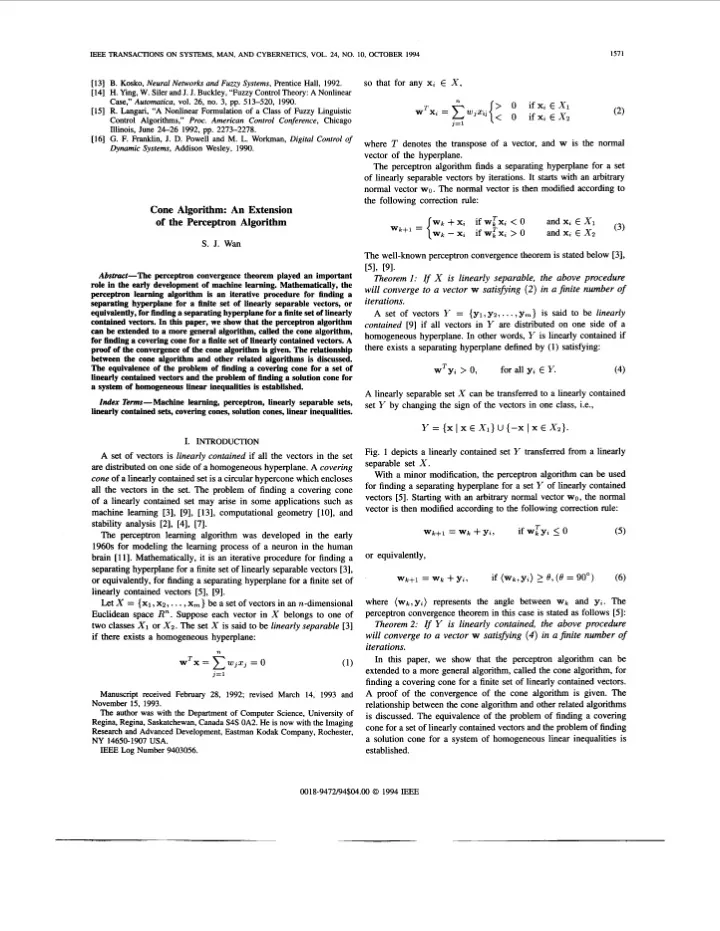
  • Fig. 1 depicts a linearly contained set Y

transferred from a linearly separable set X. With a minor modification, the perceptron algorithm can be used for finding a separating hyperplane for a set Y of linearly contained vectors [5]. Starting with an arbitrary normal vector WO, the normal vector is then modified according to the following correction rule:

  • r equivalently,

where (wk,yz) represents the angle between Wk and yz. The perceptron convergence theorem in this case is stated as follows [5]: Theorem 2: If Y is linearly contained, the above procedure will converge to a vector w satisfying (4) in afinite number o f iterations. In this paper, we show that the perceptron algorithm can be extended to a more general algorithm, called the cone algorithm, for finding a covering cone for a finite set of linearly contained vectors. A proof of the convergence of the cone algorithm is given. The relationship between the cone algorithm and other related algorithms is discussed. The equivalence of the problem of finding a covering cone for a set of linearly contained vectors and the problem of finding a solution cone for a system of homogeneous linear inequalities is established.

slide-2
SLIDE 2

1572 zyxwvutsrqponmlkjihgfedcbaZYXWVUTSRQPONMLKJIHGFEDCBA IEEE TRANSACTIONS ON SYSTEMS, MAN, AND CYBERNETICS, VOL. 24, NO. 10, OCTOBER 1994

x2 AW zyxwvutsrqponmlkjihgfedcbaZYXWVUTSRQPONMLKJIHGFEDCBA

x zyxwvutsrqponmlkjihgfedcbaZYXWVUTSRQPONMLKJIHGFEDCBA

=

{Xl, X2, X3, X4, X5, X6)

  • Fig. 1. A linearly contained set zyxwvutsrqponmlkjihgfedcbaZYXWVUTSRQPONMLKJIHGFEDCBA

Y

transferred from a linearly separable set zyxwvutsrqponmlkjihgfedcbaZYXWVUTSRQPONMLKJIHGFEDCBA X zyxwvutsrqponmlkjihgfedcbaZYXWVUTSRQPONMLKJIHGFEDCBA

  • Fig. 2. Three covering cones of Y .

1 1 . THE CONE ALGORITHM

In (6), the perceptron algorithm is expressed as a procedure for adjusting angles between the normal vector w

k

  • f a hyperplane and

the vectors in Y . The normal vector Wk is rotated towards yz if the angle between w k and yz is larger than or equal to 90". The perceptron convergence theorem guarantees that this procedure stop in a finite number of iterations. The problem that we are interested in is what would happen if we modify 0 = 90" in (6) to 0" < 0 zyxwvutsrqponmlkjihgfedcbaZYXWVUTSRQPONMLKJIHGFEDCBA

5 90".

Does the perceptron algorithm still converge in this case? To answer this question, we first introduce the notion of covering cones. A hypercone with axis w and angle 0 in R" is defined by:

C(W,@)

= (xl(w,x) 5 0,x

E R"} where w # 0 and 0" 5 0 5 9

' . A hypercone C(w,O) is said

to be a covering cone of a set Y of linearly contained vectors if

(w,

yl)

5 0 for all yt E

Y .

A covering cone of Y with the smallest angle is called the smallest covering cone, denoted by C(ws, 0,). A covering cone of Y with the largest angle zyxwvutsrqponmlkjihgfedcbaZYXWVUTSRQPONMLKJIHGFEDCBA

(e = 90") is a halfspace

bounded by the separating hyperplane wTx

=

  • 0. Fig. 2 depicts three

covering cones of Y. By modifying 0 = 90" in (6) to 0" < 0 5 go', the percep- tron algorithm becomes a more general algorithm, called the cone algorithm, stated as follows: The cone algorithm: Starting with an arbitrary axis WO, if a vector

yz in Y is not enclosed by the hypercone c(wk,@),

the axis w

k

is modified by:

Wk+l = Wk +yt,

if (wk,yz) 2 0 (0" < 0 5 90")- (7) The convergence of the cone algorithm is stated below. Theorem 3 (the cone algorithm convergence theorem): Let Y be a set o f linearly contained vectors and C(w,, 6,) be the smallest

Y = {Xl, x2, x3, -x4, -xs, zyxwvutsrqponmlkjihgfedcbaZYXWVUTSRQPONMLKJIHGFEDCBA

  • X h )

k+l

  • Fig. 3. An illustration of the convergence of the cone algorithm.

covering cone o f Y. If 0, < 6, then each correction given by (7) will bring w

k closer to w, when k is large enough, namely,

(Wk+l,Ws) < (wk,ws),

i f k > KO- (8) Prooj? See the Appendix. The convergence of the cone algorithm may be illustrated by Fig.

  • 3. The length of the normal vector Wk can become arbitrarily large

with the increase of k, but the length of each vector yz in Y is fixed. When k is large enough, if (wk,

yz)

2 8, then w k is rotated towards

y1

for a small amount, which brings wk+l closer to ws. The convergence speed of the cone algorithm may be improved by introducing a proper coefficient pk in the correction rule, namely,

wk+l =

w k +

PkYz

if (wk,yz),

> 0, (0" < 0 5 90")

(9) where P k controls the rotation angle of w k towards yz. algorithm and other related algorithms, and other related issues. In what follows, we discuss the relationship between the cone

  • A. The Cone Algorithm Versus the Perceptron Algorithm

The only difference between the cone algorithm and the perceptron algorithm (the version for linearly contained sets) is the condition for modifying the vector Wk. In the perceptron algorithm (refer to (6)), if a vector y; E Y is not located in the halfspace defined by the

slide-3
SLIDE 3

IEEE TRANSACTIONS ON SYSTEMS, MAN, AND CYBERNETICS, VOL. 24, NO. zyxwvutsrqponmlkjihgfedcbaZYXWVUTSRQPONMLKJIHGFEDCBA 10, zyxwvutsrqponmlkjihgfedcbaZYXWVUTSRQPONMLKJIHGFEDCBA

OCTOBER

1994 1573 zyxwvutsrqponmlkjihgfedcbaZYXWVUTSRQPONMLKJIHGFEDCBA

hyperplane, then the normal vector w

k

  • f the hyperplane is modified

towards this vector. The perceptron algorithm stops when a separating hyperplane of Y is obtained. In the cone algorithm (refer to (

7 ) ) ,

if a vector y1 E zyxwvutsrqponmlkjihgfedcbaZYXWVUTSRQPONMLKJIHGFEDCBA

Y is not located in the covering cone c(wk,

e), then the

axis w

k

  • f the covering cone is modified towards this vector. The

cone algorithm stops when a covering cone of Y is obtained. From a geometric point of view, the perceptron algorithm can be viewed as a procedure of adjusting the normal vector of a hyperplane so that all the vectors in Y are distributed on one side of the hyperplane, while the cone algorithm adjusts the axis of a hypercone so that all the vectors in Y are enclosed by the hypercone. Because a hyperplane is a special case of a hypercone (0 zyxwvutsrqponmlkjihgfedcbaZYXWVUTSRQPONMLKJIHGFEDCBA

=

go"),

the perceptron algorithm is a special case of the cone algorithm. zyxwvutsrqponmlkjihgfedcbaZYXWVUTSRQPONMLKJIHGFEDCBA

  • B. The Cone Algorithm Versus Other Related Algorithms

There are a number of gradient descent algorithms such as the relaxation procedures [l], [6] and variable increment procedures [3] designed for solving a system of inhomogeneous linear inequalities: (10) where bl ,

b:, ,

. .

. ,

b, are positive constants. These algorithms can be

written in the following form:

wTy, > b,, zyxwvutsrqponmlkjihgfedcbaZYXWVUTSRQPONMLKJIHGFEDCBA

i =

1,2,.

. . ,

m, wk+1 = w k

  • k pkyz,

if W ~ Y Z

5 bc,

(11) where zyxwvutsrqponmlkjihgfedcbaZYXWVUTSRQPONMLKJIHGFEDCBA

pk is a parameter. Compared with these algorithms, the

perceptron algorithm can be viewed as an approach for finding a solution vector w for a system of homogeneous linear inequalities:

wTy,>O,

i = 1 , 2

,...,

m. (12) It is clear that any solution of (10) is also a solution of (12), but the converse may not necessarily be true. Thus, the algorithms described in (1 1) are more general than the perceptron algorithm. On the other hand, the cone algorithm is designed for finding a solution vector w for the following nonlinear inequalities: wTy, zyxwvutsrqponmlkjihgfedcbaZYXWVUTSRQPONMLKJIHGFEDCBA

2 IIwlllly,llcosB,

i = 1,2,.

. .

,m. (13) If a solution w to (13) is found, a solution w' to (10) can be constructed based on w as follows:

/ b

w = - w

a where

b >

Maxb,, a = Min (wTy.). Conversely, given a solution w' to (lo), one may not be able to construct a solution to (13) based on w'. In other words, the cone algorithm can solve (lo), but the algorithms described in (1 1) cannot solve (13). The cone algorithm is more general than these algorithms.

  • C. The Smallest Covering Cone

By decreasing the angle 0 step by step, the cone algorithm can find a series of covering cones of Y approaching the smallest covering cone of Y. This may be done by setting the initial angle B = 90". The angle is then decreased by a fixed quantity 6 each time when the cone algorithm converges. The parameter S can be set in advance according to the accuracy required. Because the cone algorithm will not converge when 6

' becomes smaller than e,, a terminating condition

(for instance, a fixed number of passes over Y ) should be added in the procedure to prevent an infinite loop.

To test the above procedure, we randomly created lo00 20-

dimensional vectors in a hypercone with 0 = 70". Half of these vectors are distributed on the boundary of the hypercone. This

TABLE I

THE

CLOSENESS BETWEEN

c(wS,

6 , )

AND ~ ( w ,

e). hypercone can be treated approximately as the smallest covering cone

C(ws,

0,) of the lo00 vectors. The cone algorithm is applied to this set of linearly contained vectors with the initial angle setting 8 =

90".

Decreasing the angle by b =

5" at each step, five covering cones were

  • btained. Table I lists the angles between w, and the axes of the five

covering cones. It can be seen that when 6

' decreases, the axis w of

the covering cone approaches war

  • D. The Largest Solution Cone

The problem of finding a covering cone of Y = {

yl , yz ,

. . . ,

ym

}

is closely related to the one of finding a solution cone for a system

  • f homogeneous linear inequalities:

w T y , > 0 ,

i = 1 , 2

,...,

m. (14) If Y is linearly contained, there exist many solutions to (14). Geometrically, all the solutions can be obtained in the following

  • way. Each vector yz

defines a halfspace bounded by a homogeneous hyperplane with yz as its normal vector. The intersection of the m halfspaces forms the solution region of (14), denoted by S. It can be shown that the solution region S is a convex polyhedral cone in

R" [8, 121. A solution cone of (14) is a hypercone enclosed by the

solution region. A solution cone is said to be the largest solution cone if its angle is the largest among all the solution cones of (14). Theorem4 Let Y be a set o f linearly contained vectors.

C(w, e) is a covering cone of Y if and only if C(w, 90" - e) is a solution cone o

f (14). Proof: See Appendix. Theorem 4 indicates that there is a one-to-one correspondence between a covering cone of Y and a solution cone of (14). In a special case 0 =

Os, it states that C(ws, 0,) is the smallest covering cone of Y if and only if C(w,,90° -

e,) is the largest solution

cone of (14). Fig. 4 describes the relationship between the smallest covering cone of Y and the largest solution cone of (14). Note that the largest solution cone is enclosed by the solution region S. From a stability point of view, the solution ws is superior to any other solution in the solution region S because it can tolerate a maximum disturbance from all directions. In a noisy communication channel, the received signal y: may be different from the transmitted signal y.. However, if (yI,y:)

5 90" -

e,, w, will remain to be a solution of the system. Note that 90"

  • 8, is the maximum disturbance

angle that the system can tolerate.

1 1 1 . CONCLUSION

It is shown that the perceptron algorithm can be extended to a more general algorithm, namely the cone algorithm, for finding a covering cone of a linearly contained set. It is also shown that there

slide-4
SLIDE 4

1574 zyxwvutsrqponmlkjihgfedcbaZYXWVUTSRQPONMLKJIHGFEDCBA

IEEE TRANSACTIONS ON SYSTEMS, MAN, AND CYBERNETICS, VOL. 24, NO. 10, OCTOBER 1994

  • Fig. 4. The smallest

covering cone zyxwvutsrqponmlkjihgfedcbaZYXWVUTSRQPONMLKJIHGFEDCBA

and

the largest solution cone. Applying induction to zyxwvutsrqponmlkjihgfedcbaZYXWVUTSRQPONMLKJIHGFEDCBA (19), we obtain is a one-to-one correspondence between a covering cone of a linearly contained set and a solution cone of a system of homogeneous linear

@TWk zyxwvutsrqponmlkjihgfedcbaZYXWVUTSRQPONMLKJIHGFEDCBA

2 zyxwvutsrqponmlkjihgfedcbaZYXWVUTSRQPONMLKJIHGFEDCBA

kP cos zyxwvutsrqponmlkjihgfedcbaZYXWVUTSRQPONMLKJIHGFEDCBA

@ , +

A,

for k > zyxwvutsrqponmlkjihgfedcbaZYXWVUTSRQPONMLKJIHGFEDCBA .

  • inequalities. Compared with other gradient descent algorithms, the

cone algorithm is a more general method for solving a system of inhomogeneous linear inequalities. The main weakness of the cone algorithm is that it does not provide

  • converge. This is an inherent weakness of the gradient descent type
  • f algorithms, including the perceptron algorithm.

where X = %Two is a finite real number. Since Y is linearly contained, p and cos@, are greater than zero. By the assumption

@ ' < @'

we have '

O'

'Os "

> O' If we choose

a bound on the number of iterations required for the algorithm to y - 2ffX then,

slide-5
SLIDE 5
  • r equivalently,

This completes the proof. zyxwvutsrqponmlkjihgfedcbaZYXWVUTSRQPONMLKJIHGFEDCBA The following lemma is needed for the proof of Theorem 4. zyxwvutsrqponmlkjihgfedcbaZYXWVUTSRQPONMLKJIHGFEDCBA Lemma zyxwvutsrqponmlkjihgfedcbaZYXWVUTSRQPONMLKJIHGFEDCBA

I : For any vectors zyxwvutsrqponmlkjihgfedcbaZYXWVUTSRQPONMLKJIHGFEDCBA

x, zyxwvutsrqponmlkjihgfedcbaZYXWVUTSRQPONMLKJIHGFEDCBA

y, z E R", the following in-

equality holds: Proofi Because the length of the vectors in (23) is immaterial, It is assumed, without loss of generality, that x, y, z are unit vectors. We first construct a vector y' based on x, y. z as follows: where sin y sin p sin zyxwvutsrqponmlkjihgfedcbaZYXWVUTSRQPONMLKJIHGFEDCBA

B

a = b = zyxwvutsrqponmlkjihgfedcbaZYXWVUTSRQPONMLKJIHGFEDCBA

  • ,

p = (x,z), zyxwvutsrqponmlkjihgfedcbaZYXWVUTSRQPONMLKJIHGFEDCBA

y = (a,y). It then follows that l[y'1[2

=

a2 - 2abcosP +

b2 = 1

zTy' =

a - bcosp = cosy

T I

x y = a c o s p - b = c o s ( p + y )

This means that y' is a unit vector, and Theorem 4: Let Y be a set of linearly contained vectors.

C(w, e) is a covering cone of Y if and only if C(w,

90" - 0) zyxwvutsrqponmlkjihgfedcbaZYXWVUTSRQPONMLKJIHGFEDCBA

i s a solution cone o

f (14). Proof: We first show that C(w,

90" - 8) is a solution cone of

(14) if C(w,e) is a covering cone of Y. Because C(w,e) is a covering cone of Y, (w,yz)

5 0 for all

yz

E Y. For any x E C(w,

90" - e), we have (x,w)

5 90" -

  • 0. It

follows from Lemma 1 that for any yt E Y, ( x , Y ~ )

5 (x,w) +

( w , Y ~ )

5 (90"

  • 0) +

8 = go",

  • r

xTy,>_O,

i = 1 , 2

,...,

m. (32) This means that x is a solution of (14). Because (32) holds for any x E C(w,90"

  • e), we conclude that C(w,90°
  • 6

' ) is a solution

cone of (14). Conversely, suppose C(w, 90" - e) is a solution cone of (14). We show that C(w,O) is a covering cone of Y.

For any yz

E Y, we can construct a vector x as follows: where sin (P + 7) sin y

p = (w,y,), y = 90" - e.

>

b = -

sin p ' a = We have, (34) )lx1('

=

a '

  • 2abcosp +

b2 =

1, and,

xTw

=

a - bcosp =

COS?

  • r

( x , ~ )

=

y

=

90" - 8. (26) zyxwvutsrqponmlkjihgfedcbaZYXWVUTSRQPONMLKJIHGFEDCBA Eq. (35) indicates x E C(w,90°

  • e). Therefore,

(x,yZ)

i

go", for any y. E Y.

(X,Y'>

=

P + y

= (x,

z) + (2,y).

(27) On the other hand, from (33),

T Y

. x - = a c o s p - b = c o s ( p + y )

Next, we introduce another vector z' defined by:

IIYZ 11 cos (9) cos (9)

.

Z'

= d z , d = ____

which means (x,yl)

= p +

y, or

(X,YZ) =

(W,YZ) + (x,w).

(37) It can be shown that Combining (39437) yields

(w, yz)

= (x,

y.) - (x, w) 5 zyxwvutsrqponmlkjihgfedcbaZYXWVUTSRQPONMLKJIHGFEDCBA

goo -

(90" -

e ) = e, for ally, E Y. (38)

IIX - 2/11 + IIZ' -

Y'll = llx - Y'I). (28)

Note that y and y' are unit vectors. It follows from (26) that Thus, we conclude that C(w, 0) is a covering cone of Y . From the triangle inequality and (28), (29),

Ilx-Yll i ll~-~'ll+ll~'-Yll

=

llx--'II+lI~'-Yylll

= llx-Y'll.

(30) Because x, y, y' are unit vectors,

[I] S. Agmon, "The relaxation method for linear inequalities," Canadian

Journal of Mathematics, vol. 6, pp. 382-392, 1954. [2] A. Deif, Sensitivity Analysis in Linear Systems. Berlin: Springer-Verlag, 1986. [3] R. 0. Duda and P. E. Hart, Pattern ClassQication and Scene Analysis. John Wiley and Sons, 1973.

[4] C. H. Mays, "Effects

  • f adaptation

parameters on convergence time and tolerance for adaptive threshold elements," IEEE Trans.

  • Electr. Comput.,

[5] M. Minsky and S. Papert, Perceptrons. Cambridge, MA: MIT Press,

(X,Y) 5 (X,Y').

(31)

EC-13, pp. 465-468, 1964.

Substituting (27) into (31) yields (24).

1988 (expanded edition).

slide-6
SLIDE 6

1576 IEEE TRANSACTIONS ON SYSTEMS, MAN, AND CYBERNETICS, VOL. 24, NO. zyxwvutsrqponmlkjihgfedcbaZYXWVUTSRQPONMLKJIHGFEDCBA 10, OCTOBER 1994

[6] T. S. Motzkin and I. J. Schoenberg, “The relaxation method for linear inequalities,” zyxwvutsrqponmlkjihgfedcbaZYXWVUTSRQPONMLKJIHGFEDCBA Canadian Journal of Mathematics, vol. 6, pp. 392-404, 1954. Springer-Verlag zyxwvutsrqponmlkjihgfedcbaZYXWVUTSRQPONMLKJIHGFEDCBA

, 1985.

[7] S. Muroga, Threshold Logic and Its Applications. John Wiley and Sons, 1971. [8] zyxwvutsrqponmlkjihgfedcbaZYXWVUTSRQPONMLKJIHGFEDCBA

K . ,

Murty, Linear and Combinatorial Programming. New York John Wiley and Sons, 1976. [9] N. J. Nilsson, Learning Machines. McGraw-Hill, 1965.

[IO] E P. Preparate and

  • M. I. Shamos, Computational Geometo. New York

[ll] F. Rosenblatt,

Principles o

f Neurodynamics: Perceptrons and the Theory [12] J. Stoer and C. Witzgall, zyxwvutsrqponmlkjihgfedcbaZYXWVUTSRQPONMLKJIHGFEDCBA

Convexity and Optimization in Finite Dimension

  • f Bruin Mechanisms. Washington, D.C: Spartan Books, 1962. zyxwvutsrqponmlkjihgfedcbaZYXWVUTSRQPONMLKJIHGFEDCBA
  • 1. Berlin: Springer-Verlag. 1970.