A Feasi easibility S Study udy f for or t the A he Aut utom - - PowerPoint PPT Presentation

a feasi easibility s study udy f for or t the a he aut
SMART_READER_LITE
LIVE PREVIEW

A Feasi easibility S Study udy f for or t the A he Aut utom - - PowerPoint PPT Presentation

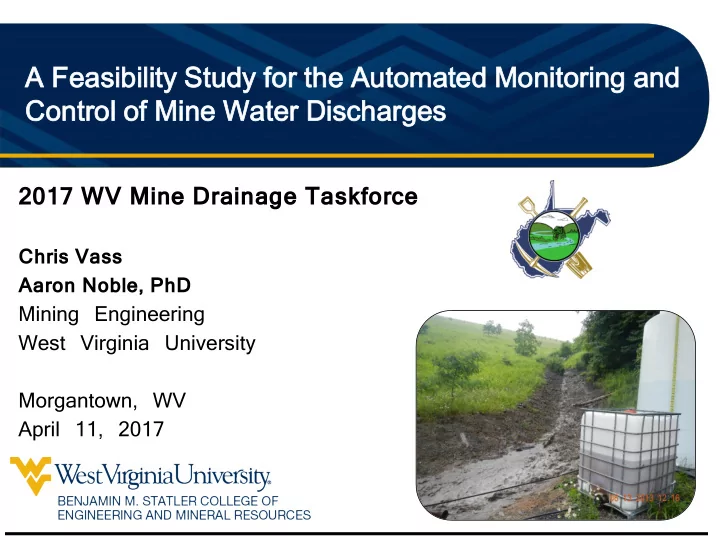
A Feasi easibility S Study udy f for or t the A he Aut utom omated ed Moni onitor oring and and Control rol o of M Mine W Water D r Discharges charges 2017 WV Mine Drainage Taskforce Chris Vass Aaron Noble, PhD Mining


slide-1
SLIDE 1

A Feasi easibility S Study udy f for

  • r t

the A he Aut utom

  • mated

ed Moni

  • nitor
  • ring and

and Control rol o

  • f M

Mine W Water D r Discharges charges

2017 WV Mine Drainage Taskforce

Chris Vass Aaron Noble, PhD Mining Engineering West Virginia University Morgantown, WV April 11, 2017

slide-2
SLIDE 2

Chris Vass 2017

2

Presentation Outline

1 2 5 3 4

BACKGROUND BENCH-SCALE SYSTEM PROOF-OF-CONCEPT RESULTS ONGOING WORK & CONCLUSIONS MAMDANI CONTROLLER

slide-3
SLIDE 3

Chris Vass 2017

3

MOTIVATION

Automated Outlet Treatment

slide-4
SLIDE 4

Chris Vass 2017

4

Challenges in CAPP

Remote Locations No Utilities Area/Access Limited by Topography Several parameter limits: pH TSS, Fe, Al, Mn, etc. Lab Results Take Time

slide-5
SLIDE 5

Chris Vass 2017

5

Traditional Practices in CAPP

Rob

Can get to the remote locations, but takes time. May make it to problematic sites once or twice per day. Not available 24/7/365. Not an environmental chemist, but knows practical water treatment. Will eventually retire or find another job.

slide-6
SLIDE 6

Chris Vass 2017

6

Research Objectives

Problem Statements:

 Given the unique environmental challenges in CAPP, traditional methods

  • f water monitoring and treatment are costly and inefficient.

 The current and future regulatory trajectory may deem many of these

practices cost prohibitive. Research Objectives:

 Evaluate the technical and economic feasibility of automated monitoring

and advanced control algorithms for chemical treatment of mine water discharges

slide-7
SLIDE 7

Chris Vass 2017

7

Generic Controller

Generic pH Control Diagram

AMD Treatment System

Process Set Point (pH = 7)

Outlet pH

Process Disturbances:

  • Incoming pH
  • Flow Rate
  • Atmospheric Conditions

Current System Conditions Treatment Flow Rate

Control Algorithm

3 5 7 9 11 250 500 750 1000 1250 Steady State pH Base Treatment Flowrate (ml/min)

Titration of HCl with Na2CO3

Problem: pH Treatment is Nonlinear!

slide-8
SLIDE 8

Chris Vass 2017

8

BENCH-SCALE SYSTEM CONSTRUCTION

Automated Outlet Treatment

slide-9
SLIDE 9

Chris Vass 2017

9

Components

Reactor Conductivity Sensor pH Sensor

slide-10
SLIDE 10

Chris Vass 2017

10

Components

Transmitters/Power Supply

DAQ Unit

slide-11
SLIDE 11

Chris Vass 2017

11

Components

Supply Pump Treatment Pump

slide-12
SLIDE 12

Chris Vass 2017

12

Components

Baffle Installed Baffle

slide-13
SLIDE 13

Chris Vass 2017

13

Bench Scale Model

slide-14
SLIDE 14

Chris Vass 2017

14

MAMDANI FUZZY CONTROLLER

Automated Outlet Treatment

slide-15
SLIDE 15

Chris Vass 2017

15

Advanced Control Techniques

MF1 MF2 MF3 MF4

ANN’s Fuzzy Logic ANFIS Several advanced pH control techniques exist; however, they are currently unproven in a mine environmental setting.

slide-16
SLIDE 16

Chris Vass 2017

16

Modeling Approach

slide-17
SLIDE 17

Chris Vass 2017

17

Fuzzy Logic - Basics

slide-18
SLIDE 18

Chris Vass 2017

18

Fuzzy Logic – Membership Functions

 Use of non-precise classes to segment process behavior

Error

MF1 MF2 MF3 MF4 MF1 MF2 MF3 MF4

slide-19
SLIDE 19

Chris Vass 2017

19

Membership Functions

Doesn’t neglect “Rob’s” intuition, 30+ years of AMD research, or the real-time data…

3 4 5 6 7 8 9 10 11 250 500 750 1000 1250 pH Base Treatment Flowrate (cc/min)

High pH Low pH Neutral pH

slide-20
SLIDE 20

Chris Vass 2017

20

RESULTS & DI SCUSSI ON

Automated Outlet Treatment

slide-21
SLIDE 21

Chris Vass 2017

21

pH Control – Experimental Tests

Test No. Simulated Condition 1 Normal field Operations under steady state conditions 2 Unsteady flow rate 3 Changing pH set point 4 Large surge in flow rate that interrupts flow recording device 5 Change in feed water pH 6 Removal of pond baffle 7 Multiple disturbances/perturbations

Define acceptable range as ±0.5 pH point.

slide-22
SLIDE 22

Chris Vass 2017

22

pH Control – Steady State

slide-23
SLIDE 23

Chris Vass 2017

23

pH Control – Varying Flow Rates & Set Point

slide-24
SLIDE 24

Chris Vass 2017

24

pH Control – Change in Feed pH

slide-25
SLIDE 25

Chris Vass 2017

25

ONGOI NG WORK & CONCLUSI ONS

Automated Outlet Treatment

slide-26
SLIDE 26

Chris Vass 2017

26

Ongoing Work

 Implementation of control scheme at AMD treatment site

slide-27
SLIDE 27

Chris Vass 2017

27

Summary & Conclusions

 Environmental monitoring and treatment costs can be significant

and require perpetual attention.

 Laboratory tests have shown that fuzzy logic is a feasible control

  • ption.

 The controller used in this testing was able to withstand multiple

perturbations and maintain pH within ±0.5.

slide-28
SLIDE 28

Chris Vass 2017

28

Questions?

For more information, please contact: Chris Vass

crvass@mix.wvu.edu

Acknowledgements: